

For many small California businesses, the difficult part isn’t completing the form. It’s deciding which kind of trademark protection they actually need.
California registration protects a mark at the state level. Federal registration can provide rights throughout the United States and its territories. The filing rules, costs, and requirements are also different.
Here’s how to register a trademark in California, what to prepare before filing, and when federal registration may make more sense.
Legal note: This guide provides general educational information, not legal advice. Trademark rights can depend heavily on the particular mark, owner, goods or services, prior users, and geographic market.
California Trademark Registration in Plain English
A trademark identifies the source of goods. It might be a brand name, logo, word, symbol, or combination of these elements. A service mark performs the same basic function for services.
You can develop trademark rights simply by using a mark in commerce. These are often called common-law trademark rights, and they may be limited to the geographic area where the mark is actually used. Registration can provide additional legal advantages, but you do not automatically lose all trademark rights merely because you haven’t registered.
In California, state trademarks and service marks are registered through the California Secretary of State. Applications can currently be submitted online through the state’s trademark filing system, by mail, or in person in Sacramento.
One distinction causes a lot of confusion: registering your LLC, corporation, fictitious business name, or other business entity is not the same as registering a trademark.
The California Secretary of State specifically explains that registering a business entity does not itself establish trademark rights in the business name. A business registration also does not give you permission to use a name that violates someone else’s trademark rights.
So if you formed Blue Mountain Clothing LLC, for example, that company registration alone would not mean BLUE MOUNTAIN is cleared or registered as a trademark for clothing.
California Trademark or Federal Trademark
Before filing anything, decide whether California registration fits the way you actually do business.
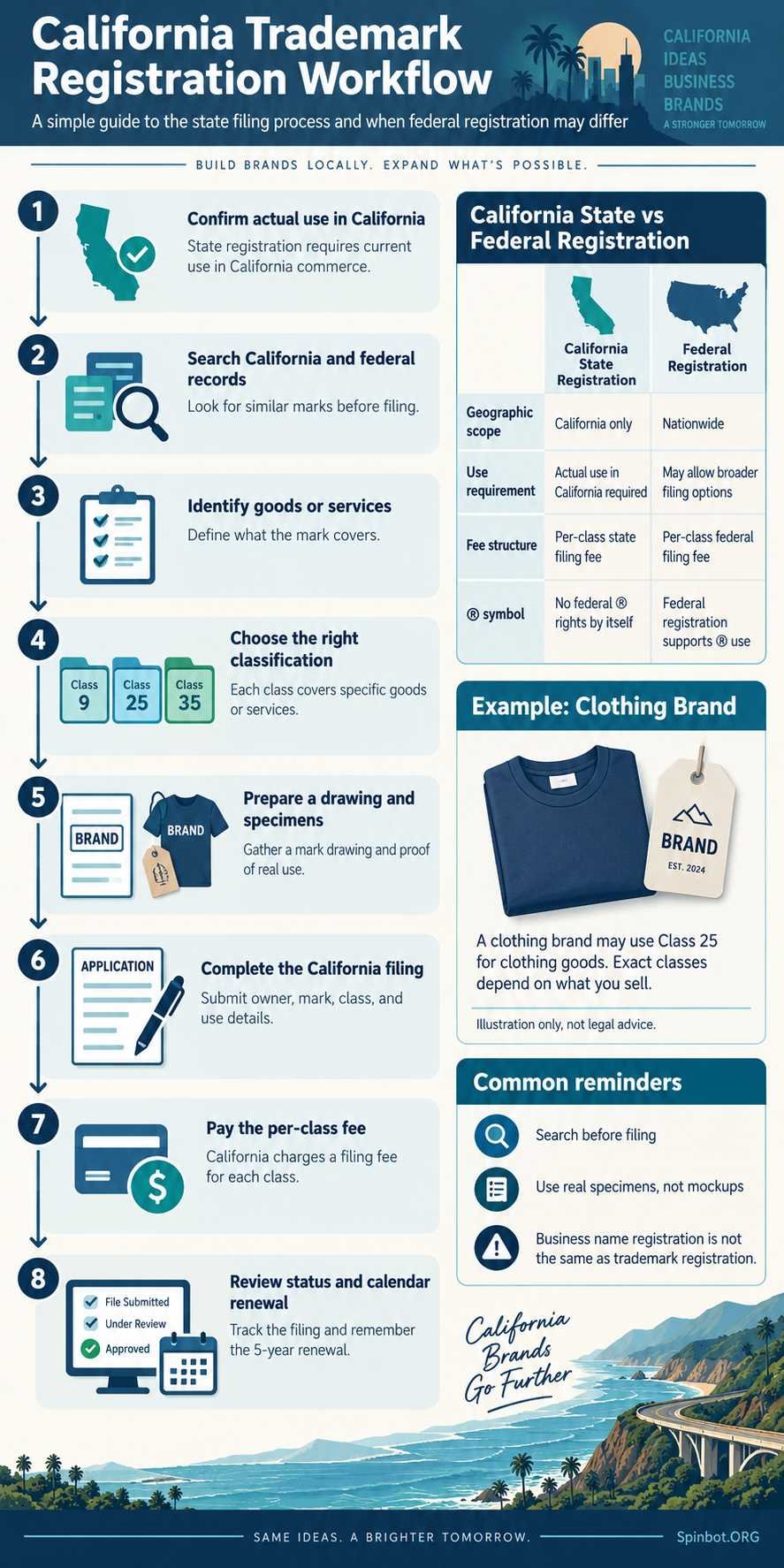
A California registration creates state-level rights. The USPTO explains that a state registration applies within that state, while federal registration creates rights throughout the United States and its territories.
The two systems also handle planned trademarks differently.
California requires the goods or services associated with the mark to be currently in commerce in California. You cannot file a California trademark application simply because you intend to launch the brand later.
The federal system allows both use-in-commerce applications and, when the requirements are met, intent-to-use applications based on a bona fide intention to use the mark in commerce. An intent-to-use applicant must complete additional steps and pay additional fees before registration.
Cost is another major difference.
As of September 2026, California charges $70 per classification code per mark for a new trademark or service mark registration. The USPTO’s base application fee for a Section 1 or Section 44 federal application is $350 per class, although additional federal fees can apply depending on how the application is completed.
For a genuinely local business serving customers only within California, state registration may provide useful protection at a lower filing cost. But if you sell products online across state lines, expect to expand nationally, or want the advantages associated with federal registration, applying through the USPTO often deserves serious consideration.
How to Register a Trademark in California
Confirm That You Are Already Using the Mark
California does not offer a state equivalent of the federal intent-to-use route.
Your mark must already be connected with goods being sold or services being provided in California before you register it.
That means designing a logo, buying a domain name, creating social media accounts, or ordering packaging does not by itself satisfy the state’s current-use requirement.
You also need evidence showing how consumers actually encounter the mark. California calls this evidence a specimen.
Search for Conflicting Trademarks
A search should come before the filing fee.
Start with the California Secretary of State’s trademark search database, but don’t stop there. Search the USPTO federal trademark database, relevant business names, internet search results, marketplaces, and other places where similar brands may appear.
The USPTO recommends a broad clearance search because conflicting rights may exist even when a mark does not appear in the federal database. A useful search can include federal records, state trademark databases, business-name records, and general internet results.
Don’t search only for an exact spelling.
Two marks may conflict when they are similar in appearance, sound, meaning, or overall commercial impression and are used with related goods or services. Likelihood of confusion is one of the most common reasons a federal application is refused.
Suppose you want to launch clothing under the name KALIVORA. Finding no exact KALIVORA registration is encouraging, but it isn’t the end of the search. Similar spellings or names that sound almost identical could still matter if they cover related products.
A complicated search is one of the points where professional trademark advice can be particularly valuable.
Identify Your Goods or Services
A trademark does not normally give you control over a word or logo for every possible use.
Rights are connected to the goods or services associated with the mark. You therefore need to describe what you actually sell rather than simply stating that you have a business.
For example, a company may use one brand for:
- T-shirts and sweatshirts
- Online retail store services
- Custom printing services
Those activities may not all belong to the same classification.
Choose the Correct Classification
Trademark systems organize goods and services into classes.
California uses classification codes to identify the goods or services connected with a mark, and its filing fee is charged for each classification code included in the application.
The international trademark system contains 45 classes. Class 25, for example, covers clothing, footwear, and headwear.
Don’t choose a class only because its title seems close to your business. Your identification should match what you actually sell or provide.
Prepare the Drawing and Three Specimens
California requires applicants to show both what the mark is and how it is being used.
A drawing represents the mark itself. For a word-only mark, the drawing can contain the words. If the trademark contains design elements, the drawing should show the design being claimed.
California also requires three identical original specimens showing the mark currently being used in commerce with the goods or services provided in California.
A specimen is not merely a concept image created for the application. It should demonstrate real commercial use.
For a product brand, this might involve the mark appearing in a way customers associate with the goods, such as appropriate product labeling or packaging. What qualifies depends on the particular mark and goods, so don’t assume every marketing image or mockup will work.
Complete and File the California Application
California uses its trademark and service mark registration process to collect information including the owner, mark, classification, goods or services, and use of the mark.
Make sure the owner is identified correctly.
If an LLC owns the trademark, for example, the owner information should correspond to that legal entity rather than casually naming an individual member instead. California’s guidance says that when a business entity owns the mark, its entity structure should be consistent with the owner information in the application.
Applications may currently be filed online, by mail, or in person. California’s online system records an online application’s actual date and time of receipt for priority purposes.
Pay the Filing Fee and Track the Filing
The current California registration fee is $70 for each classification code per mark.
That per-class wording matters.
If your mark covers goods or services in more than one classification, your total filing cost can increase. Filing separate trademark and service mark applications can also be necessary because California does not allow a trademark and service mark to be combined on the same application.
Keep copies of your application, specimens, registration documents, and records showing continued use of the mark.
Registration is useful evidence, but California warns that state registration does not by itself guarantee exclusive ownership of a trademark. Existing rights and competing users can still matter.
How to Register a Clothing Brand
A clothing business is a useful example because the phrase “register a clothing brand” can mean several different things.
Suppose you create a brand called NORTH COVE and sell branded T-shirts, hoodies, and caps.
For trademark classification purposes, ordinary clothing, footwear, and headwear generally falls under International Class 25.
You would still need to determine exactly what you are protecting.
The name NORTH COVE may be one trademark. A distinctive NORTH COVE logo could be another. Registering one version does not necessarily produce identical protection for every logo, slogan, or design you later create.
The way the mark appears on the clothing also matters. Decorative wording printed across the front of a shirt can raise different trademark questions from a brand displayed on labels or tags as an indicator of source.
Your business model matters too.
Imagine the same company begins shipping clothing from California to customers throughout the United States. At that point, federal registration may be a more logical long-term route than relying only on California registration because federal registration can provide nationwide rights.
The federal filing fee would also depend on classes. The USPTO gives a similar example: shirts and other clothing can fall in one class, while custom T-shirt printing services may require another class, resulting in a higher total filing fee.
Common California Trademark Filing Mistakes
Most problems start before the form is submitted.
Filing before you actually use the mark in California. California requires current commerce in the state. A planned launch is not enough for a California registration.
Searching only for identical names. Trademark conflicts can involve names that sound alike, look alike, or create a similar meaning or commercial impression.
Searching only California records. A federal registration, prior common-law user, or other existing rights may still create a problem.
Confusing a business name with a trademark. Forming a California company under a certain name does not automatically create a trademark registration for that name.
Choosing classifications too casually. The application needs to connect the mark to the correct goods or services, and fees can depend on how many classifications are involved.
Creating specimens only for the application. The specimens are supposed to demonstrate actual use in commerce, not simply show what future packaging might look like.
Assuming approval proves absolute ownership. California expressly cautions that registration itself does not guarantee exclusive ownership.
These are also good reasons not to rush a filing just because the form appears straightforward.
Trademark, TM, SM, and Registered Trademark Symbols
The difference between a trademark and a registered trademark becomes easier to understand once you separate trademark rights from registration status.
You can own trademark rights through use even if you haven’t registered the mark.
The symbols communicate different things:
- TM generally indicates that you claim trademark rights in a mark used for goods.
- SM performs a similar role for services.
- ® indicates federal trademark registration.
The USPTO allows businesses to use TM or SM even without filing a federal trademark application. The ® symbol is different: it may be used after the USPTO registers the trademark, and only in connection with the goods or services covered by that federal registration.
That last point is particularly important for California applicants.
A California state trademark registration alone does not give you the right to represent the mark as federally registered with ®. The federal registration is what supports use of that symbol under USPTO guidance.
How to Insert or Type the Registered Trademark Symbol
If your mark is entitled to use the registered trademark symbol, the easiest method is simply to copy it:
®
Common ways to insert it include:
- Microsoft Word: use Insert > Symbol and select ®.
- Windows: Alt+0174 commonly produces ® when entered with a numeric keypad in applications that support the shortcut.
- Mac: Option+R commonly inserts ®.
- Web content: the HTML entity
®displays as ®.
Typing the symbol is easy. Having the legal right to use it is the part that matters.
If federal registration is still pending, using TM or SM is generally the appropriate approach rather than using ® prematurely.
How Long a California Trademark Lasts
A California trademark or service mark registration lasts five years from its filing date.
California allows renewal within the six months before the registration expires, and the mark can continue to be renewed in five-year periods as long as it remains in continual use.
The current California renewal fee is $30.
That makes renewal dates worth putting on your business calendar as soon as registration is issued. A trademark portfolio becomes much harder to manage when renewal deadlines live only in someone’s inbox.
Federal registrations operate under a different maintenance schedule, so businesses holding both California and federal registrations should track them separately.
Choosing the Right Protection for Your Brand
For a small business that genuinely operates only within California, state trademark registration can be a practical and relatively inexpensive addition to the rights created through actual use.
But don’t choose it simply because $70 per class is cheaper than the federal base fee of $350 per class.
Choose the registration that fits where the brand is going.
A neighborhood business with no realistic plans to operate beyond California may find state registration sufficient for its immediate needs. An ecommerce clothing company shipping across the country, a software business serving customers in several states, or a brand preparing for national expansion has stronger reasons to consider federal registration.
And whichever route you choose, search before filing. A filing fee is much easier to spend than it is to recover from a brand conflict.
The best sequence is usually straightforward: confirm that the mark is protectable, investigate earlier users and similar marks, identify the correct owner and goods or services, choose the appropriate state or federal route, and then file with accurate information.
That preparation matters more than getting the application submitted a few minutes faster.

Academic editor turned AI copy pro, Sarah-Jane fuses research precision with smart storytelling. She covers academic writing, research, citation, plagiarism, copyright, grammar, editing, and publishing.