

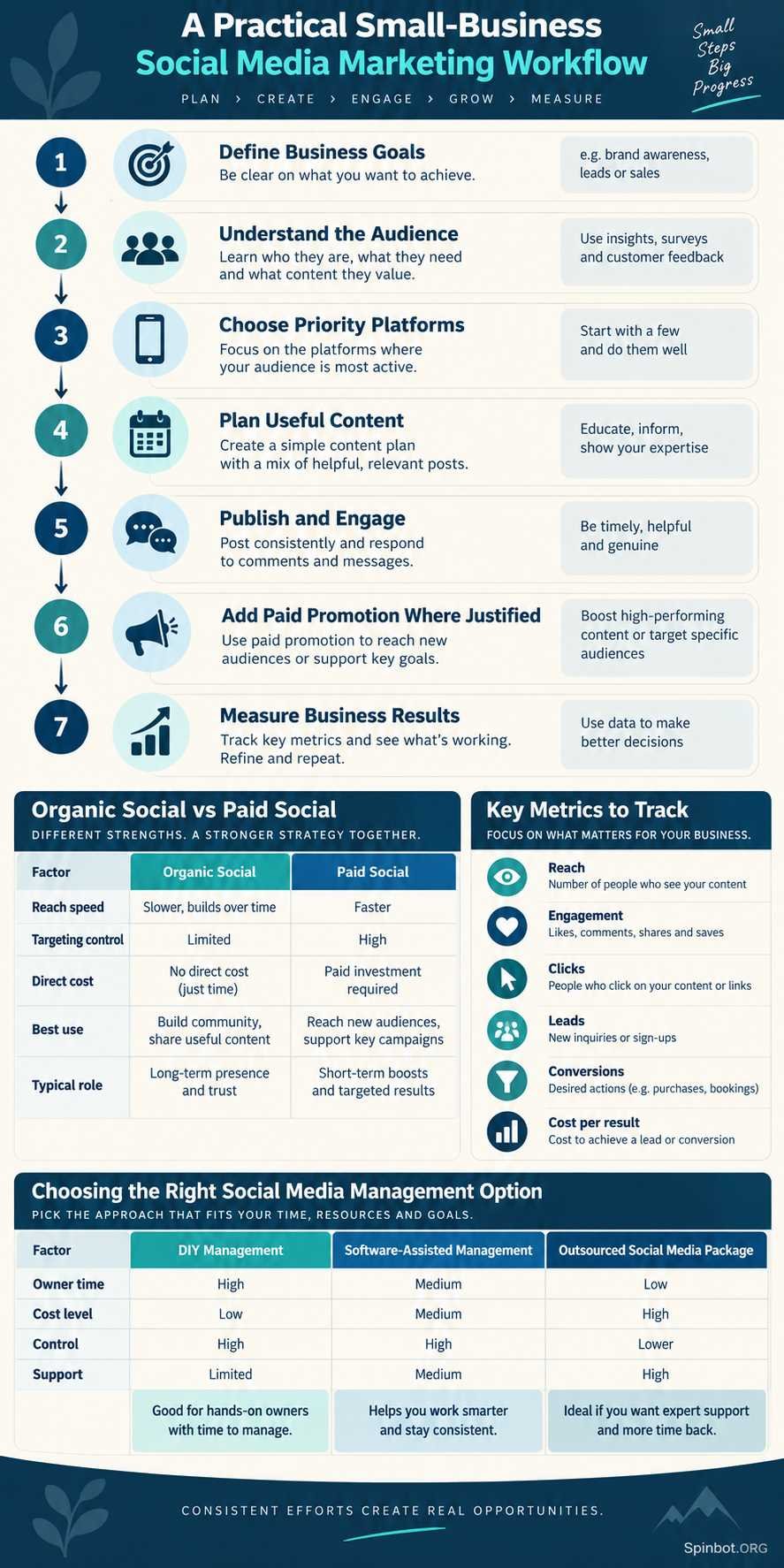
A useful social media plan starts with a business goal. You decide who you want to reach, where those people spend time, what they would find useful, and what action you want them to take. Content, comments, ads, and analytics come after that.
This matters because social media can become a serious drain on time. A business owner may spend hours making posts that collect likes but produce no website visits, inquiries, bookings, or sales. The fix is not necessarily more content. Often, it is a clearer purpose.
Social media marketing, sometimes shortened to SMM, is the use of social platforms to reach an audience, publish and distribute content, communicate with customers, promote products or services, and support measurable marketing goals. Modern strategies usually mix organic content, community interaction, and paid promotion rather than relying on only one of them.
What Social Media Marketing Actually Includes
Many beginners think social media marketing means making posts. Posting is only one part of it.
A working system normally includes three connected activities.
Organic social media
Organic social covers posts, videos, stories, comments, replies, and other activity that does not require paying the platform to distribute the content as an advertisement.
Its strengths are relationship building, brand recognition, customer communication, and learning what your audience responds to.
Organic content can also help a business show its personality. A bakery might demonstrate how a cake is decorated. A software company might answer a common setup question. A local plumber could make a short video explaining what to do when a pipe starts leaking.
None of these needs to begin with a sales pitch.
Paid social media
Paid social lets you spend money to distribute ads or promoted content to selected audiences.
It can help when you need faster reach, want to promote an offer, need leads, or want to put a proven piece of content in front of more people.
Paid distribution is not a cure for weak content, though. If people ignore an organic post because the message is confusing or uninteresting, paying for more impressions may simply help more people ignore it.
Community management
The third part is easy to overlook.
Someone has to reply when customers ask questions, leave comments, complain, tag the business, or send messages. Social media is not a one-way publishing channel.
That interaction can be especially important for small businesses because customers may use a social profile as an informal customer-service desk.
Start With the Business Result You Want
Before deciding what to post, decide what you want social media to accomplish.
A restaurant may want more local reservations. An online store may want product sales. A freelance designer may want qualified inquiries. A new company may simply need more people in its target market to recognize the brand.
Those goals lead to different strategies.
If awareness is the goal, reach, video views, and audience growth may deserve attention.
If website traffic matters, clicks and landing-page visits become more useful.
For lead generation, you may care about inquiries, form submissions, booked calls, and cost per lead.
For ecommerce, purchases, conversion rate, revenue, and return on ad spend can matter far more than follower growth.
A follower count can be encouraging, but it should not become the business goal by accident.
Suppose a small online store has 18,000 followers but gets only a handful of product-page visits each week. Another store has 3,000 followers but generates steady clicks and sales. The smaller account may be doing the better marketing job.
Your metric should follow your goal, not the other way around.
Know Who You Are Trying to Reach
Good social media marketing gets easier when the audience becomes specific.
A vague description such as people interested in fitness does not tell you much. Someone buying home workout equipment has different questions from a marathon runner or a gym owner.
Think about what your customers want, what frustrates them, what they already know, and what might make them stop scrolling.
You should also consider where they naturally spend time.
Choosing a network because it is popular is not enough. Different platforms encourage different formats, behaviors, and communities. Sprout Social’s 2026 research, based on surveys of more than 2,300 consumers in the United States, United Kingdom, and Australia plus 1,200 marketers, found that what audiences want from brands varies by network.
That is why copying exactly the same post across every account often wastes the strengths of each platform.
B2C social media marketing needs a consumer mindset
For B2C social media marketing, the buying decision may be emotional, visual, convenient, or strongly influenced by entertainment and social proof.
A clothing retailer can show styling ideas. A restaurant can feature dishes being prepared. A skincare brand can explain how a product fits into a routine.
The content gives consumers a reason to look before asking them to buy.
B2B marketing can work differently. Buyers may need deeper explanations, professional credibility, case studies, demonstrations, or evidence that a product solves an expensive business problem.
The basic marketing principles are similar, but the buyer’s questions are not.
Choose Fewer Platforms and Use Them Better
One of the fastest ways for a small company to make social media difficult is to create accounts everywhere.
Now you need Instagram posts, Facebook updates, TikTok videos, LinkedIn posts, YouTube videos, Pinterest pins, and perhaps an account on whatever platform becomes popular next month.
That sounds like reach. In practice, it can become six neglected accounts.
For a small team, one or two strong channels are usually a better starting point.
TikTok’s current small-business guidance also recommends beginning with a limited number of priority channels rather than spreading resources everywhere.
Choose based on three questions:
- Does our target audience use this platform?
- Can our business create content that fits how people use it?
- Can we maintain the account well enough to learn from it?
A photographer may have plenty of visual material for Instagram. A consultant may find LinkedIn easier to sustain. A business that can demonstrate products or teach visually may find YouTube or TikTok useful.
You do not need to reject other platforms forever. You are simply giving yourself enough focus to learn what works before expanding.
Build a Content System You Can Maintain
The best content schedule is not the most ambitious one. It is the one your business can keep producing without quality collapsing after two weeks.
Begin with a few recurring content themes.
A home-improvement company, for example, might use:
- simple repair and maintenance advice
- project examples
- common homeowner mistakes
- answers to customer questions
- behind-the-scenes work
- occasional service promotions
Now content planning becomes easier. Instead of asking What should we post today? every morning, the company has a pool of useful subjects.
You can also turn one strong idea into several formats.
A detailed article about preparing a home for winter might become a checklist, two short videos, several social posts, and a question-and-answer post. Repurposing saves time because the underlying idea has already been researched.
Still, repurposing should not mean blindly pasting the same thing everywhere. Adapt the opening, format, length, and presentation to the network.
Leave room for actual conversation
A calendar helps, but social media should not become a conveyor belt of scheduled posts.
Read the replies. Notice recurring questions. Watch for objections customers raise before buying. Those conversations can become future content.
Sometimes the comments section tells you more about what your audience needs than a month of brainstorming.
Organic and Paid Social Work Better When They Have Different Jobs
Organic and paid social are often treated as competing approaches.
They are more useful when each has a clear role.
Organic activity can help you learn which topics, messages, and creative approaches attract attention. Paid campaigns can then expand distribution, reach specific audiences, or push toward a measurable conversion.
TikTok, for example, explicitly supports a mix of organic content and paid campaigns in its small-business marketing guidance.
That does not mean every popular organic post deserves advertising money.
Imagine a local fitness studio publishes two videos. One receives many views because it is funny. The other receives fewer views but causes people to visit the studio’s class page.
If the business goal is memberships, the second video may be the more interesting advertising candidate.
The important question is not Which post looks most successful?
It is Which post produces the behavior we actually need?
Test before increasing the budget
Small businesses do not need to begin with a large advertising spend.
Start with a defined objective, controlled budget, clear audience, and a small number of creative variations. Compare the results before increasing spending.
Platforms such as Meta also provide A/B testing options for advertising, allowing businesses to compare campaign approaches rather than relying only on assumptions.
A useful test changes something meaningful: the creative, headline, audience, offer, or landing page. Changing five things at once makes it harder to understand why performance moved.
Social Media Marketing on a Small Budget
Cheap social media marketing sounds attractive, but cost needs to be understood properly.
Organic distribution may not require an advertising payment, but content still costs time. Someone has to plan it, create it, edit it, publish it, answer responses, and review performance.
A small company can keep costs low by simplifying the system rather than trying to imitate a large brand.
For example, you could:
- concentrate on one or two platforms
- use a smartphone instead of expensive video equipment
- create several posts during one content session
- reuse useful ideas in different formats
- answer real customer questions instead of constantly inventing campaigns
- use native scheduling and analytics tools where they meet your needs
- test small advertising budgets before scaling
TikTok’s guidance for low-cost promotion similarly points to content, partnerships, and free tools as ways small businesses can generate attention without immediately relying on large advertising budgets.
There is a difference, however, between low-cost and low-quality.
Saving money by using simple equipment is reasonable. Publishing inaccurate information, stealing visuals, buying fake followers, or hiring someone who sends spam comments is not.
Cheap tactics become expensive when they damage trust.
What a Social Media Marketing Package Should Include
Eventually, some businesses decide they do not want to manage everything internally.
A social media marketing package might include strategy, content creation, scheduling, account management, community responses, paid advertising, and reporting. Packages vary widely, so the number of posts per month tells you very little by itself.
Before choosing a social media marketing company or freelancer, ask what the service actually covers.
You need clarity on:
Strategy: Who decides the audience, platforms, goals, and content direction?
Content: Does the provider write captions only, or also create graphics and video?
Publishing: Who approves content, and how far in advance?
Community management: Are comments and direct messages included?
Advertising: Does the fee include ad management, and is advertising spend charged separately?
Reporting: Will reports connect social activity to useful business metrics?
Account ownership: Does your business retain control of the accounts, advertising assets, passwords, and creative files?
That last point deserves attention. Your business should not discover after ending a contract that a former provider controls an important account or advertising asset.
When outsourcing makes sense
Outsourcing can be useful when the work is consistent enough to justify professional help but is taking too much time away from the business.
It is less useful when the company has not decided what it wants social media to accomplish.
An agency can improve execution. It cannot read the owner’s mind.
A small business with a modest budget may get more value from defining its strategy internally and outsourcing a specific bottleneck, such as video editing or paid campaign management, rather than buying a large all-in-one package immediately.
Measure Results That Matter to the Business
Social platforms provide a lot of data. More numbers do not automatically produce better decisions.
Group your measurements according to the job the content is doing.
Reach and awareness
These metrics can include impressions, reach, views, and unique viewers. They tell you whether people are seeing the content.
Engagement
Comments, shares, saves, watch time, replies, and similar signals can help show whether people found the content worth interacting with.
For video, viewing depth can matter as much as the initial view. YouTube Analytics, for example, separates Reach, Engagement, Audience, Content, and other reporting areas. Its Engagement reports include watch time and average view duration, while Reach includes metrics such as impressions, views, and unique viewers.
Traffic and leads
If social media is meant to send people somewhere, track what happens after the click.
Did they visit a useful page? Submit a form? Request a quote? Join an email list? Book an appointment?
Conversions and revenue
For campaigns designed to generate sales, measure sales-related results where reliable tracking is available.
This is where a small account can outperform a large one.
Ten thousand extra video views may look impressive in a report, but 25 qualified inquiries may be more valuable to a service business.
The right metric depends on the job.
Common Social Media Marketing Mistakes
Most weak social media strategies do not fail because the owner missed a secret algorithm trick. They fail because basic decisions were never made.
Posting without a goal
If the team cannot explain why a piece of content exists, measuring it becomes difficult.
Trying to be everywhere
Every new platform creates another content and management obligation. Expand when you have a reason, not because an account is free.
Making every post promotional
People rarely follow businesses because they want a permanent stream of advertisements. Give them useful information, ideas, entertainment, access, or conversation too.
Ignoring replies
A polished publishing calendar loses value if real customers ask questions underneath the posts and nobody answers.
Paying to promote weak content
Advertising increases distribution. It does not automatically improve the message.
Chasing vanity metrics
A large follower count can be useful, but it is not proof that social media is contributing to the business.
Changing the strategy too quickly
One weak post does not prove that a platform is wrong for you. At the same time, months of poor results should not be defended with just keep posting.
Collect enough evidence to spot a pattern, then adjust.
Build Your First Practical Social Media Plan
You do not need a 40-page strategy document to get started.
Suppose a small B2C business wants more online orders. A simple first plan could look like this:
- Choose one primary outcome. Increase qualified visits to key product pages.
- Pick two priority platforms. Select them because existing and potential customers are active there, not because they are fashionable.
- Define three or four content themes. Product education, customer questions, demonstrations, and behind-the-scenes content might be enough.
- Set a realistic publishing rhythm. Choose a frequency the team can maintain while still responding to people.
- Track content performance. Look at reach and engagement, but pay particular attention to clicks and product-page behavior.
- Identify promising content. If certain demonstrations consistently generate qualified traffic, create more around that theme.
- Test paid distribution. Put a controlled advertising budget behind a proven message or campaign.
- Review the business outcome. Did traffic, leads, orders, or cost per result improve?
There is one useful failure point built into this plan.
Suppose the social posts receive plenty of clicks but almost nobody buys.
That does not automatically mean the social strategy failed. The problem could be the product page, price, shipping cost, checkout process, or mismatch between the content promise and the landing page.
Social media analytics tell only part of the story. You have to follow the customer beyond the platform.
That is the difference between managing social accounts and doing social media marketing.
The goal is not to fill a calendar with posts. It is to build a repeatable way of reaching the right people, giving them a reason to pay attention, and moving some of that attention toward a useful business result.
For most small businesses, the simpler version is better at first: one clear goal, a narrow audience, a few strong content themes, one or two priority platforms, and measurements tied to what the business actually needs.
Add more platforms, tools, content formats, advertising spend, or outside help only when the existing system gives you a reason to.

Raj blends SEO mastery with real-world freelance grit. Covers SEO, blogging, content strategy, copywriting, freelance writing, marketing, and business communication.