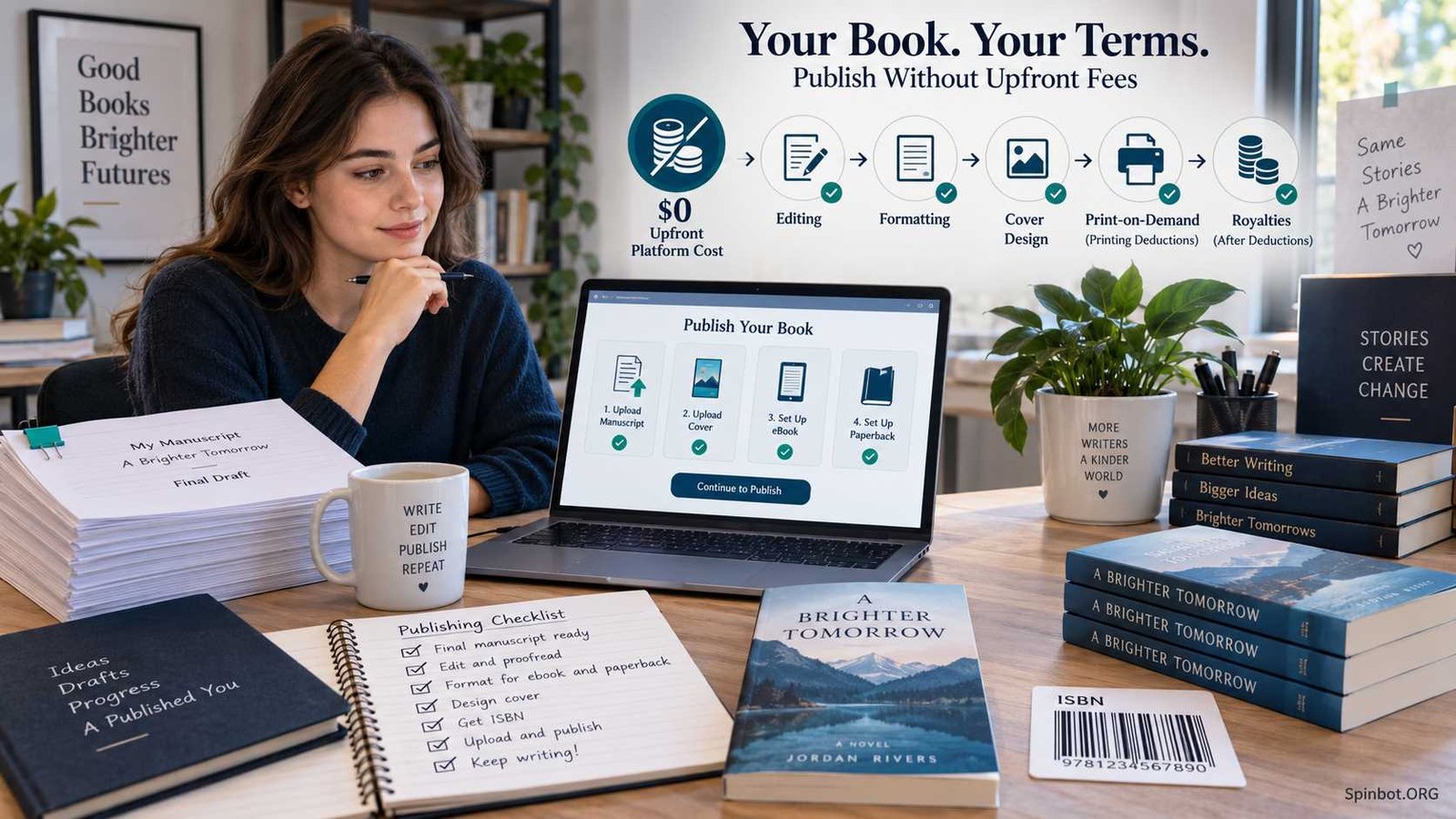
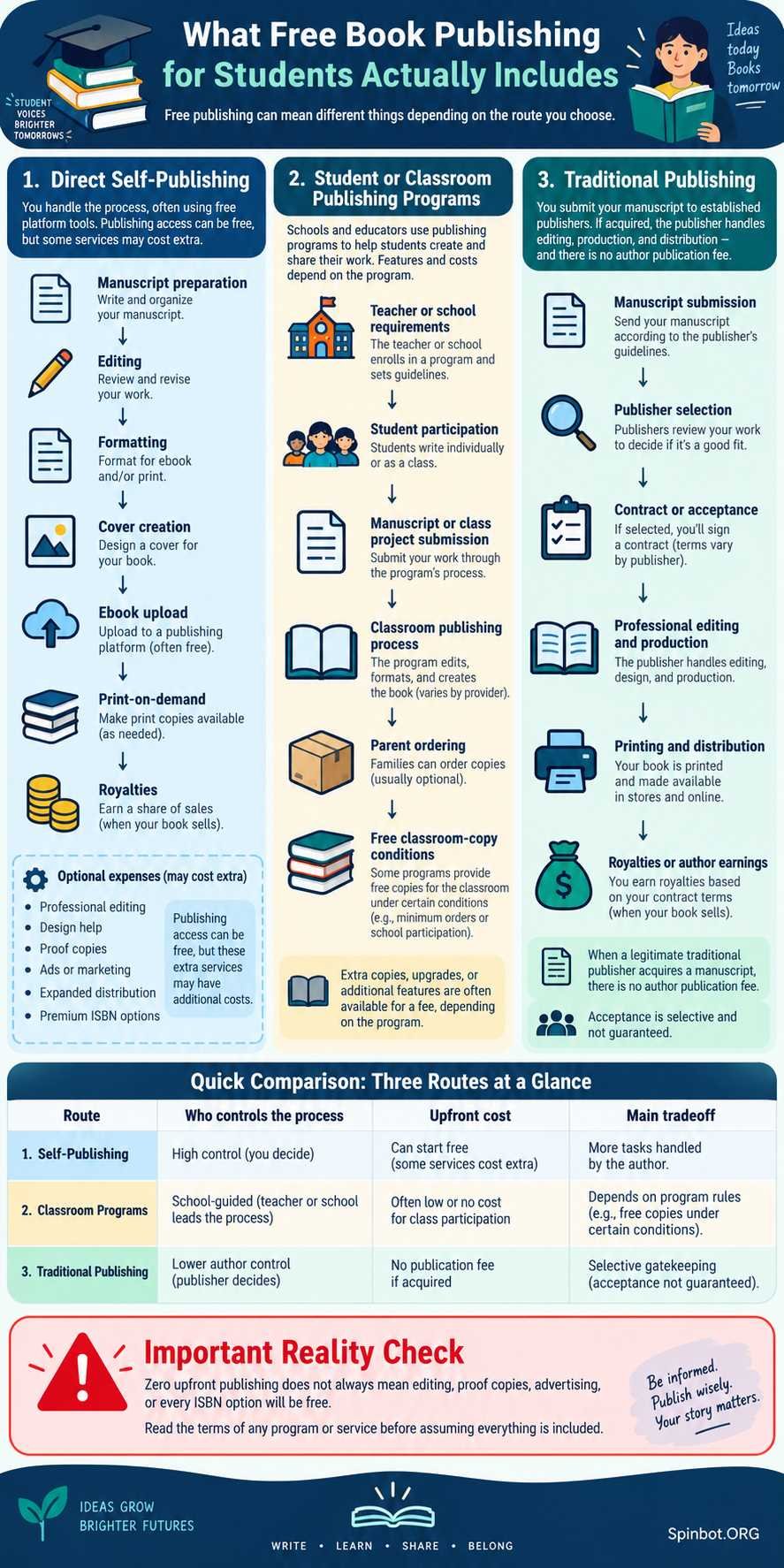
Free book publishing for students is possible, especially through self-publishing platforms that charge nothing to create an account and upload a finished book. The important part is understanding what free actually covers. A platform may let you publish for $0 while still deducting printing costs from each sale or charging for optional services.
For most students publishing an individual book, Amazon Kindle Direct Publishing is the simplest place to begin. Students interested mainly in ebooks can also consider Kobo Writing Life. IngramSpark becomes more attractive when wider print distribution matters. Younger students working through a school may have completely different options.
Can Students Really Publish a Book for Free?
Yes. A student can publish an ebook or print-on-demand book without paying a large publishing fee in advance.
Amazon Kindle Direct Publishing, usually called KDP, currently lets authors publish Kindle ebooks, paperbacks, and hardcovers for free. With print books, Amazon prints a copy only when somebody orders it and subtracts the printing cost from the royalty. You do not need to buy hundreds of books before publication.
That distinction matters.
Free publishing does not necessarily mean a completely free book-production process.
You may still decide to spend money on:
- editing
- proofreading
- cover design
- book formatting
- an ISBN
- proof copies
- author copies
- advertising
- professional illustrations
None of those expenses automatically means you must pay a publisher.
A student with a clean manuscript, a suitable cover, basic formatting skills, and access to a free self-publishing platform can realistically reach publication with little or no upfront spending.
There is another issue for younger writers: age.
Amazon says writers under 18, or under the legal age of majority where they live, can use KDP only with the involvement of a parent or guardian. Kobo Writing Life requires account holders to be at least 18 or the legal age of majority in their place of residence.
So a 14-year-old can certainly be the author of a book, but a parent or guardian may need to manage the publishing account, tax information, payments, and agreements.
Best Free Book Publishing Options for Students
The best service depends on what you are publishing and where you want readers to find it.
| Option | Upfront publishing fee | Best for | Main limitation |
|---|---|---|---|
| Amazon KDP | $0 | First-time ebook and print authors | Free KDP ISBN stays with KDP |
| Kobo Writing Life | $0 | Ebook publishing | No direct print-book publishing |
| IngramSpark | $0 to sign up and upload | Wider print distribution | Some services and printing still cost money |
| Youth Writers | Free program | Eligible student authors | Program rules and submission requirements apply |
| Classroom programs | Free under conditions | School writing projects | Usually not designed for an individual commercial book |
Amazon Kindle Direct Publishing
For an individual student asking how to publish a book for free, KDP is usually the most practical starting point.
You can publish:
- Kindle ebooks
- paperbacks
- hardcovers
For print books, KDP uses print on demand. If a reader orders your paperback, Amazon produces that copy rather than requiring you to pay for a large print run first. Printing costs are deducted when the book sells.
KDP also offers a free ISBN for eligible paperback and hardcover books. There is a tradeoff: that ISBN can be used only through KDP. If you later want to use the same edition through another publishing platform, you cannot take the free KDP ISBN with you.
For a student testing self-publishing for the first time, that limitation may not matter. Someone planning to build a long-term publishing business may prefer to own an ISBN independently.
IngramSpark
IngramSpark currently charges nothing to create an account or upload a print book or ebook. It is especially useful when broader book-trade distribution is important.
Its setup can feel more publishing-focused than KDP, which may be useful once you understand things such as ISBNs, wholesale distribution, book metadata, print specifications, and retailer discounts.
U.S. publishers can currently receive a free IngramSpark ISBN. However, the free ISBN is owned by IngramSpark, uses its Indy Pub imprint, cannot be transferred to another account, and cannot be reused on platforms such as KDP. Free IngramSpark ISBNs are currently limited to U.S. customers.
Also notice that free upload does not make every IngramSpark service free. For example, its optional print-to-ebook conversion service is currently priced per page. Preparing a valid EPUB yourself avoids the need for that particular service.
For a first student novel sold mainly through Amazon, IngramSpark may be more system than you need. It starts making more sense when broader print distribution becomes part of the plan.
Kobo Writing Life
Kobo Writing Life is a good choice for students focused on ebooks or wanting distribution beyond a single ebook store.
Kobo says there is no charge to distribute an ebook through Writing Life, and it can convert an uploaded manuscript into EPUB format without charging a conversion fee. Authors keep the rights to the work they publish.
The main difference from KDP is format. Kobo Writing Life focuses on digital publishing rather than offering the same direct paperback and hardcover production workflow.
For a student publishing a short novel, poetry collection, or other ebook, that simplicity can be useful.
Youth Writers
Younger authors may also want to examine programs created specifically for students.
Youth Writers describes itself as a student-led initiative offering free publishing support. Its current submission page accepts full books with at least 5,000 words or picture books with at least 24 pages. Its process includes submission, an author meeting, editing, publication, and reporting.
This is quite different from opening your own KDP account. Youth Writers uses a managed student-publishing model, so read its agreement carefully and understand how the book, account, rights, and royalties will be handled before submitting.
Classroom Publishing Programs
Teachers looking for free book publishing for students may mean something different: turning a whole class’s writing into a physical book.
Studentreasures has a free Classbook Program in which students contribute writing and illustrations to one collaborative book. The program currently requires at least 12 participating students for the free classbook project. Parents are given the opportunity to buy copies but are not required to purchase one, while the teacher receives a free classroom copy when the program conditions are met.
School Mate Publishing offers a similar classroom model. Its free-book requirements currently include a combined book with work from at least 10 students and, under the standard program, a Pre-K through fifth-grade classroom.
These programs are useful for teachers. They are not substitutes for KDP or IngramSpark if a college student has written a 60,000-word novel and wants to sell it commercially.
Free Publishing Platforms Are Not the Same as Traditional Publishers
Searches for publishing companies that publish for free often mix together several very different businesses.
A self-publishing platform gives you tools and distribution while you act as the publisher.
A commercial or trade publisher chooses manuscripts to acquire and takes responsibility for producing and selling accepted books.
A publishing-services company sells editing, design, printing, marketing, or distribution services to authors.
These models should not be treated as interchangeable.
With genuine trade publishing, the author normally does not pay the publisher for the privilege of being published. Writer Beware has repeatedly warned authors about fee-charging operations that present themselves as traditional publishers while requiring money, paid services, or compulsory book purchases.
That does not mean every paid publishing service is automatically dishonest. You may knowingly choose to hire someone to format your manuscript or design your cover.
The warning sign appears when a company claims it has selected your manuscript for conventional publication, then makes publication dependent on you paying a large fee.
How to Publish a Book for Free as a Student
A zero-budget publishing plan works best when you do the expensive preparation yourself and use print-on-demand or ebook distribution instead of paying for inventory.
1. Finish the manuscript before worrying about publishing
Publishing an unfinished book faster does not help you.
Complete the story, guide, poetry collection, or nonfiction manuscript first. Then give yourself enough distance to read it again with fresh eyes.
Major rewriting is much easier before you start designing covers and uploading files.
2. Get useful feedback
A professional editor can be valuable, but students with no budget still have options.
Ask a teacher, writing-group member, classmate, librarian, or trusted reader to identify confusing sections. Your goal is not to have people rewrite your book for you. You want them to notice problems you have stopped seeing.
For an important book, use several rounds of revision rather than assuming one spell-check is enough.
3. Proofread carefully
Readers notice basic mistakes.
Check spelling, punctuation, repeated words, inconsistent character names, chapter numbering, quotation marks, headings, page breaks, and missing text.
Reading slowly in a different format can help. A mistake that disappears on your laptop screen can suddenly look obvious in a PDF or printed proof.
4. Format the book
An ebook and a paperback are not the same file.
Ebooks use flexible layouts that adapt to different screen sizes. Print books have fixed dimensions, margins, page numbers, headers, and other physical requirements.
Follow the publishing platform’s current formatting instructions rather than copying dimensions from an old blog post.
5. Create a cover you are legally allowed to use
A free cover is possible, but free does not mean you can take any picture from Google Images.
Use your own artwork, public-domain material when appropriate, or assets whose license allows the intended commercial use. Check the license before publishing.
Print covers also need correct dimensions based on book size, page count, paper type, and spine width.
6. Choose ebook, print, or both
An ebook is often the easiest zero-cost format because there is nothing physical to manufacture.
Print on demand is the next useful option because copies are produced after orders arrive.
You do not need 500 paperbacks sitting under your bed before you can call yourself a published author.
7. Enter accurate book information
Platforms will ask for information such as:
- title
- author name
- description
- language
- categories
- publication rights
- price
- territories
This information is called metadata.
Treat it seriously. A beautifully written novel with a vague description and the wrong category becomes harder for the right readers to understand and discover.
8. Preview before publishing
Never assume a successful upload means a finished book looks correct.
Open the digital preview. Check chapter starts, indentation, images, page breaks, contents pages, fonts, margins, and blank pages.
For print, ordering a proof may cost money, but it can expose problems that are difficult to judge on a monitor.
What Does Publishing a Book Actually Cost?
The publishing cost of a book can range from almost nothing to thousands of dollars because two authors can choose completely different production methods.
One student might proofread with help from a teacher, format the manuscript personally, design a simple cover, and use KDP. Upfront expenditure may remain close to zero.
Another author may hire a developmental editor, copy editor, proofreader, illustrator, cover designer, formatter, publicist, and advertising specialist.
Both have self-published. Their budgets are completely different.
The costs most likely to appear are not platform-upload fees but services you choose to buy.
An ISBN is a good example. KDP provides free ISBNs for eligible print formats, while IngramSpark offers free ISBNs to U.S. publishers under its own restrictions. Buying your own ISBN can give you more control over your publishing identity and distribution, but it is not automatically necessary for a student experimenting with a first book.
Print copies are another example. Publishing a print-on-demand paperback may require no inventory purchase, but ordering copies for yourself still costs money.
A Realistic $0 Student Publishing Setup
Suppose a 17-year-old student has written a 25,000-word fantasy story.
The student revises it personally, asks an English teacher and two friends for feedback, proofreads the final manuscript, formats it according to KDP’s instructions, and creates a cover using artwork they have the right to publish.
Because the author is under 18, a parent becomes involved with the KDP account as required.
The student publishes a Kindle edition and a print-on-demand paperback. The paperback uses a free KDP ISBN.
No large print order is purchased. No publishing package is bought.
That can keep the upfront publishing cost close to $0.
There is still a catch: free does not protect the author from mistakes.
Suppose the paperback preview reveals chapter headings too close to the page edge. The correct response is not to publish because the process is free. The student should fix the manuscript file and upload a new version.
Later, if the student wants the same book under a personally owned ISBN with more flexible distribution, the original free KDP ISBN cannot simply be moved to another platform. That is one of the tradeoffs accepted in exchange for the free ISBN.
Be Careful With Old Lists of Free Publishing Companies
Publishing terms change.
Draft2Digital is a useful example. Older guides may describe it as completely free to start publishing. That information is now outdated.
As of 2026, Draft2Digital’s current FAQ says new publishing accounts have a one-time $20 activation fee. It also describes a $12 annual maintenance fee for accounts earning less than $100 per year in book sales, with additional conditions around whether titles remain in distribution.
That does not make Draft2Digital a bad service. It simply means it no longer belongs on a list promising students a true $0 publishing-account setup.
This is why platform fees should always be checked directly before you create an account.
Which Free Publishing Route Should You Choose?
There is no need to build a complicated publishing system for your first book.
Choose KDP if you are an individual student who wants the simplest route to a Kindle ebook, paperback, or hardcover without an upfront publishing charge.
Choose Kobo Writing Life if ebooks are your priority and you want another major digital distribution route.
Consider IngramSpark if print distribution beyond one retailer matters enough for you to deal with a more publishing-oriented setup.
Look at Youth Writers if you are a younger student who wants a guided program designed specifically around student authors and you meet its requirements.
Use Studentreasures or School Mate when the goal is a classroom book created by a group of students rather than an individual commercial title.
And if your real dream is to be accepted by a trade publisher, self-publishing is not a required first step. You can research suitable publishers or literary agents and submit according to their guidelines without paying someone to accept the manuscript.
Free book publishing for students is therefore less about finding a mysterious company willing to print anything for nothing. It is about choosing a publishing model where you understand exactly who pays for what.
For a first book, keep that choice simple. Finish the manuscript. Make the book as clean as you can. Use a legitimate platform with clear terms. Spend money only when a service solves a real problem you cannot reasonably solve yourself.
Your first publication does not need an expensive package to count. It needs a book you are ready to put your name on.
Academic editor turned AI copy pro, Sarah-Jane fuses research precision with smart storytelling. She covers academic writing, research, citation, plagiarism, copyright, grammar, editing, and publishing.