
That distinction matters.
A campaign that sends 10,000 generic emails and books a few random calls may look productive on a dashboard. A smaller campaign that reaches 300 carefully selected prospects and starts conversations with companies you genuinely want as customers can be far more valuable.
Good cold email lead generation is therefore less about volume and more about targeting, deliverability, relevance, qualification, and follow-up.
What Cold Email Lead Generation Actually Means
Cold email lead generation is the process of contacting potential business customers by email even though they have not previously spoken with you or joined your marketing list.
The objective is usually to create a sales opportunity rather than make an immediate sale.
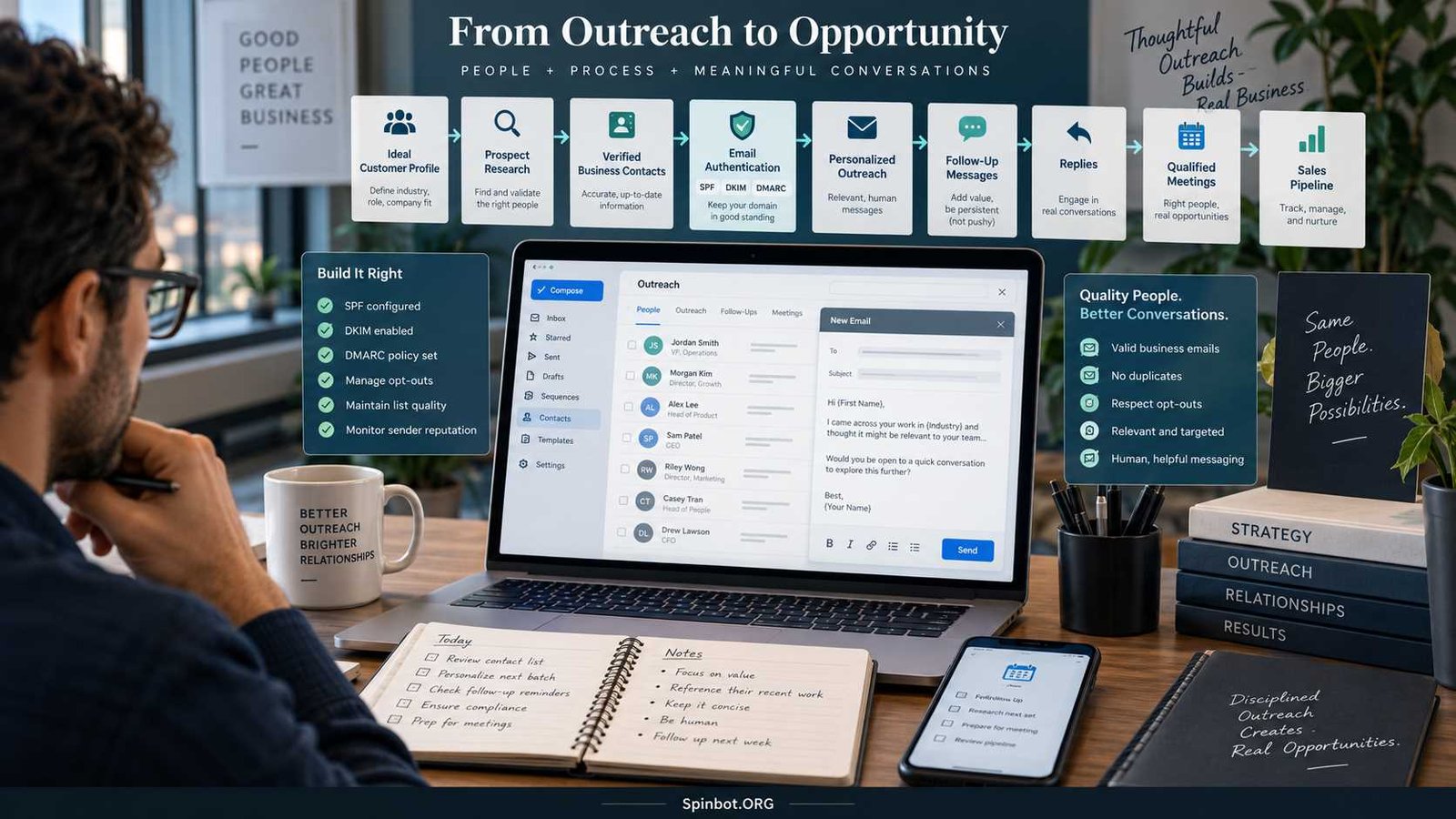
A typical process looks like this:
- Define the type of company you want to reach.
- Identify suitable companies and decision-makers.
- Find and verify business contact information.
- Prepare the sending infrastructure.
- Write a relevant outreach message.
- Follow up when appropriate.
- Qualify positive replies.
- Move suitable prospects into your sales process.
Cold email is different from an email newsletter. A newsletter normally goes to people who deliberately subscribed. Cold outreach starts with a business relationship that does not yet exist, which creates additional deliverability, privacy, and compliance concerns.
It is also different from spam in an important practical sense. A serious cold outreach program selects recipients because there is a reasonable connection between the recipient and the offer. Dumping a huge purchased database into an email tool and sending the same vague pitch to everyone is not a sensible lead-generation strategy.
Start With the Right Prospects, Not More Prospects
Most weak campaigns fail before the first email is written.
The problem is usually the list.
Suppose a web design agency says its target market is small businesses. That includes restaurants, accountants, manufacturers, dentists, law firms, consultants, online stores, gyms, plumbers, and thousands of other businesses with completely different buying needs.
That is not a useful target market for cold email.
Define a useful ideal customer profile
Your ideal customer profile, usually called an ICP, describes the type of organization that is most likely to benefit from your offer.
For a B2B service, useful filters might include:
- Industry
- Company size
- Location
- Revenue range
- Technology used
- Number of employees
- Growth stage
- Current marketing activity
- Hiring activity
- Business model
- Specific problem your service solves
You may then narrow the list further by job role.
A B2B SEO agency, for example, could target software companies with 20 to 200 employees that already publish content but have weak organic visibility. The relevant contact may be the head of marketing, growth manager, or founder, depending on company size.
That is much stronger than searching for anyone with marketing in their job title.
Look for a reason to contact them now
Firmographic data tells you whether a company fits. A buying signal tells you why your message may be timely.
Useful signals vary by offer.
A web design lead generation campaign could identify businesses with:
- An outdated mobile experience
- Broken pages
- A recent rebrand
- A newly opened location
- Poorly presented service pages
- A site that does not clearly explain the company’s offer
A marketing agency might look for companies that recently raised funding, hired a marketing leader, entered a new market, launched a product, or increased hiring.
The point is not to manufacture a creepy personalization line. It is to find a genuine business reason for the conversation.
Verify the contact data
Poor contact data hurts both sales productivity and email delivery.
Check addresses before putting them into a live sequence. Remove obvious duplicates, invalid addresses, irrelevant job functions, companies outside your target market, and contacts who have previously opted out.
A list of 500 well-matched, verified prospects is usually more useful than 20,000 names collected with weak filters.
Get the Sending Foundation Right Before Scaling
Your copy cannot rescue a broken sending setup.
Mailbox providers evaluate technical authentication, sending behavior, recipient complaints, and other reputation signals. Google currently requires senders to personal Gmail accounts to use SPF or DKIM authentication, valid DNS records, and TLS. Senders exceeding 5,000 messages per day to personal Gmail accounts face additional requirements, including SPF and DKIM, DMARC, domain alignment, and one-click unsubscribe for applicable marketing messages.
Yahoo similarly requires authentication for senders and stronger SPF, DKIM, DMARC, alignment, and unsubscribe practices for bulk senders.
What SPF, DKIM, and DMARC do
You do not need to become an email engineer to understand the basics.
SPF identifies which servers are allowed to send email for your domain.
DKIM adds a digital signature that helps receiving systems verify that the message genuinely came from an authorized sender and was not altered on the way.
DMARC builds on SPF and DKIM. It gives domain owners a policy for handling messages that fail authentication and provides reporting that can help detect problems.
These records should be configured correctly before a serious outbound campaign begins.
Sending reputation matters more than clever tricks
There is no magic daily volume that guarantees inbox placement.
What matters is how recipients and mailbox providers respond to your mail.
Google advises senders to keep user-reported spam rates below 0.1% and avoid reaching 0.3% or higher. Yahoo tells senders to keep spam complaint rates below 0.3%.
That gives you a useful operational rule: if complaints rise, do not solve the problem by adding more mailboxes and sending faster.
Investigate the campaign.
The issue could be poor targeting, misleading subject lines, stale contact data, irrelevant copy, excessive frequency, or an offer that simply does not belong in the recipient’s inbox.
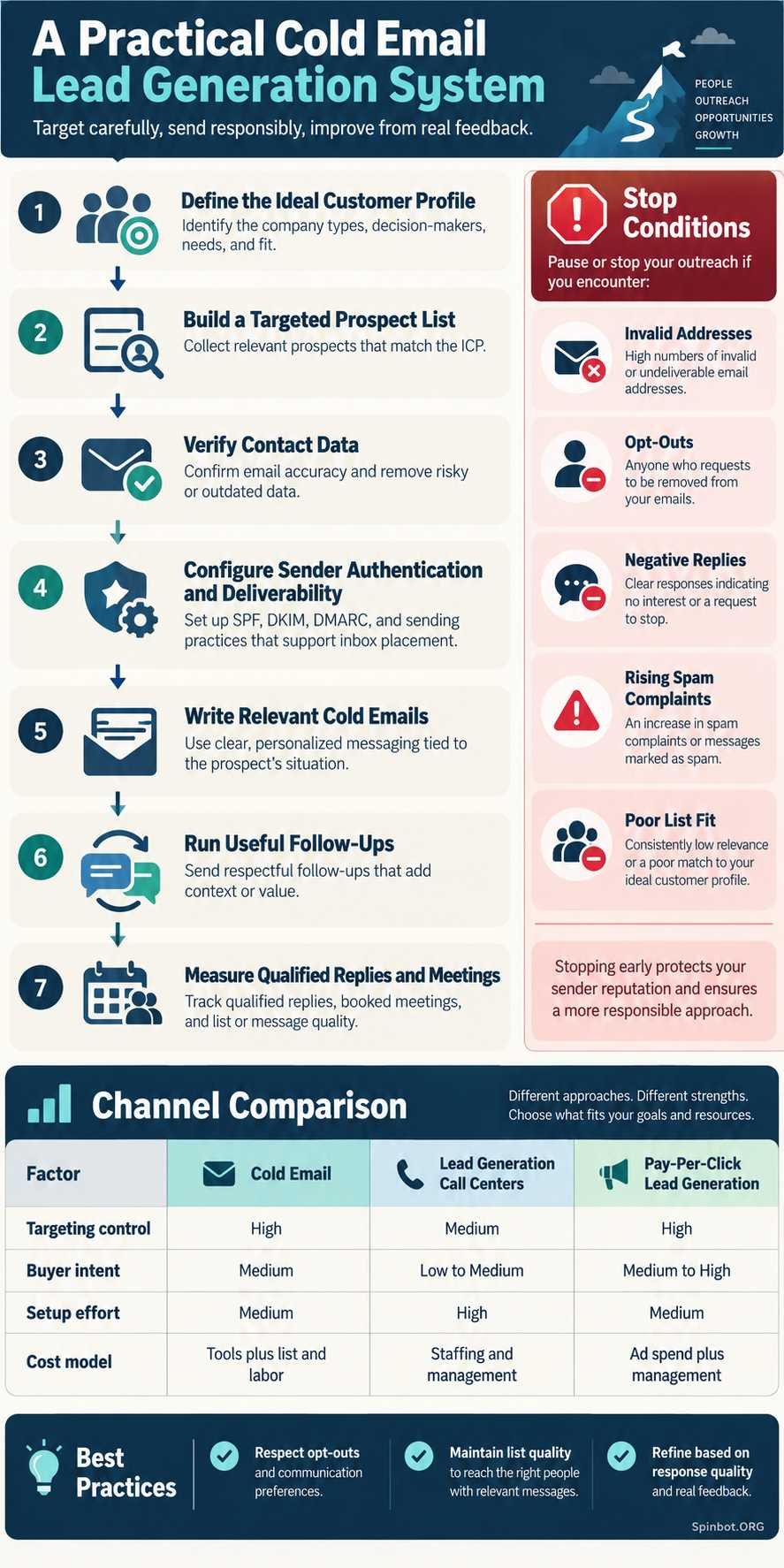
A sensible system should also stop contacting addresses that bounce, people who ask not to be contacted, and prospects who clearly say no.
Write Cold Emails That Make Sense to the Recipient
Cold email copy is often overcomplicated.
You do not need a miniature sales page inside someone’s inbox. You need enough information for the recipient to understand three things:
Why are you contacting me? Why might this matter? What do you want me to do next?
A practical structure is:
Relevant context → problem or opportunity → useful offer → simple next step
For example, suppose a web design company is approaching independent dental groups.
Weak version:
We are a full-service digital agency offering innovative web design solutions that help businesses increase conversions. Would you like to schedule a call?
The problem is not just the wording. Nothing explains why this particular dentist was contacted.
A stronger approach might reference a real issue found during research:
I noticed the mobile version of your treatment pages makes it difficult to reach the appointment form without several taps. We help dental groups simplify that path and improve how treatment pages work on smaller screens. I can send over the three changes I would look at first if that would be useful.
The message gives the recipient context before asking for anything substantial.
Personalization should improve relevance
Putting someone’s first name into an email is not meaningful personalization.
Neither is writing a sentence about their university, hometown, or latest LinkedIn post when that detail has nothing to do with your offer.
Useful personalization changes the business case.
It might refer to:
- A product the company recently launched
- A relevant part of its website
- A role it is hiring for
- A market it recently entered
- A problem visible in its current marketing
- A technology or workflow connected to your service
If removing the personalized sentence would not change the reason for contacting that company, the personalization is probably decorative.
Keep the next step easy
Cold prospects have not agreed to spend 30 minutes learning about your company.
Asking for a long demonstration in the first message creates unnecessary friction.
Depending on the service, a better first step may be asking whether they want a short audit, a comparison, two suggestions, an example, a pricing range, or a quick conversation.
The right call to action depends on how much trust the buyer needs before moving forward.
Follow-Up Should Add Something
Many prospects will not respond to the first email even when the offer is relevant. They may be busy, traveling, dealing with another priority, or simply reading at the wrong moment.
That makes follow-up useful.
It does not make endless follow-up useful.
Avoid sending five variations of:
Just checking whether you saw my previous email.
Give the recipient another reason to evaluate the offer.
A follow-up could:
- Clarify the problem you solve
- Provide a useful example
- Answer an obvious objection
- Mention a relevant business trigger
- Make the next step easier
- Close the conversation politely
If several attempts produce no response, stop. Repeated unwanted contact can damage both your brand and sender reputation.
Turn Replies Into Qualified Leads
A reply is not automatically a lead.
Cold email campaigns generate several kinds of responses:
- Interested
- Not interested
- Ask me later
- Wrong person
- Referral to another employee
- Pricing question
- Existing supplier
- Automatic reply
- Unsubscribe request
Your workflow needs to distinguish them.
For a marketing agency, a qualified lead might need a minimum company size, the right geography, an active marketing budget, and a service requirement the agency can actually solve.
A prospect who replies positively but cannot buy your service should not be counted the same way as a qualified sales opportunity.
This is why reply rate alone can be misleading.
Measure outcomes that connect to revenue
Useful cold email metrics can include:
- Delivery failures
- Bounce rate
- Spam complaints
- Opt-outs
- Positive replies
- Qualified replies
- Meetings booked
- Meetings attended
- Opportunities created
- Proposals sent
- Customers won
- Cost per qualified meeting
- Revenue generated
Be cautious about treating open rate as a reliable success metric. Google says it does not track open rates and cannot verify the accuracy of open-rate data reported by third-party systems.
A campaign with fewer apparent opens but more qualified meetings is the better campaign.
Cold Email Lead Generation for Marketing Agencies
Lead generation for marketing agencies works best when the agency stops selling marketing in general.
The offer needs a sharper connection between a prospect problem and a service.
Suppose a B2B content agency wants SaaS clients.
A useful workflow might be:
Target: B2B SaaS companies with 30 to 150 employees.
Signal: The company publishes content but important commercial topics have not been updated for more than a year.
Contact: Head of content or marketing.
Offer: Identify three pages with the clearest opportunity for refresh or consolidation.
Email: Explain one observed issue, why it may matter, and offer to send the short analysis.
The agency is no longer asking strangers whether they need content marketing. It is starting a conversation around something specific.
Web design lead generation works in much the same way. Instead of saying we make beautiful websites, choose prospects where you can identify a concrete usability, messaging, mobile, accessibility, conversion, or maintenance issue.
This approach takes more research per prospect.
That is usually a good trade.
Should You Hire a Cold Email Lead Generation Agency?
A cold email lead generation agency can be useful when your company has a proven offer but lacks the people or systems to handle prospect research, deliverability, sequencing, and campaign operations.
It is less useful when you have not yet worked out who buys your service or why.
Outsourcing an unclear offer generally produces a larger version of the same problem.
Before hiring an agency, ask how it handles:
- ICP development
- Data sourcing
- Email verification
- Sending domains and mailboxes
- SPF, DKIM, and DMARC
- Suppression and opt-out lists
- Personalization
- Reply management
- CRM handoff
- Reporting
- Compliance
- Ownership of domains, data, and accounts
Pay particular attention to ownership.
If an agency controls every sending account, domain, prospect list, and conversation history, leaving the relationship may become unnecessarily difficult.
Also remember that outsourcing does not automatically outsource legal responsibility. In the United States, the FTC explicitly warns that companies cannot simply contract away CAN-SPAM obligations by hiring another business to send email on their behalf.
Cold Email Versus Call Centers and Pay Per Click Lead Generation
Cold email is one way to create demand. It is not automatically the best one.
| Channel | Prospect Intent | Targeting Control | Human Effort | Cost Model | Best Fit |
|---|---|---|---|---|---|
| Cold email | Usually low to medium | High | Medium | Data, tools, infrastructure, labor | Narrow B2B audiences |
| Lead generation call center | Usually low to medium | High | High | Staff or outsourced calling | Offers that benefit from live conversation |
| Pay per click lead generation | Often medium to high when search-driven | Medium to high | Lower per interaction | Pay per click or impression | Existing search demand |
Pay per click lead generation is especially useful when prospects are already searching for the service. A commercial cleaning company, for instance, may benefit from advertising around searches that clearly show buying intent.
Cold email works differently. It lets you identify suitable accounts before they search for you.
A lead generation call center adds immediate human interaction but usually requires more labor per contact.
Many businesses eventually use more than one channel. The mistake is assuming they are interchangeable.
Cold Email Compliance Changes by Market
Cold email laws are not universal. Your obligations depend on where recipients are located, what type of recipient you contact, how you obtained their data, and the purpose of the message.
This section is a practical overview, not legal advice.
United States
The CAN-SPAM Act covers commercial email and does not create a special exemption for business-to-business messages. The FTC requires, among other things, accurate header information, non-deceptive subject lines, identification of commercial messages, a valid postal address, and a working opt-out method. Opt-out requests must be honored within the required period.
So B2B does not mean anything goes.
United Kingdom
UK rules require more nuance.
The Information Commissioner’s Office explains that under PECR, corporate subscribers such as limited companies are treated differently from sole traders and certain partnerships. The electronic-mail rules that apply to individuals also apply to sole traders and some partnerships, while electronic mail to corporate subscribers is treated differently under PECR. Personal-data rules can still apply when you process information about identifiable business contacts.
The ICO also notes that its B2B marketing guidance is currently under review following changes made by the Data (Use and Access) Act, so businesses targeting the UK should check the current guidance rather than relying on an old cold-email checklist.
Canada
Canada’s Anti-Spam Legislation is stricter than the U.S. framework.
The CRTC states that commercial electronic messages generally require consent, identification information, and an unsubscribe mechanism. Consent can be express or implied, but implied consent only exists in defined circumstances. The rules can also apply to commercial messages sent into Canada from another country.
Do not assume that finding a Canadian business email address online automatically gives you permission to add it to an unrestricted outreach campaign.
European Union
The EU framework is also more restrictive than a simple U.S.-style opt-out model.
Article 13 of the ePrivacy Directive addresses unsolicited electronic communications for direct marketing and includes prior-consent rules along with a limited existing-customer exception. Member states implement parts of the framework through national law, so the exact B2B position can differ by country.
If Europe is a major target market, build your compliance process around the countries you actually contact rather than treating the EU as one identical rule set.
Measure the System Before You Scale It
The temptation in cold outreach is to scale as soon as something looks promising.
That is usually too early.
Imagine you test 150 prospects and get poor results. Before increasing that to 1,500, diagnose what happened.
Were the addresses valid?
Did the companies fit the ICP?
Were you reaching the right roles?
Did recipients understand the offer?
Were spam complaints appearing?
Did positive replies come mostly from one industry or company size?
Did people ask the same objection repeatedly?
A small campaign gives you information cheaply. A large campaign multiplies whatever is already there, including mistakes.
That is why the best next step is often not another mailbox or another thousand leads. It is fixing the weakest part of the system.
Build a Smaller System You Can Actually Improve
Cold email lead generation works best when each part of the process is connected.
Target the wrong companies and better copy will not save you. Use poor data and deliverability suffers. Send irrelevant messages and complaints rise. Generate replies without qualification and your sales team wastes time. Scale before learning and you simply make the weaknesses bigger.
For most B2B businesses, the sensible starting point is a narrow segment, a clear problem, a verified list, properly configured sending infrastructure, and one offer you can explain in a few sentences.
Run the campaign at a controlled size. Study the replies. Remove poor-fit prospects. Improve the offer. Watch deliverability. Track qualified meetings and opportunities rather than celebrating activity for its own sake.
That turns cold email from a numbers game into what it should be: a disciplined way to start useful conversations with businesses you are genuinely equipped to help.

Raj blends SEO mastery with real-world freelance grit. Covers SEO, blogging, content strategy, copywriting, freelance writing, marketing, and business communication.