

You know the topic. You may even know the keywords you want to cover. But then the questions start: What should come first? How many sections do I need? Should this be a list, tutorial, comparison, or guide?
A blog post formula solves that problem by giving you a reusable structure.
It does not write the post for you. It simply gives your ideas somewhere to go.
The key is choosing the right formula for the reader’s goal. A step-by-step tutorial needs a different structure from a comparison or case study. Ahrefs makes the same distinction in its blog-post templates, separating formats such as list posts, step-by-step guides, expanded definitions, comparisons, and beginner guides.
Here are 11 practical blog post formulas you can reuse.
What Is a Blog Post Formula?
A blog post formula is a repeatable structure for organizing an article.
Think of it as a frame rather than a finished house.
For example, a basic how-to formula might look like this:
Problem → Goal → Requirements → Steps → Mistakes → Next Action
You can use that structure for hundreds of topics:
- How to start a newsletter
- How to edit a blog post
- How to create a content calendar
- How to optimize an image
- How to write a cover letter
The subject changes, but the reader’s journey stays similar.
Templates can also make outlining faster. HubSpot distinguishes a content brief, which defines strategy and intent, from an outline, which turns that strategy into headings, examples, supporting points, and calls to action.
That distinction matters. Your formula should organize the answer, not replace research or judgment.
1. The How-To Formula
Use this structure when the reader wants to complete a specific task.
Formula:
Problem → Desired result → What you need → Step 1 → Step 2 → Step 3 → Common mistakes → Next action
Imagine you are writing:
How to Refresh an Old Blog Post
A useful structure could be:
- Explain why old posts need refreshing.
- Identify posts that are losing traffic or becoming outdated.
- Check whether search intent has changed.
- Update facts, examples, screenshots, and links.
- Improve weak sections.
- Review the title and description.
- Republish meaningful improvements.
- Measure what happens afterward.
The order matters because the reader is trying to accomplish something.
Do not interrupt a tutorial every few paragraphs with background information that belongs elsewhere. Give readers what they need at the point they need it.
When this formula works best
Choose it for topics beginning with phrases such as:
- How to
- How do I
- Step-by-step
- How can I
- How do you
A strong how-to post should leave the reader able to take action without hunting through another five articles.
2. The List Post Formula
List posts work well when readers want several ideas, options, tools, tips, mistakes, examples, or strategies.
Formula:
Clear promise → Selection criteria → Numbered items → Explanation of each → Practical takeaway
For example:
15 Ways to Improve Your Blog Writing
You might cover clarity, headlines, introductions, examples, editing, internal links, formatting, research, and calls to action.
But a good list is more than a pile of bullet points.
Each item should answer three questions:
What is it? Why does it matter? What should the reader do with it?
Search Engine Land’s current collection of blog templates includes the classic list post as one of its reusable formats, describing listicles as collections of tips, strategies, techniques, tools, or other items that logically belong together.
One common mistake is choosing a large number only because it looks impressive.
If you have seven useful ideas, publish seven. Twenty weak ideas do not beat seven strong ones.
3. The Problem-Solution Formula
This formula works when your reader knows something is wrong but does not yet know how to fix it.
Formula:
Problem → Why it happens → Why it matters → Possible solutions → Recommended approach → Action steps
Suppose your topic is:
Why Is My Blog Getting Traffic but No Sales?
You could structure the post like this:
- Explain the mismatch between traffic and conversions.
- Identify possible causes.
- Check search intent.
- Review the offer.
- Review calls to action.
- Examine landing-page friction.
- Recommend which issue to investigate first.
The strongest problem-solution posts do not jump immediately to one cure.
A symptom can have several causes.
If a blogger’s traffic falls, for example, rewriting every article is not automatically the correct response. The problem could involve changing demand, outdated information, competition, technical issues, or a shift in what searchers want.
Diagnose first. Prescribe second.
4. The Beginner’s Guide Formula
A beginner usually needs context before tactics.
That is why beginner guides require a different structure from ordinary tutorials.
Formula:
Simple definition → Why it matters → Essential concepts → How it works → First steps → Examples → Common mistakes → Where to go next
For example:
SEO Writing for Beginners
You might explain:
- What SEO writing means.
- What search intent is.
- Why keywords matter.
- How headings help organize content.
- How to research a topic.
- How to create an outline.
- How to write naturally.
- How to edit before publishing.
Ahrefs describes a beginner’s guide as an educational resource that introduces a topic in a way newcomers can understand, rather than simply giving them a sequence of actions.
That is an important distinction.
Do not assume readers already understand your industry’s basic language.
If a term is necessary, explain it when it first appears.
5. The Comparison Formula
Use a comparison formula when the reader is deciding between two or more choices.
Formula:
Options → Decision criteria → Side-by-side comparison → Strengths → Weaknesses → Best option for each situation
Suppose the article is:
Blogging vs. YouTube: Which Should You Start?
Useful criteria might include:
| Factor | Blogging | YouTube |
|---|---|---|
| Main skill | Writing | Video communication |
| Production needs | Text and images | Recording and editing |
| Content format | Articles | Video |
| Best fit | Writers and researchers | Visual communicators |
The real value comes after the table.
Explain who each option fits.
A good comparison rarely ends with one universal winner. Different readers have different budgets, skills, audiences, and goals.
A useful ending might say:
Choose blogging if you enjoy researching and explaining ideas in writing. Choose video if your subject benefits strongly from demonstrations or personality-led presentation. Use both when you have the resources to repurpose ideas effectively.
That is more useful than simply declaring that one option is best.
6. The Case Study Formula
Case studies work because they connect actions with outcomes.
Formula:
Starting point → Challenge → Action → Evidence → Result → Lessons
For example:
How a Blog Refresh Improved an Old Content Library
A proper case study would explain:
- What the situation looked like before the work began
- Which pages were selected
- What was changed
- What measurement period was used
- What happened afterward
- What cannot be proven from the results
- What other bloggers can learn
The evidence is the important part.
Do not invent numbers just to make the story sound impressive.
If you do not have real results, do not label a hypothetical example as a case study. Call it an example, scenario, or sample workflow instead.
7. The Expanded-Definition Formula
Some searches begin with a simple question but require more than a dictionary-style answer.
That is where the expanded-definition formula helps.
Formula:
Direct definition → Why it matters → How it works → Examples → Types or components → Common questions
Suppose your title is:
What Is Content Repurposing?
Start by answering the question immediately.
Then expand into:
- Why marketers repurpose content
- What can be repurposed
- Examples of repurposing
- What repurposing is not
- A simple workflow
- Common mistakes
Ahrefs recommends this type of format when readers need to understand a concept before they can follow the rest of the discussion.
The important rule is simple:
Do not hide the definition.
If someone searches what a term means, answer first and explain afterward.
8. The Checklist Formula
A checklist post is useful when readers need to confirm that nothing important has been forgotten.
Formula:
Goal → Requirements → Grouped checks → Completion criteria
For example:
Blog Post Publishing Checklist
You could divide it into four stages.
Before writing
- Confirm the topic.
- Identify the reader’s intent.
- Research key questions.
- Create an outline.
During writing
- Answer the main question early.
- Use descriptive headings.
- Add useful examples.
- Support factual claims.
During editing
- Remove repetition.
- Check links.
- Improve unclear sentences.
- Verify facts.
Before publishing
- Review the title.
- Write the meta description.
- Add image alt text.
- Check mobile formatting.
- Test important links.
A checklist should be easy to scan. Long paragraphs defeat its purpose.
9. The Mistakes-and-Fixes Formula
People often search because they suspect they are doing something incorrectly.
This format meets them exactly there.
Formula:
Desired result → Mistake → Why it causes trouble → Better approach
For example:
10 Blogging Mistakes That Waste Your Time
One section could look like this:
Mistake: Writing before checking search intent
You may create a detailed article and still miss what readers wanted.
Why it causes trouble
A person looking for a quick definition has different needs from someone comparing software or following a tutorial.
Better approach
Check the purpose behind the query before deciding on the structure.
Repeat the pattern for each mistake.
This formula is especially useful because every section offers both diagnosis and correction.
10. The Question-and-Answer Formula
Some topics contain several tightly related questions.
Instead of creating a random FAQ at the bottom of the page, you can build the entire article around a logical sequence of questions.
Formula:
Main question → Direct answer → Explanation → Example or evidence → Next related question
For example:
How Often Should You Update Blog Content?
Natural follow-up questions might include:
- Do all posts need updating?
- Which posts should you update first?
- Should you change the publication date?
- Should old posts ever be deleted?
- How do you measure whether an update worked?
Each answer should stand on its own while moving the reader toward the larger answer.
This format works particularly well when the questions represent stages in the reader’s thinking rather than a collection of unrelated keyword variations.
11. The Ultimate Resource Formula
Use this for broad topics that genuinely require several kinds of information.
Formula:
Reader goal → Core concepts → Process → Tools or resources → Examples → Problems → Solutions → Next steps
Imagine:
The Complete Guide to Starting a Blog
The reader may need to understand:
- Choosing a topic
- Selecting a platform
- Setting up the site
- Planning content
- Writing posts
- Basic SEO
- Promotion
- Monetization
- Measurement
This format can become long quickly, so be strict about scope.
An ultimate guide should be complete because the topic requires depth, not because the writer wants the article to look authoritative.
Sometimes a focused 1,500-word tutorial is more useful than a 6,000-word guide full of tangents.
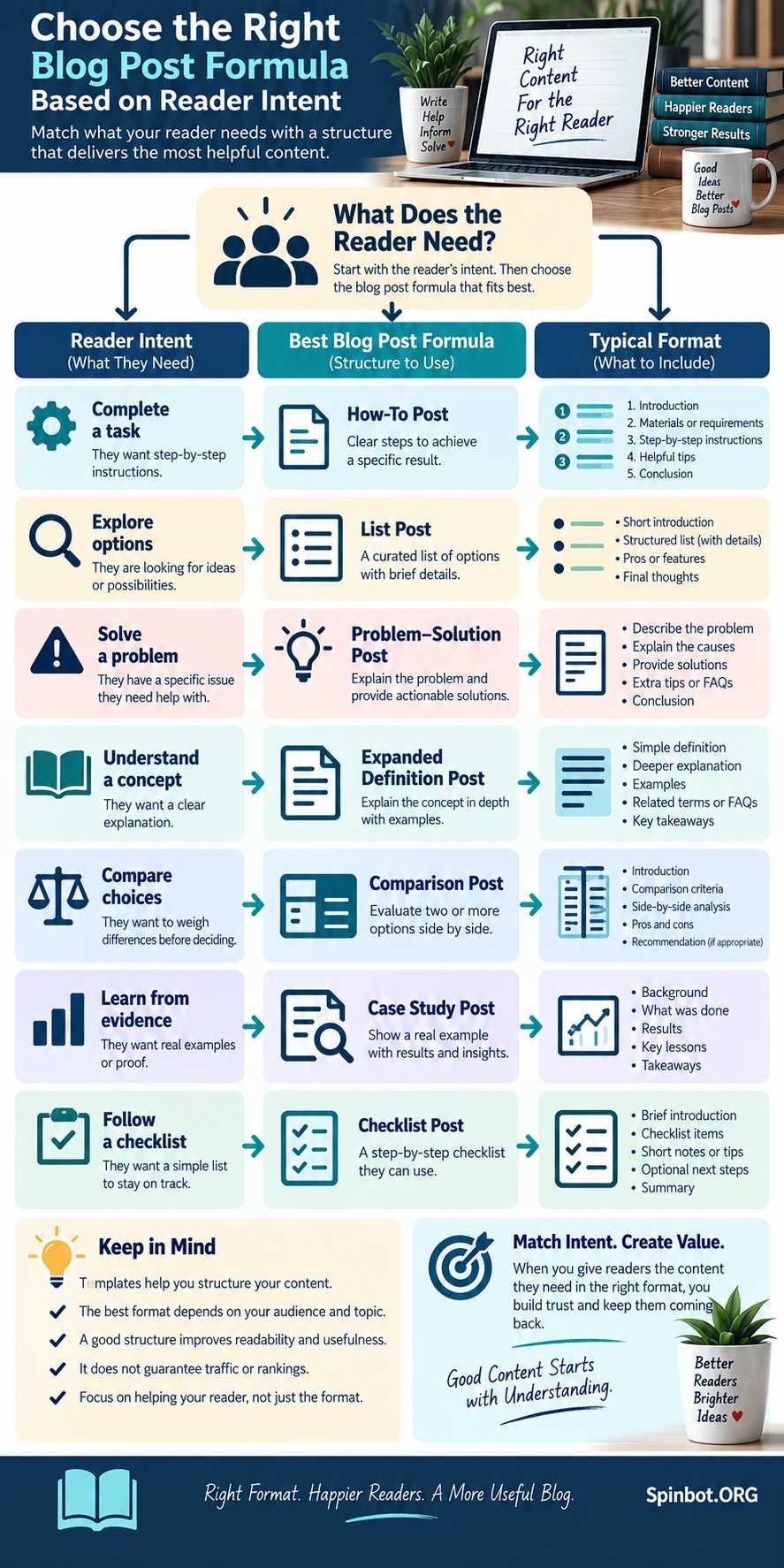
How to Choose the Right Blog Post Formula
Do not choose a formula because you like it.
Choose it because it matches what the reader is trying to do.
A simple decision process looks like this:
If the reader wants to complete a task: use a how-to post.
If the reader wants several ideas or options: use a list post.
If the reader has a problem: use problem-solution.
If the reader is new to a subject: use a beginner’s guide.
If the reader is deciding between options: use a comparison.
If you have real evidence from a project: use a case study.
If the reader wants to understand a term: use an expanded definition.
If the reader wants to verify completion: use a checklist.
If common errors are blocking progress: use mistakes-and-fixes.
You can also combine compatible formulas.
A beginner’s guide may contain a checklist. A how-to post may contain a mistakes section. A comparison may finish with recommendations for different types of readers.
The formula gives you structure. It should not trap you inside it.
How Do I Write Effective Blog Posts?
An effective blog post does more than follow a template.
Start with the reader.
Before writing, you should be able to complete this sentence:
After reading this post, the reader should be able to ________.
That one line keeps your article focused.
Next, give the post a logical outline. HubSpot’s updated outlining guidance recommends validating the topic and intent, studying competing coverage, finding a useful angle, and then organizing H2 and H3 sections before drafting.
From there, focus on a few basics.
Answer the main question early
Do not make readers pass through six paragraphs of background before reaching the answer.
Make headings useful
A heading should tell the reader what the next section covers.
“Things to Consider” says very little.
“How to Choose the Right Formula for Your Topic” says exactly what the reader will get.
Use examples where ideas become abstract
A formula is much easier to understand when readers can see it applied to a real topic.
Remove anything that does not serve the reader
Your first draft may contain repeated explanations, long introductions, weak transitions, and side topics.
Editing is where a good structure becomes a good article.
What Is the 80/20 Rule for Blogging?
The 80/20 rule is a popular way of describing the Pareto principle: a relatively small share of inputs can sometimes account for a large share of outputs.
For bloggers, the useful lesson is not that exactly 20% of your posts will always generate exactly 80% of your results.
That is not a fixed law.
The useful lesson is prioritization.
Look for the pages, topics, channels, and activities producing disproportionate value.
For example, you may discover that a small group of posts produces much of your search traffic, email signups, affiliate sales, or leads.
Instead of treating every article equally, you could spend more time:
- Refreshing strong posts
- Expanding successful topic clusters
- Improving internal links to important pages
- Updating posts that already show potential
- Repurposing your strongest ideas
- Cutting activities that consume time but produce little value
The practical question is not “Is my ratio exactly 80/20?”
Ask:
Which small group of activities is producing most of the useful result?
Then protect and improve those activities.
Can a Blog Post Formula Get You 1,000 Views Per Day?
No.
A writing formula can help you structure better posts, but it cannot guarantee 1,000 daily views.
Traffic depends on much more than article structure.
You need topics people actually care about. For search traffic, there also needs to be relevant search demand, a realistic opportunity to compete, content that satisfies the query, and enough authority and discovery for people to find the page.
Promotion matters too.
So do internal links, existing audience size, backlinks, distribution channels, content freshness, and how long the site has had to build visibility.
A more useful goal is to build a repeatable traffic system:
- Find topics your audience wants.
- Identify what they are trying to accomplish.
- Choose the right article format.
- Create something genuinely useful.
- Publish consistently enough to build a useful library.
- Connect related posts through internal links.
- Promote important content.
- Track which pages gain traction.
- Improve promising posts.
- Repeat what evidence shows is working.
One article might eventually bring hundreds or thousands of visits. Another might bring very little.
That is normal.
Judge your blogging strategy across a body of work, not by expecting every post to hit the same traffic target.
Build Your Own Reusable Blog Formula
Once you understand the structures above, you can create your own.
Here is a simple framework that works as a starting point for many informational posts:
Intent → Promise → Direct answer → Main sections → Evidence → Examples → Action
Intent
What does the reader actually want?
Promise
What will the post help them understand or accomplish?
Direct answer
What information should they receive immediately?
Main sections
What does the reader need to know next, and in what order?
Evidence
Which claims need sources, data, documentation, or proof?
Examples
Where would a concrete example make the idea easier to understand?
Action
What should the reader be able to do after finishing?
This is also a useful editing checklist.
If a section does not help fulfill the promise, ask whether it belongs in the article at all.
Use the Formula, Then Make the Post Your Own
Blog post formulas are valuable because they remove unnecessary decisions.
You no longer have to invent the shape of every article from scratch.
A tutorial can follow a process. A comparison can follow clear criteria. A definition can answer the question first. A case study can move from problem to action to evidence. A checklist can help readers confirm they have covered the essentials.
But the formula is only the starting point.
The quality still comes from understanding the reader, researching carefully, explaining ideas clearly, adding useful examples, checking facts, and editing anything that does not earn its place.
So use templates freely.
Just remember the rule behind all the formulas: structure should follow the reader’s need.
Once you get that right, writing becomes much easier.

Raj blends SEO mastery with real-world freelance grit. Covers SEO, blogging, content strategy, copywriting, freelance writing, marketing, and business communication.