

It should not exist simply because the first chapter feels slow. If removing the prologue changes nothing important, the manuscript probably does not need it.
What Is a Prologue in a Book?
A prologue is a separate narrative section placed before the first chapter. It belongs to the story, even when it occurs in another period, follows a different character, or uses a viewpoint that does not appear elsewhere in the book.
A good prologue provides information or an experience that affects how readers understand the main narrative. It may establish the setting, reveal an earlier event, introduce a conflict, create suspense, or hint at what is coming. Reedsy describes it as a short opening section that is separate from the main narrative but still takes place within the story’s world.
A prologue usually appears after preliminary pages such as the copyright page, dedication, and epigraph but before Chapter One. There is no universal required length, although it is normally shorter than a regular chapter.
The simplest definition is this:
A prologue is a scene or narrative passage that prepares readers for the main story while remaining part of that story.
This distinction matters. A note in which the author explains why the book was written is not normally a prologue. It is more likely a preface.
What Is the Purpose of a Prologue?
The purpose of a prologue is not merely to introduce a book. It must give readers something they need, or will benefit from knowing, before the main narrative begins.
Here are the most useful reasons to include one.
Establish essential context
Some stories depend on an event that happened long before Chapter One. Rather than explaining that event through dialogue or a block of exposition, the author can let readers experience it directly.
Imagine a mystery novel in which a child witnesses a disappearance. The main story begins 20 years later when that child, now an adult, returns to the same town. Showing the disappearance as a scene may create more emotional force than having another character explain it later.
However, “context” does not mean giving readers the complete history of a fictional kingdom, organization, or family. A prologue should dramatize the part of the past that matters.
Introduce another viewpoint
A prologue can be told from the perspective of someone who will not narrate the main story. Crime and thriller writers sometimes use this approach to show a victim, criminal, witness, or investigator encountering the central danger.
This can create dramatic irony: readers know something the protagonist does not. That difference in knowledge produces tension as the main character moves closer to a threat the audience has already seen.
The viewpoint should still connect meaningfully to the main plot. Introducing an interesting stranger is not enough if that person or event never matters again.
Set the tone and genre
Chapter One may begin during a calm period in the protagonist’s life, even though the larger novel contains danger, magic, horror, or political conflict. A prologue can provide an early sample of that larger experience.
For example, a fantasy novel might begin with an ordinary character living on a farm. A short prologue showing a supernatural attack elsewhere can establish the book’s genre promise before the quieter main narrative starts.
The Novel Factory notes that a prologue can establish mood and prepare readers for a tone that may not be immediately visible in the first chapter. It also warns that the prologue cannot serve as the book’s only compelling hook. Chapter One must remain engaging in its own right.
Create a question readers want answered
A prologue can show an event without immediately explaining its full meaning. Readers might wonder who caused it, why it happened, or how it connects to the protagonist.
This works when the uncertainty feels deliberate. Mystery creates curiosity; confusion makes readers feel lost.
Give readers enough information to understand the immediate action. You can withhold identities, motives, or consequences, but readers should still know what is happening in the scene.
Foreshadow later events
Some prologues offer a glimpse of a future crisis and then return to an earlier point in Chapter One. This creates a question about how the characters will reach the situation readers have witnessed.
A future-scene prologue should not reveal so much that it weakens the later climax. Its purpose is to create anticipation, not summarize the book’s most important scene in advance.
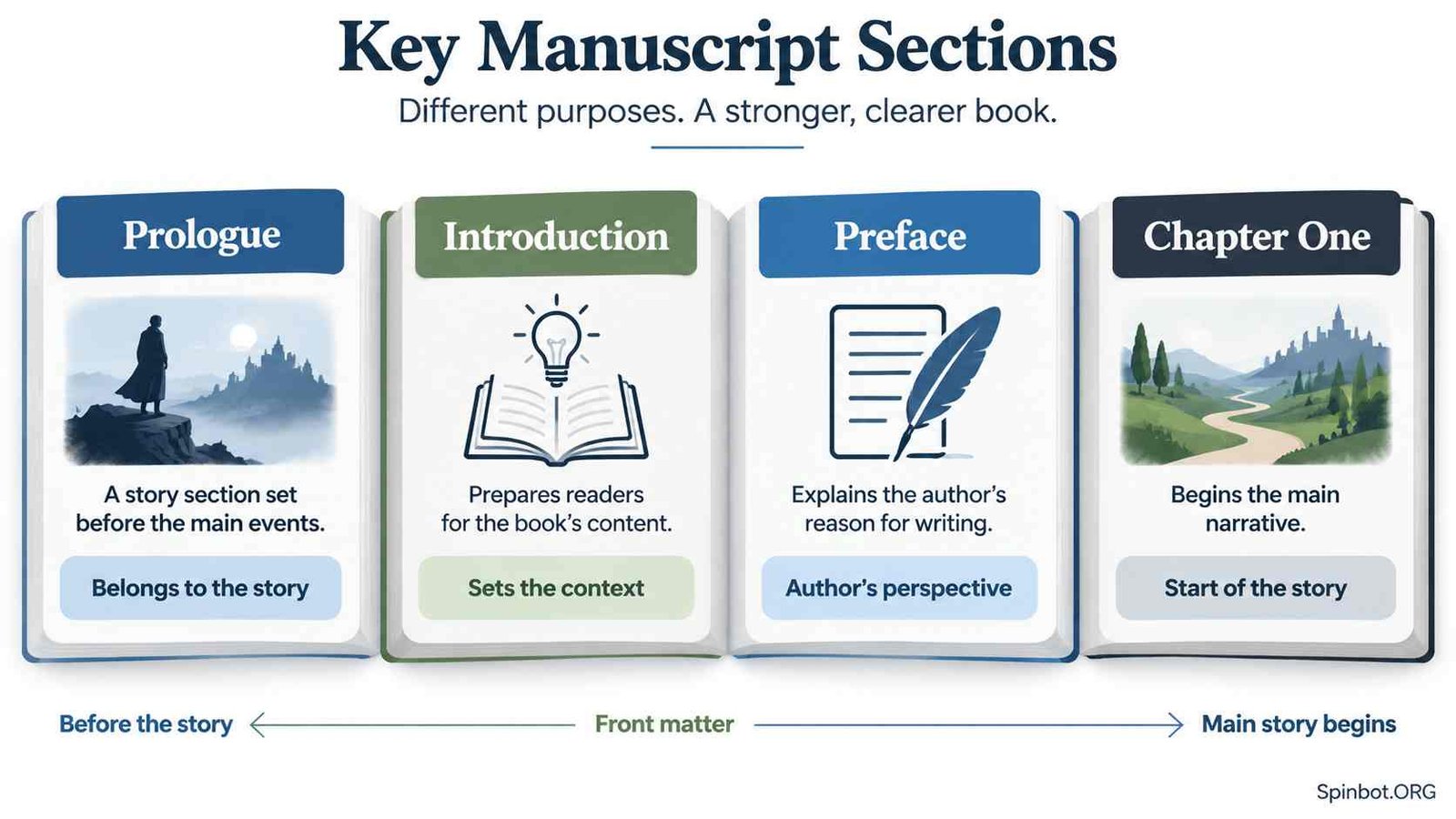
Prologue vs Introduction vs Preface
These terms all describe material placed near the beginning of a book, but they do different jobs.
| Section | Main purpose | Part of the story? | Most common use |
|---|---|---|---|
| Prologue | Presents a scene, event, or narrative context | Yes | Fiction and narrative works |
| Preface | Explains why or how the author wrote the book | No | Nonfiction and some fiction |
| Introduction | Prepares readers for the book’s subject or argument | Usually part of the main content | Nonfiction |
| Chapter One | Begins the primary narrative or teaching sequence | Yes | Fiction and nonfiction |
Prologue vs introduction
A prologue usually tells part of a story. An introduction explains the book’s content, central subject, method, or argument.
Introductions are especially common in nonfiction. An introduction might define an important term, explain the problem the book addresses, or tell readers what they will learn. It leads directly into the book’s subject.
A prologue may reveal an event without explaining its significance. Its connection to the main story can become clear several chapters later.
These labels are not governed by rigid laws, and authors occasionally use them differently. The practical distinction is more valuable than the label: a prologue is narrative, while an introduction guides readers into the content.
Prologue vs preface
A preface is usually the author speaking directly to the reader about the book. It might explain what inspired the project, how the research was completed, or what changed in a new edition.
A prologue stays inside the narrative world. Even if the prologue uses a narrator, the focus remains on the story rather than the author’s writing process.
As The Write Practice explains, a preface provides background about the creation of the book, while a prologue generally reads like a story.
Prologue vs Chapter One
This is the harder decision. Both sections are part of the narrative, and both must interest the reader.
Chapter One begins the main storytelling pattern. It normally introduces the central timeline, protagonist, setting, or conflict that the following chapters will continue.
A prologue stands apart for a clear reason. It may occur decades earlier, follow a different narrator, show an event outside the protagonist’s experience, or briefly reveal the future.
If the opening uses the same viewpoint, period, location, and narrative direction as the next chapter, calling it a prologue may be unnecessary. It may simply be Chapter One.
Does Your Book Actually Need a Prologue?
Before writing one, decide whether it adds something essential. Use this three-part test.
Keep it as a prologue when:
- It contains an event readers need to witness before the main timeline begins.
- Its time, setting, or viewpoint is clearly separate from Chapter One.
- It creates a question that receives a meaningful payoff later.
- It establishes an important genre promise or source of tension.
- Moving the information into later chapters would weaken the story.
Turn it into Chapter One when:
- It begins the protagonist’s main journey.
- The following chapter continues the same scene or timeline.
- It uses the book’s regular point of view and storytelling style.
- It contains the actual inciting action rather than preliminary context.
- Calling it a prologue adds no useful distinction.
Remove it when:
- It summarizes history that could be revealed naturally.
- It exists only to make a slow first chapter seem more exciting.
- Its characters and events never become important.
- Readers can skip it without losing anything.
- It delays the story the reader came to experience.
Career Authors offers a useful principle: a prologue should influence or propel the overall story rather than function as a decorative opening. It should also avoid becoming an information dump. If it is not integral to the narrative journey, it probably does not belong.
How to Write a Prologue Readers Will Continue
Once you know the book needs a prologue, treat it with the same care as any other important scene.
1. Give it one main job
Choose the most important result you want from the prologue. Are you revealing an earlier event, creating suspense, establishing tone, or introducing an unusual perspective?
A prologue can achieve more than one result, but it should have a clear center. Trying to introduce the world, explain the magic system, summarize a war, present six characters, and foreshadow the ending will overload the opening.
Write its purpose in one sentence:
This prologue lets readers witness the betrayal that causes the present-day conflict.
If you cannot state its purpose clearly, reconsider whether you need it.
2. Build a scene instead of delivering a lecture
Let something happen. Give a character an immediate goal, place an obstacle in the way, and create a change by the end of the scene.
Instead of explaining that two royal families have fought for generations, show the moment a peace agreement fails. Rather than listing the dangers of an abandoned research station, let a technician discover that something inside has escaped.
Readers remember experiences more easily than historical summaries.
3. Open with relevant tension
Tension does not always mean violence. A character can hide a letter, break a promise, make a discovery, or realize that a trusted person has lied.
The opening action should represent the kind of story that follows. An explosive prologue can mislead readers if the rest of the book is a quiet family drama. The tone, pacing, and genre should feel connected even when the characters or period change.
4. Create questions without hiding basic facts
Readers should understand the surface-level situation. They can know that a guard is fleeing an unseen creature even if they do not yet know what the creature is or why it has returned.
Avoid withholding ordinary information solely to manufacture mystery. Repeatedly calling someone “the man” when the viewpoint character knows his name often feels artificial.
The strongest prologues create questions through meaningful events, not missing labels.
5. Connect it to the main plot
Every major detail in the prologue creates an expectation. A symbol, character, warning, or unexplained event should affect the later story.
The connection does not need to become clear immediately. In fact, delayed recognition can be satisfying. But there must eventually be a payoff.
Reedsy’s prologue guide recommends focusing on what readers should take away and planting themes or motifs that create cohesion with the rest of the novel.
6. Keep it focused
There is no fixed prologue word count. Genre, audience, and chapter length all affect what feels appropriate. A brief thriller prologue may be only a few pages, while an epic fantasy opening may be longer.
A useful rule is that the prologue should not exceed the book’s typical chapter length. In many cases, it can be considerably shorter.
Do not cut a necessary scene merely to satisfy an arbitrary number. Remove repetition, background explanation, and details that readers can learn later.
7. Revise it after finishing the book
You may not know what the prologue truly needs until the rest of the manuscript exists.
After completing the draft, reread the prologue beside the final chapters. Check whether its questions receive answers, its tone matches the finished book, and its details remain accurate. Remove promises the story no longer fulfills.
Then read Chapter One immediately after it. The transition should create forward movement, not make readers feel as though the book has started twice.
Prologue Examples and What They Accomplish
Strong examples show that prologues can work in several different ways.
In Shakespeare’s Romeo and Juliet, the opening prologue tells the audience that the lovers will die and introduces the conflict between their families. The suspense does not come from wondering whether they survive. It comes from watching how the tragedy unfolds.
George R. R. Martin’s A Game of Thrones begins beyond the Wall with characters who are not the novel’s central protagonists. The scene introduces a supernatural danger before much of the main story recognizes that the threat exists. It establishes genre, danger, and dramatic irony.
Brandon Sanderson’s The Way of Kings uses preliminary scenes to show important events outside the main timeline. The assassination that reshapes the political world is experienced as action rather than delivered later as a history lesson. Savannah Gilbo uses this opening to illustrate how an origin-event prologue can show the spark that ignites a larger conflict.
These examples differ in form, but each changes how readers approach the story that follows.
Common Prologue Mistakes
The most common problem is an information dump. Writers sometimes treat a prologue as storage for every historical fact readers might need. Essential information should emerge through action, decisions, and consequences.
Another mistake is a false opening. A dramatic murder, battle, or chase may attract attention, but it creates the wrong promise when it has little connection to the main plot.
Too many unfamiliar names can also create trouble. Readers have no established context at the beginning, so six kingdoms, three ancient wars, and a list of magical titles can quickly become noise.
Other problems include changing to a completely unrelated writing style, making the prologue longer than necessary, and failing to provide a later payoff.
Most importantly, do not use a prologue to excuse a weak first chapter. Readers must become interested again when the main narrative begins.
A Final Prologue Editing Checklist
Before keeping the prologue, ask:
- Does it perform a necessary narrative function?
- Is it clearly different from Chapter One?
- Does something meaningful happen?
- Does the opening match the book’s genre and tone?
- Can readers understand the immediate situation?
- Does it create curiosity rather than confusion?
- Will its important details matter later?
- Have I removed unnecessary background information?
- Is the transition into Chapter One smooth?
- Would the story lose something valuable without it?
A prologue in a book succeeds when it gives readers a compelling piece of the story that belongs before the main narrative. Keep it purposeful, scene-based, and connected to what follows. If it cannot pass that test, begin with Chapter One.

Raj blends SEO mastery with real-world freelance grit. Covers SEO, blogging, content strategy, copywriting, freelance writing, marketing, and business communication.