
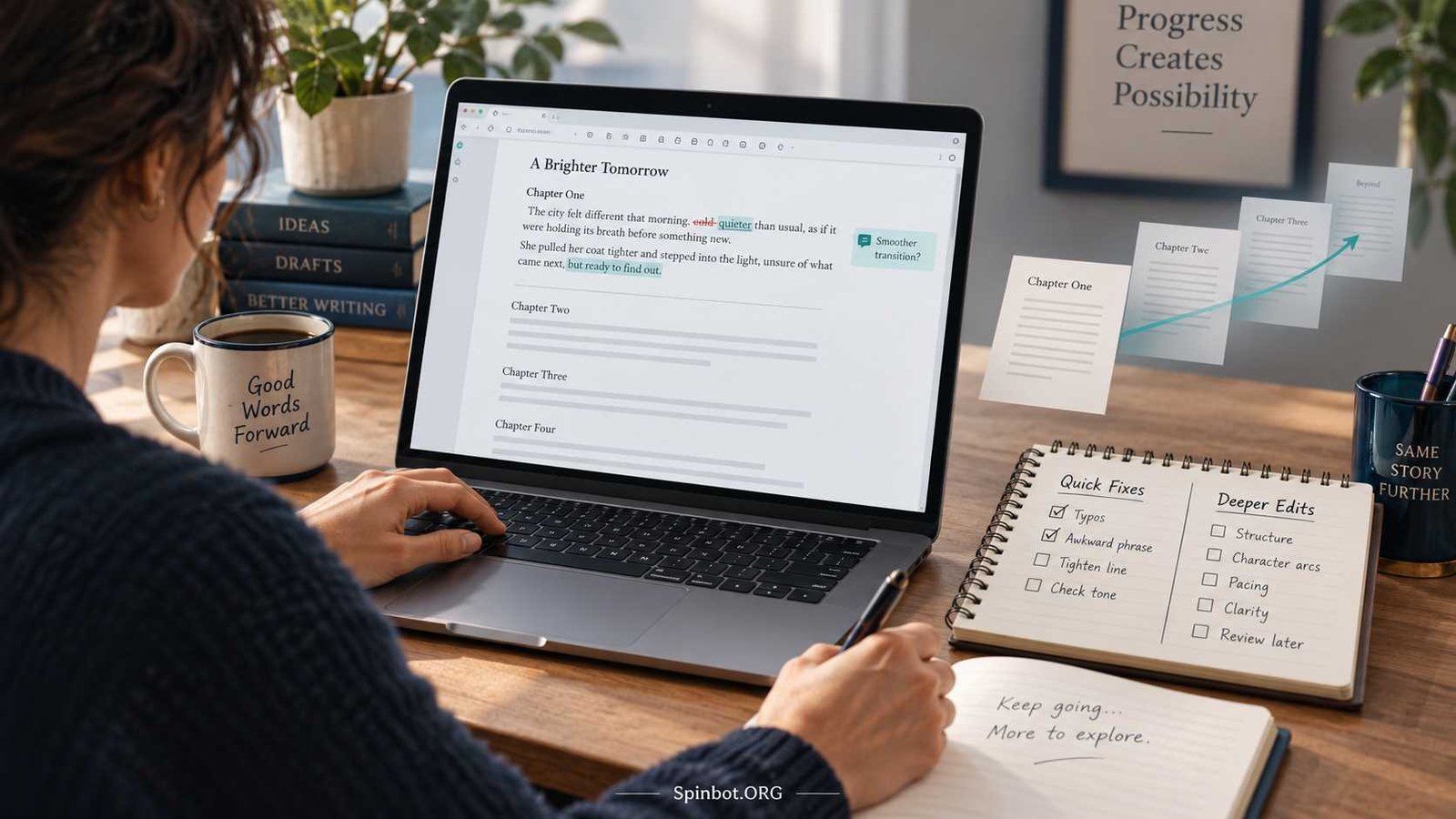
That is why editing while you write can become frustrating. You type one sentence, change it three times, replace a word, read the paragraph again, and suddenly ten minutes have passed without moving the draft forward.
But you do not have to choose between writing a completely messy first draft and editing every sentence until it feels perfect.
A better approach is controlled editing. Fix small problems when the correction is quick and obvious. Mark bigger problems for later. Then keep writing.
This lets you improve your draft without losing the momentum that helps you finish it.
Should You Edit While You Write?
Yes, you can edit while you write, but only to a point.
Traditional writing advice often separates drafting from editing because the two activities have different goals. Drafting develops ideas. Revision looks at the larger meaning and structure. Editing improves sentences and word choice. Proofreading checks final surface errors.
The University of Toronto recommends working from large issues toward smaller ones. Before spending time polishing language, writers should first make sure their ideas, reasoning, and organization work.
That does not mean you must ignore every mistake until the end.
Imagine you type:
The students was asked to complete the survey.
You immediately notice the problem. Changing was to were takes a second. There is little reason to leave the obvious error untouched.
Now imagine you reach a paragraph and realize the whole section may belong earlier in the article.
That is different. Moving the section may force you to rethink several paragraphs, change transitions, and reconsider your outline. Doing all of that during the first draft can break your writing flow.
The useful rule is simple:
Fix small problems now. Save expensive problems for later.
An expensive problem is not necessarily difficult. It is anything that pulls you away from drafting for too long.
What Editing in Writing Actually Means
Writers often use the words revision, editing, and proofreading as though they mean the same thing. They are connected, but each has a different job.
Revision deals with the big picture. You may change ideas, reorganize sections, add evidence, remove unnecessary material, or rewrite part of the argument.
Editing improves how those ideas are expressed. You work on sentence structure, clarity, word choice, tone, repetition, and flow.
Proofreading happens near the end. You look for spelling mistakes, punctuation problems, formatting errors, missing words, and similar details.
Grammarly describes the usual order as revision first, editing second, and proofreading last, while acknowledging that writers sometimes move back and forth between stages.
This distinction matters when you edit your own writing.
If you try to revise, edit, proofread, research, format, and draft at the same time, every paragraph becomes a collection of competing decisions.
Instead, give your attention a narrower job.
During drafting, ask:
Does this problem need to be fixed before I can continue clearly?
If not, mark it and move on.
What You Can Safely Edit While Writing
Some corrections are small enough that making them immediately usually does not interrupt your thought process.
Obvious typing and spelling mistakes
If you type form instead of from and notice it immediately, correct it.
You do not gain anything by deliberately keeping simple mistakes that take one second to fix.
Missing or repeated words
Perhaps you write:
This method can can help beginners write faster.
Delete the repeated word and continue.
Likewise, if you immediately notice a missing word that changes the meaning, add it.
A sentence that does not express your idea
Sometimes you know what you want to say, but the sentence comes out wrong.
For example:
Editing makes writing better because it changes writing.
You can probably improve that quickly:
Editing improves a draft by making its meaning clearer and its language more precise.
If the solution appears immediately, make the change.
If you are still rewriting the sentence five minutes later, you are no longer making a quick edit. Mark it and keep going.
Small repetition
Repeated words are especially easy to notice while drafting.
The tool gives writers useful suggestions. These useful suggestions can help writers improve useful parts of a draft.
A quick correction makes the paragraph easier to continue:
The tool gives writers useful suggestions that can help improve parts of a draft.
Again, the key is speed. You are cleaning a small obstacle, not rebuilding the paragraph.
Facts you already know are wrong
If you write the wrong date, name, or number and already know the correct information, fix it immediately.
But if correcting the fact requires opening ten browser tabs and spending twenty minutes researching, use a placeholder instead.
What Should Wait Until the Draft Is Finished
The biggest mistake in editing while writing is treating every problem as urgent.
Many problems become easier to solve after the full draft exists.
Major restructuring
Do not spend half an hour rearranging sections when you have written only 20 percent of the piece.
You may discover later that a section you carefully moved needs to be deleted anyway.
Complete enough of the draft to understand its overall shape first.
Rewriting entire sections
A weak paragraph might need work. An entire weak section usually deserves a later revision pass.
Mark it with something obvious such as:
[REWRITE THIS SECTION]
Then continue.
Research gaps
Suppose you are writing about productivity and suddenly realize that you need evidence for a claim.
Instead of stopping immediately, type:
[SOURCE NEEDED]
or
[CHECK STATISTIC]
You have preserved the question without sacrificing the current writing session.
Perfect word choice
Writers can lose surprising amounts of time searching for one perfect word.
If the current word communicates the basic meaning, keep it temporarily.
You can refine vocabulary during editing.
Formatting
Fonts, spacing, heading styles, image placement, and other layout issues rarely need attention while you are creating the draft.
Write first. Format when the content is stable.
Final proofreading
Proofreading works best near the end because there is little value in perfectly proofreading a paragraph that may later be rewritten or deleted.
Proofreading is generally treated as the final refinement stage after the larger questions of content and sentence quality have been addressed.

A Simple Edit-While-You-Write Method
You can turn these ideas into a practical workflow.
1. Write until something interrupts your understanding
Do not stop because every sentence is slightly imperfect.
Stop only when the problem prevents you from expressing the next idea clearly.
A typo rarely does that. A broken line of reasoning sometimes does.
2. Use the one-minute rule
When you notice a problem, ask yourself:
Can I fix this in about a minute without losing my train of thought?
If yes, fix it.
If no, mark it for later.
The exact time is not important. The purpose of the rule is to stop a small editing decision from turning into an unexpected revision session.
3. Leave visible placeholders
Placeholders are one of the simplest ways to maintain momentum.
You might use:
- [CHECK FACT]
- [ADD EXAMPLE]
- [SOURCE]
- [BETTER WORD]
- [REWRITE]
- [MOVE THIS?]
- [NEED TRANSITION]
Choose markers that are easy to search for later.
Instead of trying to solve every problem while drafting, you create a clear editing list inside the document.
4. Finish the paragraph before looking backward
If possible, complete your current idea before rereading the previous sentences.
This helps prevent a common loop:
write → reread → edit → reread → edit → lose the next idea.
Finishing the paragraph gives your thought somewhere to land before you evaluate it.
5. Edit at natural stopping points
Not every edit needs to wait until the whole document is finished.
You can do a short cleanup after completing a section, chapter, email, or major argument.
For example, after writing 500 words, spend five minutes checking whether anything is obviously confusing. Then continue drafting.
This creates a useful rhythm:
draft → quick cleanup → draft → quick cleanup → full revision later
The writing keeps moving, but the document does not become unnecessarily messy.
How to Edit Your Own Writing After the Draft
Once the draft is complete, change your approach.
Now you can stop protecting drafting momentum and start judging the piece as a reader would.
Start with the big problems
Do not begin by hunting for commas.
Ask:
- Does the writing achieve its purpose?
- Is anything important missing?
- Does each section belong?
- Are the ideas in the right order?
- Does the reader receive enough explanation?
- Is anything repeated?
The University of Toronto describes this approach as starting large and ending small. Structural and reasoning problems should be addressed before detailed language polishing.
Edit for clarity
Once the structure works, move to paragraphs and sentences.
Look for:
- vague wording
- unnecessary repetition
- overly long sentences
- weak transitions
- confusing pronouns
- inconsistent tone
- unnecessary words
Ask what each sentence is supposed to do. If it has no clear job, revise or remove it.
Read the writing aloud
Reading aloud changes how you experience your own words.
Your eyes may glide over an awkward sentence because you know what you intended to write. Your ears often notice the problem more easily.
Reading aloud can help reveal clumsy rhythm, repeated words, missing words, and sentences that are difficult to follow. It is also recommended as a useful revision technique in writing guidance from Grammarly.
Proofread last
After the content and language are stable, do one final pass for surface errors.
Check spelling, punctuation, capitalization, grammar, formatting, names, numbers, links, and other details.
Now those corrections are worth making because the text is unlikely to change significantly afterward.
How to Stop Editing the Same Sentence Repeatedly
Some writers do not struggle with editing. They struggle with stopping.
A sentence can almost always be changed.
That does not mean every change makes it better.
Consider:
Good editing helps readers understand your ideas.
You might change it to:
Effective editing allows readers to understand your ideas more clearly.
Then:
Careful editing makes ideas clearer and easier for readers to understand.
Then:
Editing improves clarity by helping readers understand your meaning.
All four versions are acceptable.
At some point, you are no longer correcting a problem. You are simply exchanging one reasonable sentence for another.
Set a stopping rule.
After two or three versions, ask:
Is the sentence clear, accurate, and appropriate for the reader?
If yes, continue.
Perfection is a poor finishing condition because there is always another possible edit. Clarity is much easier to judge.
Can Editing Tools Help While You Draft?
Grammar checkers, spell-checkers, and AI writing tools can help identify problems, but constant alerts can also interrupt your thinking.
You do not have to respond to every suggestion the moment it appears.
If a tool marks a typo that you can correct instantly, fine.
If it suggests rewriting an entire paragraph while you are still developing the idea, consider ignoring the suggestion until the editing stage.
Treat automated suggestions as options, not commands.
A tool may identify an awkward sentence, but you still understand the purpose, audience, context, and intended voice better than a generic suggestion does.
The same principle applies to AI-assisted editing. It can be useful for asking questions such as:
- Which sentence is hardest to understand?
- Where am I repeating the same idea?
- Can you identify sentences longer than 30 words?
- Which paragraph seems disconnected from the one before it?
- Give me three clearer versions without changing the meaning.
These prompts use AI as a second set of eyes rather than handing over the editorial decision.
Build an Editing Rhythm That Fits Your Writing
There is no rule saying you must write an entire first draft without touching a single sentence.
There is also no benefit in polishing every paragraph before you know whether it belongs in the finished piece.
The useful middle ground is controlled editing.
Correct the typo. Fix the missing word. Clarify the sentence when the solution is obvious.
But when an edit turns into research, restructuring, repeated rewriting, or a search for perfect wording, leave yourself a marker and move forward.
Then, after the draft exists, work from large problems to small ones: revise the ideas and structure, edit the language, and proofread the final version.
That is how to edit while you write without letting editing stop you from actually writing.

Academic editor turned AI copy pro, Sarah-Jane fuses research precision with smart storytelling. She covers academic writing, research, citation, plagiarism, copyright, grammar, editing, and publishing.