
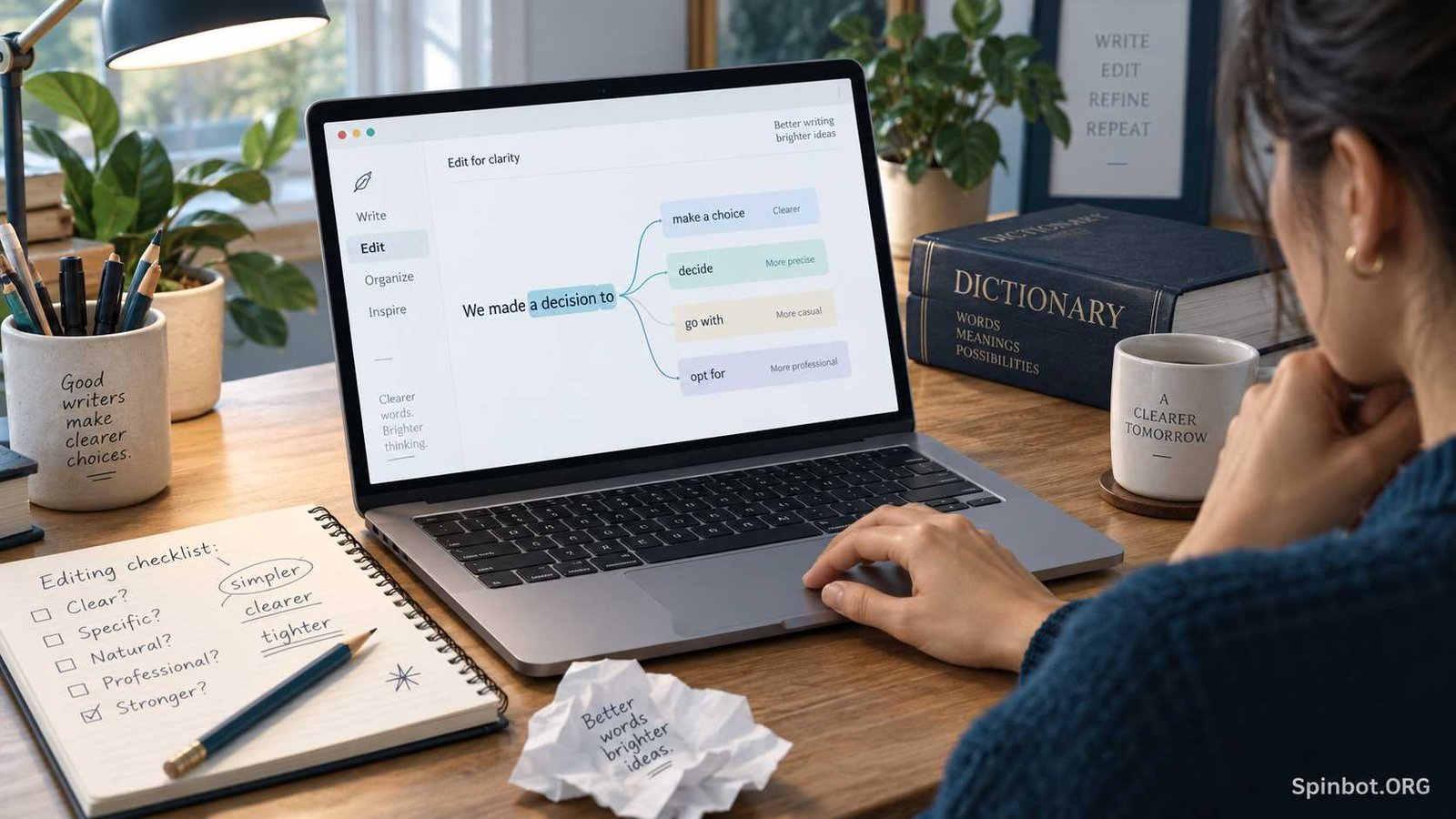
Finding a better way to say something does not mean replacing every simple word with a complicated one. It means choosing language that matches your meaning, your reader, and the tone you want.
For example:
Weak: This is a very good idea.
Better: This is a practical idea.
Stronger for business: This is a promising approach.
Stronger for praise: This is an excellent idea.
All four sentences are correct, but they do not communicate exactly the same thing.
That is why good word choice is about more than hunting for synonyms. Merriam-Webster defines synonyms as words or expressions with the same or nearly the same meaning, which means two synonyms may still differ in tone, strength, or use.
This guide gives you better words to use, alternative words and phrases for common situations, and a simple method for rephrasing complete sentences without losing their original meaning.
What Does “A Better Way to Say” Really Mean?
A better way to say something is a clearer, more accurate, or more suitable way to express the same basic idea.
The best choice depends on context.
Consider the word good.
You could replace it with:
- excellent
- useful
- effective
- enjoyable
- skilled
- reliable
- kind
- suitable
But these words are not interchangeable.
A good employee might be reliable.
A good movie might be enjoyable.
A good strategy might be effective.
A good fit might be suitable.
So when searching for another way to say a word or phrase, first ask what you actually mean. That small step prevents many awkward sentences.
Better Words to Use Instead of Common Words
Common words are not bad. In fact, simple words are often the clearest choice. The problem starts when the same vague word appears again and again or fails to express your meaning precisely.
Here are useful synonyms for common words, grouped by meaning.
| Common word | Better alternatives | Example |
|---|---|---|
| Good | excellent, effective, useful, strong | The campaign produced strong results. |
| Bad | poor, harmful, weak, disappointing | The update caused poor performance. |
| Big | large, major, significant, substantial | We saw a significant improvement. |
| Small | minor, limited, slight, compact | There was a slight difference. |
| Nice | pleasant, thoughtful, attractive, helpful | She gave a thoughtful reply. |
| Important | essential, significant, critical, valuable | Clear instructions are essential. |
| Interesting | engaging, unusual, compelling, fascinating | The report offers compelling evidence. |
| Happy | pleased, delighted, satisfied, cheerful | The client was pleased with the result. |
| Sad | upset, disappointed, unhappy, discouraged | He was disappointed by the decision. |
| Angry | annoyed, frustrated, irritated, furious | She felt frustrated by the delay. |
| Smart | clever, thoughtful, skilled, knowledgeable | It was a thoughtful decision. |
| Hard | difficult, demanding, challenging, complex | The assignment was challenging. |
| Easy | simple, straightforward, manageable, effortless | The setup process is straightforward. |
| Fast | quick, rapid, prompt, efficient | We received a prompt response. |
| Slow | gradual, delayed, steady, sluggish | Progress was gradual at first. |
| Make | create, build, produce, develop | The team developed a new plan. |
| Get | receive, obtain, gain, become | You can gain useful experience. |
| Help | assist, support, guide, improve | This checklist can guide your review. |
| Show | display, demonstrate, reveal, illustrate | The results demonstrate a clear pattern. |
| Say | state, explain, mention, suggest | The report suggests a different approach. |
| Think | believe, consider, expect, conclude | We believe the change will help. |
| Use | apply, employ, choose, adopt | You can apply this method to emails. |
| Change | revise, adjust, modify, transform | Revise the sentence for clarity. |
| Fix | correct, repair, resolve, improve | The editor corrected the error. |
| Look at | review, examine, inspect, consider | Review the paragraph before submitting it. |
These are word choice alternatives, not automatic replacements. The sentence should decide which word you choose.
Alternative Words and Phrases for Different Situations
Sometimes the problem is not one word. It is a whole phrase that sounds repetitive, vague, or unsuitable for the reader.
Here are common alternatives you can adapt.
Everyday conversation
Instead of I think, try:
- I believe
- I feel
- It seems to me
- My view is
- I would say
- From what I can see
Instead of I don’t know, try:
- I’m not sure
- I haven’t found out yet
- I don’t have enough information
- That’s something I need to check
- I couldn’t say for certain
Instead of that’s good, try:
- That sounds promising
- That works well
- That’s helpful
- That’s great news
- That makes sense
These small changes can make speech feel more natural without making it formal.
Professional emails and workplace writing
Instead of I want to tell you, try:
- I’d like to let you know
- I wanted to update you
- I’m writing to inform you
- I’d like to share
- Please note that
Instead of do this quickly, try:
- Please prioritize this
- Please complete this as soon as practical
- A prompt response would be appreciated
- Could you address this today?
- Please handle this at your earliest convenience
Instead of you are wrong, try:
- I see this differently
- There may be another interpretation
- I believe this point needs clarification
- The available information suggests otherwise
- We may need to review this again
Professional writing often improves when you become more precise, not more formal.
Essays and academic writing
Instead of this shows, you might write:
- this demonstrates
- this indicates
- this suggests
- this illustrates
- this reveals
The right choice depends on the strength of your evidence. Demonstrates can sound stronger than suggests, so do not switch between them casually.
Instead of a lot of, consider:
- many
- numerous
- several
- substantial
- a large amount of
- a significant number of
Again, grammar matters. You would normally use many with countable things, such as many students, while a large amount of fits uncountable things, such as a large amount of information.
Friendly and creative writing
Instead of very tired, try:
- exhausted
- worn out
- drained
- sleepy
- weary
Instead of very scared, try:
- frightened
- terrified
- nervous
- alarmed
- uneasy
Instead of walked, depending on the scene:
- strolled
- hurried
- marched
- wandered
- stepped
- crept
- paced
This is where precise verbs can do more work than extra adjectives.
“She walked slowly and quietly into the room” may become:
“She crept into the room.”
The second sentence is shorter, yet it creates a clearer picture.
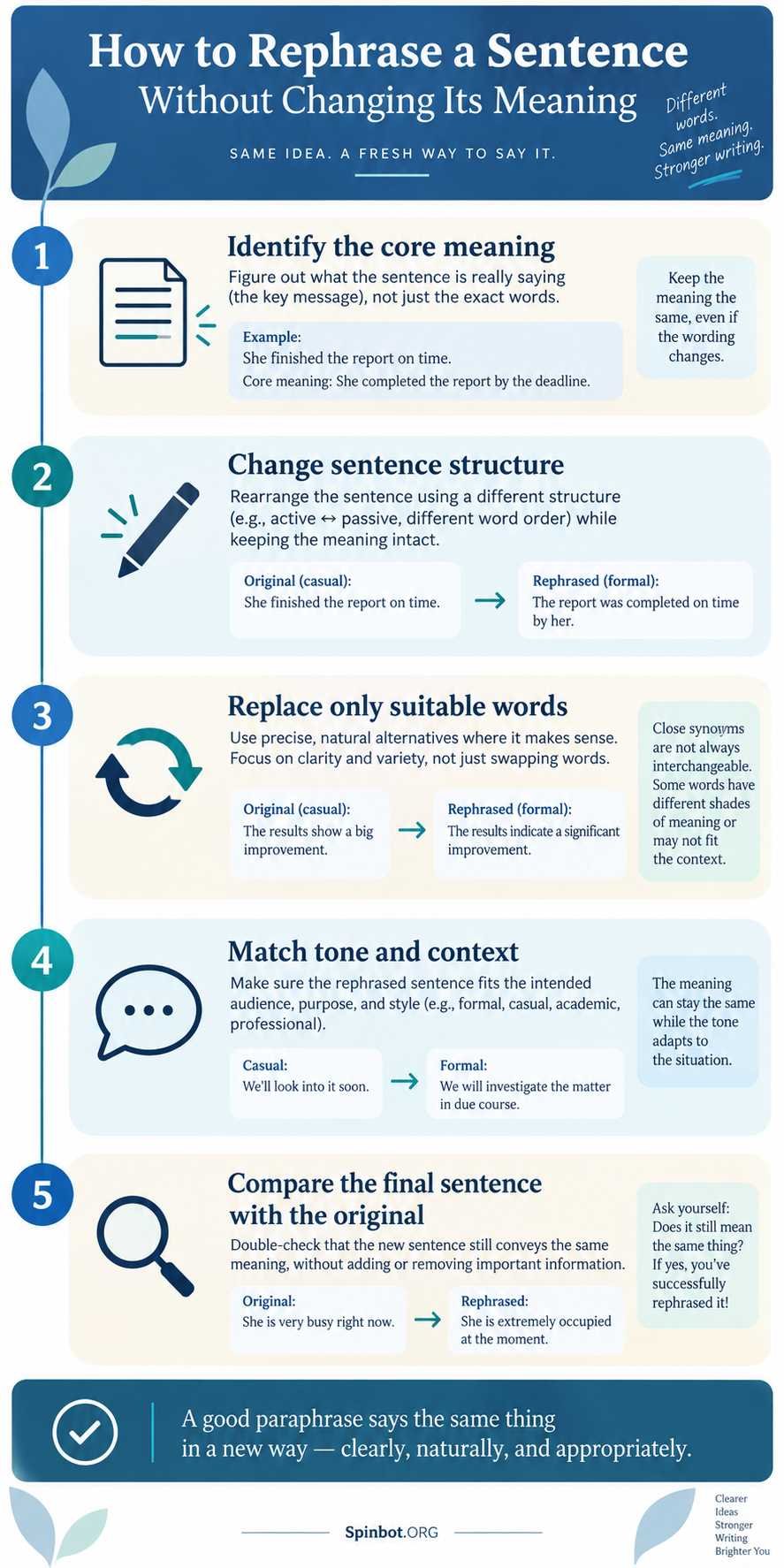
How to Rephrase a Sentence Without Changing Its Meaning
If you’re wondering how to rephrase a sentence, avoid changing words one by one. That method often creates stiff or inaccurate writing.
A better approach is to work with the whole idea.
1. Identify the core meaning
Ask yourself:
What must remain true after I rewrite this sentence?
Original:
The company changed its policy because customers complained about long delivery times.
The essential meaning is:
- the company changed a policy
- customers had complained
- the complaints concerned delivery time
- the complaints caused or influenced the change
Keep those facts intact.
2. Change the sentence structure
Instead of replacing individual words, reorganize the information.
Original:
The company changed its policy because customers complained about long delivery times.
Rephrased:
Customer complaints about slow deliveries led the company to revise its policy.
The structure is different, but the main meaning remains.
3. Replace words only where they fit
You can now make smaller changes.
Another version:
After receiving complaints about delivery delays, the company updated its policy.
Notice that the sentence was not built by searching for a synonym for every word. It was rewritten around the idea.
4. Match the tone to the reader
One message may need several versions.
Casual:
We changed the plan after customers told us deliveries were taking too long.
Professional:
The company revised its policy in response to concerns about delivery delays.
More formal:
Customer concerns regarding delivery times prompted a revision of the company’s policy.
None is automatically better. Each serves a different audience.
5. Compare the new version with the original
Read both sentences and check:
- Did the main meaning stay the same?
- Did I add a claim that was not there before?
- Did I remove an important detail?
- Is the new sentence easier to understand?
- Does it sound natural?
If the rewrite changes the facts, it is not simply a clearer version. It is a different statement.
Why the First Synonym You Find May Be Wrong
A thesaurus is useful, but it cannot make the final decision for you.
The University of Nevada, Reno Writing & Speaking Center recommends using a thesaurus together with a dictionary because similar words are not necessarily interchangeable. Their meanings and connotations can change with context.
Take bad.
A thesaurus might lead you toward words such as poor, terrible, harmful, unpleasant, or even more extreme terms.
But these sentences mean different things:
I had a bad day.
I had an unpleasant day.
I had a terrible day.
The second sounds milder and more formal. The third is much stronger.
Now consider:
That is a bad business strategy.
Depending on what you mean, better choices could include:
- ineffective
- risky
- costly
- unrealistic
- poorly planned
Each gives the reader more information than bad.
Connotation matters
A word has a dictionary meaning, but it may also carry feelings and associations.
Compare:
confident and arrogant
Both can describe someone who strongly believes in their abilities, but one is usually positive and the other negative.
Likewise:
persistent can sound admirable.
stubborn can sound critical.
Slim and skinny may describe similar physical qualities, but they often carry different tones.
Writing centers also emphasize that word choice affects tone, meaning, and the relationship between writer and audience.
How to Choose the Best Word Choice Alternative
When you have five possible replacements in front of you, use this quick test.
Check the exact meaning
Ask what you want the reader to understand.
Instead of:
The results were good.
Decide what “good” means.
Were they:
- accurate?
- profitable?
- encouraging?
- better than expected?
- useful?
- consistent?
Then write that.
The results were encouraging.
That sentence tells the reader more.
Check your audience
You might tell a friend:
Thanks for helping me out.
In a formal message, you might write:
Thank you for your assistance.
Neither is more correct. They suit different situations.
Check the strength
Some alternatives change intensity.
Consider:
annoyed → angry → furious
or:
concerned → worried → alarmed
Choose the level you actually mean.
Check whether people naturally use the words together
English words often appear in familiar combinations.
We normally say:
strong evidence
rather than:
powerful evidence
even though strong and powerful can sometimes be close in meaning.
We say:
heavy rain
rather than:
weighty rain
Natural word combinations are called collocations. Learning them helps your writing sound clearer and less forced.
Read the sentence aloud
This simple test catches more problems than many writers expect.
If a replacement sounds as though you selected it just to avoid a common word, reconsider it.
Clear writing should not draw attention to the thesaurus behind it.
Before-and-After Examples of Better Wording
The easiest way to understand better wording is to see it in context.
Before:
I am emailing you because I want to ask about the meeting.
Better:
I’m writing to ask about the meeting.
The revised version says the same thing with fewer words.
Business writing
Before:
We made a lot of changes to make customer service better.
Better:
We introduced several changes to improve customer service.
The verbs introduced and improve make the sentence more precise.
Essay
Before:
This shows that the problem was very important.
Better:
This evidence suggests that the problem was significant.
The revised sentence identifies what “this” refers to and replaces vague wording.
Blog post
Before:
There are many things you can do to make your writing good.
Better:
You can improve your writing by choosing clearer words and cutting unnecessary phrases.
The second version gives the reader useful information instead of making a broad claim.
Customer service
Before:
You didn’t send us the right information.
Better:
It looks like some of the required information is missing.
The revision is less accusatory while still explaining the problem.
Request
Before:
I need you to send this fast.
Better:
Could you send this by Friday afternoon?
Specific deadlines are often better than vague urgency.
Feedback
Before:
This paragraph is bad and hard to understand.
Better:
This paragraph would be clearer if the main point appeared earlier.
Useful feedback explains what needs to change.
Creative writing
Before:
She was very angry and walked quickly across the room.
Better:
She stormed across the room.
A precise verb can replace several weaker words.
When Simple Words Are Actually Better
Searching for alternative words and phrases can improve your writing, but replacing simple vocabulary just to sound smarter usually has the opposite effect.
Consider:
Use this tool to check your spelling.
You could replace use with utilize, but the sentence would not become clearer.
Likewise:
We need to help customers.
is often better than:
We need to facilitate assistance for customers.
Good editing removes friction between the idea and the reader.
Simple words such as use, help, ask, start, end, buy, fix, and show are perfectly good when they express the meaning clearly.
Look for another word when the original is vague, repetitive, inaccurate, too weak, too strong, or wrong for the tone. Otherwise, leave it alone.
Make Better Word Choices Without Overthinking Them
Finding a better way to say something starts with meaning, not vocabulary.
First decide what you really want to communicate. Then consider the reader and the tone. After that, explore synonyms, restructure the sentence, or choose a more precise phrase.
A thesaurus can show you possibilities. A dictionary can help you check meaning. But your sentence provides the context that determines whether a word actually belongs there.
The goal is not to make ordinary writing sound impressive.
It is to make the right idea easier to understand.
When the original wording already does that well, keep it. When it does not, choose the alternative that says exactly what you mean.

Academic editor turned AI copy pro, Sarah-Jane fuses research precision with smart storytelling. She covers academic writing, research, citation, plagiarism, copyright, grammar, editing, and publishing.