
A good spelling test for second graders should do more than check whether a child memorized a list of words the night before. It should show which spelling patterns the child understands and which ones still need practice.
The 20-word test below covers common Grade 2 skills, including long vowels, vowel teams, blends, digraphs, prefixes, suffixes, compound words, and several irregular words. These skills fit well with Grade 2 phonics and spelling expectations, which include recognizing common vowel teams, reading two-syllable words, working with prefixes and suffixes, and applying learned spelling patterns in writing. 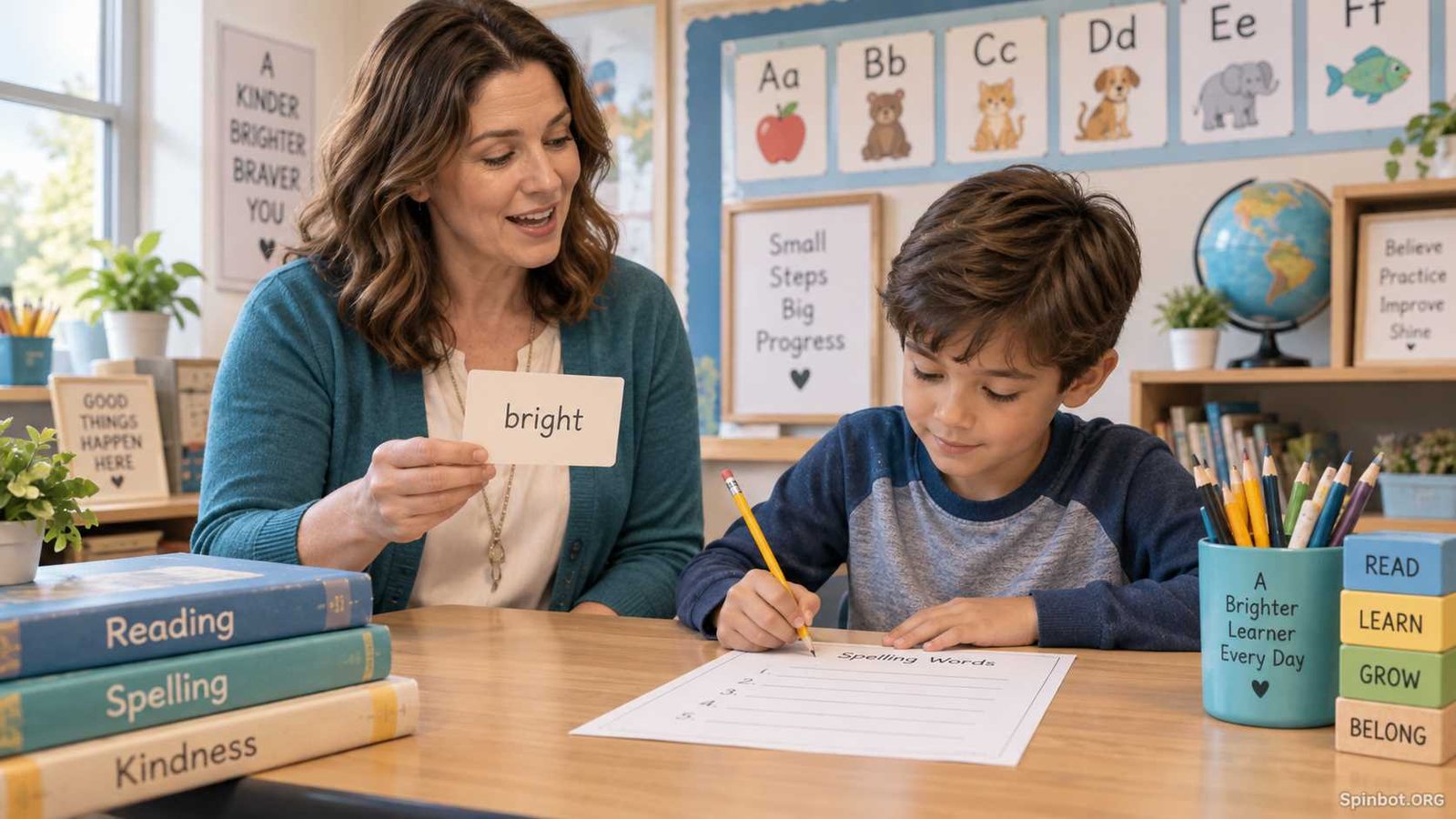
You can use this test at home, in a classroom, or during tutoring. It takes only a few minutes and includes sentences, an answer key, scoring guidance, and ideas for practicing missed words.
Ready-to-Use Spelling Test for Second Graders
Give your child or student a numbered sheet from 1 to 20.
For each item:
- Say the spelling word clearly.
- Read the example sentence.
- Say the spelling word again.
- Give the child enough time to write it.
For example:
Rain. We stayed inside because of the rain. Rain.
Using a sentence helps the child hear the word in context and understand which word you mean.
20 Second-Grade Spelling Words
| Number | Word |
|---|---|
| 1 | cake |
| 2 | rain |
| 3 | seed |
| 4 | boat |
| 5 | night |
| 6 | chair |
| 7 | brush |
| 8 | clock |
| 9 | star |
| 10 | turn |
| 11 | playground |
| 12 | sunshine |
| 13 | jumped |
| 14 | helping |
| 15 | unhappy |
| 16 | retell |
| 17 | people |
| 18 | does |
| 19 | could |
| 20 | children |
This list mixes regular spelling patterns with words that require a little more memory. That makes the test more useful than a list built around only one simple pattern.
Read-Aloud Sentences for the Test
Use these sentences while giving the spelling test.
- Cake — We ate cake after dinner.
- Rain — The rain fell all morning.
- Seed — I planted a seed in the garden.
- Boat — The small boat crossed the lake.
- Night — We could see the stars at night.
- Chair — Please sit on the chair.
- Brush — I use a brush for my hair.
- Clock — The clock is on the wall.
- Star — I saw a bright star.
- Turn — Turn the page slowly.
- Playground — We ran across the playground.
- Sunshine — The warm sunshine came through the window.
- Jumped — The frog jumped into the pond.
- Helping — Mia is helping her little brother.
- Unhappy — The boy felt unhappy when his toy broke.
- Retell — Please retell the story in your own words.
- People — Many people came to the park.
- Does — What does your sister like to read?
- Could — We could go outside after lunch.
- Children — The children played a game together.
For younger second graders, you can pause after the sentence and repeat the word once more.
Answer Key
- cake
- rain
- seed
- boat
- night
- chair
- brush
- clock
- star
- turn
- playground
- sunshine
- jumped
- helping
- unhappy
- retell
- people
- does
- could
- children
Mark one point for each correctly spelled word.
A perfect score is 20, but the number alone does not tell the whole story.
Look at which words were missed. A child who spells 15 words correctly but struggles with vowel teams may need different practice from a child who gets the vowel patterns right but misses irregular words such as people and could.
What This Second-Grade Spelling Test Checks
Second-grade spelling is not simply about memorizing longer word lists. Children begin using patterns they already know to work out unfamiliar words.
The Common Core Grade 2 standards, for example, include common vowel teams, long and short vowels, regularly spelled two-syllable words, prefixes and suffixes, irregularly spelled words, and the ability to apply learned spelling patterns when writing.
This test touches several of those areas.
Long Vowels and Vowel Teams
Words such as:
- cake
- rain
- seed
- boat
- night
help check whether the child recognizes different ways vowel sounds can be written.
Notice that the same general idea can appear in several forms. The long vowel sound in cake is not spelled the same way as the vowel sound in rain or boat.
Children need repeated exposure to these patterns so they can begin recognizing them instead of treating every new word as a separate spelling problem.
Blends, Digraphs, and R-Controlled Vowels
Words such as brush, clock, chair, star, and turn introduce other common spelling features.
A child may hear all the sounds in clock but leave out a letter in the opening blend. Another child may write a sound-based version of chair without remembering its usual spelling pattern.
These mistakes are useful clues. Instead of simply saying the word is wrong, identify the part that caused trouble.
Prefixes, Suffixes, and Word Endings
Words such as:
- jumped
- helping
- unhappy
- retell
show whether a student can recognize a familiar base word when something is added to it.
For example:
help + ing = helping
un + happy = unhappy
re + tell = retell
Grade 2 students are expected to work with common prefixes and suffixes as part of word analysis.
Teaching the parts of a word can make spelling feel much more manageable.
Compound Words
Playground and sunshine are compound words.
A child who already knows play and ground has a useful way to work out playground. The same idea applies to sun + shine.
Compound words also connect spelling with vocabulary. Grade 2 language standards include using the meanings of individual words to help predict the meaning of compound words.
Irregular Words
Words such as people, does, and could are harder to spell by sound alone.
These words often need more direct practice because a child cannot always write them correctly simply by saying each sound slowly.
That does not mean they should only be memorized as random letter strings. Let the child notice the unusual part of the word and practice that part several times.
How to Score the Spelling Test
For a simple classroom or home spelling test, give one point for every correct word.
| Correct Words | Score | Practical Interpretation |
|---|---|---|
| 18–20 | 90–100% | Strong performance on this list |
| 15–17 | 75–85% | Mostly secure, with a few areas to review |
| 11–14 | 55–70% | Several patterns need more practice |
| 0–10 | Below 50% | Consider an easier list and focused practice |
These ranges are only a practical guide for this particular test. They are not standardized grade-level scores and should not be used to diagnose a learning problem.
The better question is: What type of mistake keeps happening?
If rain, seed, and boat are all wrong, focus on vowel teams.
If jumped and helping cause trouble, review word endings.
If most regular words are correct but people, does, and could are missed, spend more time on irregular high-frequency words.
What to Do With Misspelled Words
Do not immediately give the child another list of 20 words.
Start with the mistakes.
Group Mistakes by Spelling Pattern
Suppose a child writes:
- ran instead of rain
- bot instead of boat
- sed instead of seed
These are three missed words, but they may point to one larger issue: vowel teams.
Practice several related examples:
- rain, train, mail
- boat, coat, road
- seed, need, green
This teaches a reusable pattern instead of asking the child to memorize three isolated answers.
Grade 2 writing expectations specifically include using learned spelling patterns when writing new words.
Hear It, Say It, Write It, Use It
A simple four-part routine works well for spelling practice:
- Hear the word.
- Say the word slowly.
- Write the word.
- Use the word in a sentence.
For boat, for example, the child might say the word, identify the oa pattern, write boat, and then write:
The boat is blue.
This connects spelling with real language rather than turning it into a memory contest.
Children can also use a beginning dictionary when they need to check spelling. Consulting age-appropriate reference materials is part of Grade 2 language expectations.
Make the Test Easier or Harder
Not every second grader needs the same spelling test.
A child at the beginning of Grade 2 may still need practice with simpler one-syllable words. Another child may already be ready for longer words and more challenging spelling patterns.
When First-Grade Words Are a Better Fit
If the child misses many basic words or seems frustrated, move down temporarily rather than making spelling stressful.
Spelling tests for 1st graders often focus more heavily on simple short-vowel words, basic consonant patterns, and common sight words.
You might try words such as:
cat, ship, stop, red, hand, jump, make, this, went, and from.
Once those patterns become comfortable, return to the second-grade list.
Moving to an easier list is not failure. It gives you a clearer starting point.
When to Try Third-Grade Spelling Words
If a second grader gets almost every word correct without much effort, increase the challenge.
Spelling tests for 3rd graders may include longer words, more complex vowel patterns, additional prefixes and suffixes, and words with less predictable spellings.
You can also keep the Grade 2 list but add five challenge words instead of jumping to a completely different level.
Possible challenge words include:
- beautiful
- different
- suddenly
- careful
- remember
There is little reason to bring a spelling list for 5th graders or spelling words for 4th graders into routine second-grade practice unless the child is clearly working well above grade level.
A Simple Weekly Spelling Practice Routine
Spelling practice does not need to take an hour every night.
Try this five-day routine.
Monday: Introduce 10 to 20 words. Read each word and identify its spelling pattern.
Tuesday: Sort the words into groups, such as vowel teams, endings, compound words, and irregular words.
Wednesday: Write each difficult word in a short sentence.
Thursday: Give a quick practice test. Review only the missed words afterward.
Friday: Give the final spelling test.
Keep practice short and focused. If a child already knows a word, there is little benefit in writing it ten more times. Spend more time on the words and patterns that actually cause trouble.
Help Your Second Grader Build Better Spelling Habits
A useful spelling test for second graders does not end when you count the correct answers.
Use the results to decide what to teach next.
If vowel teams are difficult, practice families of words with the same pattern. If endings cause trouble, break words into base words and suffixes. If irregular words are the problem, highlight the unusual letters and practice those words in meaningful sentences.
Over time, the goal is not simply to score 20 out of 20 on spelling tests for 2nd graders. The bigger goal is for children to notice patterns, check their own spelling, and use what they have learned when they meet a new word.
That is when a spelling test becomes more than a weekly quiz. It becomes a tool for helping a young writer grow.

Academic editor turned AI copy pro, Sarah-Jane fuses research precision with smart storytelling. She covers academic writing, research, citation, plagiarism, copyright, grammar, editing, and publishing.