
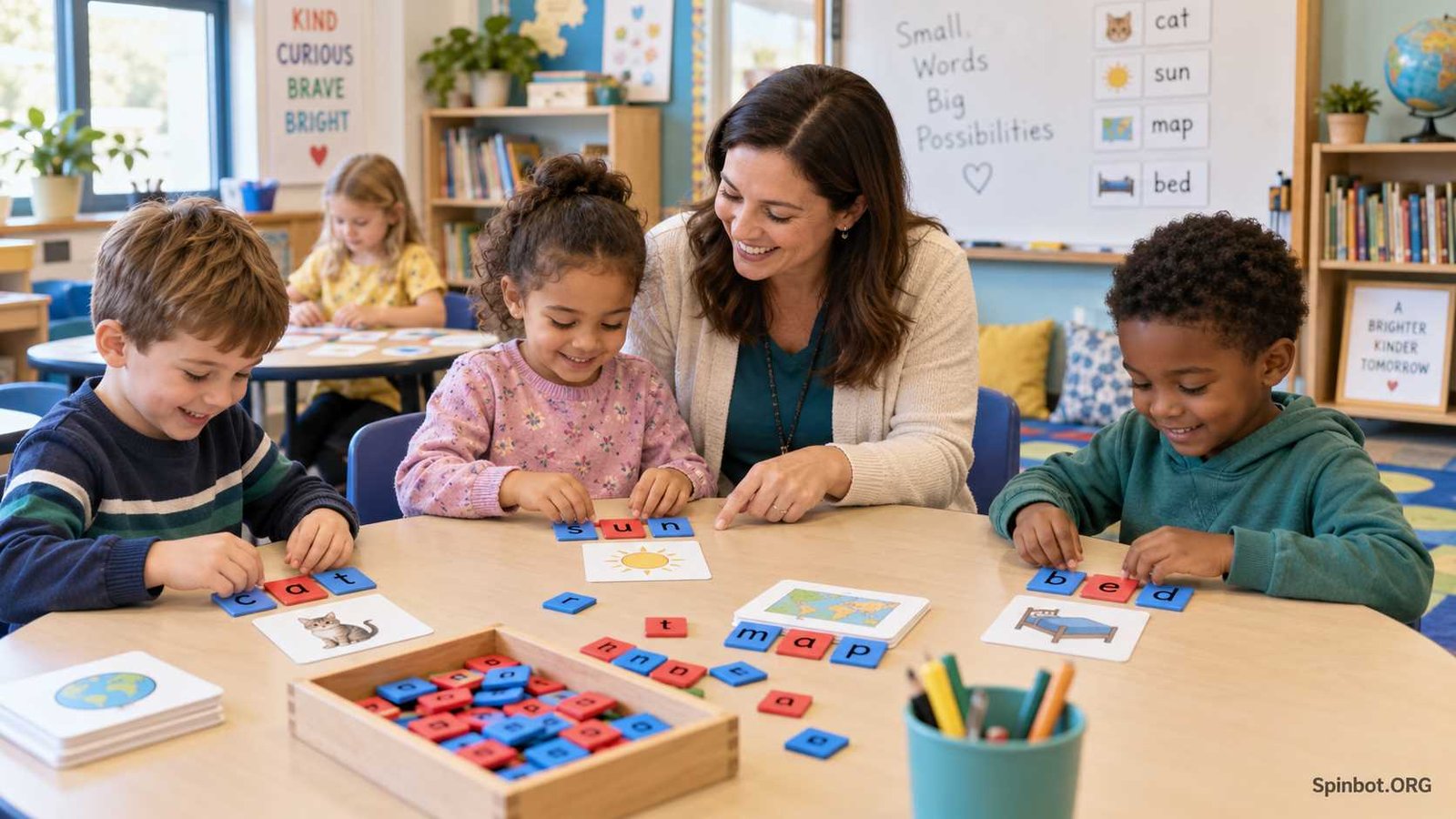
The best spelling games for 1st graders turn a short word list into something children can build, sort, hunt for, say aloud, or use in a friendly challenge. The goal is not only to memorize words for Friday. It is to help children notice how sounds and letters work together.
Grade 1 language standards expect children to use conventional spelling for words with common patterns and frequently occurring irregular words. They should also be able to make reasonable phonetic attempts at words they have not yet learned. The What Works Clearinghouse recommends activities that connect letter-sound knowledge with phonemic awareness, including word-building practice.
What Makes a Good Spelling Game for First Graders?
A useful first-grade spelling game should practice a skill the child is actually learning. It should also be simple enough to start without spending half the lesson explaining the rules.
Good games usually:
- use familiar letters and spelling patterns;
- give several chances to read, say, build, or write a word;
- focus on accuracy, not speed alone; and
- can be adjusted when a word is too easy or too hard.
First-grade phonics commonly includes short-vowel words and common digraphs such as ch, sh, th, wh, and ck. Consonant blends and other vowel patterns can be added as children become ready for them.
You do not need special software or expensive supplies. Paper, pencils, index cards, magnetic letters, letter tiles, or sticky notes are enough for most of these games.
15 Fun Spelling Games for 1st Graders
1. Letter Tile Build and Swap
Give the child letter tiles and say a simple word such as cat. Ask them to say the sounds slowly and build the word.
Then change one sound.
Can they turn cat into hat? Next, change hat into hot, then hot into hop.
This works especially well with CVC words. CVC means consonant-vowel-consonant, as in sun, map, pig, and bed.
The child can see that changing one letter changes the word.
2. Sound-Box Spelling
Draw three boxes for a three-sound word.
Say dog slowly. The child touches one box for each sound:
/d/ /o/ /g/
Next, they write the letter that represents each sound in the matching box.
For a four-sound word, simply add another box. This activity helps children connect the sounds they hear with the letters they need to write.
3. Word Family Sort
Write words from two or three word families on cards.
For example:
- cat, hat, sat, mat
- pin, win, fin, tin
- hop, top, mop, pop
Mix all the cards together and ask the child to sort them by ending.
Once the groups are complete, ask what the words in each group have in common.
This moves attention away from memorizing each word separately and toward spotting spelling patterns that can be reused.
4. Spelling Memory Match
Make two cards for each spelling word and place all the cards face down.
Players turn over two cards at a time. If the words match, the player reads and spells the word before keeping the pair.
For a slightly harder version, put the written word on one card and a simple picture on the matching card. The child identifies the picture and spells its name to keep the pair.
5. Roll and Spell
Assign a spelling activity to each number on a die:
- Say the word.
- Spell it aloud.
- Write it.
- Use it in a sentence.
- Build it with letters.
- Say each sound you hear.
The child rolls the die, chooses a spelling word, and completes the matching task.
This is especially useful when ordinary spelling practice starts to feel repetitive.
6. Missing Letter Race
Write a spelling word with one or more letters missing:
c_t
sh_p
bl_ck
Ask the child to fill in the missing letter.
Despite the name, it does not have to be a real race. For many first graders, it is better to focus on thinking carefully than answering quickly.
As the child improves, remove two letters or ask them to explain why a certain letter belongs in the gap.
7. Spelling Hopscotch
Write letters or spelling chunks on paper squares and place them safely on the floor.
Say a word. The child steps or hops to the letters in the correct order while spelling the word aloud.
For an easier version, make one floor square for each letter position. Let the child carry letter cards and place the correct letter on each square.
It adds movement while keeping attention on spelling.
8. Word Hunt
Hide spelling-word cards around the room.
Each time the child finds a card, they read the word, spell it aloud, and bring the card back.
When all the words have been found, add a second challenge. Ask the child to sort them into groups such as:
- short-a words;
- short-i words;
- words beginning with sh; or
- words ending with the same letters.
At home, a five-minute spelling review suddenly becomes a small treasure hunt.
9. Spelling Tic-Tac-Toe
Draw a normal tic-tac-toe board.
Before a player can place an X or O, they must complete a spelling task.
You might:
- say a word for them to spell;
- show a misspelled word for them to fix; or
- ask them to build a word with letter tiles.
Keep the words at a comfortable level. A spelling game should provide useful practice, not make every mistake feel like a penalty.
10. Build a Word Staircase
Choose a spelling word and add one letter on each line.
For sun:
s
su
sun
For flag:
f
fl
fla
flag
After the child builds the staircase, cover it and ask them to spell the complete word from memory.
This simple activity gives extra attention to letter order.
11. Team Word Jumble
Write the letters of a familiar spelling word on separate cards and mix them up.
The child rearranges the letters to make the correct word. Once it is complete, they say the word and read it back.
For beginners, provide a picture clue.
For stronger spellers, give only the mixed letters.
In a classroom, two children can solve the jumble together instead of racing against each other.
12. Spelling Relay
Place a spelling list at one end of the room and paper at the other.
The child looks at one word, walks back to the paper, and writes it from memory.
If they forget part of the word, they can go back and look again.
In a classroom, children can work in pairs. One reads while the other writes, then they switch roles.
The activity combines memory, movement, reading, and writing without requiring complicated rules.
13. Listen, Say, Build, Write
This game follows four simple steps:
- Listen to the word.
- Say the word.
- Build it with letters.
- Write it without looking.
For example, say shop. The child repeats shop, builds it with letter tiles, covers the tiles, and writes the word.
The sequence encourages children to pay attention to both sounds and letter order. It also reflects the broader teaching principle of connecting spoken sounds with letters, reading, and spelling.
14. Mystery Word Guessing Game
Choose a spelling word but do not say it.
Instead, give clues.
For fish, you might say:
“It has four letters. It begins with f. It ends with sh. It lives in water.”
Once the child guesses the mystery word, ask them to spell it.
This game adds meaning to spelling practice. The child is not only remembering the order of letters but also connecting the written word with an idea.
15. First-Grade Mini Spelling Bee
A spelling bee for 1st graders should be friendly and low-pressure.
Choose five to ten words the child has already practiced. Say each word clearly. If needed, use it in a short sentence and repeat the word.
Give the child time to think before spelling.
Instead of making elimination the main event, you can award points for:
- correct spelling;
- noticing individual sounds;
- fixing a mistake independently; or
- remembering a difficult spelling pattern.
At home, switch roles for one round and let the child quiz the adult. Making an occasional pretend mistake gives the child a chance to become the spelling teacher.
Which Words Should You Use in First-Grade Spelling Games?
The word list matters more than the game.
Start with spelling patterns the child has already been taught. First-grade spelling instruction commonly works with short vowels, consonant blends, digraphs, and then additional vowel patterns as children progress.
A practical mix might include:
Short-vowel CVC words:
cat, bed, sit, hop, sun
Word-family words:
map, cap, tap
hen, pen, ten
Digraph words:
ship, chat, thin, when
Blend words:
flag, stop, crab, swim
Frequently occurring irregular words:
Include familiar words children are expected to recognize and spell even when the spelling is less predictable.
Do not raise the difficulty simply because the game makes it possible. Match the words to what the child is currently learning.
Turn Spelling Games Into a 10-Minute Weekly Routine
You do not need a completely different activity every day.
A short routine can make spelling practice easier for teachers, parents, and children.
Day 1: Meet the words.
Read the week’s words together. Say them slowly and notice any shared sounds or patterns.
Day 2: Build the words.
Try Letter Tile Build and Swap or Sound-Box Spelling.
Day 3: Find the patterns.
Use Word Family Sort, Memory Match, or Word Hunt.
Day 4: Practice recall.
Play Roll and Spell, Listen, Say, Build, Write, or hold a mini spelling bee.
Day 5: Do a quick check.
Ask the child to spell the words independently. Spend extra time only on the words that still cause trouble.
The Institute of Education Sciences notes that younger students need explicit instruction and frequent practice as they build foundational writing skills such as spelling.
Ten focused minutes can be much easier to manage than a long practice session before test day.
Spelling Games and Spelling Tests Work Differently
Spelling games and spelling tests for 1st graders can support each other, but they have different purposes.
A game provides practice. Children can handle letters, hear sounds, notice patterns, use clues, make mistakes, and correct those mistakes.
A test checks what the child can spell independently at that moment.
That means practice should usually come first.
When a child makes a mistake during a game, avoid immediately supplying the correct answer.
Say the word slowly. Ask what sound they hear. Compare the word with one they already know.
For example, if a child can spell camp but struggles with lamp, drawing attention to the shared -amp pattern can help them use existing knowledge to approach the new word. The Institute of Education Sciences describes this kind of spelling by analogy as one useful way children can apply known spelling patterns to unfamiliar words.
Make the Games Easier or Harder
Children in the same first-grade class can have very different spelling skills.
You do not necessarily need a new game. Change the amount of support instead.
To make a game easier:
- use fewer words;
- choose shorter words;
- provide picture clues;
- show the first letter;
- let the child build the word before writing it; and
- practice one spelling pattern at a time.
To make it harder:
- remove picture clues;
- mix two familiar spelling patterns;
- ask the child to use the word in a sentence;
- add a new word that follows the same pattern; or
- ask the child to explain what changed between two words.
For example, a beginner might build cat from three tiles.
A stronger learner might change cat to chat and explain what happens when h is added after c.
The game stays familiar, but the thinking becomes more challenging.
Keep First-Grade Spelling Practice Playful
You do not need all 15 games in one week.
Pick two or three that suit the child and rotate them when interest starts to drop.
For a learner who likes to move, try Spelling Hopscotch or a Word Hunt. For a child who enjoys puzzles, use Word Jumble or Memory Match. For focused spelling-pattern practice, Letter Tile Build and Swap and Word Family Sort are useful choices.
Most of all, keep the words connected to what the child is learning.
Good spelling games for 1st graders are not simply entertainment added to a spelling lesson. They give children another chance to hear a word, see its pattern, build it, write it, and remember it.
That is the bigger goal: not just getting this week’s spelling list right, but gradually understanding how sounds and letters work together in written English.

Academic editor turned AI copy pro, Sarah-Jane fuses research precision with smart storytelling. She covers academic writing, research, citation, plagiarism, copyright, grammar, editing, and publishing.