

Paying for help is not automatically the problem. What the person does for you matters. Tutoring, proofreading, research coaching, and some forms of feedback may be allowed. Paying another person to complete an assessed paper that you then submit as your own is very different. Universities commonly describe that as contract cheating.
The safest approach is simple: get help that improves your skills without replacing your authorship.
Can You Pay Someone to Help With a Research Paper?
Yes, you can often pay for legitimate academic support. But you need to know where the line is.
A tutor might help you understand a difficult concept. An editor might point out grammar problems. A librarian might teach you how to search a research database. A writing coach might show you why your outline is confusing.
Those forms of assistance can support your learning while leaving the actual academic work in your hands.
The problem begins when another person effectively becomes the author.
The Quality Assurance Agency for Higher Education defines contract cheating around situations where a third party completes work that a student submits as their own when that outside input is not permitted. It can involve commercial essay services, but money does not have to change hands for academic misconduct to occur.
University rules can differ, so never assume that a type of assistance is acceptable simply because a website sells it.
When Paid Research Help Becomes Contract Cheating
A useful test is to ask:
Who is doing the intellectual work?
If you choose the research question, read the evidence, develop the argument, write the paper, and make the final decisions, you are still the author.
If another person does those things and gives you a finished paper to submit, you are no longer simply receiving support.
The University of Bristol describes contract cheating as having someone else complete an assessment for you. Its examples include paying an essay company, asking a private tutor to write an assessment, or accepting extensive outside input that goes beyond what the assessment permits.
That distinction also matters when using AI. An AI tool may be allowed for brainstorming, spelling checks, or another defined purpose in one course and prohibited in another. The assessment instructions and your institution’s policy should decide what you can use.
Is paying for a research paper illegal?
There is no single worldwide answer.
Laws vary by country and jurisdiction, and academic misconduct rules are separate from criminal law.
England provides one clear example. The Skills and Post-16 Education Act 2022 created offences covering the commercial provision, arrangement, and advertising of certain cheating services for students at English post-16 institutions. The law focuses on services relating to assignments students are required to complete personally. Its explanatory notes also recognize that normally permitted assistance can include tutoring and legitimate proofreading or copy-editing.
That does not mean the same law applies everywhere. Nor does it mean that conduct outside the scope of criminal law is acceptable under university rules.
If you are unsure, check your institution’s academic-integrity policy or ask your instructor before paying for assistance.
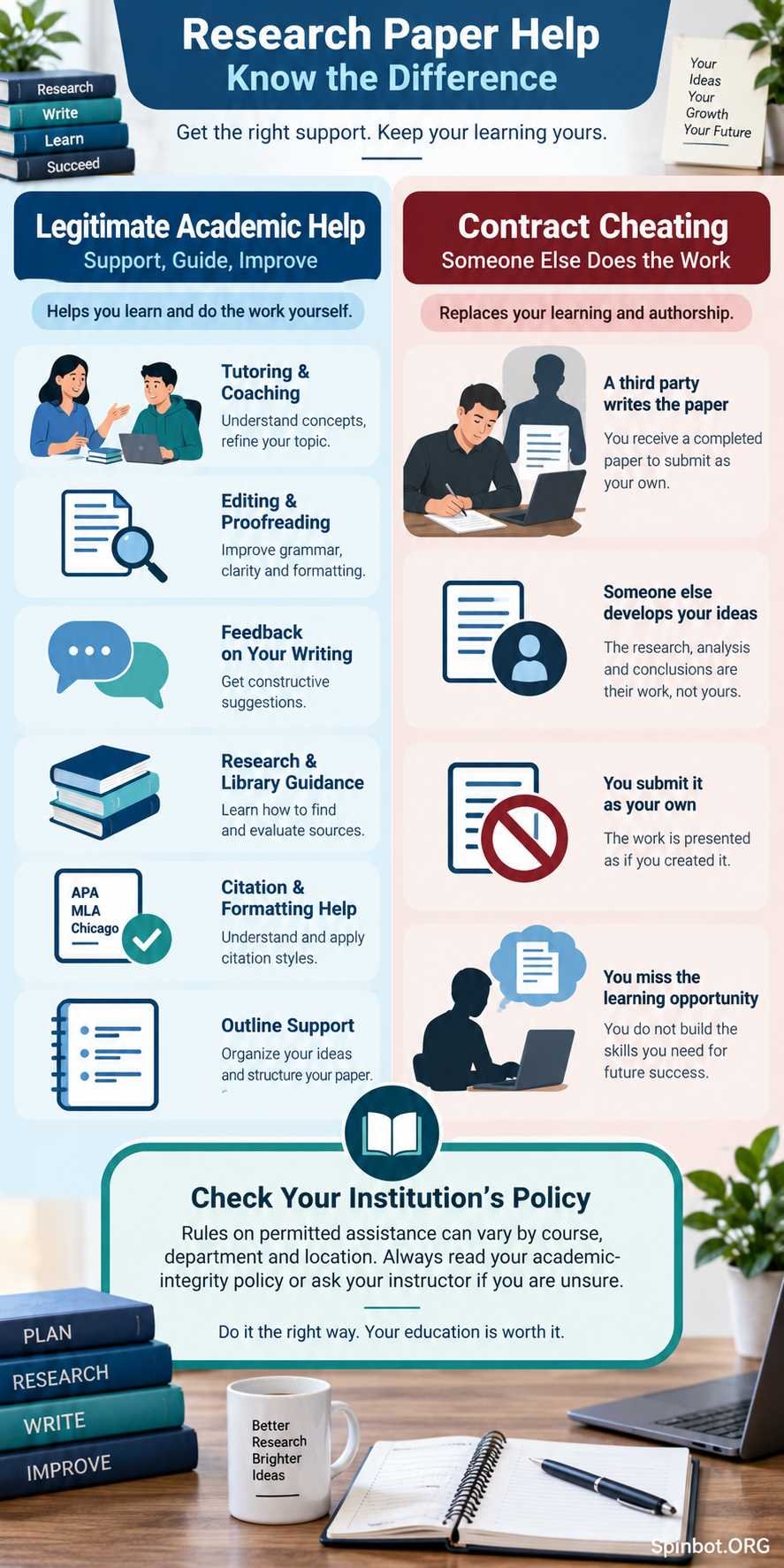
Paid Research Help That May Be Legitimate
The most useful paid support usually teaches, reviews, or guides instead of producing assessed work for you.
Here are some common examples.
Tutoring and research coaching
A tutor can help you understand the assignment, narrow your topic, develop a research question, or learn how to evaluate evidence.
Good tutoring should leave you more capable of doing the work yourself.
For example, imagine you are writing about the effects of remote work on employee productivity. A tutor could help you turn that broad topic into a researchable question:
How has hybrid working affected reported productivity among software employees since 2020?
You would still search for studies, evaluate them, form your argument, and write the paper.
Proofreading
Proofreading generally focuses on surface-level issues such as spelling, punctuation, grammar, formatting, and presentation.
The exact boundary depends on institutional rules. Bristol’s current research-degree guidance, for example, permits certain third-party proofreading but states that a proofreader should not add ideas, produce text, change arguments, or alter the intellectual substance of the dissertation.
That is a useful principle even if you study elsewhere: proofreading should improve how your work is presented, not secretly change who created it.
Feedback on your writing
Feedback can be valuable when it explains problems rather than rewriting the paper for you.
A reviewer might say:
“Your second section does not clearly connect the evidence to your thesis.”
That tells you what needs attention.
It is much more problematic if the reviewer simply replaces several paragraphs with new arguments and polished prose that you submit unchanged.
Research and library guidance
You can also receive help learning how to find information.
University librarians regularly teach students how to use databases, develop search terms, evaluate sources, and manage references. This is not outsourcing your research. It is learning how to research more effectively.
Citation and formatting help
Citation styles can be confusing. APA, MLA, Chicago, Harvard, IEEE, Vancouver, OSCOLA, and other systems have different rules.
Getting help understanding those rules is different from inventing sources or asking someone to build an argument for you.
The University of Bristol’s referencing guidance advises students to cite information and ideas taken from other sources and to use the referencing style required by their course or school.
What Are the Main Parts of a Research Paper?
There is no single structure that fits every research paper.
A history paper may look very different from a psychology experiment. A literature review does not need the same sections as a laboratory report.
Still, many academic papers contain some combination of the following parts.
Introduction
The introduction tells the reader what you are investigating and why the issue matters.
It often includes:
- background or context
- the research problem
- your research question
- your thesis or central claim
- a brief indication of the paper’s direction
A strong introduction creates a clear purpose. It does not need to explain everything you discovered.
Literature review
A literature review examines what other researchers have already said about your topic.
Its job is not simply to summarize Source A, then Source B, then Source C.
A good literature review connects sources. It identifies agreements, disagreements, patterns, limitations, and gaps in existing knowledge. George Mason University’s Writing Center describes literature reviews as a synthesis of scholarship rather than a sequence of separate summaries.
Some research papers include a separate literature-review section. Others integrate existing research throughout the paper.
Methods
If you conducted original research, you may need a methods section explaining how the research was carried out.
This could cover:
- participants
- materials
- data
- procedures
- measurements
- interviews
- surveys
- experiments
- analysis methods
The exact content depends on the field.
Results
A results section reports what the study found.
It generally focuses on findings rather than lengthy interpretation.
Tables, figures, statistics, themes, or observations may appear here depending on the research method.
Discussion
The discussion explains what the findings mean.
You might connect your results to previous research, explain unexpected findings, discuss limitations, or show how the results answer your research question.
A common structure in empirical research is IMRaD: Introduction, Methods, Results, and Discussion. George Mason University’s Writing Center notes that this structure is often used for systematic research in natural sciences, social sciences, engineering, and related fields.
Conclusion
The conclusion brings the paper’s main reasoning together.
Depending on the assignment, it may:
- return to the research question
- explain the significance of the findings
- identify limitations
- suggest areas for future research
- reinforce the main argument
Some disciplines combine conclusion material with the discussion rather than creating a separate section.
References
Your reference list or bibliography records the sources you used.
Do not treat this as an administrative task to finish at the last minute. Keeping accurate source information while you research makes citation much easier later.
Common Kinds of Research Papers
The phrase kinds of research paper can mean several things because papers may be classified according to their purpose, method, or discipline.
For a typical student assignment, two useful categories are analytical and argumentative papers.
Analytical research paper
An analytical paper examines information and develops an interpretation from the evidence.
You may compare explanations, identify patterns, evaluate causes, or examine how several factors relate to one another.
Your goal is not necessarily to persuade the reader to support a position. You are trying to make sense of the evidence.
Argumentative research paper
An argumentative paper uses research to support a position or claim.
The important word here is research.
Your argument should not be based only on what you believe. You need evidence strong enough to support your reasoning, and you should engage fairly with important competing views.
Excelsior University’s Online Writing Lab describes research assignments as often following either an analytical approach that explores and evaluates or an argumentative approach that persuades.
Empirical research paper
An empirical paper reports research based on observed or collected data.
Examples include experiments, surveys, interviews, field observations, and quantitative datasets.
These papers commonly use a structure such as IMRaD.
Literature review
A literature review may be one section inside a research study or a complete assignment of its own.
Instead of collecting new experimental data, you examine existing scholarship and organize it around themes, debates, methods, trends, or gaps.
Whatever type you are assigned, read the instructions first. Your professor’s definition matters more than a generic template found online.
How to Write an Outline for a Research Paper
An outline is not busywork. It is a way to test your reasoning before you spend hours polishing paragraphs.
Here is a practical process.
1. Write your research question
Start with what the paper is trying to answer.
A weak topic might be:
“Social media.”
A more useful research question could be:
“How does nighttime social media use affect sleep quality among university students?”
The second version gives your research direction.
2. Draft a working thesis
Your thesis states the main idea or position your paper will develop.
Call it a working thesis because research may change it.
Do not force your evidence to support the first idea you had. Good research sometimes leads you somewhere unexpected.
3. List the major points you need to establish
Ask what a reader must understand before accepting your conclusion.
Suppose your thesis is about nighttime social media use and sleep. Your main sections might examine:
- patterns of nighttime phone use
- mechanisms that may affect sleep
- evidence from sleep studies
- important limitations or competing explanations
You now have the beginning of an outline.
4. Put the points in a logical order
Every section should prepare the reader for the next one.
A common mistake is to organize the paper according to the order in which sources were found.
Do not let your browser history determine your structure.
Organize around ideas, not Source 1, Source 2, Source 3.
5. Add evidence beneath each point
Under each section, note which studies, statistics, examples, or quotations may support it.
For example:
II. Nighttime device use and sleep
A. Study on screen exposure before bed
B. Research on sleep timing
C. Alternative explanation: academic workload
D. Limitations in existing studies
This immediately shows whether a section has enough evidence.
6. Revise the outline while researching
An outline should change as your understanding improves.
You may discover that two sections overlap. Another section may have almost no reliable evidence. A new theme may turn out to be much more important than expected.
That is normal.
Purdue OWL’s outlining guidance similarly presents outlines as flexible tools that can range from broad topic structures to more detailed sentence-based plans.
How to Find Sources for a Research Paper
Finding five websites that mention your topic is not the same as finding five good research sources.
A better process starts with your question.
Begin with your university library
Your library search system can help you find academic books, journal articles, reports, and databases that may not appear clearly in a normal web search.
Also check your subject guide. Different fields use different databases.
A nursing student, historian, engineer, and marketing researcher should not necessarily search in the same places.
Turn your question into search terms
Do not paste your entire research question into every database.
Break it into concepts.
For:
“How does nighttime social media use affect sleep quality among university students?”
you might begin with:
- social media
- smartphone use
- nighttime phone use
- sleep quality
- sleep duration
- college students
- university students
Then combine terms.
For example:
“social media” AND “sleep quality” AND students
If the results are too narrow, remove a term. If they are too broad, add one.
University library guidance commonly recommends using related terms, phrase searching, filters, and Boolean operators such as AND, OR, and NOT to improve database searches.
Use Google Scholar carefully
Google Scholar can help you discover scholarly material, but do not assume every result is automatically suitable for your assignment.
Check:
- who wrote it
- where it was published
- when it was published
- what evidence it uses
- whether the full paper is available
- whether it actually answers your research question
Your goal is not simply to collect citations. You need sources you understand and can evaluate.
Follow citations in both directions
Once you find one strong article, use it to find others.
Look at its reference list to discover earlier research.
Then check which newer papers have cited it.
The University of Bristol specifically recommends this approach and points to tools including Web of Science, Scopus, and Google Scholar for tracing related scholarship.
This technique can be much more productive than repeatedly starting new searches from zero.
Evaluate every important source
Before relying on a source, ask:
Who created it?
What evidence supports the claim?
Is the method clear?
How recent is the information?
Does the author have a conflict of interest?
Do other reliable sources reach similar conclusions?
Bristol’s source-evaluation guidance recommends looking at responsibility for the information, the quality of the evidence, transparency, currency, possible motivations, and what other sources say.
A source can look professional and still be weak.
Record citation details immediately
Do not tell yourself you will find the citation again later.
Save the author, title, publication, date, DOI or URL, page numbers where relevant, and any notes you need.
Reference managers such as Zotero, Mendeley, and EndNote can help organize sources and generate citations, although you should still check the output against your required style.
A Simple Test Before You Pay for Academic Help
Before paying a tutor, editor, consultant, or online service, ask five questions:
- Will this person teach me or do the work for me?
- Will the ideas, analysis, and final argument remain mine?
- Could I explain and defend every part of the submitted paper myself?
- Does my instructor or institution permit this kind of assistance?
- Do I need to disclose the assistance I received?
If the service promises to create a complete assessed paper that you can simply put your name on and submit, you have crossed from academic support into a serious academic-integrity problem.
Marketing language does not change that.
Terms such as “original,” “custom,” or “plagiarism-free” do not answer the central question: who actually did the assessed work?
Get Help Without Giving Away Your Research
When you feel stuck, paying for support can seem like the quickest route out. But the best help does not remove you from the research process. It makes that process easier to understand.
Use a tutor to clarify difficult ideas. Ask a librarian how to find sources for a research paper. Get feedback on your outline. Learn how the different parts of a research paper work together. Use legitimate proofreading when your institution permits it.
Then keep the research, reasoning, and authorship yours.
That approach may require more effort than buying a finished paper, but it gives you something much more useful than a document with your name on it: the ability to research, judge evidence, build an argument, and write the next paper with greater confidence.

Academic editor turned AI copy pro, Sarah-Jane fuses research precision with smart storytelling. She covers academic writing, research, citation, plagiarism, copyright, grammar, editing, and publishing.