
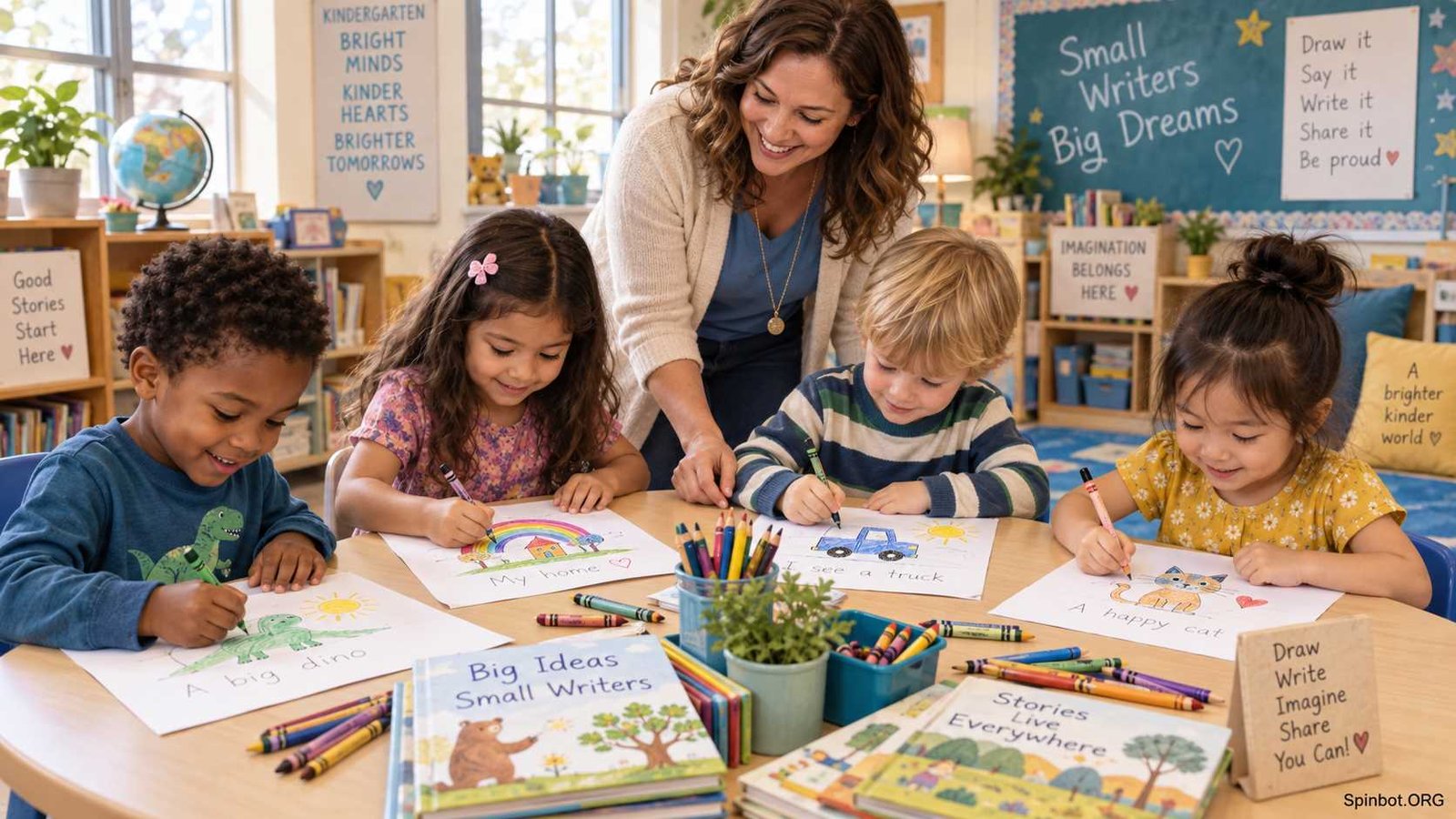
That is real writing development.
In fact, kindergarten writing standards recognize that young children can communicate ideas through a combination of drawing, dictating, and writing. The goal is to help children connect an idea in their mind with words on a page, not to make every sentence perfectly spelled or punctuated from the start.
Good creative writing for kindergarten should feel playful, manageable, and meaningful. A child might draw a purple dinosaur, tell you that it lives under a school, and then write, “My dinosaur is big.” That small piece of writing contains imagination, storytelling, vocabulary, and sentence practice all at once.
What Creative Writing Looks Like in Kindergarten
Kindergarten writing can look very different from one child to another.
One child may draw a detailed picture and dictate a complete story to an adult. Another may write labels such as “dog,” “mom,” and “park.” A more confident writer may produce one or two simple sentences.
All of these can be useful stages of development.
Reading Rockets notes that kindergarten writers commonly draw pictures that tell stories, add labels, use invented spelling, and begin writing stories with some readable parts.
So, when you see something like:
“I lik mi dg.”
the first response does not need to be a red pen.
The child may be trying to write, “I like my dog.” That attempt shows that the child understands that spoken sounds can be represented by letters.
Drawing, dictating, and writing all count
Creative writing begins before a child can spell every word independently.
A useful progression is:
Draw → Tell → Write
A child draws an event or imaginary scene. Next, the child explains what is happening. Finally, the child writes a label, phrase, or sentence about it.
If independent writing is difficult, an adult can write down the child’s spoken sentence first. The child can then copy part of it, add a word, or attempt a sentence independently.
The Common Core kindergarten standards specifically allow children to combine drawing, dictation, and writing when creating opinion, informational, and narrative pieces.
Perfect spelling is not the starting goal
Young writers often spell words according to the sounds they hear.
A child might write “frg” for “frog” or “luv” for “love.” This is often called invented spelling or phonetic spelling.
Reading Rockets describes invented spelling as normal in kindergarten because children are learning to translate spoken sounds into written letters.
That does not mean spelling instruction should disappear. Children still need systematic teaching of letter sounds, common spelling patterns, and frequently used words. The key is not letting corrections interrupt every creative thought.
How to Teach Creative Writing in Kindergarten
The easiest way to teach writing is to reduce the number of things a child must do at the same time.
A beginner may be trying to think of an idea, remember letter shapes, hear individual sounds, spell words, leave spaces, form a sentence, and hold a pencil correctly. That is a lot of work for one small writer.
Use this simple five-step process:
- Talk about the idea. Ask the child to tell you what they want to write before the pencil touches the page.
- Draw it. Let the child make a picture showing the character, place, object, or event.
- Add words. Label important parts of the picture with words the child knows or can sound out.
- Build one sentence. Turn the spoken idea into a short written sentence.
- Read it aloud. Ask the child to read the finished sentence or tell the story again.
Reading aloud matters because children begin to see writing as communication rather than simply handwriting practice. Reading Rockets encourages kindergarten children to read their own writing aloud.
Short sessions usually work better than pushing for a full page.
Five or ten focused minutes can produce more useful writing than a long session in which the child becomes tired or frustrated.
Writing a Sentence for Kindergarten
A kindergarten sentence does not have to be complicated.
Start with sentences built around familiar people, objects, actions, and experiences:
“My cat runs.”
“I see a frog.”
“We went to the park.”
“The monster is green.”
“I like pancakes.”
A simple sentence frame can also remove the pressure of deciding how to begin. Try frames such as “I see ___,” “I like ___ because ___,” “My favorite ___ is ___,” or “One day, I saw ___.”
Once the child understands the pattern, change it.
Instead of repeatedly completing “I like ___,” encourage sentences about actions, places, feelings, problems, and imaginary events.
What should you correct?
For beginning writers, focus on one or two skills at a time.
You might remind a child that a sentence starts with a capital letter and ends with a period, while allowing an unfamiliar word to remain phonetically spelled.
On another day, the focus might be spaces between words.
Trying to correct handwriting, spelling, capitalization, punctuation, grammar, and story structure in one short sentence can make writing feel like a test instead of communication.
Easy Creative Writing Activities for Kindergarten
Children usually write more willingly when they have something interesting to say.
Draw and tell: Ask the child to draw anything they want. When the picture is finished, ask what is happening. Write or help the child write one sentence about it.
Finish the sentence: Begin with something open-ended such as “When I opened the box…” or “The tiny dragon wanted…” Let the child complete the idea.
My imaginary pet: The child invents an animal, names it, draws it, and writes one fact about what it eats, where it lives, or what funny thing it does.
Magic object story: Show an ordinary object such as a spoon, shoe, key, or backpack. Ask, “What if this were magic?” The answer becomes the writing idea.
What happens next?: Read part of a story or show an interesting picture. Stop and let the child imagine the next event.
Make a tiny book: Fold a few sheets of paper into a simple book. Let each page contain one picture and one sentence.
Class story: One child begins a story aloud. Other children add events. The teacher records the class story and later rereads it with everyone.
Favorite-place writing: Ask children to draw somewhere they enjoy, such as a playground, bedroom, beach, grandparent’s house, or park. Then add a sentence explaining what happens there.
Picture sequence: Give children three simple pictures showing a beginning, middle, and end. Ask them to put the pictures in order and tell or write what happened.
Story from a read-aloud: After reading a picture book, ask children to invent another adventure for the character rather than simply answering comprehension questions.
These activities give young writers a reason to communicate, which is more useful than repeatedly copying unrelated sentences.
Creative Writing Prompts Kindergarteners Can Actually Use
The best kindergarten prompts are concrete enough to understand but open enough to invite imagination.
Try questions such as:
“What would happen if your teddy bear could talk?”
“Where would you fly if you had wings?”
“What would you keep inside a magic box?”
“What is the funniest animal you can imagine?”
“What would happen if it snowed ice cream?”
“Who lives inside the tiny door in the wall?”
“What would your perfect playground have?”
“What would you do if you found a baby dinosaur?”
“What can your superhero do?”
“Where does your imaginary pet sleep?”
You can also use familiar experiences: birthdays, family meals, rainy days, playground games, pets, favorite foods, trips, holidays, or something funny that happened at school.
A prompt works when the child has an idea to express. It fails when the child spends the entire writing period trying to understand the question.
Examples of Kindergarten Writing at Different Stages
Children do not suddenly move from scribbles to perfectly written stories. Writing develops in steps, and those steps often overlap.
| Writing stage | Possible kindergarten example | What the child is practicing |
|---|---|---|
| Drawing plus dictation | Child draws a rocket and says, “I went to the moon with my dog.” | Story ideas and oral language |
| Drawing plus label | Picture of a house labeled “mom” and “cat” | Connecting words with objects |
| Phonetic spelling | “I lik mi dg” | Hearing sounds and representing them with letters |
| Simple sentence | “The frog can jump.” | Sentence structure and meaning |
| Connected sentences | “I have a red bike. I ride it fast.” | Connecting related ideas |
Real kindergarten writing can include unconventional spelling, uneven handwriting, missing punctuation, and incomplete sentences while children are still learning. Reading Rockets’ collection of kindergarten writing samples reflects a range of developing skills rather than one fixed level every child must match.
The useful question is not simply, “Is this correct?”
Ask, “What is this child learning to communicate?”
Spelling Words Without Taking Over Creative Writing
A small word bank can help children write without asking an adult how to spell every second word.
Useful words might include a child’s name, family names, classroom words, colors, common animals, favorite foods, and frequently used words such as “I,” “my,” “the,” “is,” “can,” “like,” “see,” and “we.”
Keep the bank small enough to scan quickly.
Children should also get chances to sound out unfamiliar words. By kindergarten, many children are learning to represent consonant and short-vowel sounds with letters and to spell simple words phonetically.
If a child asks, “How do you spell spaceship?” you do not always have to provide every letter immediately.
You might slowly say the word and ask, “What sound do you hear first?”
That turns the writing moment into useful spelling practice without making spelling the entire activity.
How Reading Can Support Kindergarten Writing
Reading and writing work well together because books give children characters, vocabulary, story patterns, and ideas.
After reading a picture book, ask the child to draw a favorite part and write one sentence about it. Another day, ask what could happen after the book ends.
You can also notice how authors use language.
A teacher might point to a repeated phrase, an interesting action word, or the way a character speaks. The goal is not to give a kindergarten lesson on literary analysis. It is simply to help children notice that writers make choices.
Reading Rockets also recommends giving young children experiences worth writing about and connecting reading with everyday writing opportunities.
Reading worksheets for kindergarten can have a place when they practice a specific skill, but they should not replace real books, conversation, drawing, storytelling, and meaningful writing.
When a Child Says “I Can’t Write”
Usually, “I can’t write” does not mean the child has nothing to say.
The task may simply feel too large.
Ask the child to tell you the story instead.
If the child says, “There was a shark and it ate the pirate’s hat,” you already have material to work with.
Say, “Great. Let’s draw that.”
Then ask which part should become the sentence.
You can also offer two choices instead of an unlimited prompt: “Would you rather write about a funny animal or a magic car?”
Another option is to let the child dictate while you write. NAEYC recommends inviting young children to dictate stories and letting them see adults use writing for meaningful everyday purposes.
Over time, transfer more of the work to the child.
You might write the first sentence while the child adds one word. Later, the child writes the whole sentence with help. Eventually, the child may create several connected sentences independently.
The amount of support should change as the child becomes more confident.
Keep Kindergarten Writing Creative and Manageable
Creative writing for kindergarten works best when children understand that writing is a way to share an idea, not just a way to prove that they can spell.
Give them something worth talking about. Let them draw it. Listen to the story behind the picture. Help them turn part of that story into words.
Some days, the finished product may be one sentence.
That is enough.
A child who writes “My dragon eats pizza” has practiced imagination, vocabulary, letter sounds, spelling, sentence formation, and communication in six words.
Keep building from there. With regular opportunities to draw, tell, read, and write, those six-word stories can slowly become longer ones.

Academic editor turned AI copy pro, Sarah-Jane fuses research precision with smart storytelling. She covers academic writing, research, citation, plagiarism, copyright, grammar, editing, and publishing.