
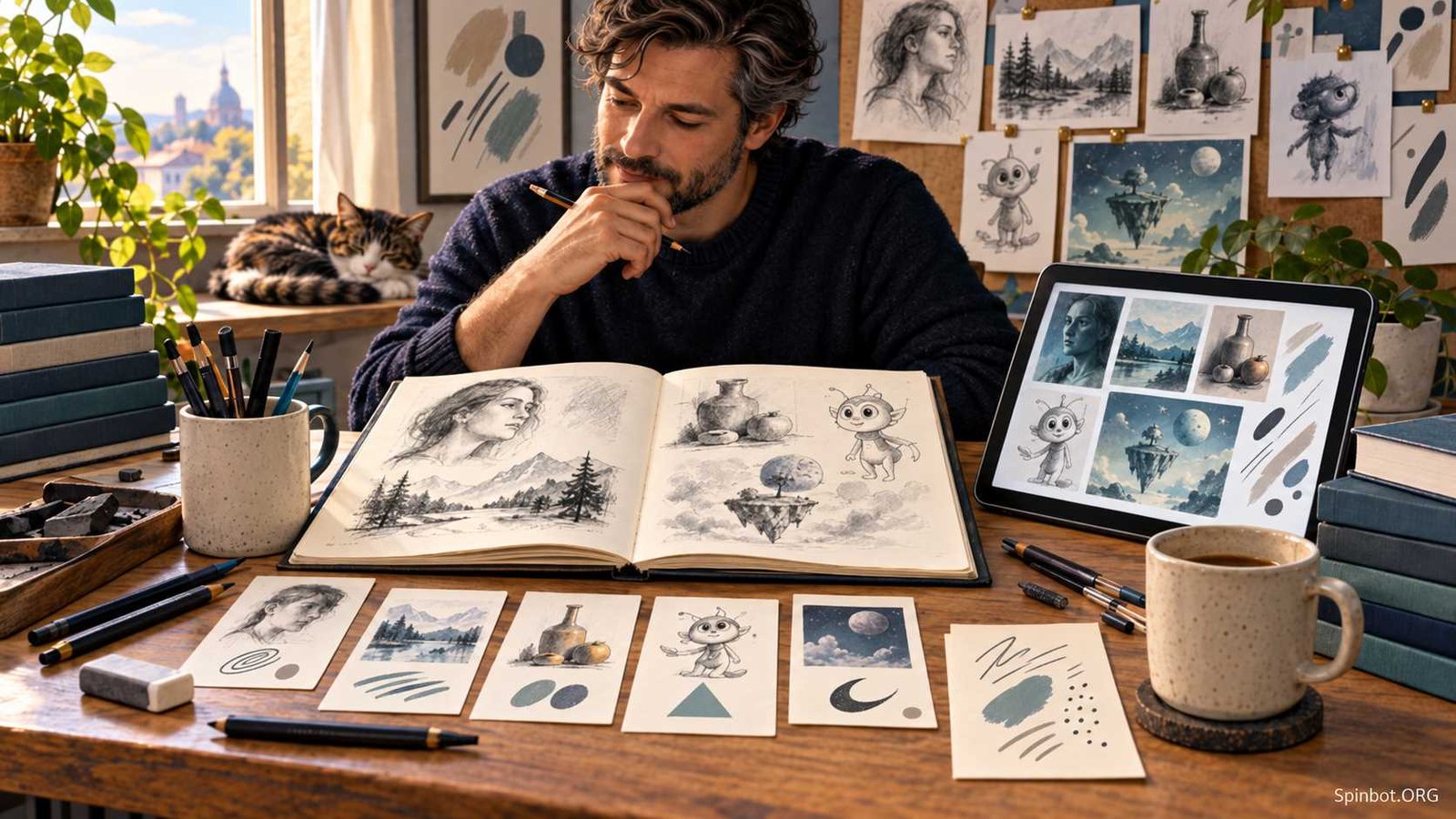
That is where drawing prompts for adults help. A good prompt gives you a starting point without deciding everything for you. You still choose the composition, mood, medium, details, and meaning.
The prompts below work for beginners, returning artists, casual doodlers, and experienced people who simply need fresh ideas. Some take five minutes. Others can become full illustrations. You can use pencil, pen, charcoal, markers, watercolor, a tablet, or whatever tool is already on your desk.
You do not need to complete all 100. Pick the one that makes you curious enough to start.
What Makes a Good Drawing Prompt for Adults?
The best drawing prompt sits between too vague and too restrictive.
“Draw something interesting” gives you almost no direction. At the other extreme, a prompt that describes every object, angle, color, expression, and background leaves little room for your own ideas.
A useful prompt usually gives you one strong starting point: a subject, situation, setting, emotion, visual limitation, or skill to practice.
You can also choose prompts based on what you need that day. If you have ten minutes, make a quick sketch. If you want to improve, choose something involving perspective or light. If you feel stuck, choose an absurd or surreal idea where realism does not matter.
Most importantly, do not treat a prompt as an instruction you must obey perfectly. Change it. Combine two ideas. Remove parts you dislike. A prompt should start creativity, not control it.
Quick Drawing Prompts for Adults
These first ideas are good when you want to draw but do not have much time. Set a timer for five to fifteen minutes and resist the urge to turn every sketch into a finished piece.
- Draw the contents of your pocket or bag. Arrange the objects as a tiny still life instead of drawing them separately.
- Sketch your coffee mug from an unusual angle. Try looking down from above or placing your eyes near table level.
- Draw your non-dominant hand. Focus on the major shapes before worrying about fingers and small details.
- Sketch the nearest pair of shoes. Pay attention to folds, worn areas, laces, and the shape of the soles.
- Draw one object using only straight lines. Curved objects become surprisingly interesting when simplified into angular shapes.
- Sketch a houseplant in five minutes. Capture its overall direction and rhythm rather than every individual leaf.
- Draw the view through a nearby window. Simplify buildings, trees, roads, or rooftops into large shapes first.
- Sketch something shiny. Try a spoon, metal bottle, kettle, or another reflective object and study where highlights appear.
- Draw your breakfast from memory. Do not check the plate or photo. Let imperfect memory shape the drawing.
- Sketch three different chairs. Give yourself only three minutes for each one and concentrate on proportion.
- Draw an object without lifting your pencil. One continuous line forces you to observe instead of constantly correcting.
- Sketch your phone charger as if it were a mechanical invention. Exaggerate connectors, bends, and cables.
- Draw the same simple object three times. Make one realistic, one simplified, and one deliberately exaggerated.
- Sketch a crumpled piece of paper. Look for large light and dark shapes rather than every tiny crease.
- Draw something on your desk using only shadow shapes. Avoid outlining the object completely.
Creative and Surreal Drawing Prompts
When creative block hits, realism can become another source of pressure. Surreal prompts remove that pressure because there is no correct version of the scene.
- Draw a city growing inside a glass bottle. Decide how roads, buildings, parks, and people fit into the limited space.
- Create a tree whose branches turn into rivers. Let boats, fish, bridges, or waterfalls appear among the leaves.
- Draw a library at the bottom of the ocean. Imagine how books, shelves, sea life, and readers would coexist.
- Design a door that opens into a completely different season. Show clues from both seasons in the same scene.
- Draw a giant sleeping animal with a village built on its back. Think about scale before adding tiny details.
- Create a staircase that seems to lead into the moon. Decide whether the scene feels peaceful, mysterious, or impossible.
- Draw an ordinary kitchen after gravity disappears. Plates, vegetables, chairs, and water can float in different directions.
- Imagine flowers growing from an old machine. Mix rough mechanical forms with soft organic shapes.
- Draw a person carrying a storm cloud instead of an umbrella. Use the weather to suggest a mood or story.
- Create an island shaped like an everyday object. A shoe, key, teapot, guitar, or book could become an entire landscape.
- Draw a train traveling through the clouds. Add stations, bridges, birds, or floating signs if the scene needs more life.
- Design a room inside a giant clock. Let gears, hands, numbers, and furniture interact with each other.
- Draw a fish swimming through a living room. Treat the air like water while keeping the furniture perfectly normal.
- Create a forest where the trees are made of household objects. Lamps, pencils, spoons, or umbrellas can become trunks and branches.
- Draw a mountain with a secret doorway halfway up. Suggest what might exist behind it without revealing everything.
- Imagine a lighthouse floating above the sea. Decide what holds it in the air and what it is guiding.
- Draw a person whose shadow has a different personality. Use pose and gesture to show the contrast.
- Create a café for mythical creatures. Invent customers, furniture, food, and small interactions between characters.
- Draw a garden growing across an abandoned vehicle. Contrast rigid manufactured shapes with vines, flowers, and roots.
- Illustrate a dream you almost remember. Fill missing pieces with symbols, strange scale changes, or unfinished forms.
Reflective and Personal Drawing Prompts
Not every adult drawing prompt needs to produce something impressive. Drawing can also help you notice your memories, habits, surroundings, and emotional associations.
- Draw an object you have owned for many years. Include scratches, repairs, wear, or other signs of its history.
- Sketch a room from your childhood from memory. Accuracy matters less than the details you still remember.
- Draw five objects that represent your current routine. Arrange them into one connected composition.
- Illustrate a place where you feel calm. It can be real, remembered, imagined, or a combination of all three.
- Draw an ordinary object connected to someone important to you. Let the object carry the meaning rather than drawing the person.
- Create a self-portrait without drawing your face. Use belongings, colors, spaces, habits, and symbols instead.
- Draw your ideal quiet afternoon. Include small sensory details such as light, weather, furniture, books, or food.
- Illustrate one memorable journey using only five visual symbols. Think about what made the experience distinctive.
- Draw something you once disliked but now appreciate. Show the subject in a way that reflects that change.
- Sketch the oldest object in your home. Imagine the scenes it might have witnessed.
- Draw your current mood as a landscape. Translate emotion into weather, terrain, light, scale, and distance.
- Create a visual map of your week. Represent different days with shapes, objects, paths, or small scenes.
- Draw a meal that reminds you of home. Concentrate on the objects, arrangement, and atmosphere around it.
- Illustrate a goal without writing any words. Use visual symbols to show progress, obstacles, direction, or change.
- Draw something you would save from your home if you could choose only one ordinary object.
Skill-Building Drawing Prompts
Some prompts are useful because they quietly turn practice into a project. Rather than drawing random exercises, give yourself a small visual problem to solve.
- Draw three objects with different textures. Try glass, cloth, wood, metal, fruit, ceramic, or paper.
- Sketch one object under strong side lighting. Reduce the scene to clear areas of light, middle tone, and shadow.
- Draw a transparent glass filled halfway with water. Observe distortion instead of assuming you know what glass looks like.
- Sketch a hallway using one-point perspective. Add doors, lights, floor tiles, or furniture to strengthen the sense of depth.
- Draw a street corner using two-point perspective. Start with simple boxes before adding windows and signs.
- Sketch a person in motion using thirty-second gestures. Focus on direction, balance, and energy rather than anatomy.
- Draw fabric hanging over the edge of a chair. Look for large folds and places where gravity changes their direction.
- Sketch the same object from three viewpoints. Try eye level, above, and below.
- Draw a simple still life using only five values. Limiting your tonal range makes light easier to understand.
- Sketch a metallic object beside a matte object. Compare the way each surface handles highlights and reflections.
- Draw a group of overlapping household items. Use overlap and size changes to create clear depth.
- Sketch a face using only large shadow shapes. Avoid eyelashes, individual hairs, and tiny features until the structure works.
- Draw a room using only black, white, and one middle tone. Concentrate on composition before detail.
- Sketch a tree without outlining every leaf. Build the canopy from grouped shapes and areas of light.
- Draw the same subject at morning, noon, and evening. Change shadows and atmosphere rather than redesigning the subject.
- Create a composition using only circles, squares, and triangles. Then turn those shapes into recognizable objects.
- Draw an object that extends beyond the edge of the page. Use cropping to make the composition feel more deliberate.
- Sketch two people having a conversation without drawing facial expressions. Communicate emotion through posture and gesture.
- Draw a scene with one obvious focal point. Use size, contrast, placement, or surrounding empty space to guide the eye.
- Redraw an old sketch using what you know now. Compare decisions rather than judging whether the newer version is prettier.
Cartoon and Character Drawing Prompts
Character prompts are useful even if you do not consider yourself a cartoonist. They force you to think about shape language, expression, clothing, gesture, and storytelling.
- Design a tired superhero whose power only works before breakfast.
- Draw a librarian who secretly hunts monsters after closing time.
- Create a chef whose tiny assistant is a dragon.
- Design a detective who solves mysteries using plants instead of technology.
- Draw a nervous ghost attending its first haunted-house job.
- Create three characters based on a circle, square, and triangle. Let each shape influence personality and posture.
- Design an explorer dressed for a place no human has visited before.
- Draw an elderly robot who keeps repairing objects nobody uses anymore.
- Create a villain whose appearance looks friendly rather than threatening.
- Design a musician whose instrument is made from an impossible object.
- Draw one character showing five emotions without changing the basic face design.
- Create two characters who clearly dislike each other using only posture and distance.
- Design a shopkeeper for a store that sells memories.
- Draw a cartoon animal doing a very serious office job.
- Create one character in three stages of life: young, middle-aged, and old.
If you use AI only to brainstorm visual directions, generic style descriptions are usually more useful than chasing the name of a particular artist. Try phrases such as bold ink cartoon, flat geometric cartoon, soft watercolor cartoon, retro newspaper-comic look, simple editorial cartoon, or rounded storybook character design.
This keeps the creative direction clear while leaving plenty of room to develop your own visual language.
Drawing Prompts for Creative Block
Creative block often gets worse when you keep searching for the perfect idea. These prompts deliberately introduce limitations, because fewer choices can make starting easier.
- Draw something using only one pencil and ten minutes.
- Fill a page with twenty variations of the same tiny object.
- Draw the first object you see after looking away from the screen.
- Choose two unrelated nouns and combine them into one believable object.
- Draw something badly on purpose, then improve only one part of it.
- Make a drawing using no eraser and no restarting.
- Draw an ordinary object as if it were extremely valuable.
- Sketch the same scene using three different levels of detail.
- Turn a random scribble into a character, building, animal, or landscape.
- Draw an object using only its negative spaces instead of outlining the object itself.
- Choose a photograph you took yourself and simplify it into five major shapes.
- Draw a familiar room from a viewpoint near the floor.
- Take yesterday’s unfinished sketch and add one unexpected element.
- Draw something you normally avoid because you think it is too difficult. Give yourself ten minutes only.
- Close this list, choose one object near you, and draw it before searching for another idea.
That final prompt may be the most useful one.
Turn Any Idea Into Your Own Drawing Prompt
Once you understand how prompts work, you do not need a collection of thousands of them.
Start with a subject.
Suppose your subject is a bicycle.
Add an action or situation: an abandoned bicycle.
Add a setting: an abandoned bicycle beside an old railway station.
Then add a visual constraint: draw the scene using dramatic evening shadows.
You now have a useful creative brief:
An abandoned bicycle beside an old railway station at sunset, with long dramatic shadows and only a few background details.
You can go further by adding your medium, skill goal, or time limit:
Sketch an abandoned bicycle beside an old railway station at sunset. Use charcoal, concentrate on strong light and shadow, and finish within 20 minutes.
That is much easier to act on than simply telling yourself to “draw something.”
A simple formula is:
Subject + situation + setting + visual constraint + optional skill goal
You can change any one part whenever an idea feels stale.
How to Use ChatGPT to Personalize Drawing Prompts
ChatGPT can be useful before you draw, even when you do not want AI to create the finished artwork.
Instead of asking it to make an image, ask it to act as an idea generator or creative-brief assistant. Give it the information that actually affects what you want to practice.
For example:
Give me 10 drawing prompts for an intermediate pencil artist. Each should take about 20 minutes and help me practice light and shadow. Use ordinary household subjects rather than fantasy scenes.
You could also ask:
Turn the idea “old train station” into five drawing prompts. Make each version use a different composition, weather condition, and mood.
OpenAI’s current prompting guidance recommends clear, specific instructions with enough context, followed by iterative refinement when needed. Its image-prompt guidance similarly emphasizes practical details such as the subject, setting, purpose, style, framing, lighting, and constraints rather than clever or unnecessarily complicated wording.
The same principle works well for drawing practice. Tell the AI what you actually need: your skill level, medium, available time, preferred subject, and the skill you want to improve.
If the first batch feels too difficult, do not rewrite everything. Say, “Keep the same ideas but make them easier,” or “Keep the subject but give me closer compositions.” Small changes usually preserve the parts you already liked.
AI is most useful here as a brainstorming partner. The drawing decisions still belong to you.

Turn the Prompts Into a Drawing Habit
A long collection of drawing prompts has little value if you spend more time browsing than drawing.
A simple seven-day challenge can work better than promising yourself that you will suddenly sketch every day forever. Pick seven prompts now. Put them somewhere easy to see. Give yourself a realistic time limit, perhaps 10, 20, or 30 minutes.
If daily drawing does not fit your schedule, use a slower rhythm.
Established drawing challenges make the same point. Inktober’s official rules say participants may draw daily, every other day, or once a week, with consistency being more important than following one rigid frequency.
You can build your own 30-day version the same way. Choose categories instead of assigning every individual prompt in advance. Monday might be observation. Tuesday could be characters. Wednesday could be perspective. Another day could simply be “draw anything for ten minutes.”
The goal is not to produce 30 portfolio pieces.
The goal is to make starting normal.
Keep unfinished drawings. Keep awkward drawings. Date them if you want to see your progress later. A sketchbook becomes much more useful when it records experiments rather than only your best work.
Pick One Prompt and Start Small
You do not need better pencils, a new sketchbook, a perfect reference photo, or another hundred ideas.
Choose one of these drawing prompts for adults and reduce it until starting feels easy.
If “draw a library at the bottom of the ocean” feels too ambitious, draw one underwater bookshelf. If a full street scene sounds exhausting, sketch one doorway in perspective. If you have only five minutes, draw your coffee mug.
The prompt has already done its job once it gets your pencil moving.
After that, the interesting part is what you decide to do with it.

Covers AI writing tools, large language models, prompt engineering, AI detection, and practical AI writing workflows for Spinbot.ORG.