
That distinction matters.
AI humanizers rewrite sentences, change word choices, vary sentence patterns, and sometimes restructure paragraphs. Those changes can affect an AI detector’s result. But Turnitin has also changed its detection system over time. Its current English AI detector is designed to identify likely AI-generated writing even when that writing has been modified by an AI paraphraser, word spinner, or bypasser tool.
So, does Humanize AI work on Turnitin?
Sometimes a rewritten document may receive a different result. That is not the same as saying a humanizer reliably “passes Turnitin.” No outside tool can promise that outcome, and Turnitin itself says AI detection is not perfectly accurate.
Here’s what you should understand before relying on any humanizer.
What Turnitin Actually Checks
One reason this topic gets confusing is that people often talk about “Turnitin detection” as if Turnitin performs one single test.
It does not.
Two different systems are especially important.
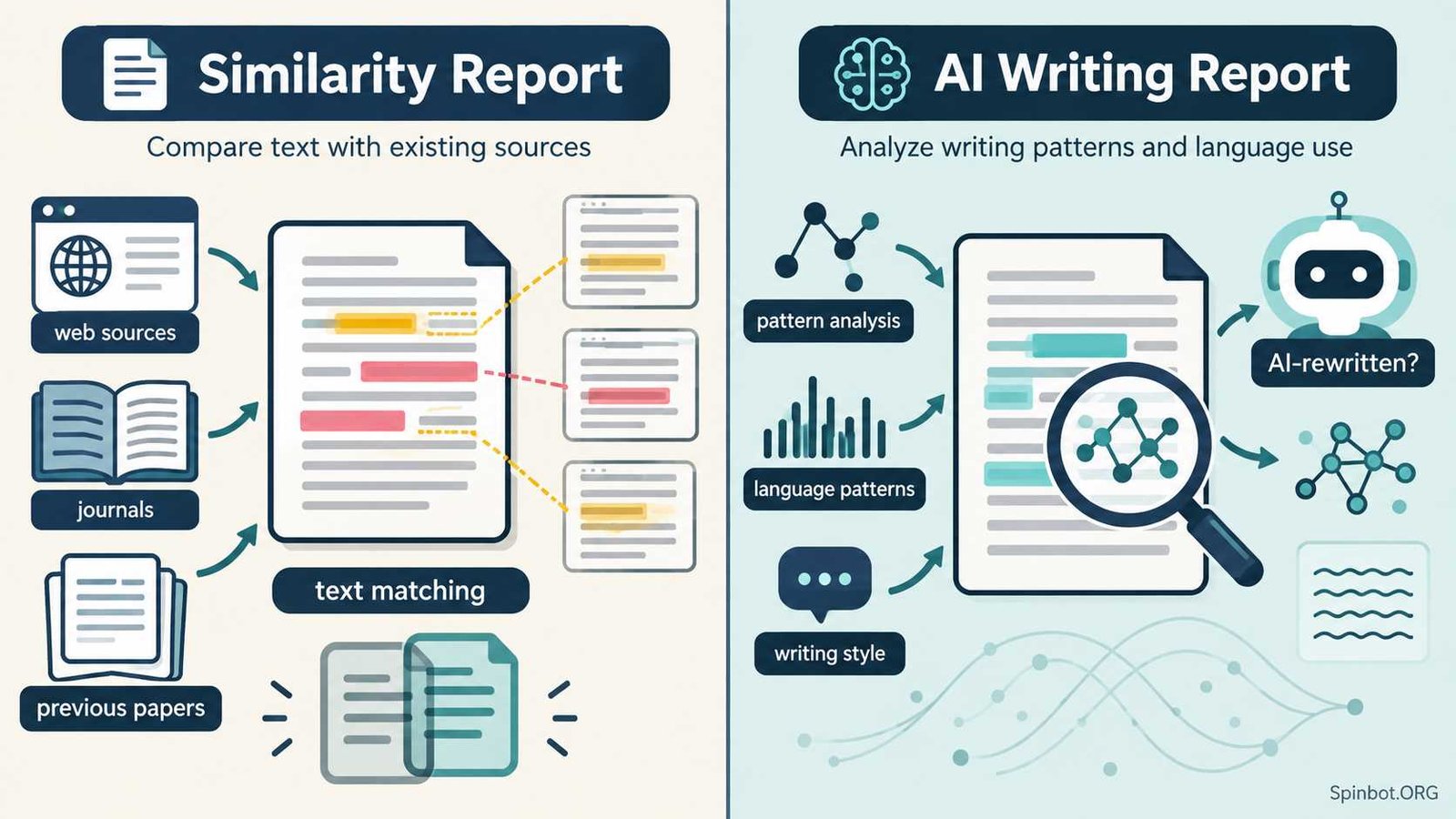
The Similarity Report
Turnitin’s Similarity Report compares submitted writing with material in its databases.
According to Turnitin, these sources include billions of current and archived web pages, publications, journals, and previously submitted student papers. When similar wording appears, Turnitin highlights the matching text.
A similarity score therefore tells you how much text matches sources in the database.
It does not automatically mean plagiarism occurred.
A properly quoted paragraph, bibliography entry, technical phrase, or cited source may create a match. Turnitin specifically explains that some similarity is normal and that the report requires interpretation.
The AI Writing Report
The AI Writing Report does something different.
It analyzes qualifying prose and estimates how much of that writing may have been generated by AI.
Turnitin says its current system can identify likely text produced by large language models as well as likely AI-generated text that has subsequently been modified using AI paraphrasers, bypassers, or word-spinning tools.
That means a paper can have:
- low similarity but a high AI-writing indication,
- high similarity but little detected AI writing,
- both types of signals,
- or neither.
The two reports answer different questions.
Can Turnitin Detect Humanized or Paraphrased AI Text?
Potentially, yes.
This is one of the biggest changes people should understand when reading older articles about Turnitin.
Turnitin previously displayed AI-generated text and AI-paraphrased text as separate categories in its report. On August 4, 2026, the company changed the presentation so these are now combined into a single AI-generated category.
The underlying detection did not simply disappear.
Turnitin states that its model will continue identifying likely AI-generated content that may have been further modified through AI paraphrasers or bypasser tools.
Its current documentation also says the English AI detector includes paraphrasing and bypasser detection. That capability is not currently included in the same way in its Spanish and Japanese detectors.
This makes claims such as “paraphrase it once and Turnitin cannot detect it” especially unreliable.
Changing vocabulary is only one part of writing.
An AI detector may analyze broader patterns across sentences and paragraphs. More importantly, detection systems themselves change. A rewriting method that affects one detector today may produce a different result after a model update.
Why an AI Humanizer Cannot Guarantee a Turnitin Pass
You will find plenty of AI humanizer websites advertising phrases such as:
- undetectable AI,
- passes Turnitin,
- 0% AI detection,
- 100% human score,
- guaranteed bypass.
Those are marketing claims, not universal technical guarantees.
There are several reasons.
Detectors use different models
Turnitin, Grammarly, GPTZero, Copyleaks, and other detection services do not use one shared AI-detection model.
Grammarly, for example, explicitly says that its AI detection percentage may differ from Turnitin and other detectors because the companies use different proprietary systems.
A document receiving one result in one detector therefore tells you very little about the exact result another system will produce.
Detectors change
Turnitin continues to update its detection system.
A humanizer could be optimized around patterns associated with an earlier detector, while a later detector may analyze those patterns differently.
That creates an endless cycle: writing generators change, humanizers change, and detectors change.
There is no permanent “pass” state.
Human writing can also be flagged
AI detection has another important limitation: false positives.
Turnitin itself warns that its AI writing model may misidentify human-written, AI-generated, and AI-paraphrased text. For that reason, Turnitin says an AI Writing Report should not be used by itself as the basis for adverse action against a student. Human review and institutional policies should also be considered.
Grammarly gives a similar warning about AI detection in general, noting that detector percentages are estimates rather than objective proof.
That is why chasing a perfect “0% AI” number can be misleading.
Does Turnitin Detect Grammarly?
This question needs a more careful answer than yes or no because Grammarly now includes several very different types of writing assistance.
Traditional Grammarly corrections such as basic spelling, punctuation, and grammar suggestions are not the same as generating new sentences with an AI model.
Grammarly says its traditional non-generative corrections should typically not affect its AI-detection percentage.
But its newer generative tools are different.
Grammarly explains that rewrites produced through its Grammarly, Paraphraser, and Humanizer agents come from a large language model. Because of that, its own AI detector may identify rewritten passages as AI-generated.
This does not mean Turnitin will always produce exactly the same result. Grammarly also warns that AI detectors use different models, so its score should not be treated as a prediction of a Turnitin score.
The useful distinction is simple:
| Grammarly use | What is happening |
|---|---|
| Fixing spelling | Traditional editing |
| Correcting punctuation | Traditional editing |
| Accepting basic grammar suggestions | Traditional editing |
| Generating a paragraph | Generative AI |
| Rewriting sentences with an AI agent | Generative AI |
| Using an AI paraphraser or humanizer | AI-assisted rewriting |
If your institution allows proofreading tools but restricts generative AI, those activities may also be treated differently under its academic policy.
Check the policy rather than assuming all Grammarly features are considered the same.
Does Turnitin Detect Copy and Paste?
Turnitin can detect matching text, but copying and pasting is not itself a special AI-detection category.
Suppose you copy a paragraph from a website and paste it into your essay.
If Turnitin has that source in its database, the Similarity Report may highlight the matching text. Turnitin compares submissions against internet content, publications, journals, and repositories of submitted work.
But the important issue is attribution.
Copying a sentence and placing it inside quotation marks with the correct citation may be completely legitimate depending on the assignment. The passage can still appear as a similarity match.
Copying the same passage without attribution creates a different academic-integrity problem.
That is why Turnitin says it does not itself determine whether plagiarism occurred. The report identifies similarities for a person to evaluate.
So:
Similarity does not automatically equal plagiarism, and plagiarism does not automatically equal AI writing.
They are separate issues.
Does Walter Writes AI Bypass Turnitin?
Walter Writes is one of the tools frequently mentioned when people search for an AI humanizer that passes Turnitin.
Its website currently makes strong claims.
Walter Writes says its tool achieves a greater than 99% Turnitin bypass rate based on user testing. It also says the product is designed to remove patterns associated with AI-generated text.
Those numbers should be understood for what they are: claims published by Walter Writes itself.
They are not a guarantee about what Turnitin will report on your document.
There is another reason to be cautious. Turnitin explicitly says its English detector is designed to identify likely AI-generated content that has been modified by AI bypassers, paraphrasers, and word spinners.
Both things can therefore be true at the same time:
Walter Writes can claim strong results in its testing, while Turnitin can continue developing systems intended to identify AI text after bypasser modification.
Neither tells you with certainty what will happen to one specific essay tomorrow.
There is also a writing-quality problem to consider.
Heavy rewriting can change more than detector patterns. It can alter meaning, remove technical precision, introduce awkward wording, damage citations, or make a paragraph inconsistent with the rest of your essay.
For academic work, those risks may matter more than an AI percentage.
Is There a Best AI Humanizer for Turnitin?
There is no responsible way to name a permanent “best AI humanizer for Turnitin” based only on which tool claims the lowest detector score.
Detection changes too quickly.
A better way to compare humanizers is to look at what happens to the writing itself.
Check whether a tool:
- preserves the original meaning,
- keeps names, facts, numbers, and quotations accurate,
- leaves citations intact,
- avoids inventing sources,
- produces readable sentences,
- handles your document privately,
- clearly explains how uploaded text is stored,
- and fits your school or university’s AI policy.
You should also ask a more basic question:
Why are you using the humanizer?
If you wrote the paper yourself and simply want clearer prose, ordinary editing may be enough.
If AI generated most of the paper and your course prohibits that use, running the text through several rewriting tools does not change how the work was produced.
And if generative AI is permitted for brainstorming, feedback, or editing, keeping a transparent record of how you used it may be more valuable than trying to reach a particular detector score.
How to Access the Turnitin AI Detector
Students often search for a public Turnitin AI checker so they can test a paper before submitting it.
Turnitin’s official AI Writing Detection feature does not work like a typical public detector where anyone can paste text into a website.
AI writing detection is part of Turnitin’s Originality add-on for institutional accounts. Turnitin says institutions and account administrators control whether AI writing detection is enabled.
For institutions that have the required license and enable the feature, instructors can see AI-writing information alongside supported Turnitin workflows. For example, Turnitin’s Standard Assignment documentation describes an AI Writing column available to instructors when the institution has Originality and AI detection enabled.
Student access is different.
Students may be able to view their Similarity Report when instructors permit it, but that should not be confused with having independent access to Turnitin’s AI Writing Report.
Be cautious with websites claiming to provide a secret or unofficial Turnitin AI check. Uploading an unpublished essay to an unknown service may create privacy, copyright, or data-storage concerns.
What If Your Own Writing Gets Flagged as AI?
An AI indication does not automatically prove that you used AI.
Turnitin acknowledges that its model can make mistakes and specifically advises against treating the AI Writing Report as the sole evidence for adverse action.
If you genuinely wrote the work yourself, evidence of your writing process can help provide context.
Useful records may include:
- Earlier drafts. Keep versions showing how your argument developed.
- Research notes. Save notes, source lists, PDFs, and citation records.
- Document history. Google Docs, Microsoft Word, or other writing platforms may preserve revision history.
- Your outline. A rough outline can show how you planned the paper.
- Source annotations. Notes about why you used particular sources demonstrate actual engagement with the research.
- AI-use records when required. If your course permits AI assistance but requires disclosure, document what you used and how.
The goal is not to “prove the detector wrong” with another detector.
The goal is to show how the work was created.
This is increasingly important as writing tools themselves become more complicated. A student might write an original paragraph, accept ordinary grammar corrections, ask an AI tool for feedback, rewrite part of the paragraph manually, and later receive an automated AI indication.
A percentage cannot tell that whole story.
Humanizers Can Change Text, Not Guarantee Outcomes
So, does Humanize AI work on Turnitin?
An AI humanizer can certainly change AI-generated writing. Because detector scores depend on the resulting text and the detector being used, those changes may sometimes affect an AI-detection result.
But there is no reliable guarantee that a humanizer will make AI-generated writing undetectable by Turnitin.
Turnitin’s current English system specifically includes detection intended for likely AI-generated text modified by paraphrasers and bypassers. Turnitin also keeps updating that system. At the same time, the company acknowledges that AI detection is imperfect and requires human judgment.
That leads to a much more useful approach than hunting for an “AI humanizer that passes Turnitin.”
Use AI within the rules that apply to your assignment. Write and revise enough of the work yourself that you understand and can defend every argument. Check facts and citations. Keep your drafts. Use proofreading tools for the purpose your institution allows them for.
And treat any AI-detection percentage, whether it comes from Turnitin, Grammarly, or another detector, as one signal rather than a final verdict about who wrote the text.

Covers AI writing tools, large language models, prompt engineering, AI detection, and practical AI writing workflows for Spinbot.ORG.