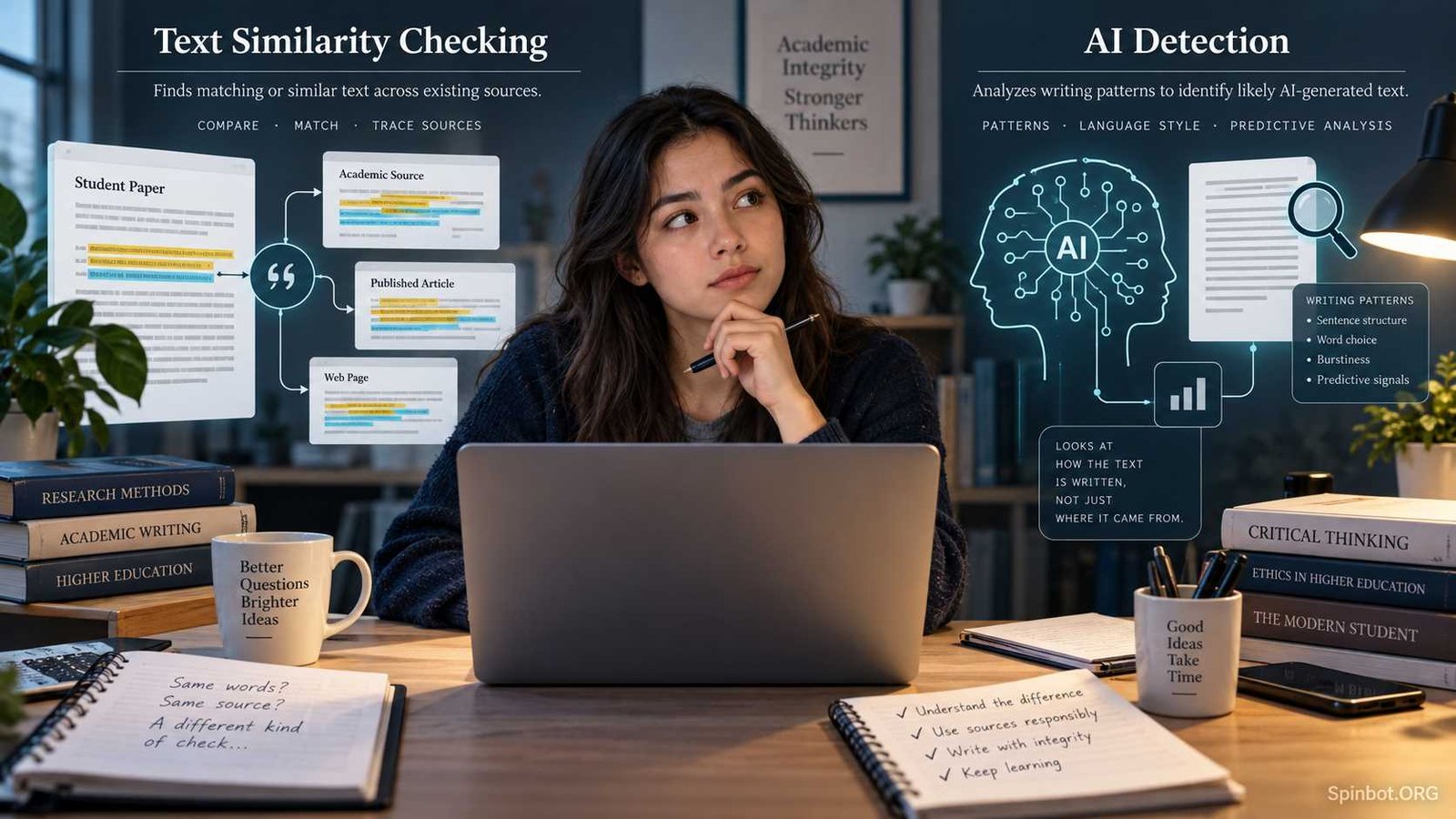
The short answer is no. SafeAssign does not currently work as an AI-writing detector. Its main job is to compare submitted text with existing sources and show where wording matches or closely resembles material already in its databases.
That distinction matters. A SafeAssign report can tell an instructor that parts of your paper resemble existing content. It does not tell the instructor whether ChatGPT, Claude, Gemini, or another AI tool wrote the paper.
As of September 2026, Anthology’s current SafeAssign documentation continues to describe the service as a text-matching and originality system. Northern Illinois University also states that SafeAssign does not detect AI-generated text.
Does SafeAssign Detect AI?
SafeAssign does not have a built-in AI detector that labels writing as human-written or AI-generated.
Instead, SafeAssign looks for exact and inexact text matches between a submitted paper and material available in the sources it searches. After processing the work, it produces an Originality Report showing possible matches.
Anthology describes SafeAssign as using a text-matching algorithm to compare student work with existing source material.
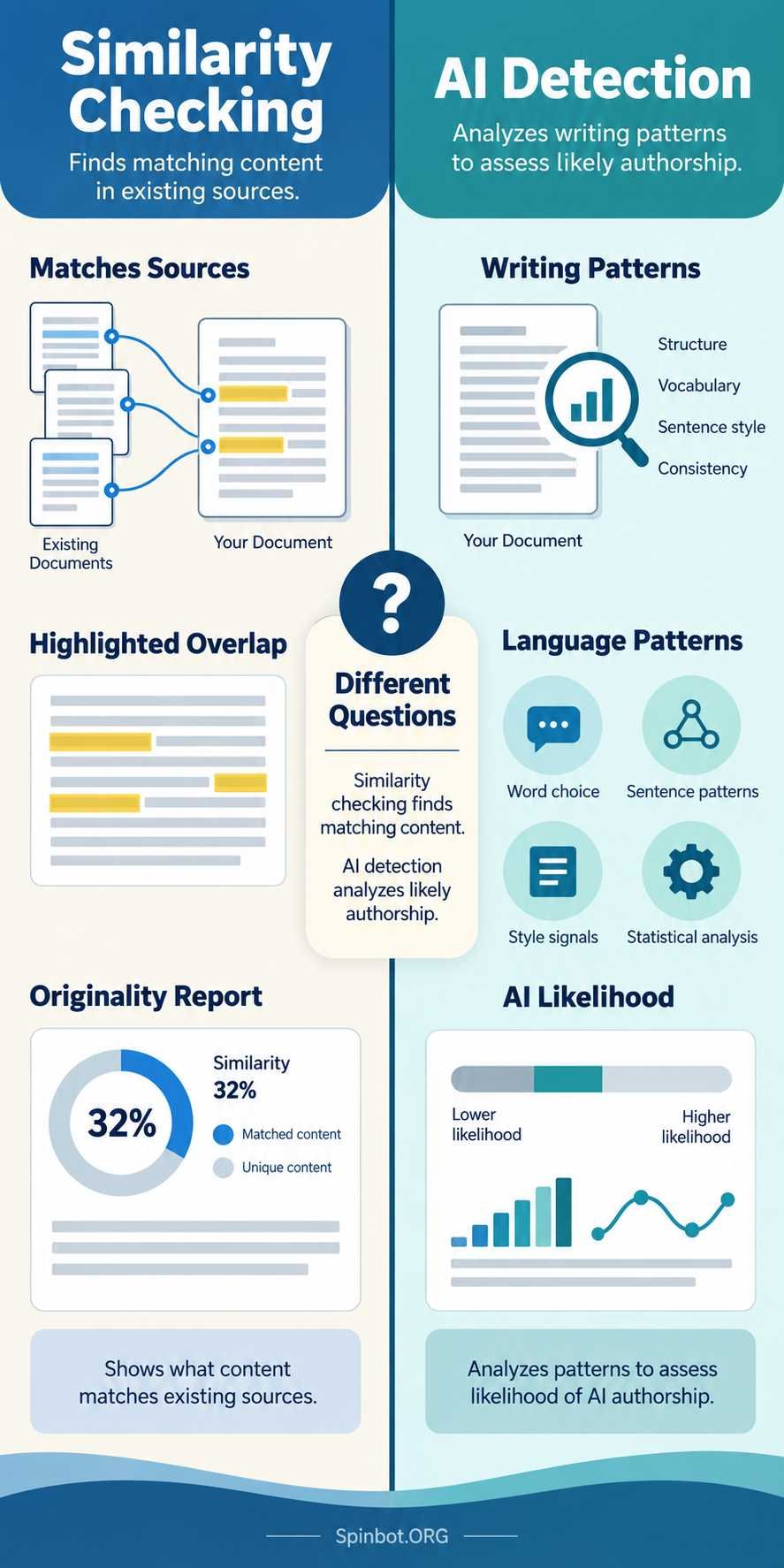
This means SafeAssign answers a question such as:
Does this wording resemble something already published or submitted?
An AI detector tries to answer a very different question:
Does this writing appear statistically likely to have been produced by AI?
Those are not the same test.
For example, imagine a student uses an AI assistant to create a completely new paragraph. If that paragraph does not closely match anything in SafeAssign’s databases, SafeAssign may show little or no matching text.
Now imagine a student personally copies several sentences from a website. SafeAssign may find those sentences even though no AI was involved at all.
So a SafeAssign match is about text similarity, not proof of AI authorship.
What Does SafeAssign Actually Check?
SafeAssign is designed mainly to help instructors and students review originality and source attribution.
According to Anthology, SafeAssign compares submitted work with several collections of existing content. Its system can identify both exact and less-exact matches rather than looking only for perfectly copied sentences.
When the check finishes, SafeAssign produces an Originality Report.
That report can show:
- sections of text that match possible sources
- the sources connected with those matches
- overall text-matching information
- matching percentages for parts of the submission
- document information when available
The report highlights matching blocks so an instructor can examine them in context.
This is an important point: SafeAssign itself does not make the final decision that a student plagiarized.
Anthology says the SafeAssign score should be treated as a warning indicator. The instructor still needs to examine the matching material and decide whether it is properly quoted, cited, or otherwise acceptable.
A quotation with a correct citation, for example, may legitimately match another source.
What Does “SafeAssign Enabled” Mean?
Students sometimes see wording such as SafeAssign enabled and assume every type of academic-integrity detection has been activated.
That is not what it means.
In the current Blackboard workflow, instructors can enable an Originality Report and choose to check submissions for plagiarism using SafeAssign.
Once SafeAssign is active for an assignment, it can process a student’s submission and generate the Originality Report.
Depending on the settings chosen by the instructor, students may also be allowed to view that report themselves.
Anthology says instructors decide whether students can access their Originality Reports. When access is allowed, students can normally review the report after the submission has been processed.
So if your assignment says SafeAssign or Originality Report is enabled, the safest interpretation is:
Your work is being checked for text matches against SafeAssign’s sources.
It does not automatically mean a SafeAssign AI checker is analyzing whether you used generative AI.
Can SafeAssign Flag AI-Written Text?
This part can be confusing.
SafeAssign can potentially flag matching text that happens to be AI-generated, but that does not mean it recognized the text as AI-generated.
Suppose an AI tool produces this hypothetical sentence:
Regular exercise can improve physical and mental health.
Similar wording may already appear across many websites, papers, or student submissions.
SafeAssign could find a match because of the similarity between the sentence and an existing source. But its report would be identifying the overlap, not identifying the tool that produced the sentence.
The same thing can happen with common definitions, standard academic language, quotations, technical phrases, and widely repeated statements.
This leads to a useful rule:
A SafeAssign match can tell you something about similarity. It cannot, by itself, tell you who or what wrote the text.
SafeAssign vs. an AI Detector
SafeAssign and AI-writing detectors analyze writing for different purposes.
| Feature | SafeAssign | AI detector |
|---|---|---|
| Main purpose | Find text similarity | Estimate possible AI authorship |
| Compares against sources | Yes | Not necessarily |
| Produces originality matches | Yes | Usually no |
| Identifies possible source text | Yes | Usually no |
| Gives an AI probability | No | Often |
| Proves plagiarism | No | No |
| Proves AI use | No | No |
That last row is especially important.
Even dedicated AI detectors should not automatically be treated as proof that someone used AI. Northern Illinois University notes that AI-detection systems can produce unreliable results and says Anthology decided against incorporating AI detection into SafeAssign after evaluating the technology.
Academic decisions should therefore involve more than one automated score.
An instructor might consider citations, drafts, writing history, assignment requirements, conversations with the student, and the institution’s AI policy.
What Does a SafeAssign Score Mean?
SafeAssign’s percentage can also cause unnecessary confusion.
A student may see a number such as 8%, 24%, or 45% and assume it represents a plagiarism score.
It doesn’t work quite that simply.
The percentage reflects how much potential matching text SafeAssign has identified in relation to existing sources. Anthology says the overall score serves as a warning indicator and should be reviewed rather than treated as an automatic plagiarism judgment.
Its current guidance groups results roughly into three ranges:
- Below 15%: generally considered a low matching range
- 15% to 40%: a medium range that may contain substantial quoted, paraphrased, or matching material
- Above 40%: a high range that deserves closer review
These ranges are not pass-or-fail grades.
A properly researched academic paper could contain legitimate matches from quotations, titles, references, standard terminology, or correctly cited material.
Likewise, a very low SafeAssign score does not prove that a paper is original in every possible sense.
And it definitely does not mean:
5% SafeAssign = 95% human-written.
SafeAssign’s similarity percentage and AI authorship are separate concepts.
Can Blackboard Assignments Be Checked for AI Another Way?
Yes. This is where students need to look beyond SafeAssign itself.
The fact that SafeAssign does not detect AI does not mean an instructor or institution cannot use another method or service.
A university may have its own academic-integrity procedures. An instructor may also review writing manually or use other tools permitted by institutional policy.
Northern Illinois University’s current Blackboard guidance says there is no built-in Blackboard method there for determining whether students used generative AI. Its guidance also explains that Anthology chose not to incorporate an AI detector into SafeAssign after concerns about reliability.
Policies, however, can differ between schools.
That makes the course syllabus or university AI policy more important than assumptions about what SafeAssign can or cannot do.
For example, one instructor may permit AI for brainstorming but require disclosure. Another may allow grammar help but prohibit generating assignment text. A third may restrict generative AI completely for a particular assessment.
SafeAssign’s technical limits do not change those rules.
Does Using ChatGPT Automatically Cause a High SafeAssign Score?
No.
There is no fixed relationship between using ChatGPT and receiving a particular SafeAssign percentage.
A SafeAssign score depends primarily on how much submitted text matches material available to the system.
An AI-generated passage could have a low similarity score if the wording does not match indexed sources.
A completely human-written paper could have a higher score because it includes:
- direct quotations
- commonly used definitions
- citations
- technical terminology
- material from a student’s earlier sources
- phrases frequently used in academic writing
This is another reason not to read a similarity score as an AI score.
Trying to predict AI use from a SafeAssign percentage is comparing two different measurements.
What About Multiple SafeAssign Submissions?
SafeAssign can also handle assignments where students are allowed more than one attempt.
Anthology’s current documentation says each attempt can receive an Originality Report when SafeAssign is enabled. It also states that SafeAssign recognizes multiple attempts by the same student for the same assignment and does not check the current attempt against that student’s previous attempts for that assignment.
That feature helps prevent a student from receiving a large match simply because an earlier version of the same assignment was submitted through the same workflow.
It still has nothing to do with AI detection.
What Students Should Do With a SafeAssign Report
The useful question is not, “How do I get a zero?”
The better question is, “Are these matches legitimate and properly attributed?”
If your instructor allows you to view the Originality Report, review each meaningful match.
Check whether:
- Direct quotations have quotation marks where required.
- Sources are cited in the required citation style.
- Paraphrases genuinely use your own wording and sentence structure.
- Ideas taken from another source receive proper attribution.
- References match the sources used in the paper.
- You have followed your instructor’s policy for AI-assisted work.
Anthology itself presents SafeAssign as a tool that can help students identify opportunities to attribute sources properly.
You also do not need to panic over every highlighted phrase. Some matches may be ordinary language, reference material, properly quoted text, or wording that happens to resemble another source.
The report needs context.
Can SafeAssign Tell Whether You Copied and Pasted?
SafeAssign may identify copied-and-pasted text if that text matches a source available to its comparison system.
But it does not watch your keyboard or determine how text entered the document.
If you copy several sentences from a source that SafeAssign can match, those sentences may appear in the Originality Report.
If you manually type those exact same sentences, the result can still be similar.
The important factor is the wording in the submitted document, not whether you used Ctrl+C and Ctrl+V.
In other words, SafeAssign is analyzing the submitted text, not reconstructing your writing process.
Is SafeAssign an AI Checker in 2026?
No. As of September 2026, SafeAssign remains primarily an originality and text-matching system, not a dedicated AI-writing detector.
Its Originality Report can identify text that resembles existing sources and help instructors investigate possible plagiarism or citation problems. It does not provide an AI-authorship percentage or determine that ChatGPT or another generative AI tool wrote a paper.
That does not give students a free pass to ignore AI rules. Your school or instructor may have separate policies, review methods, or approved tools.
Here’s what matters: treat SafeAssign as a similarity checker, not an AI detector, and follow the actual AI-use policy for your course rather than trying to interpret an originality percentage as evidence of authorship.
Covers AI writing tools, large language models, prompt engineering, AI detection, and practical AI writing workflows for Spinbot.ORG.