
But choosing royalty-free cinematic music is not only about finding a track that sounds good. You also need to know whether you can legally use it in your project.
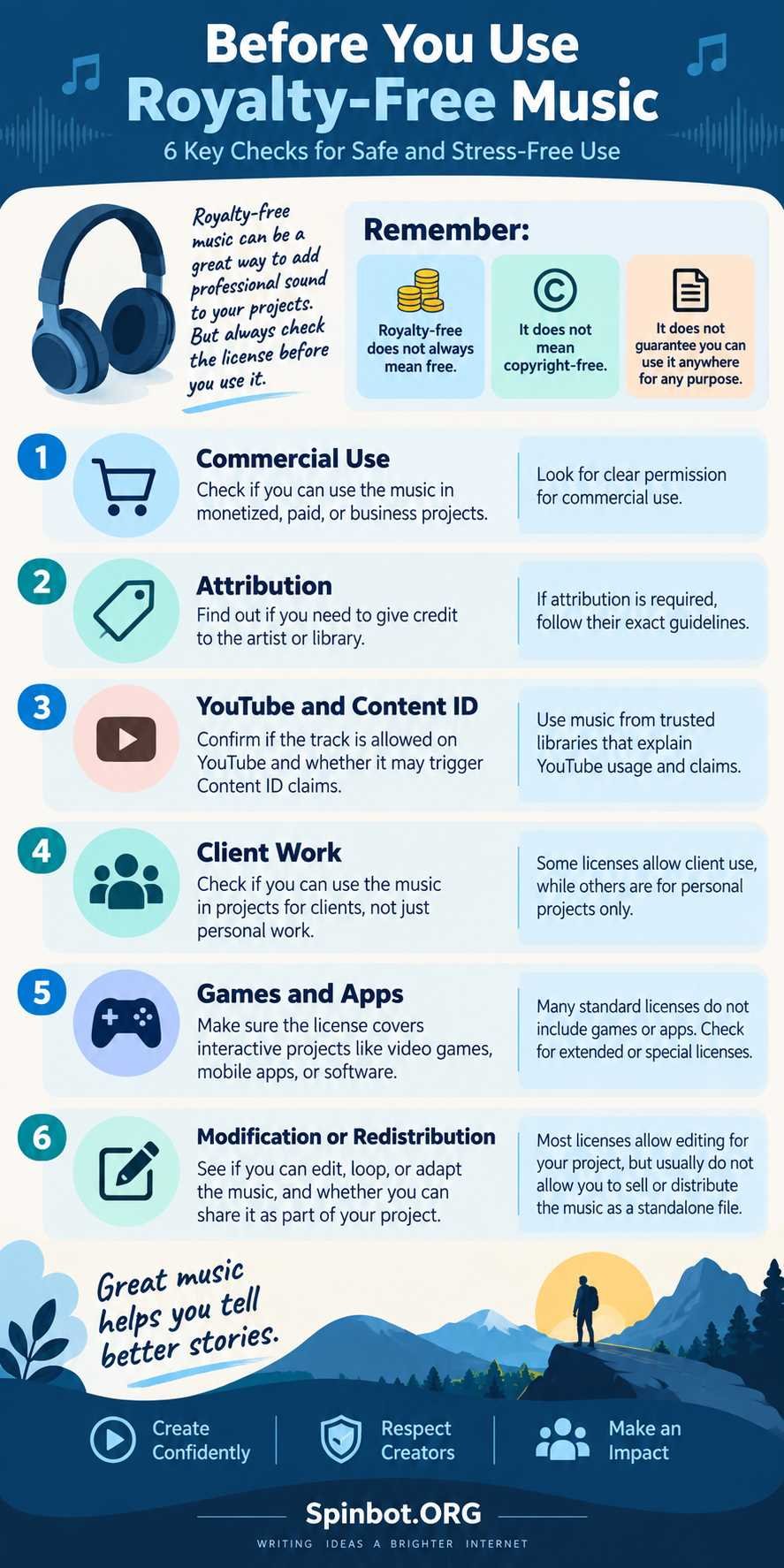
That matters because royalty-free does not always mean free, copyright-free, attribution-free, or approved for every type of commercial use. Each music library has its own license.
The safest approach is simple: choose music by mood, then check the license before you publish.
What Is Royalty-Free Cinematic Music?
Royalty-free cinematic music is music licensed under terms that generally let you use a track without paying royalties every time your project is played.
The music itself can still be protected by copyright. You are usually receiving permission to use it under a specific license rather than ownership of the song.
That distinction matters.
A royalty-free track might be:
- completely free to download and use
- free only when you provide attribution
- available after a one-time payment
- included with a paid subscription
- licensed for YouTube but not television
- approved for videos but restricted in games or apps
Free Music Archive explains that Creative Commons and royalty-free licensing do not remove copyright automatically. Individual tracks can carry very different permissions and restrictions.
Royalty-free does not always mean free
The word royalty describes an ongoing payment connected to the use of copyrighted material.
Royalty-free licensing normally removes some or all repeated royalty payments under the terms of the license. It does not automatically mean the track costs nothing.
Some libraries provide free royalty-free music. Others charge by track or through a subscription.
For example, Mixkit provides free stock music, while Adobe Stock and Artlist use licensing models where access and permitted uses depend on the relevant plan or license.
Royalty-free is also different from copyright-free
Copyright-free is often used loosely online, which creates confusion.
A song can remain copyrighted while the copyright owner gives you broad permission to use it. Creative Commons music is a good example. The creator still owns copyright, but a particular Creative Commons license may allow copying, commercial use, adaptation, or redistribution under stated conditions.
So never assume a track is unrestricted simply because a website describes it as free music.
Where to Find Royalty-Free Cinematic Music
There is no single best library for every creator. The right source depends on your budget, project type, publishing platform, and licensing needs.
Here are several places worth checking.
YouTube Audio Library
For YouTube creators, the YouTube Audio Library is one of the simplest places to begin.
YouTube provides music and sound effects through YouTube Studio. Some tracks use the standard YouTube Audio Library license and do not require attribution. Other tracks use Creative Commons licensing and require the specified attribution in your video description.
YouTube also states that music and sound effects downloaded from its Audio Library are known to YouTube to be copyright-safe and should not receive rights-holder Content ID claims.
This makes the library especially useful for:
- YouTube videos
- educational content
- tutorials
- short films
- channel intros
- documentary-style videos
However, YouTube specifically warns that it cannot guarantee music described as royalty-free on unrelated YouTube channels or third-party libraries.
Pixabay Music
Pixabay provides a large collection of free media, including music.
Under the current Pixabay Content License, content can generally be used for free, attribution is not required, and users may modify or adapt the content. However, Pixabay prohibits selling or distributing its content on a standalone basis and notes that additional rights can sometimes apply.
That makes Pixabay useful when you need background music for:
- cinematic videos
- social media
- presentations
- documentaries
- personal creative projects
- online marketing content
Still, check the individual asset and current license before publishing an important commercial project.
Mixkit
Mixkit offers free stock music under its music license.
Its current guidance says music can be used in projects such as YouTube videos, websites, social media, podcasts, and online advertising. Attribution is appreciated but not required.
There is an important limitation, though.
Mixkit says its stock music is not permitted in video games, CDs, DVDs, or TV and radio broadcasts.
That is a good example of why checking the license matters more than simply seeing the words royalty-free.
Bensound
Bensound has music organized around moods and styles such as cinematic, dramatic, corporate, funny, action, dark, and epic.
Its free music section allows eligible tracks to be used with attribution. Bensound currently instructs YouTube users of its free license to place the required single-use attribution text in the video description.
Paid licensing is available for creators who need different usage rights or do not want to rely on free-license conditions.
Free Music Archive
Free Music Archive is useful when you are comfortable working with Creative Commons licenses.
This requires more care than simply downloading a song.
Different tracks can use different licenses. For example, CC BY allows commercial use and adaptation with attribution, while CC BY-NC restricts commercial use. A NoDerivatives license can also create problems for video creators because synchronizing music with moving images can count as creating a derivative work under the site’s licensing guidance.
Always check the license shown on the exact track page.
Artlist
Artlist is designed for creators who need licensed music for larger publishing workflows.
Current Artlist guidance says projects created and published using licensed assets while a qualifying subscription is active can continue to be used after the subscription ends. Its Pro licensing can also cover qualifying client projects.
But this is another place where project type matters. Artlist currently lists areas such as apps, software, games, broadcasters, and some larger business uses under dedicated business licensing requirements.
Adobe Stock Audio
Adobe Stock provides royalty-free audio under Standard and Extended licensing.
The Standard Audio License covers many common projects such as websites, social media, digital advertising, and corporate presentations.
Adobe says its Extended Audio License is required for uses including television or radio, theatrical releases, paid-access streaming, apps, and video games.
This distinction is especially important for game developers and professional filmmakers.
Choose Cinematic Music by Mood and Project
Cinematic music is not one sound. The best track depends on what the audience should feel.
Royalty-free dramatic music
Royalty-free dramatic music works well when a scene needs tension, urgency, emotion, or scale.
Common elements include:
- rising strings
- deep percussion
- brass
- pulses
- piano
- crescendos
- sudden pauses
It can work well in trailers, documentaries, sports edits, serious YouTube stories, presentations, and dramatic reveals.
Do not automatically choose the loudest track. Music often feels more dramatic when it grows with the scene.
Funny royalty-free music
Funny royalty-free music usually uses a very different musical language.
You may hear:
- pizzicato strings
- ukulele
- playful percussion
- whistles
- light piano
- unusual sound effects
This style can fit comedy videos, children’s content, light advertising, animation, or an awkward moment in a vlog.
The main risk is choosing music that becomes distracting. If every action has a musical joke attached to it, the soundtrack can overpower the story.
Royalty-free corporate music
Royalty-free corporate music is commonly used in business presentations, company videos, product explainers, training videos, and promotional content.
Look for tracks that feel positive without becoming too dramatic.
Acoustic guitar, light electronic rhythms, piano, percussion, and gentle builds are common choices.
For business projects, licensing becomes particularly important because a personal creator license may not automatically cover client advertising or company-wide use.
Royalty-free fantasy music
Royalty-free fantasy music often uses orchestral instruments, choirs, flutes, strings, percussion, and atmospheric sounds.
It works well for:
- fantasy films
- storytelling videos
- tabletop content
- medieval scenes
- adventure videos
- fictional worlds
Try matching the size of the music to the size of the scene. A quiet forest sequence may need soft atmosphere rather than a full orchestra.
Royalty-free documentary music
Good royalty-free documentary music supports the story without telling viewers too aggressively what to feel.
For interviews, a simple ambient bed or gentle piano may work better than dramatic orchestration.
Historical, investigative, nature, travel, and human-interest documentaries can each require different moods.
The most useful rule is this: if viewers are paying more attention to the background music than the person speaking, the track may be too strong.
Royalty-free music for video games
Game music requires extra licensing care.
A license that allows a song in a YouTube video does not necessarily allow that same song to be packaged inside a downloadable game.
For example, Adobe requires its Extended Audio License for apps and video games, while Mixkit specifically states that its stock music cannot be used in video games. Artlist also identifies games and software among uses that may require dedicated business licensing.
Game developers should therefore check whether a license permits:
- inclusion inside the game
- commercial distribution
- multiple platforms
- downloadable releases
- looping or editing
- trailers and promotional videos
- future updates
Do this before building the soundtrack around a particular track.
What to Check Before Downloading a Track
A license page can look dull compared with a beautiful soundtrack, but reading it can save a great deal of trouble later.
Before using music, check these points:
- Commercial use: Can you use the track in monetized or paid projects?
- Attribution: Must you credit the composer or library?
- Platform coverage: Does the license cover YouTube, TikTok, podcasts, websites, television, or streaming?
- Client work: Can you create and deliver the finished project to a client?
- Games and apps: Is interactive or software distribution included?
- Editing: Can you shorten, loop, fade, or otherwise modify the track?
- Standalone distribution: Can the music be extracted or redistributed separately?
- Subscription rules: Must the project be published while your subscription is active?
- Content ID: Does the library provide a way to clear or resolve claims?
These conditions vary widely between libraries. That is why the license attached to the actual track matters more than a search result calling something free music.
How to Pick Music That Fits Your Video
Once the licensing is clear, focus on the creative decision.
Start with the emotion you want.
Do not search only for cinematic music. Search for a more specific mood such as tense cinematic, hopeful documentary, dark ambient, playful comedy, uplifting corporate, or epic fantasy.
Then listen for structure.
A good cinematic track often has sections that make editing easier: a quiet opening, gradual development, a larger middle section, a climax, and a natural ending.
Also check how the music behaves under speech. Dense music with strong melodies can fight with narration. Simpler arrangements often work better behind interviews and voiceovers.
Track length matters too. A two-minute soundtrack may be perfect for a short video but awkward for a ten-minute documentary unless the license allows editing or looping.
If the library offers stems, alternate edits, or shorter versions, those can give you more control over the final mix.
Keep Proof of Every Music License
Licensing information can change. Websites can update their terms, tracks can disappear, and subscription accounts can expire.
Keep a record when you download music for an important project.
Save:
- the track title
- artist or composer
- download date
- source page
- license type
- license receipt or certificate
- required attribution text
- purchase confirmation when applicable
This is particularly useful for client work and monetized content.
A folder containing the project file, music license, and receipt takes only a few minutes to create. It is much easier than trying to reconstruct the licensing history months or years later.
Choose the License Before You Choose the Track
The best royalty-free cinematic music is not simply the track with the biggest orchestra or most dramatic build. It is music that fits your scene and comes with a license that fits your project.
For a basic YouTube video, the YouTube Audio Library may be enough. Pixabay and Mixkit can provide useful free options for many online projects. Free Music Archive offers broader Creative Commons choices if you are willing to check individual licenses carefully. Bensound provides both free and paid options, while libraries such as Artlist and Adobe Stock serve creators who may need broader professional licensing.
The important habit is the same in every case: never choose music based only on the words free or royalty-free.
Check whether commercial use is allowed. Check attribution. Check client rights. Check whether the license covers games, apps, broadcast, or paid distribution if those matter to you.
Then save your proof of license and start editing.
That small step lets the music do what it should do: strengthen your story instead of creating a copyright problem later.

Academic editor turned AI copy pro, Sarah-Jane fuses research precision with smart storytelling. She covers academic writing, research, citation, plagiarism, copyright, grammar, editing, and publishing.