
A song may be in the public domain while the recording you found on YouTube, Spotify, or an old CD is still protected. A modern piano arrangement of a public domain classical piece can also have its own copyright.
That distinction matters.
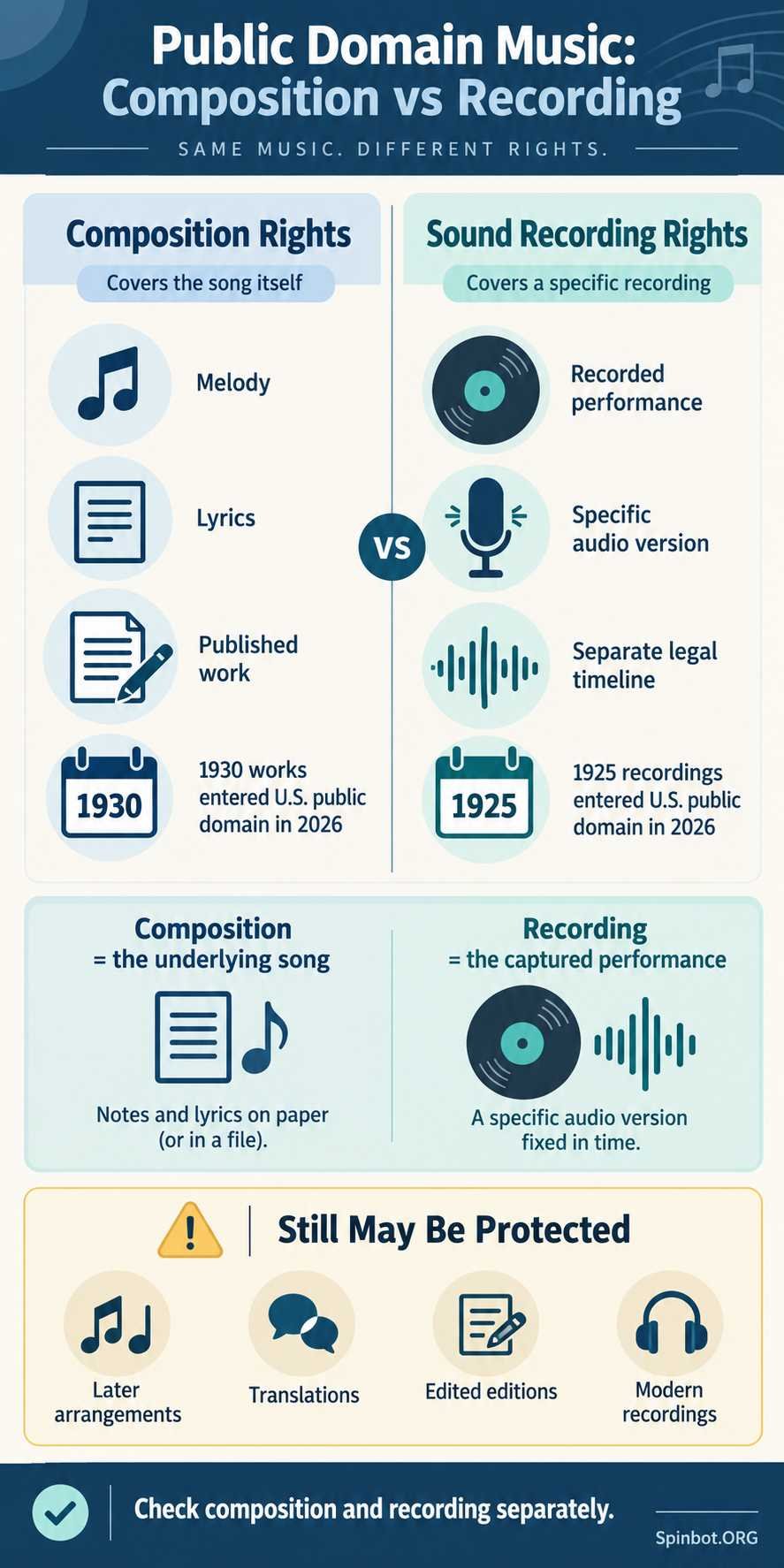
As of January 1, 2026, works from 1930 entered the U.S. public domain, along with sound recordings first published in 1925. Duke Law’s Center for the Study of the Public Domain confirms both milestones.
So, if you’re looking for a useful public domain music list, start with the composition itself. Then check the recording and arrangement separately.
Quick answer: In the United States, musical compositions from 1930 and earlier can generally be used without copyright permission once their copyright has expired. But that does not automatically make a later recording, arrangement, translation, or adaptation public domain.
What Music Is Public Domain in 2026?
For U.S. copyright purposes, January 1, 2026 brought works from 1930 into the public domain.
This includes well-known compositions such as I Got Rhythm, Georgia on My Mind, Dream a Little Dream of Me, Body and Soul, and On the Sunny Side of the Street.
Public domain status means copyright no longer prevents people from using the protected material in the original work. Depending on what the work contains, you may be able to:
- perform it
- record your own version
- reproduce qualifying sheet music
- adapt it
- arrange it
- include it in a video
- use it in a podcast
- build a new creative work around it
- use it commercially
But there is one rule worth remembering before everything else:
A musical composition and a sound recording are two different copyrighted works.
A 1920s song might be public domain, while a recording of the same song made in 1995 remains protected.
Public Domain Music List: 100+ Songs and Compositions
The following list of music in the public domain focuses on traditional material and compositions with old U.S. publication histories. PD Info maintains large research lists based on U.S. copyright law, but it also correctly warns that a title on a list should not replace checking the exact version you plan to use.
Popular Songs and Early Standards
Many familiar jazz, Tin Pan Alley, Broadway, and popular compositions from the early twentieth century are now public domain in the United States.
Examples include:
- After You’ve Gone
- Ain’t Misbehavin’
- Ain’t She Sweet
- Alabamy Bound
- Always
- Avalon
- Baby Face
- Blue Skies
- Button Up Your Overcoat
- Bye Bye Blackbird
- California Here I Come
- Charleston
- Crazy Rhythm
- Dinah
- Five Foot Two, Eyes of Blue
- Honeysuckle Rose
- I Can’t Give You Anything but Love
- I Wanna Be Loved by You
- I’m Looking Over a Four Leaf Clover
- It Had to Be You
- Ja-Da
- Makin’ Whoopee
- Me and My Shadow
- My Blue Heaven
- Oh, Lady Be Good!
- Puttin’ on the Ritz
- Singin’ in the Rain
- Stardust
- Sweet Georgia Brown
- Tea for Two
- Tiptoe Through the Tulips
- Yes Sir, That’s My Baby
For any title, check the original composition rather than assuming a particular commercial recording is free.
Famous Songs That Entered the Public Domain in 2026
The 2026 additions are especially interesting because several songs from 1930 remain widely performed.
Duke identifies these compositions among the notable works becoming public domain:
- I Got Rhythm
- I’ve Got a Crush on You
- But Not for Me
- Embraceable You
- Georgia on My Mind
- Dream a Little Dream of Me
- Livin’ in the Sunlight, Lovin’ in the Moonlight
- On the Sunny Side of the Street
- It Happened in Monterey
- Body and Soul
- Just a Gigolo, referring to the first English translation
- You’re Driving Me Crazy
- Beyond the Blue Horizon
- The Royal Welch Fusiliers
These examples show why checking dates carefully matters.
Mood Indigo, for example, is associated with 1930, but Duke notes that its sheet music was not published until 1931. Under that analysis, it does not enter the U.S. public domain until 2027. By contrast, Dream a Little Dream of Me had a 1930 copyright registration, which places it in the 2026 group.
The title or recording date alone is not always enough.
Folk and Traditional Public Domain Songs
Traditional songs can be especially useful for filmmakers, teachers, musicians, and content creators because many have been circulating for generations.
Examples include:
- Aura Lee
- Barbara Allen
- Buffalo Gals
- Camptown Races
- Careless Love
- Casey Jones
- Danny Boy
- Down by the Riverside
- Erie Canal
- Frankie and Johnny
- Frère Jacques
- Goodnight Ladies
- Greensleeves
- Home on the Range
- I’ve Been Working on the Railroad
- John Henry
- Loch Lomond
- My Bonnie Lies Over the Ocean
- Oh! Susanna
- Polly Wolly Doodle
- Red River Valley
- She’ll Be Coming ‘Round the Mountain
- Shenandoah
- Skip to My Lou
- The Yellow Rose of Texas
- Turkey in the Straw
- Wayfaring Stranger
- When the Saints Go Marching In
- Yankee Doodle
The same warning applies here. Someone can create a new arrangement of an old folk song and claim copyright in the new material they added.
Use the underlying traditional song, not somebody else’s protected arrangement, unless you have permission.
Children’s Public Domain Songs
Many nursery rhymes and children’s songs are old enough to have public domain versions.
Examples include:
- Alphabet Song
- Baa, Baa, Black Sheep
- Goosey Goosey Gander
- Here We Go Round the Mulberry Bush
- Hey Diddle Diddle
- Hickory Dickory Dock
- Humpty Dumpty
- Jack and Jill
- Little Bo-Peep
- Little Miss Muffet
- London Bridge Is Falling Down
- Mary Had a Little Lamb
- Old King Cole
- Pop Goes the Weasel
- Rock-a-Bye Baby
- Row, Row, Row Your Boat
- Sing a Song of Sixpence
- The Farmer in the Dell
- Three Blind Mice
- Twinkle, Twinkle, Little Star
PD Info maintains hundreds of children’s-song entries and bases its list on old published sources. It also warns users to verify the exact music and lyrics involved.
That warning is useful because nursery songs often have many versions. A very old melody may be public domain while a recently written verse is not.
Patriotic Songs in the Public Domain
Creators working on historical, educational, military, or patriotic projects also have many older compositions available.
Examples include:
- America, also known as My Country, ‘Tis of Thee
- America the Beautiful
- American Patrol
- Battle Cry of Freedom
- Battle Hymn of the Republic
- Columbia, the Gem of the Ocean
- Hail, Columbia
- Liberty Bell March
- Over There
- The Stars and Stripes Forever
- When Johnny Comes Marching Home
- You’re a Grand Old Flag
Anchors Aweigh needs more care. PD Info documents its original 1906 version but notes that the words were later rewritten. That makes the exact lyrics or arrangement important when deciding what can be reused.
This is a good example of why saying “the song is old” is not enough.
Hymns and Spirituals in the Public Domain
A large amount of traditional sacred music also has public domain source material.
Examples include:
- Abide with Me
- All Hail the Power of Jesus’ Name
- Amazing Grace
- Blessed Assurance
- Come Thou Fount of Every Blessing
- Crown Him with Many Crowns
- Deep River
- Go Down, Moses
- Holy, Holy, Holy
- How Firm a Foundation
- Jesus Loves Me
- Michael, Row the Boat Ashore
- Nearer, My God, to Thee
- Nobody Knows the Trouble I’ve Seen
- Onward, Christian Soldiers
- Rock of Ages
- Steal Away
- Swing Low, Sweet Chariot
- The Old Rugged Cross
- Wade in the Water
- Were You There
- What a Friend We Have in Jesus
PD Info’s spirituals collection alone contains hundreds of researched entries based on early published sources.
Again, a modern gospel recording of one of these songs is not automatically free to copy simply because the underlying hymn or spiritual is old.
Public Domain Holiday Music
Christmas music creates more copyright confusion than almost any other category.
Some of the best-known carols are centuries old. Others that sound traditional were written much later and may still have protected versions.
Examples of public domain holiday music include:
- Angels from the Realms of Glory
- Angels We Have Heard on High
- Away in a Manger
- Bring a Torch, Jeanette, Isabella
- Coventry Carol
- Deck the Halls
- God Rest Ye Merry, Gentlemen
- Good Christian Men, Rejoice
- Good King Wenceslas
- Hark! The Herald Angels Sing
- Here We Come A-Wassailing
- I Heard the Bells on Christmas Day
- In the Bleak Midwinter
- It Came Upon the Midnight Clear
- Jingle Bells
- Joy to the World
- O Christmas Tree
- O Come, All Ye Faithful
- O Come, O Come, Emmanuel
- O Holy Night
- Once in Royal David’s City
- Silent Night
- The First Noel
- The Twelve Days of Christmas
- Up on the Housetop
- We Three Kings
- We Wish You a Merry Christmas
- What Child Is This?
- While Shepherds Watched Their Flocks
PD Info maintains a dedicated Christmas public domain list based on early sheet-music evidence.
But don’t extend that assumption to every familiar Christmas hit. A song being associated with Christmas does not make it traditional or copyright-free.
Classical Music in the Public Domain
When people search for classical music public domain, they often expect Beethoven, Mozart, Bach, or Chopin to be completely free to use.
The underlying compositions usually are. The recording you choose may not be.
Examples of old public domain compositions include:
- Beethoven’s Symphony No. 5
- Beethoven’s Symphony No. 9
- Beethoven’s Moonlight Sonata
- Beethoven’s Für Elise
- Mozart’s Eine kleine Nachtmusik
- Mozart’s Symphony No. 40
- Mozart’s Requiem
- Mozart’s Rondo Alla Turca
- Bach’s Brandenburg Concertos
- Bach’s The Well-Tempered Clavier
- Bach’s Orchestral Suite No. 3
- Handel’s Messiah
- Handel’s Water Music
- Vivaldi’s The Four Seasons
- Chopin’s Nocturne in E-flat Major, Op. 9 No. 2
- Chopin’s Prelude in E Minor
- Chopin’s Fantaisie-Impromptu
- Tchaikovsky’s The Nutcracker
- Tchaikovsky’s Swan Lake
- Tchaikovsky’s 1812 Overture
- Debussy’s Clair de Lune
- Satie’s Gymnopédie No. 1
- Brahms’s Hungarian Dance No. 5
You can create your own performance of an eligible public domain composition.
What you generally cannot do is take a modern orchestra’s commercial recording and use it simply because Beethoven died in 1827.
The orchestra’s recording has its own rights.
Public Domain Song vs. Public Domain Recording
This is the single most useful distinction to understand.
Imagine you want to use Georgia on My Mind.
The underlying 1930 composition is now in the U.S. public domain. Duke specifically confirms this and explains that the music and lyrics can be copied, performed, recorded, and adapted.
That does not mean you can download Ray Charles’s later recording and place it in your video.
His recording is a separate work.
Think of it this way:
| What you’re using | Copyright question |
|---|---|
| Original melody | Is the composition public domain? |
| Original lyrics | Are those lyrics public domain? |
| Modern arrangement | Does the arranger own new creative material? |
| Studio recording | Is that specific sound recording protected? |
| Translation | Is the translation itself protected? |
Checking the song title answers only the first part of the problem.
What About Old Sound Recordings?
Sound recordings have their own U.S. timetable.
Under the Music Modernization Act, recordings published between 1923 and 1946 receive 100 years of protection. The Library of Congress explains this schedule, while Duke confirms that recordings from 1925 became available for public reuse in 2026.
That means some actual historic recordings, rather than merely their compositions, can now be reused.
Duke’s 2026 examples include 1925 recordings involving artists such as Marian Anderson, Bessie Smith, Louis Armstrong, and others. But only the qualifying 1925 recordings are entering the public domain, not every recording those performers ever made.
The Library of Congress also provides public domain audio through parts of its Citizen DJ project. Material identified there as public domain can be copied, modified, distributed, and used commercially, subject to possible non-copyright issues such as privacy or publicity rights.
What Can You Do With Public Domain Music?
Once you’ve confirmed that the material you need is genuinely public domain in the country where you’re using it, copyright law gives you much more freedom.
You can generally:
- Record your own performance.
Play, sing, or produce your own version of the composition. - Make an arrangement.
Turn an old piano piece into an orchestral, electronic, jazz, or acoustic arrangement. - Use it commercially.
Public domain status does not mean noncommercial use only. - Put it in videos or podcasts.
Your own recording of a public domain composition can avoid the licensing problem created by copying someone else’s protected recording. - Adapt the work.
You may build new creative material around eligible public domain elements. - Create new copyrighted material.
Your original arrangement, recording, or added creative elements may themselves receive copyright protection even though the source composition remains public domain.
What May Still Be Copyrighted?
Several layers can sit on top of an old song.
Watch for:
- recent recordings
- new instrumental arrangements
- newly written lyrics
- modern translations
- edited musical editions
- new orchestrations
- remixes
- samples from protected recordings
- creative additions to public domain sheet music
Duke emphasizes that only the version whose copyright has expired becomes public domain. Later adaptations and other newly created versions can remain protected.
So if you find a beautiful 2024 piano arrangement of an 1800s melody, the age of the melody does not give you permission to copy the 2024 arrangement.
How to Check If a Song Is Really Public Domain
A public domain songs list should be the beginning of your research, not the end.
Use this process.
1. Identify the exact song
Write down its title, composer, lyricist, and any alternate titles.
2. Find the relevant publication information
For older U.S. works, the publication or registration year can determine when copyright expires.
The U.S. Copyright Office notes that copyright duration depends on several factors, including whether and when a work was published.
3. Check music and lyrics
Sometimes a melody is older than the words attached to it.
Confirm both.
4. Check the recording separately
If you’re using an existing audio file, find out when that particular recording was published.
Do not substitute the composition date.
5. Check the arrangement or edition
A modern arranger may have added original harmony, orchestration, notation, or other creative material.
6. Check the country
Public domain status is territorial.
A work that is free to use in the United States may still be protected elsewhere because copyright terms differ between countries. Duke explicitly limits its 2026 Public Domain Day analysis to U.S. law.
7. Save your evidence
Keep copies or links showing:
- publication date
- copyright notice
- registration information
- source sheet music
- recording date
- public domain statement from a reliable archive
This is especially useful when uploading content to platforms that use automated copyright-matching systems.
Useful Places to Find Public Domain Music
A few resources are much more useful than random “copyright-free music” lists.
U.S. Copyright Office
Use it for copyright-duration rules and official copyright records.
Library of Congress National Jukebox
Useful for researching early American recordings and understanding their rights status.
Library of Congress Citizen DJ
Includes selected collections explicitly identified as public domain and available for reuse.
PD Info
Useful for researching popular songs, children’s music, patriotic songs, spirituals, and Christmas music. It also reminds users that its lists are research aids rather than automatic legal clearance.
IMSLP
Particularly useful when researching classical scores and historical editions. Check the copyright notes for the particular score or recording rather than assuming every downloadable file has the same status.
The Safest Way to Use Public Domain Music
The simplest workflow is often this:
Find a verified public domain composition, then make your own recording of it.
That removes one of the biggest sources of confusion: accidentally copying a protected modern sound recording.
For example, if you want to use a classical piece in a YouTube video, you might verify that the composition is public domain, obtain an appropriate public domain score, and record your own performance. Alternatively, find an audio recording from a trustworthy collection that explicitly identifies that recording as public domain.
Do not rely on labels such as “old song,” “royalty free,” “copyright free,” or “classical.” Those phrases do not establish legal status.
A reliable public domain music list gives you good candidates. Careful verification tells you which exact composition, lyrics, arrangement, and recording you can actually use.
For creators, that extra check is usually worth the few minutes it takes.
This guide discusses U.S. copyright principles for general information and is not legal advice. Copyright rules and public domain dates can differ in other countries.

Academic editor turned AI copy pro, Sarah-Jane fuses research precision with smart storytelling. She covers academic writing, research, citation, plagiarism, copyright, grammar, editing, and publishing.