
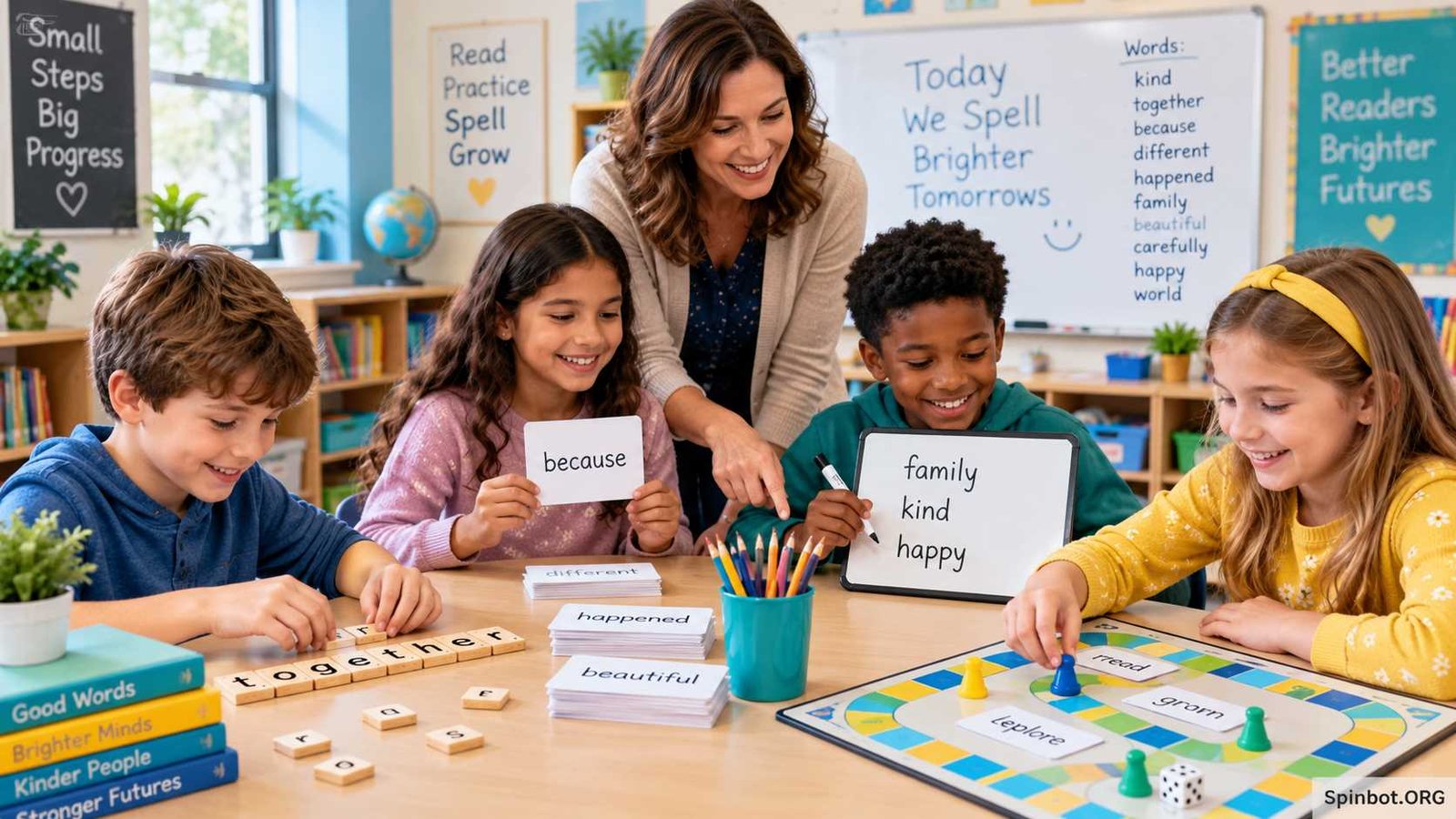
For many third graders, spelling becomes easier to practice when words are turned into small challenges, puzzles, races, and games. The goal is not simply to keep children entertained. A good spelling game asks them to look closely at words, listen to sounds, notice patterns, remember letter order, and spell without always seeing the answer.
These spelling games for 3rd graders work with classroom word lists, homework lists, high-frequency words, and words a child often misspells. Most need only paper, pencils, cards, letter tiles, or a whiteboard.
What Should a Third Grader Practice in Spelling?
By third grade, spelling practice usually goes beyond short words such as cat, sun, and fish. Children begin working with longer words and more complicated spelling patterns.
For example, Grade 3 language standards include spelling studied and high-frequency words correctly, adding suffixes to base words, and using patterns such as word families, syllable patterns, ending rules, and meaningful word parts. Grade 3 foundational reading skills also include working with prefixes, suffixes, multisyllable words, and irregularly spelled words.
That means useful games for spelling words should do more than test whether a child can memorize a list. They can also help children notice why a word is spelled a certain way.
Here are 15 easy ways to do that.
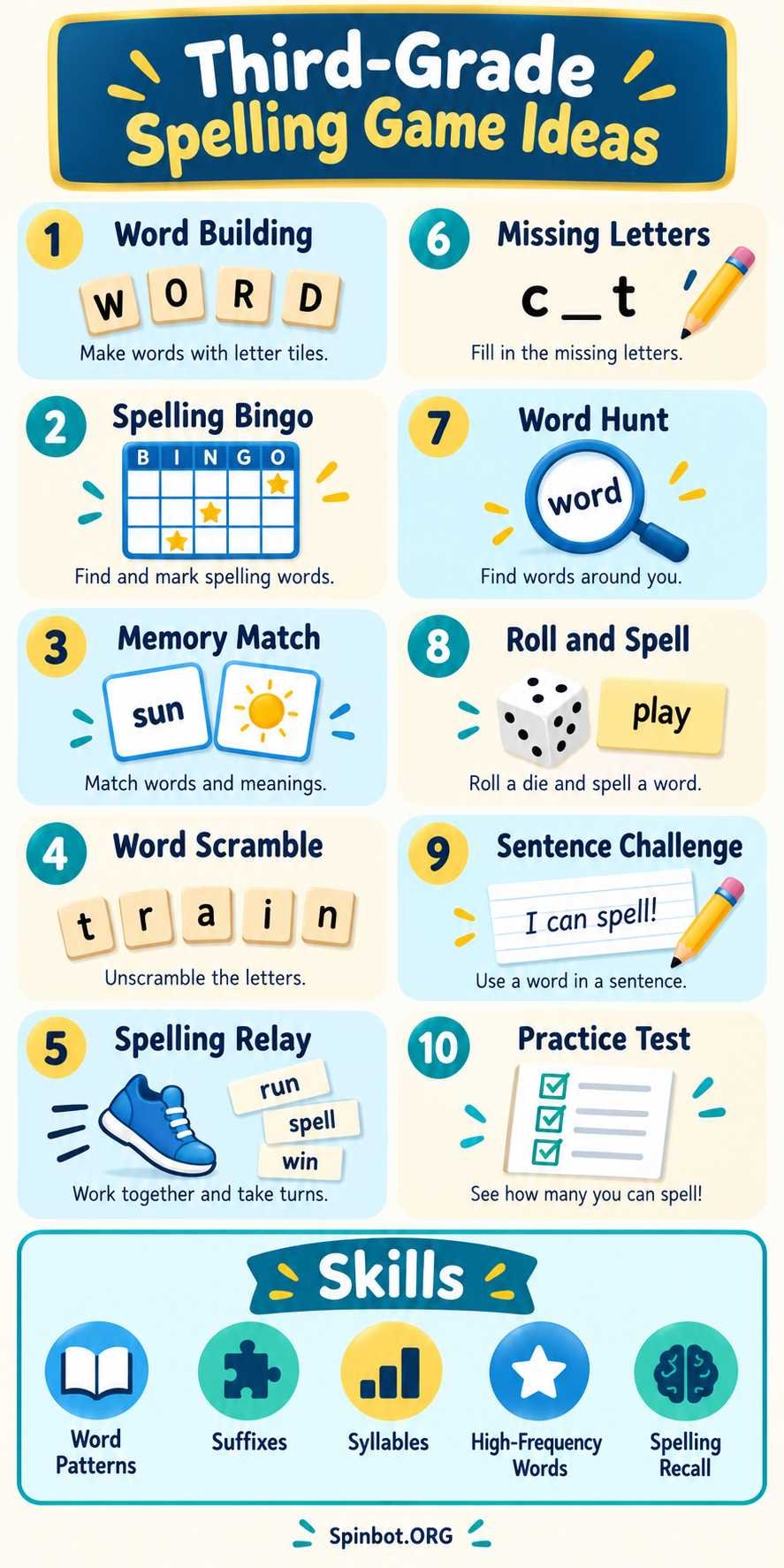
15 Fun Spelling Games for 3rd Graders
1. Spelling Bingo
Make a bingo card and place one spelling word in each square. Instead of simply calling out the written word, say the word aloud.
The child has to recognize it, find the correct spelling, and mark the square.
For a harder version, give a definition or use the word in a sentence instead of saying it directly.
This works especially well with a full weekly spelling list and can be played by one child, a small group, or the whole class.
2. Build the Word With Letter Tiles
Write or say a spelling word and ask the child to build it using letter tiles, magnetic letters, or letters written on small pieces of paper.
After building the word correctly, mix the letters and try again without looking at the original.
You can also remove one letter and ask:
Which letter is missing?
This simple activity is useful for words where students often put letters in the wrong order.
3. Spelling Memory Match
Create two cards for every spelling word.
One card contains the full word. The matching card can contain:
- the same word
- a definition
- a picture
- a sentence with a blank
- the word with missing letters
Place all cards face down. Players turn over two cards at a time and try to find matching pairs.
Before keeping a pair, the player must spell the word aloud.
This adds spelling practice to a familiar memory game without requiring complicated materials.
4. Word Scramble Race
Scramble the letters in each spelling word.
For example:
because → ebcusea
The student rearranges the letters to make the correct word.
Start without a timer. Once the child understands the activity, turn it into a friendly race against the clock or against their previous score.
For difficult words, keep the first letter in the correct position as a clue.
5. Missing Letter Challenge
Write spelling words with one or more letters missing:
diff_rent
happ_ned
fam_ly
Ask the child to complete each word.
Once that becomes easy, remove several letters.
The important part comes next: ask the student to write the complete word from memory after solving it.
Otherwise, the activity can become more of a guessing puzzle than a true spelling exercise.
6. Spelling Scavenger Hunt
Hide spelling cards around the classroom or home.
When a child finds a card, they read the word, cover it, and write it from memory on their answer sheet.
You can make the hunt more interesting by hiding words in places connected to their meanings. A card with kitchen, for example, might be placed near the kitchen door.
For classrooms, children can work in pairs instead of racing.
The movement gives this activity a different feel from sitting at a desk with a worksheet.
7. Roll and Spell
Give each number on a die a different spelling task.
For example:
- Spell the word aloud.
- Write the word.
- Use it in a sentence.
- Spell it backward, then correctly.
- Name a word with a similar pattern.
- Break the word into syllables.
The student rolls the die and completes that task using a word from the week’s list.
This game is easy to reuse because the words can change every week while the rules stay the same.
8. Word Family Sort
Give students a mixed collection of words and ask them to sort words that share useful spelling patterns.
For example:
light, night, bright
play, stay, day
hope, hoping, hoped
The point is not just to finish the groups. Ask students what they notice about each group.
This helps move spelling beyond memorizing individual words toward recognizing patterns. Grade 3 standards specifically include using word families and spelling generalizations when writing words.
9. Spelling Relay
Divide students into small teams.
Say one spelling word. The first student writes the first letter, then passes the marker to the next student, who adds the next letter.
The team continues until the word is complete.
For example, beautiful requires several students to remember where the word is going rather than simply copying it.
Keep the focus on accuracy rather than speed. A correctly spelled word should count more than being the first team to finish.
10. Spell It and Use It in a Sentence
Give the child a spelling word and ask for two things:
- Spell the word correctly.
- Say or write a sentence using it.
A child may memorize the letters in a word without fully understanding the word itself. Adding a sentence connects spelling to real writing.
For example, instead of stopping after spelling different, the student might write:
My two shoes are different colors.
This is especially useful for words that children recognize but rarely use in their own writing.
11. Board Game Spelling Challenge
You do not need a special spelling board game.
Draw a simple path of 20 to 30 spaces on paper. Players roll a die and move their markers. Before staying on the new space, they must complete a spelling challenge.
Possible challenges include:
- spell a word aloud
- write a word from memory
- correct a misspelled word
- add a suffix
- divide a word into syllables
- use the word in a sentence
Use the child’s current school list so the game supports what they are already learning.
12. Mystery Word
Choose one spelling word but do not show it.
Give clues one at a time.
For carefully, clues might include:
- It has three syllables.
- It begins with c.
- It is based on the word care.
- It ends in -ly.
Once the student identifies the mystery word, ask them to spell it.
You can also reverse the activity and let the child create clues while you guess.
Creating good clues requires the student to think about the word’s spelling, meaning, and structure.
13. Correct or Incorrect?
Write two versions of the same word:
becaus / because
happened / happend
friend / freind
The child chooses the correct spelling and explains what is wrong with the other version.
Then remove both choices and ask them to write the word independently.
This last step matters. Recognizing the correct answer is easier than producing the spelling without clues.
You can use real mistakes from previous work rather than inventing random misspellings.
14. Listen and Spell
Say a spelling word without showing it. Use it naturally in a sentence, then repeat the word.
The child writes what they hear.
After several words, let them compare their answers with the original list and correct mistakes.
This is close to the recall required in many spelling tests for 3rd graders, so it works well near the end of the week’s practice.
Online spelling resources often use a similar approach by letting children practice or test themselves using a prepared or customized spelling list.
15. Beat Your Own Score
Turn spelling practice into a personal challenge rather than a competition against another child.
Choose ten words and test them once.
If the child gets seven correct, the target for the next round is eight or more.
Keep a small record:
Monday: 6/10
Wednesday: 8/10
Friday: 10/10
More importantly, keep track of which words were missed.
A child who repeatedly misses because needs more practice with because, not five extra rounds with words they already know.
Online Spelling Games for Third Graders
Online games can be useful when they match the words a child actually needs to learn.
Look for activities that let teachers or parents enter a custom spelling list. Some spelling platforms allow children to practice weekly lists through word searches, fill-in-the-blank activities, games, and spelling tests.
A useful online spelling activity should require the child to do something with the word rather than simply click colorful objects.
Good tasks include:
- hearing a word and spelling it
- filling in missing letters
- identifying the correct spelling
- building words
- matching words with meanings
- using current classroom spelling lists
Screen games are best treated as one option, not the entire spelling routine. Children also need chances to write words themselves because spelling is ultimately used in real writing.
Turning Games Into Spelling Test Practice
A fun activity is useful, but eventually the child needs to spell a word without a board, letter tile, or visible clue.
A simple way to prepare for a weekly test is to reduce help as the week progresses.
Early in the week, let the child see and handle the words. Try letter tiles, matching games, word sorts, and missing-letter puzzles.
In the middle of the week, require more recall. Use spelling bingo, mystery words, and sentence challenges.
Near the test day, move toward listen and spell activities where the child hears the word and writes it without seeing it.
That progression helps you discover which words are truly known and which are only recognized when clues are available.
Making a Spelling Game Easier or Harder
The same game can work for children with different spelling levels.
To make it easier:
- use fewer words at one time
- give the first letter as a clue
- show the word briefly before hiding it
- use shorter or more familiar words
- allow letter tiles instead of handwriting
To make it harder:
- remove visual clues
- add longer words
- ask for a sentence
- ask students to explain a spelling pattern
- include prefixes or suffixes
- use words with several syllables
- mix familiar words with newer ones
This is often more useful than simply moving a child to a different grade-level list.
A third grader who struggles with a certain spelling pattern may need easier practice with that pattern. Another child may be ready for a harder version of the same activity.
A Simple Weekly Spelling Game Routine
You do not need to play all 15 games every week.
Pick a few and rotate them.
A simple routine could look like this:
Monday: Build words with letter tiles and sort them by pattern.
Tuesday: Play spelling bingo or memory match.
Wednesday: Try word scrambles and mystery words.
Thursday: Play Correct or Incorrect, then practice Listen and Spell.
Friday: Give a short spelling check and review only the words that still cause trouble.
Keep sessions manageable. Ten focused minutes with a clear group of words can be more practical than turning spelling into a long nightly task.
Most importantly, choose games based on what the child needs to practice.
If letter order is the problem, use tiles and scrambles. If the child recognizes words but cannot spell them independently, use listening and recall games. If spelling rules are confusing, group words by families, suffixes, syllables, or other patterns.
The best spelling games for 3rd graders are not necessarily the fanciest ones. They are the games that make children look at words carefully, retrieve the spelling from memory, notice useful patterns, and then apply those words in their own writing.

Academic editor turned AI copy pro, Sarah-Jane fuses research precision with smart storytelling. She covers academic writing, research, citation, plagiarism, copyright, grammar, editing, and publishing.