That’s why learning how to promote a self-published book matters just as much as learning how to format, upload, and publish one. A good book can sit unnoticed for months if the right readers never see it. On the other hand, promotion cannot rescue a weak cover, confusing description, or book aimed at the wrong audience.
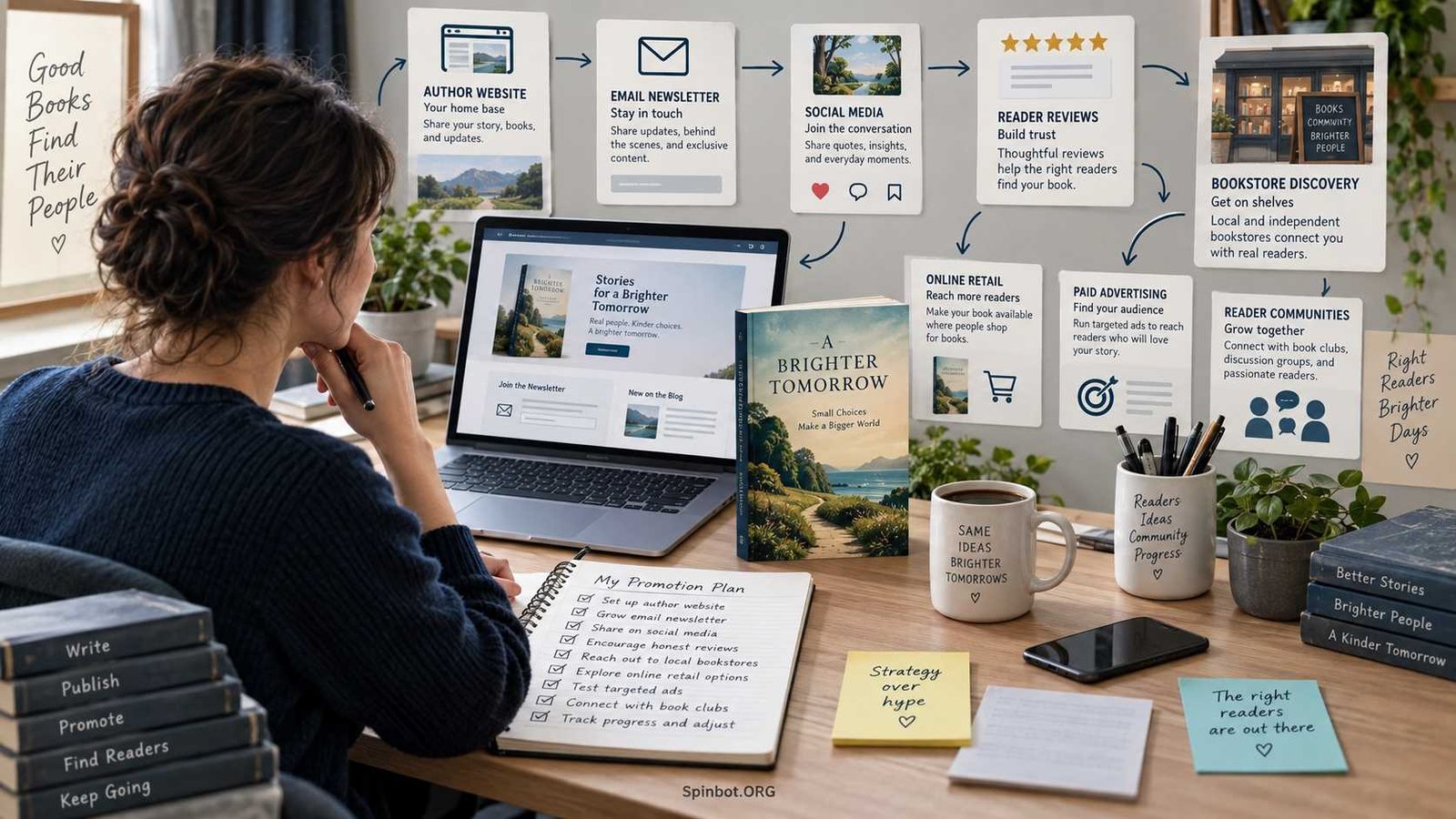
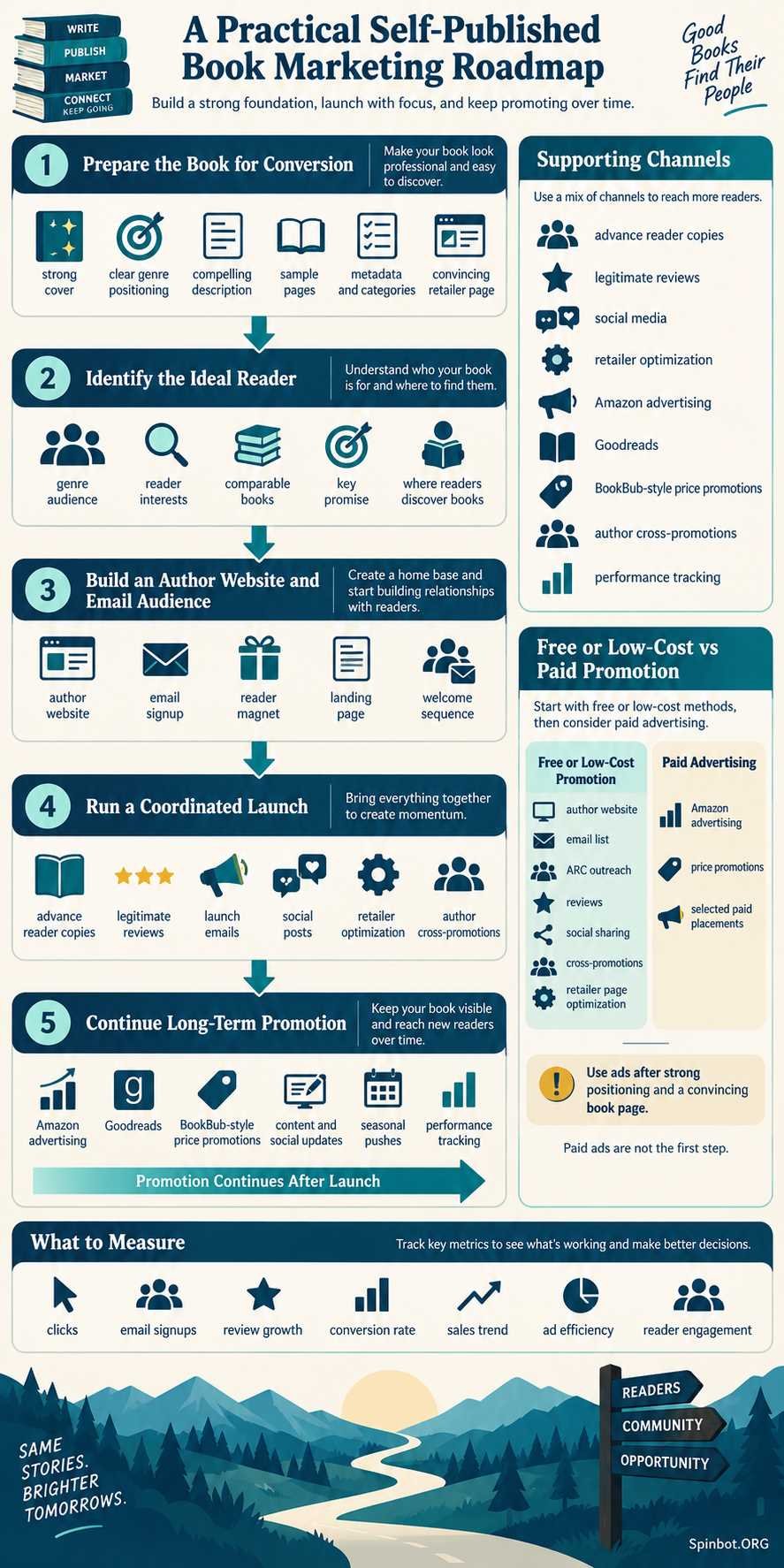
The practical approach is to build promotion in layers. First, make the book easy to understand and buy. Then build direct ways to reach readers. After that, add social media, reviews, partnerships, promotions, and paid advertising where they make sense.
You do not need to use every marketing tactic available. You need a few channels that reach the right readers and that you can keep using long after launch week.
Make Your Book Easier to Sell Before Promoting It
Before sending traffic to a book page, look at it as a reader would.
Suppose you publish a mystery novel and spend $200 on advertising. Your ads get clicks, but the cover looks more like a romance novel, the description takes four paragraphs to explain the premise, and the book appears in weak or inaccurate categories.
The advertising may be doing its job. The sales page is the problem.
Book promotion works better when these basic pieces are already strong:
- A cover that clearly fits the genre
- A title and subtitle that make sense
- A description that quickly shows what the reader will get
- Accurate categories
- Relevant search keywords
- A professional-looking author profile
- Consistent book information across formats
Amazon KDP currently lets authors choose up to three categories for a title and up to seven relevant keywords. Amazon recommends choosing accurate categories and keywords that reflect what readers may actually search for rather than using unrelated terms to chase visibility.
Metadata matters outside Amazon as well. IngramSpark describes titles, author information, book descriptions, publication details, subject categories, and keywords as important parts of making a book discoverable.
This is the first lesson in how to market a self-published book: traffic is valuable only when the destination can turn interest into a sale.
Know Exactly Who You Want to Reach
Many new authors describe their target reader as anyone who likes books.
That audience is too broad to market to.
A better question is: who is most likely to enjoy this specific book?
For a novel, think about genre, subgenre, themes, tone, age range, comparable reading interests, and the emotional experience the story offers.
A cozy mystery reader is not looking for exactly the same experience as a dark psychological thriller reader. Someone buying a beginner gardening guide has different needs from someone searching for an advanced book on commercial greenhouse management.
Your audience affects nearly every marketing decision you make, including:
- Which social platform deserves your time
- Which reviewers you contact
- What your ads target
- Which podcasts or blogs are relevant
- What lead magnet you offer email subscribers
- Which authors make useful cross-promotion partners
- What language you use in your description
If you are trying to figure out how to market a self-published novel, this becomes especially important. Fiction marketing often depends less on explaining useful information and more on matching readers with the kind of story they already enjoy.
Do not try to make every reader interested.
Make the right reader curious.
Build an Author Home Base You Control
Social platforms are useful, but they are rented space. Algorithms change, accounts lose reach, platforms come and go, and followers do not automatically become book buyers.
An author website gives you a place you control.
It does not need to be complicated. A useful author website can start with five things:
- A clear author introduction
- Your books
- Links to places where readers can buy them
- An email signup form
- A contact or media page
IngramSpark describes an author website as a central part of an author’s online presence and book marketing platform because the author controls the presentation and content there.
This is where the idea of promoting your website connects naturally with promoting your book. You do not need a separate campaign designed simply to generate website traffic. Your site should support the larger goal of building a reader relationship.
For example, someone could discover your novel through a TikTok video, visit your website, read a sample chapter, join your mailing list, and buy the book two weeks later.
The website did not make the first introduction. It helped keep the relationship going.
Build an email list early
An email list is especially useful because you can contact subscribers directly when you have something worth sharing.
That might include:
- A new release
- A cover reveal
- A preorder announcement
- A limited discount
- A bonus chapter
- Behind-the-scenes material
- News about the next book in a series
Avoid treating the list as a permanent sales broadcast. Readers have little reason to stay subscribed if every email asks them to buy something.
Give them something enjoyable or useful between launches.
A nonfiction author might send short practical tips related to the book’s subject. A fantasy author might share maps, character notes, reading recommendations, or progress on the next novel.
The goal is not simply collecting email addresses. It is building a small audience that wants to hear from you again.
Start Promoting Before Publication Day
A common self-publishing mistake is finishing the book, clicking publish, and only then asking how to find readers.
You can start earlier.
IngramSpark’s current guidance for indie authors treats book marketing as a timeline rather than a single launch-day event. Planning can begin well before release and continue after publication.
Several weeks before launch, you might prepare:
- Your author website and email signup
- Your retailer description and metadata
- Advance reader copies
- A list of suitable reviewers or creators
- Social content
- A launch email
- Sample chapters or excerpts
- Promotional graphics
- Possible cross-promotions with other authors
Advance reader copies, often called ARCs, can be particularly useful. You provide the book before publication so interested readers can read it in advance and, if they choose, share an honest review.
The key word is honest.
You are providing access to the book, not buying praise.
Goodreads explicitly permits pre-publication reviews from readers with advance copies, while its current review rules require authentic reading experiences and prohibit undisclosed paid or commercial reviews.
Starting early also removes some pressure from launch day. Instead of trying to build your audience, find reviewers, fix your website, create social accounts, and learn advertising all at once, you already have the pieces in place.
How to Promote a Book on Social Media
Social media can help sell books, but only when you stop treating it like a digital billboard.
Posting the same book cover with Buy my book every few days gives people little reason to follow you.
A better approach is to create content around the interests that brought the reader to your book in the first place.
A thriller author might discuss unusual mystery plots, suspense-writing choices, favorite crime-fiction settings, or books that inspired the genre.
A business author could share short explanations, mistakes to avoid, examples, charts, or useful ideas from the subject area.
A children’s author might show illustrations, reading activities, character sketches, or material for parents and teachers.
The exact platform matters less than whether your intended readers are there.
Instead of trying to maintain six accounts badly, choose one or two platforms where you can consistently create useful or entertaining material.
Your content mix might include:
- Short passages from the book
- Character introductions
- Research behind the story
- Reader questions
- Short videos
- Writing updates
- Book recommendations
- Behind-the-scenes publishing material
- Relevant educational posts
- Launch announcements
Most posts should give readers something before asking for something.
That also makes promotion feel less exhausting. You are joining a conversation around books and ideas rather than endlessly asking strangers to purchase a product.
Use Amazon’s Free Promotion Tools Before Spending Heavily
If your book is available through KDP, Amazon provides several tools that may help with discovery and promotion.
Current options include Author Central, Amazon Advertising, certain KDP Select promotions, Kindle ebook preorders, gifting, previews, and sample chapters. Availability can vary by marketplace and program.
Set up Author Central
Amazon Author Central lets authors create an author page where readers can find their books and author information together. Authors can manage their biography, add books, check reviews, monitor some sales information where available, and see follower numbers.
It takes little effort compared with most marketing activities, so there is little reason to leave the page empty.
Keep your bio, photograph, and book list current.
Consider promotional pricing carefully
Discounts and free-book promotions can work, but the goal should determine whether they make sense.
A temporary discount may help a reader take a chance on an unfamiliar author. A free first book can sometimes make sense for a series if enough readers continue to later paid books.
That logic becomes weaker when you have only one book and no clear next step.
Giving away thousands of copies can look impressive while producing little long-term value if those readers never join your list, review the book, or buy another title.
Promotion numbers are not the same as business results.
Add Paid Advertising After the Basics Work
Paid advertising can speed up discovery. It can also speed up the loss of money.
Amazon Ads currently allows eligible authors to set their own campaign budgets and use formats including Sponsored Products and, where eligible, Sponsored Brands. Sponsored Product clicks can send shoppers directly to a book detail page.
That makes the condition of the book page important.
Imagine two authors each spend $100.
Author A has a genre-appropriate cover, clear description, good reader targeting, several genuine reviews, and a strong series page.
Author B has an unclear cover, almost no description, and broad ad targeting.
The same advertising platform could produce completely different results.
For a beginner, I would rather see $20 or $30 used as a controlled test than several hundred dollars spent before the author understands what converts.
Watch:
- Clicks
- Cost per click
- Sales
- Royalties
- Conversion rate
- Read-through into later books
- Email signups if ads lead to your site
If an ad gets plenty of clicks but almost no purchases, do not immediately increase the budget. Investigate the cover, description, price, reviews, targeting, or product-page fit.
The problem may be after the click.
BookBub can be useful, but it is not one single tool
BookBub offers several marketing options for authors and publishers. Its current tools include curated Featured Deals and paid advertising, with different purposes and requirements.
A Featured Deal usually revolves around a discounted ebook and is selected by BookBub rather than automatically available to every applicant.
BookBub Ads, by contrast, are advertising campaigns authors can control more directly.
Think of these as separate tools rather than one BookBub strategy.
The best choice depends on your catalog, pricing, audience, and whether one discounted book can lead readers somewhere profitable afterward.
Get Reviews Without Crossing Ethical Lines
Reviews can reduce uncertainty for someone considering an unfamiliar author. That makes them valuable, but it also makes shortcuts tempting.
Avoid them.
Do not buy positive reviews, create fake reader accounts, pressure reviewers to give five stars, or join schemes where favorable reviews are exchanged.
Amazon warns authors that promotional tactics that manipulate Kindle services can lead to serious account consequences.
Goodreads similarly says reviews should reflect authentic reading experiences and can remove or limit content associated with artificial rating behavior, spam, or undisclosed commercial reviews.
A safer review strategy is straightforward:
Give legitimate readers an opportunity to read the book, then invite them to leave an honest review if they wish.
The Goodreads Author Program can also give published authors a profile they can manage and tools for engaging with readers. The program is free for eligible authors whose published or soon-to-be-published books appear in the Goodreads database.
The purpose is not to control the conversation around your book.
It is to make it easier for genuine readers to find and discuss it.
Borrow Audiences Through Partnerships
Building an audience entirely from zero is slow.
Partnerships can shorten the path.
Look for authors, newsletters, bloggers, podcasters, reviewers, communities, organizations, or creators that already reach people who may enjoy your book.
The important part is audience fit.
A romance novelist with 2,000 engaged romance readers may be a better promotional partner for another romance author than a general influencer with 100,000 unrelated followers.
Possible collaborations include:
- Newsletter swaps
- Joint giveaways
- Author interviews
- Podcast appearances
- Guest articles
- Reading events
- Bundled promotions
- Group sales
- Genre-specific recommendations
- Cross-promotion between related book series
Keep the exchange balanced. Nobody wants to receive a message that amounts to Please promote my book to your audience for free.
A better proposal explains what you can offer their readers or how you can support their work in return.
Track What Actually Produces Readers and Sales
Book marketing becomes much easier when you stop judging it by activity.
Posting 40 times is activity.
Getting 120 qualified people onto your email list is a result.
Running an ad is activity.
Learning that one audience converts at three times the rate of another is a result.
Keep a simple spreadsheet and record where your marketing effort goes. You might track:
| Channel | Cost | Time Spent | Clicks or Visits | Sales | Email Signups | Keep Testing? |
|---|---|---|---|---|---|---|
| Email newsletter | $0 | 1 hour | 95 | 14 | 3 | Yes |
| Social posts | $0 | 4 hours | 70 | 2 | 5 | Maybe |
| Amazon Ads | $35 | 2 hours | 82 | 9 | N/A | Yes |
| General giveaway | $50 | 3 hours | 400 | 1 | 2 | No |
Those numbers are only an illustrative example, not expected results.
The point is the decision.
A channel that creates attention but no readers, subscribers, or sales may not deserve more time. A small channel that repeatedly produces buyers may deserve more.
This matters even more when you are a solo author. Your time is part of the marketing cost.
How Much Do Self-Published Authors Make?
There is no useful single income figure that tells a new author what their book will earn.
Income varies with genre, number of books, pricing, formats, distribution, audience size, marketing skill, advertising spend, publishing frequency, series read-through, and how long an author has been building a catalog.
The Alliance of Independent Authors currently reports a $13,500 median gross income among respondents in its 2025 Indie Author Income Survey.
Do not turn that into an expected salary for a first-time self-published author.
Survey populations matter, and established indie authors with multiple books operate very differently from someone publishing one novel with no existing audience.
A better early goal is to build evidence.
Can you get the first 10 strangers to buy?
Can you identify where they discovered the book?
Can you turn some readers into subscribers?
Can your next book sell faster because the first one built an audience?
Those questions tell you more about the health of an author business than one impressive industry income statistic.
A Practical 30-Day Book Promotion Plan
If your book is already published and barely moving, you do not need to rebuild your entire author platform this weekend.
Use the next month deliberately.
Week 1: Fix the foundation
Review the cover, description, categories, keywords, price, author profile, retailer links, and website.
Compare the presentation with successful books aimed at the same type of reader. Do not copy them. Look for signals readers in that genre expect.
Make sure someone who lands on the sales page can understand the book quickly.
Week 2: Build direct audience assets
Set up or improve your email signup.
Create a useful reason to subscribe.
Prepare a short welcome email and a few pieces of content you can reuse. Contact legitimate early readers, reviewers, or relevant creators where appropriate.
Do not send hundreds of identical messages. Ten carefully selected contacts are more useful than 500 random ones.
Week 3: Create consistent reader-focused promotion
Choose one or two social channels.
Publish content connected to your readers’ interests, not just promotional graphics.
Share excerpts, useful ideas, short videos, research, story details, questions, or recommendations. Include direct book promotion when it fits, but let the account have a reason to exist between sales posts.
Reach out to a few authors or creators with similar audiences about cross-promotion.
Week 4: Test one measurable promotion
Now choose one tactic that costs either money or concentrated effort.
That could be:
- A small Amazon Ads test
- A temporary price promotion
- A newsletter placement
- A BookBub advertising test
- A genre-specific promotional service you have carefully researched
Set a limit before starting.
Then measure what happened.
If you spend $30 and get no sales, that does not automatically mean advertising never works. Look at the whole path from audience targeting to the book page.
If you spend $30 and sell books but lose $20 after royalties, decide whether there is another business reason to continue. A series author may accept a loss on book one if enough readers buy books two and three. A single-book author has less room for that strategy.
Context changes the answer.
Build a Promotion System You Can Keep Using
The strongest answer to how to promote a self-published book is not to collect more marketing tricks.
Build a system.
Make the book easy to discover. Give interested readers a convincing sales page. Create an author home base. Build an email list. Use social media where your readers actually spend time. Encourage legitimate reviews. Form useful partnerships. Test paid promotion carefully and measure what produces real readers rather than impressive-looking activity.
Then repeat what works.
A first book rarely comes with a large built-in audience. That is not a reason to promote everywhere at once. It is a reason to learn where your readers come from.
Two reliable marketing channels you understand are worth far more than ten accounts, five ad platforms, and a promotion calendar you cannot maintain.
Your goal is not simply to launch one book loudly.
It is to make the next reader easier to reach than the last one.

Raj blends SEO mastery with real-world freelance grit. Covers SEO, blogging, content strategy, copywriting, freelance writing, marketing, and business communication.