

That part can feel harder when you’re new. You may have no testimonials, no paid samples, and no list of past clients to impress people with. Still, you don’t need to wait until someone magically discovers you.
The basic process is simple: learn enough to offer a useful service, create proof that you can do the work, find businesses that need it, and contact them with a relevant pitch.
You can find clients through freelance platforms, your existing network, agencies, LinkedIn, local businesses, online communities, and direct outreach. You do not need to use all of these methods at once. Start with two or three, track what works, and improve from there.
The Short Answer: How Do You Get Copywriting Clients?
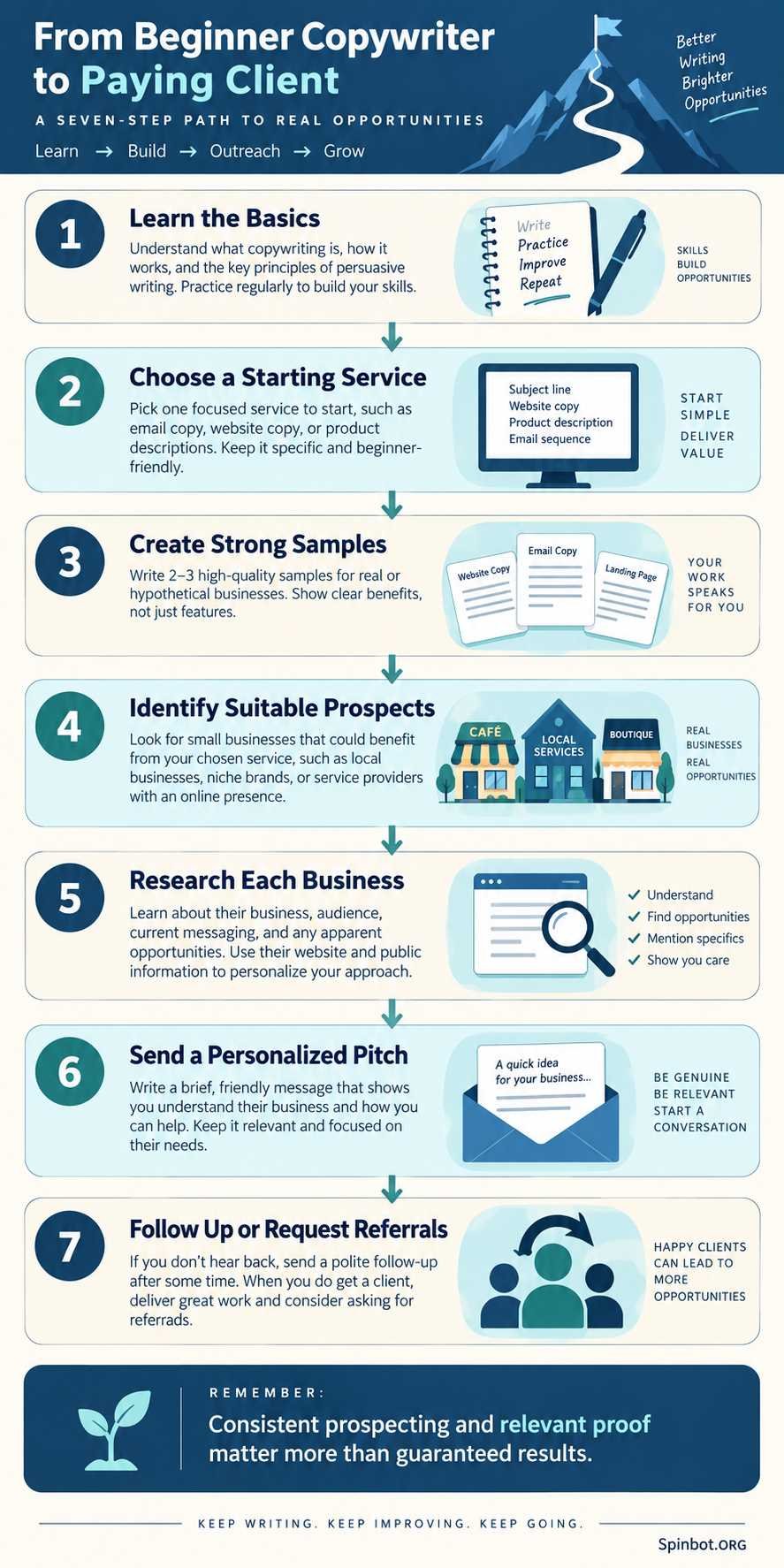
A practical client-acquisition process looks like this:
- Choose a copywriting service you can confidently offer.
- Create two or three strong samples.
- Decide what type of client you want to approach.
- Build a list of potential clients.
- Research each business before contacting it.
- Send a short, personalized pitch.
- Follow up when appropriate.
- Do good work and ask satisfied clients for referrals.
There is no single website or trick that guarantees clients. Current Upwork guidance also recommends combining several approaches such as networking, portfolio building, proposals, freelance platforms, and direct outreach rather than depending on one source of work.
The important part is consistency. Finding clients is a business activity, not something you do once when you run out of work.
Get Ready to Sell Copywriting Before You Pitch
If you search for how to get into copywriting or how do I get into copywriting, you will find endless advice about courses, books, niches, and portfolios.
Those things can help, but you do not need to master every type of copy before looking for your first client.
You need enough skill to solve one clear problem.
Learn the copywriting basics you actually need
Start by understanding what copywriting is meant to do.
Copy usually encourages the reader to take an action. That action might be:
- buying a product
- requesting a quote
- joining an email list
- booking a consultation
- downloading something
- clicking through to another page
Learn the basics of headlines, benefits, calls to action, customer pain points, objections, clarity, and editing.
Then practice.
Take a weak product description and rewrite it. Create an imaginary landing page. Write a welcome email for a business you understand. Rewrite the homepage of a fictional local service company.
Practice gives you something more useful than passive learning: work you can review and improve.
Choose one starting service instead of offering everything
One reason how to start copywriting feels confusing is that copywriting covers many types of work.
You could write:
- landing pages
- website copy
- product descriptions
- email campaigns
- sales pages
- advertisements
- brochures
- social media ads
- lead-generation pages
You do not need to sell all of them.
Imagine two freelancers approaching a small software company.
The first says, “I provide copywriting, blogging, SEO, social media management, editing, branding, and marketing.”
The second says, “I write landing pages and onboarding emails for software companies.”
The second offer is easier to understand.
You can expand later. At the beginning, clarity helps clients understand why they should talk to you.
Create samples even if nobody has hired you yet
The obvious beginner problem is this:
You need clients to build a portfolio, but clients want to see a portfolio before hiring you.
The solution is to create your own samples.
Upwork’s current freelancer guidance specifically recommends creating portfolio projects when you do not yet have client work. Its examples include redesigning a website, creating a sample campaign, or producing work within your chosen niche.
A beginner copywriter might create:
- a homepage rewrite for a fictional plumbing company
- three promotional emails for an imaginary skincare brand
- a landing page for a made-up software product
Clearly label speculative work as a sample or concept. Do not imply that a real company hired you when it did not.
Two excellent, relevant samples can be more persuasive than ten unrelated pieces.
Decide Who You Want to Write For
You do not need to choose a niche for the rest of your career.
You only need enough focus to make prospecting easier.
For example, you could start with:
- local service businesses
- ecommerce stores
- software companies
- coaches and consultants
- real estate businesses
- marketing agencies
You could also specialize by service rather than industry, such as email copywriting or landing-page copy.
The point is not to trap yourself in a tiny niche. It is to make your offer easy to understand.
Small businesses can be good first prospects
Copywriting for small business can be a practical starting area because many small companies need help explaining their services clearly.
Look at real business websites in an industry you understand.
You may notice problems such as:
- a homepage that never explains who the service is for
- weak or missing calls to action
- confusing service descriptions
- pages that focus entirely on the company rather than the customer
- outdated copy
- emails that sound generic
- product pages that list features but not benefits
Those are potential copywriting problems.
Do not contact a business merely to tell the owner that the website is terrible. Identify something specific you could improve and explain why the change may make the message clearer or more persuasive.
Where to Find Copywriting Clients
There is no shortage of businesses that use written marketing. The harder job is finding the ones that both need your help and are willing to pay for it.
Here are several practical places to look.
Start with people already in your network
Your first client does not have to come from a stranger.
Tell former coworkers, business contacts, friends, designers, developers, marketers, and business owners what service you now offer.
Keep the message specific.
“I’m doing freelance copywriting” is vague.
“I’m helping small service businesses improve website and landing-page copy” gives people something they can remember.
You are not asking everyone to hire you. You are making it easier for them to refer someone who may need your service.
Look for businesses that visibly need better copy
Direct prospecting works best when you have a reason to contact the prospect.
Suppose you write email copy for ecommerce companies. You discover a store with a strong product range but no visible welcome offer after joining its mailing list.
That gives you a specific conversation starter.
Or perhaps you write website copy for local businesses and find a company whose homepage never clearly explains its main service.
Build a prospect list based on actual opportunities, not random company names.
Use freelance marketplaces selectively
Platforms such as Upwork can give beginners access to clients who are already looking for freelancers.
The advantage is clear: you do not have to convince the prospect that hiring a freelancer is an option.
The disadvantage is competition.
That is why sending a large number of generic applications is usually a weak strategy. Upwork’s 2026 proposal guidance recommends personalizing proposals, connecting your experience directly to the client’s needs, including relevant proof, and giving the client a clear next step.
Apply to jobs where your samples and skills actually fit.
Five thoughtful applications can teach you more than fifty copied-and-pasted messages.
Approach agencies
Marketing, branding, web design, SEO, and advertising agencies regularly need written content and copy.
Some have in-house writers. Others use freelancers when workloads increase or when they need someone with a specific specialty.
Create a short list of agencies whose work fits your skills. Check whether they mention freelancers, contractors, writers, or careers on their sites.
Even when no opening is advertised, a brief introduction can put you on their radar for future projects.
Use LinkedIn and professional communities
LinkedIn can help you identify founders, marketing managers, content leads, agency owners, and other people involved in hiring writers.
Do more than send connection requests followed immediately by a sales pitch.
Follow people in your target market. Read what they publish. Learn what problems they discuss. Share useful observations about copywriting.
Professional communities can work in a similar way. The goal is not to enter every group and announce that you are available for work. Become recognizable for being useful.
How to Pitch a Copywriting Client
A pitch should answer one basic question:
Why is this message worth the client’s attention?
A long biography usually does not answer that.
Research the business first
Before contacting someone, spend a few minutes understanding:
- what the company sells
- who its customers appear to be
- what page or campaign you could help with
- what seems unclear or weak
- what kind of copy you could provide
This gives you something specific to talk about.
Lead with their problem, not your biography
Compare these openings:
“I am a passionate freelance copywriter offering professional writing solutions.”
And:
“I noticed your service page explains what your team does, but the booking button only appears at the bottom. I have an idea for making the next step clearer earlier on the page.”
The second message starts a business conversation.
Your entire pitch does not have to be clever. It has to be relevant.
A simple structure is:
Observation → problem or opportunity → how you can help → relevant sample → next step.
Show relevant proof
If you are pitching an ecommerce email project, send an ecommerce email sample.
Do not make the prospect hunt through a portfolio containing restaurant blogs, academic essays, poetry, and unrelated website projects.
Current Upwork guidance similarly recommends leading with relevant experience or samples and tailoring each proposal to the client’s goals.
Relevance often matters more than volume.
Give the prospect one clear next step
Do not finish with five requests.
Ask one simple question.
For example, you could ask whether they are interested in discussing the page, whether they would like to see a relevant sample, or whether a short call would be useful.
A clear next step makes replying easier.
What If You Have No Client Experience?
Lack of paid experience does not mean you have nothing to show.
Use:
- spec samples
- personal projects
- volunteer work you genuinely completed
- closely related professional writing
- small starter projects
What you should not do is invent clients or results.
If a sample was created as practice, say so. If you have not increased a company’s conversion rate, do not claim that you have.
Credibility grows faster from good work and honest positioning than from exaggerated claims.
You can also begin with smaller, well-defined projects rather than trying to sell a huge website rewrite.
A five-email welcome sequence is easier for both sides to evaluate than an open-ended promise to “handle all marketing copy.”
Build a Simple Client Outreach Routine
Client acquisition becomes easier when it is a process rather than a mood.
Try this routine:
- Add suitable prospects to your list. Record the business, contact person, website, service you could offer, and why the prospect looks relevant.
- Research a small number each day. Find one real reason to contact each person.
- Send personalized messages. Keep them concise and focused on the prospect.
- Track responses. Record replies, calls, rejections, and unanswered pitches.
- Follow up appropriately. A prospect may simply have missed your first message.
- Review your results. Notice which industries, offers, samples, and pitch styles create conversations.
You do not need complicated software. A spreadsheet can be enough when you are starting.
Tracking also stops you from making decisions based on feelings.
If one pitch gets ignored, that tells you very little. If fifty carefully targeted pitches produce the same result, you have useful evidence that your targeting, offer, portfolio, or message may need work.
Turn One Copywriting Client Into More Work
Winning your first client is useful.
Building a relationship is better.
When you complete a project successfully, look for the logical next need.
A homepage client might later need:
- service pages
- email copy
- landing pages
- product descriptions
- advertisements
Do not push unnecessary work. Simply pay attention to related problems you can genuinely solve.
When appropriate, ask the client whether you may include the completed project in your portfolio. You can also request a testimonial after the client has had enough time to judge your work.
Satisfied clients can become referral sources too. Upwork’s current freelancer guidance identifies repeat work and referrals as part of building a steadier freelance business rather than constantly starting from zero.
Stay in touch with good clients instead of contacting them only when you need money.
Mistakes That Make Finding Clients Harder
Some beginner mistakes waste more time than a lack of experience.
Sending generic mass pitches. If the same message could go to 500 businesses unchanged, it probably gives the recipient little reason to respond.
Waiting for a perfect portfolio. You need credible proof, not a museum of everything you have ever written.
Offering too many services. A focused offer is easier to understand and refer.
Talking mainly about yourself. Clients care about your background, but they care even more about whether you understand their problem.
Doing entire projects for free. A small sample can sometimes help demonstrate your approach. Completing substantial unpaid work simply to prove yourself can become an expensive habit.
Giving up after one attempt. Some prospects will not respond. Others do not need a writer now. Client acquisition needs enough volume to separate a weak strategy from ordinary rejection.
Making promises you cannot prove. Good copy aims to improve business communication and persuasion, but no responsible copywriter can guarantee a particular sales or conversion result from copy alone.
From Learning Copywriting to Getting Paid
If you are trying to figure out how to get copywriting clients, do not make the process more mysterious than it needs to be.
Pick one useful service. Practice it. Create a few relevant samples. Find people and businesses that may genuinely need that service. Research them. Send thoughtful pitches. Follow up. Learn from the responses.
Your first goal is not to build the perfect freelance business.
It is to create a repeatable way to move from I can write copy to I know how to find someone who may need it.
Start small today: create or improve one strong sample, then identify ten businesses that could realistically use that kind of copy. That gives you something far more valuable than another week of reading about freelancing. It gives you a client pipeline to work on.

Raj blends SEO mastery with real-world freelance grit. Covers SEO, blogging, content strategy, copywriting, freelance writing, marketing, and business communication.