
If you’ve ever written something amazing online that nobody read, you’ve already felt the quiet heartbreak that led to the birth of SEO writing. You pour your thoughts into an article, edit it to perfection, hit publish… and crickets. No clicks, no comments, no readers.
That’s where SEO writing steps in not to replace creativity, but to guide it so your words actually reach people. It’s the invisible bridge between great writing and great discoverability. Let’s break down what it means, why it matters, and how you can master it without sounding robotic.
Understanding SEO Writing in Simple Terms
SEO stands for Search Engine Optimization. It’s the practice of making your content easy for both people and search engines to understand. When we talk about SEO writing, we mean crafting articles, blog posts, or web pages in a way that:
- Answers what people are really searching for.
- Uses keywords naturally.
- Follows logical structure and readability best practices.
- Builds trust and authority through accurate, relevant information.
In short: SEO writing helps your content appear when someone Googles a question you can answer.
Think of it as writing that speaks two languages at once human and algorithm. Humans see a helpful article. Google sees clean structure, context, and intent alignment.
Why SEO Writing Matters More Than Ever
Today, millions of new blog posts go live every single day. Even the most brilliant idea can vanish under that avalanche of noise. SEO writing keeps you visible.
It matters because it:
- Brings consistent, free traffic. Instead of buying ads, you earn attention by being relevant.
- Builds authority. When Google ranks you higher, people assume you’re trustworthy.
- Drives conversions. Quality SEO content doesn’t just attract; it convinces.
- Supports long-term growth. Good SEO writing compounds old articles keep bringing in new readers.
Without SEO writing, your content might still be good. But it’s like whispering in a crowded room. With SEO, you’ve got a microphone, a spotlight, and a front-row audience.
The Heart of SEO Writing: Intent
Search engines have become incredibly smart. They no longer just match words; they interpret intent. That’s why modern SEO writing focuses less on keyword stuffing and more on understanding what users want.
When someone types “best laptops for students,” Google isn’t just looking for those exact words it’s looking for answers that compare, explain, and guide purchase decisions.
So before you write, ask:
- What problem is the reader trying to solve?
- What emotion or motivation drives this search?
- What kind of answer would feel satisfying?
If your article nails those, you’ve done 70% of SEO right already.
The 3 C’s of SEO Writing
You might’ve heard about “the 3 C’s” of SEO Content, Context, and Clarity. These are your cornerstones.
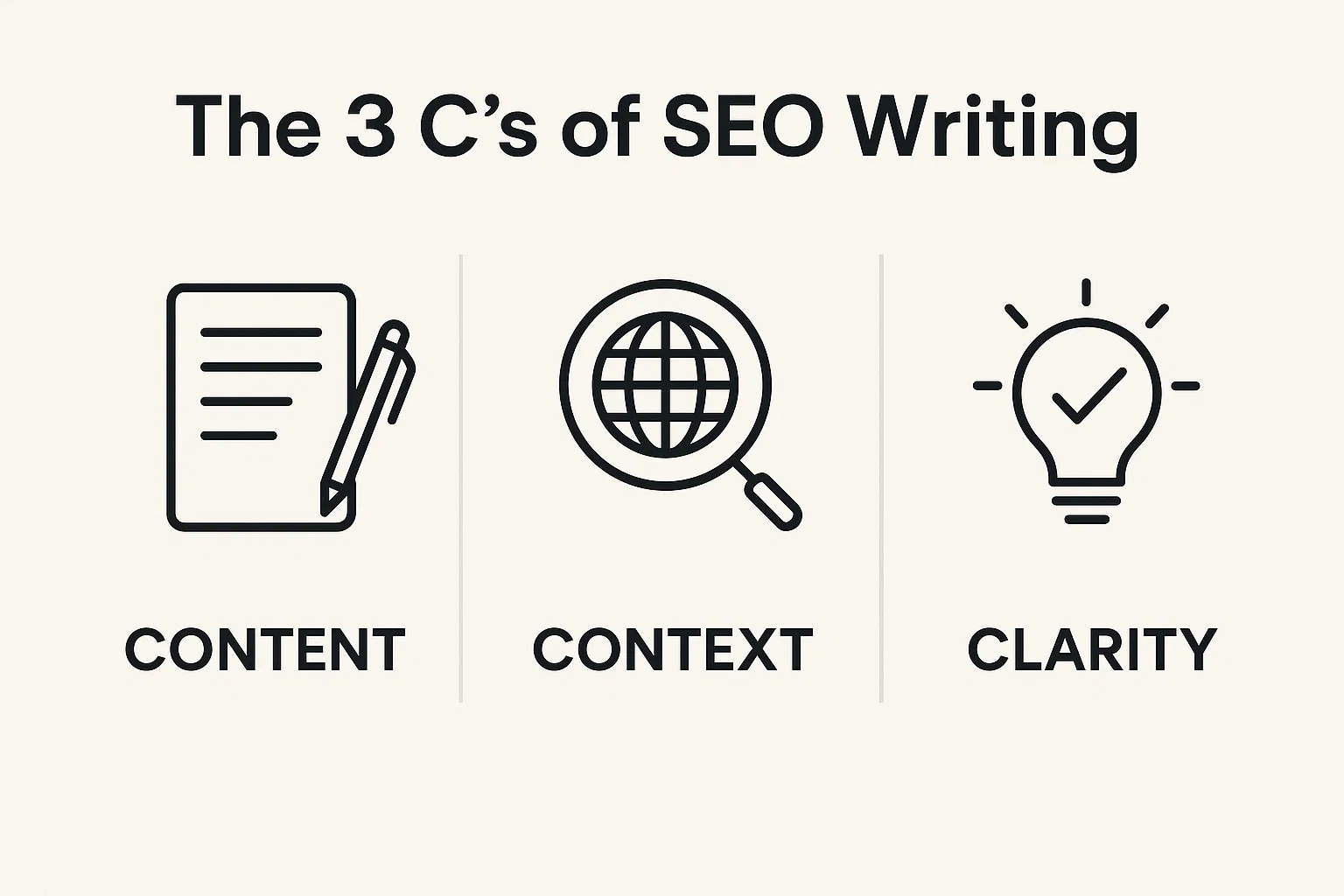
1. Content
This is your foundation. Great SEO writing begins with helpful, original, and comprehensive content. Google’s 2024 update puts heavy emphasis on Experience, Expertise, Authoritativeness, and Trustworthiness (E-E-A-T). That means every word you write should come from real knowledge or experience.
Ask yourself:
- Am I adding something new or just rephrasing what’s already out there?
- Does my article truly solve the reader’s question?
- Is it written in plain, engaging language?
2. Context
Keywords are still crucial, but they’re now about context the web of meanings around your topic. Using related phrases, entities, and subtopics helps search engines understand the bigger picture.
For example, if you’re writing about “SEO writing,” contextual terms might include keyword research, on-page optimization, readability, meta tags, and content intent.
3. Clarity
Clarity means structure, flow, and tone. An article with short paragraphs, descriptive headings, and clear takeaways keeps readers (and Google) happy.
Avoid jargon unless you explain it. Use active voice, sub-headings, and even bullet lists. Your goal is to make information digestible like a well-organized menu instead of a messy buffet.
The Anatomy of an SEO-Optimized Article
Let’s go practical. A solid SEO article follows a structure that feels natural to readers and logical to search engines:
| Section | Purpose | SEO Role |
|---|---|---|
| Headline (H1) | Hooks the reader | Includes the main keyword |
| Introduction | Sets context, builds curiosity | Early keyword placement |
| Body (H2/H3) | Delivers value in sections | Keyword variations, semantic terms |
| Examples/Lists | Clarify and engage | Enhances user time on page |
| Conclusion | Summarizes and inspires action | Encourages internal linking and shares |
When you write with this anatomy in mind, SEO feels less like an algorithmic game and more like thoughtful organization.
Keyword Research The GPS of SEO Writing
Keywords are your compass. They tell you where readers are and what they want. But good keyword research goes beyond high search volume it finds the right intent match.
Here’s a quick system I use:
- Start with questions. What are people asking on Google or Reddit?
- Use keyword tools. Platforms like Ahrefs, SEMrush, or even Google’s “People Also Ask” section show real search patterns.
- Check competition. If big brands dominate the top results, aim for a niche angle instead.
- Balance volume and difficulty. A keyword with 1,000 searches and low difficulty beats one with 10,000 and impossible competition.

Example
If your niche is content marketing, “what is SEO writing” is a strong root keyword. Related terms like “SEO content tips,” “how to write for SEO,” and “SEO copy examples” are supporting branches that grow your topical authority.
Writing for Humans First (and Google Second)
The biggest mistake beginners make is writing for algorithms instead of people. Google’s AI (RankBrain, BERT, and Gemini updates) now measures engagement time on page, scroll depth, and bounce rate as signals of quality.
So if your content feels dull, over-optimized, or repetitive, it’s not going to perform.
Tips for Human-First SEO Writing
- Write conversationally. Imagine you’re talking to one person.
- Use short, rhythmic sentences mixed with occasional longer thoughts.
- Add micro-stories or relatable examples.
- Break monotony with visuals, quotes, or tables.
- Re-read aloud if it sounds weird, it is weird.
Real Example of SEO Writing
Let’s illustrate with a quick example.
Non-SEO writing:
“Our company offers multiple solutions that can optimize digital presence for potential clients.”
SEO-friendly rewrite:
“We help small businesses grow online through simple SEO strategies that boost visibility and sales.”
See the difference? The second one uses clear language, natural keywords (“SEO strategies,” “boost visibility”), and direct value for the reader. It feels authentic yet optimized.
That’s SEO writing at its best clear, helpful, and discoverable.
How AI Tools Can Help (Without Replacing You)
As someone who’s worked with GPT, Jasper, Claude, and more, I’ll say this upfront: AI can assist, but not replace, great writers.
Here’s how you can use AI tools wisely in SEO writing:
- For idea generation. Ask AI for headline options, subtopics, or related keywords.
- For first drafts. Let it outline or expand your ideas, then humanize and fact-check.
- For optimization. Use AI SEO analyzers to check readability, tone, or missing keywords.
- Never for final voice. Always rewrite in your tone AI doesn’t understand your brand’s emotion or nuance.
Think of AI as a smart assistant, not a ghostwriter. You provide the brain; AI provides the speed.
Common SEO Writing Mistakes to Avoid
Even experienced writers slip into bad SEO habits. Watch out for these pitfalls:
| Mistake | Why It Hurts |
|---|---|
| Keyword stuffing | Makes content unreadable and flags Google spam filters |
| Ignoring search intent | Misleads readers and increases bounce rate |
| Writing for bots | Produces bland, lifeless copy |
| Skipping meta details | Misses out on click-through opportunities |
| Forgetting internal links | Weakens content authority and site structure |
| Neglecting readability | Loses human trust the most important ranking signal |
Remember: SEO isn’t about tricking Google. It’s about helping it understand your helpfulness.
How to Measure SEO Writing Success
After publishing, don’t just walk away. Track and learn.
Here’s what to monitor:
- Organic traffic: Use Google Search Console to see keyword impressions and clicks.
- Engagement: Tools like Google Analytics or Plausible show bounce rate and time on page.
- Rank positions: Track keywords monthly to spot growth trends.
- Backlinks: Quality backlinks validate your authority.
Even small improvements like moving from position 10 to 6 can double your traffic. SEO is long-term patience rewarded with compounding results.
Beyond Keywords: The Role of Topical Authority
Search engines don’t just rank pages anymore they rank publishers with expertise.
If you write multiple well-connected articles around one topic (like “SEO writing,” “keyword strategy,” “content optimization,” etc.), you build topical authority.
Think of your blog as a neighborhood. Each article is a house. Internal links are the roads. The better connected your roads, the easier it is for both users and crawlers to explore.
That’s why internal linking isn’t optional; it’s architecture.
How Readability and Emotion Boost SEO
Emotion keeps readers reading. Google tracks engagement metrics so when readers scroll, pause, highlight, or share, it signals value.
Write with empathy:
- Use you and we often.
- Replace “users” with “people.”
- Avoid walls of text; use rhythm and white space.
- Sprinkle curiosity: ask questions like “Ever wonder why your blog isn’t ranking yet?”
Good SEO writing feels alive.
Creating an SEO Writing Workflow
Here’s a repeatable 7-step workflow that works whether you’re writing a blog, guide, or landing page:
- Research your topic deeply. Know what’s ranking and what’s missing.
- Outline logically. Group ideas under strong H2/H3 headings.
- Find keywords. Use 2–3 main and 5–10 supporting ones.
- Write the first draft freely. Don’t obsess about SEO yet.
- Optimize naturally. Add keywords, links, and meta tags after editing.
- Read aloud for flow. If it sounds robotic, rephrase.
- Publish and track. Re-optimize after a few weeks based on data.
That’s the rhythm professionals follow part creativity, part system.
Why SEO Writing Is the Future of Digital Communication
SEO writing is no longer a niche skill; it’s literacy for the digital age. Whether you’re a freelance writer, marketer, or business owner, understanding SEO is like knowing how to read the map of the internet.
The future belongs to those who can combine human storytelling with algorithmic awareness. AI will continue to evolve, but empathy, insight, and originality will remain unbeatable advantages.
So, Writing That Connects and Converts
So, what is SEO writing and why does it matter?
It’s the art of making your words visible, valuable, and findable. It turns ideas into discoverable experiences.
You don’t have to chase every Google update or memorize every ranking factor. Just remember this: write for humans, optimize for clarity, and stay consistent.
Every great SEO writer starts the same way with one helpful article that earns attention naturally. Let yours be that one.

Covers AI writing tools, large language models, prompt engineering, AI detection, and practical AI writing workflows for Spinbot.ORG.