
Ever stumbled across two blog posts that looked oddly alike same structure, same ideas, only the words shuffled around like a deck of cards?
Welcome to the world of content spinning a clever, controversial, and surprisingly educational corner of online writing.
I’ve spent years watching spinning tools evolve from primitive “replace-word-with-synonym” gimmicks into sophisticated AI rewriters. Some people still call it cheating; others call it automation genius.
Let’s unpack what’s really going on here, how content spinning works, and where the line between smart optimization and plagiarism lies.
The Idea Behind Content Spinning
At its core, content spinning means rewriting existing text to create a new version one that looks different to search engines but conveys the same meaning to readers.
Back in the early 2010s, spinners were the secret weapon of SEO hustlers. Writers took one decent article, ran it through a “spinner,” and generated hundreds of “new” posts. The idea was simple: more pages, more backlinks, higher rankings.
It sort of worked until Google caught on.
Modern spinning, however, has taken on a new life thanks to AI rewriting tools like Spinbot, Quillbot, and ChatGPT. Instead of producing gibberish, these tools can restructure, simplify, and clarify text while keeping its intent intact.
So yes, content spinning still exists but it’s evolving.
How Content Spinning Works (Step by Step)
To understand spinning, picture a writer trying to say “The quick brown fox jumps over the lazy dog” without copying it.
They could write:
- “A fast brown fox leaps across a sleepy dog.”
- “The brown fox swiftly jumped over the resting dog.”
Same meaning, new wording that’s manual spinning.
Now let’s break down how tools automate this process.
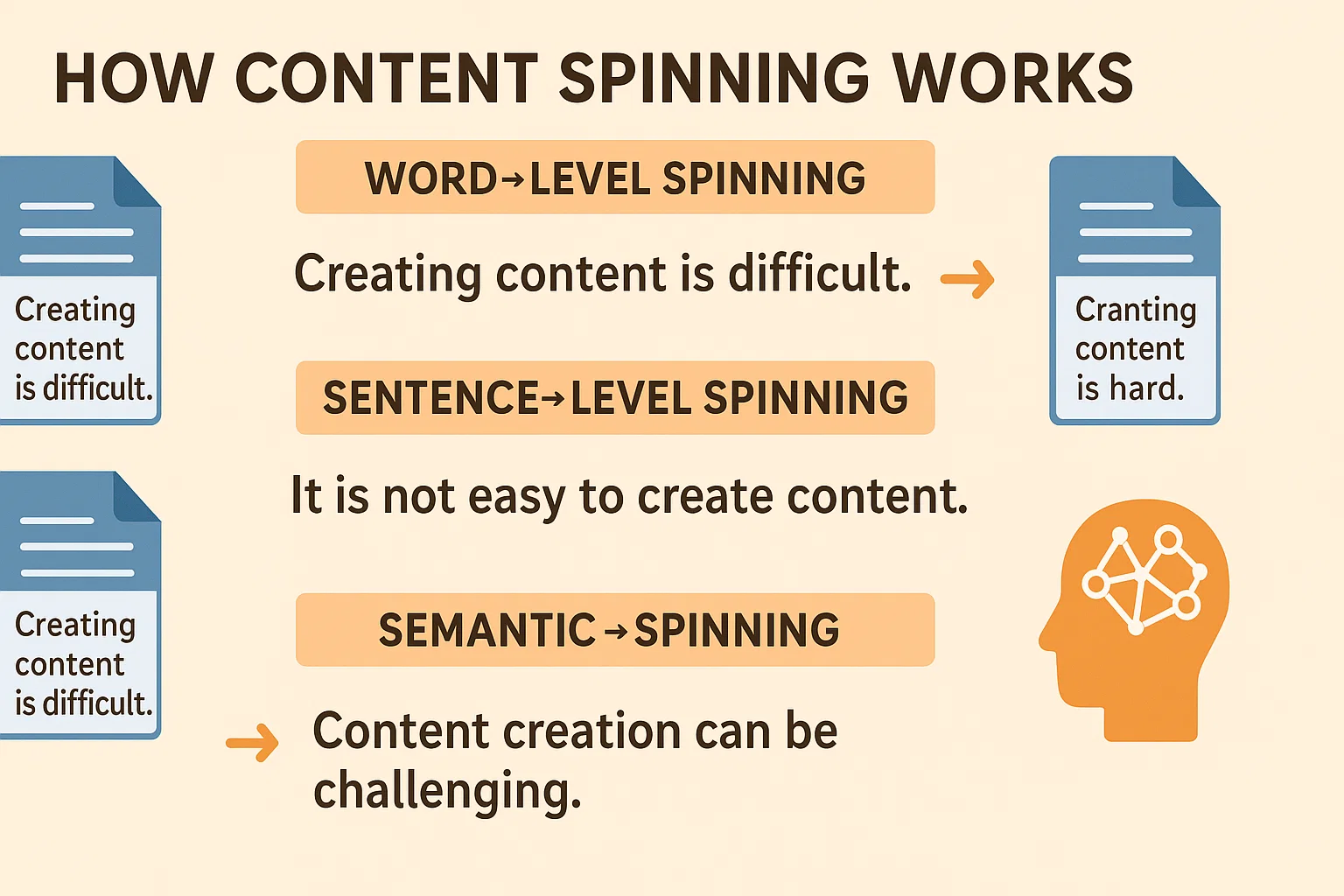
1. Word-Level Spinning
Early spinners simply swapped synonyms:
Original: The company announced a new product.
Spun: The corporation declared a novel item.
This type worked fast but produced robotic, sometimes unreadable sentences.
2. Sentence-Level Spinning
More advanced spinners rearranged sentence order or rewrote sentences completely.
They analyzed grammar patterns and tried to maintain context, which made text flow a little better.
3. Semantic or AI-Based Spinning
Today’s AI spinners rely on natural-language processing (NLP) to understand meaning.
They paraphrase, rephrase, shorten, or expand ideas contextually. For example, GPT-based tools can detect tone, intent, and topic relevance.
Instead of “find synonym,” they think in concepts: How else can this idea be said clearly?
That shift from mechanical substitution to semantic understanding is why spinning has resurfaced as a legitimate writing technique when used wisely.
Old-School vs. AI-Driven Spinning
| Feature | Old-School Spinning | AI-Driven Spinning |
|---|---|---|
| Method | Synonym swapping | Semantic rewriting |
| Readability | Often poor | Usually natural |
| Goal | Bulk content | Quality rephrasing |
| Human Edit Needed | Always | Sometimes minimal |
| Google Friendly? | Risky | Safer (if original meaning preserved) |
In the old days, you could spot spun text a mile away: awkward phrases, broken grammar, nonsense words.
AI spinning, though, has blurred that line. Many tools now promise “human-grade rewriting,” and while they’re impressive, they still require your judgment.
If you use them like a magic wand, you’ll still end up with fluff. But when used as creative assistants, they can help reframe ideas, avoid redundancy, and overcome writer’s block.
Is Article Spinning Legal?
Here’s where it gets tricky.
Legally speaking, spinning isn’t automatically illegal but it can cross into copyright infringement if you duplicate someone’s protected text.
Copyright law protects expression, not ideas. So if your spun version copies the original’s structure or phrasing too closely, you’re in danger.
Think of spinning like remixing a song. You can’t just speed up someone else’s track and call it yours. You have to transform it bring something new.
In academia and journalism, spinning without credit equals plagiarism. In marketing, it’s a gray zone. The key test is transformative use:
- Did you rewrite enough to create new value?
- Did you add insight, analysis, or examples?
If yes, you’re fine. If no, you’re skating on thin ethical ice.
Are Article Spinners Ethical to Use?
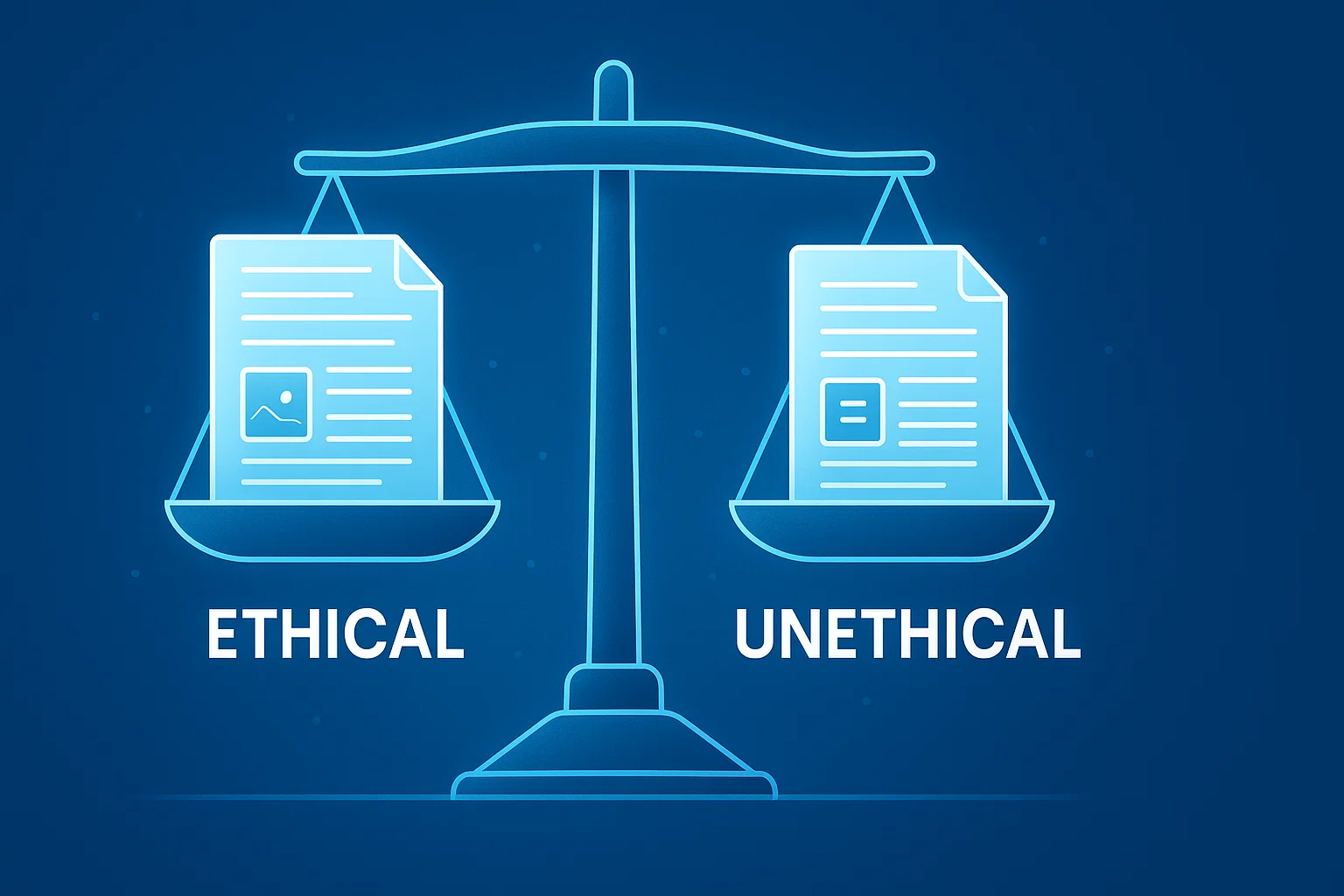
Ethics depend on intent.
If you’re spinning content just to trick Google into ranking duplicate pages, that’s unethical.
If you’re using spinning tools to learn how to rephrase, simplify, or draft multiple versions for testing totally fair.
Writers use spinning ethically when they:
- Rewrite their own work to sound fresher.
- Simplify complex explanations for different audiences.
- Generate variations for A/B testing or social media snippets.
Unethical spinning happens when:
- The user hides the source.
- The output misleads readers into thinking it’s unique.
- It replaces research and originality with automation.
In short: use spinning for creativity, not deception.
What Happens When You Publish Spun Content?
Google’s algorithms especially after the Helpful Content and SpamBrain updates are trained to detect duplication and low-value paraphrasing.
Here’s what can happen if you abuse spinning:
- Ranking Drops: Duplicate or low-quality pages get filtered out.
- Domain Reputation Damage: If your site repeatedly posts spun text, Google may treat it as spam.
- Reader Trust Erosion: Human readers notice bland, repetitive phrasing. They bounce fast.
Modern SEO favors original thought, helpful intent, and clear writing over quantity.
If spinning saves time, great but it must serve a creative or educational purpose.
Smarter Alternatives to Old-School Spinning
There’s a difference between spinning for SEO and rewriting for clarity.
Here are modern, ethical ways to achieve the latter:
Use AI Rewriting Tools as Co-Writers
Tools like Spinbot, Quillbot, and ChatGPT can paraphrase paragraphs without distorting meaning. The secret is to guide them don’t just paste and pray.
Feed them prompts like:
“Rewrite this in a friendlier tone for beginners.”
“Make this paragraph sound more natural.”
Rewrite From Notes, Not Copy
Take bullet points or quotes, then explain them in your own words. This keeps your thinking in control.
Combine Sources Thoughtfully
Merge insights from several articles, then synthesize them into something new.
If three sources say the same thing, explain why it matters rather than repeating.
Add Personal Touches
Tell a short story, an example, or a lesson from experience. No spinner can imitate your lived perspective and that’s your biggest advantage.
How Writers Can Use Spinning Wisely
I often tell beginner writers: spinning isn’t evil; laziness is.
Used correctly, it can sharpen your writing muscles.
Here’s how:
- Draft Fast: Spin your rough paragraph to see alternate phrasings.
- Learn Synonyms Naturally: Observe how AI rephrases and pick what fits your voice.
- Compare Styles: Use different tools and notice tone shifts formal, casual, academic.
- Refine for Flow: After spinning, always read aloud. Anything awkward must go.
- Check for Plagiarism: Use tools like Grammarly, Copyscape, or Turnitin before publishing.
When you treat spinning as a learning exercise, not a shortcut, it becomes an ethical skill-builder.
Human Touch: The Secret Ingredient
Even with flawless grammar, AI text can feel cold.
Readers crave emotion, rhythm, and storytelling things humans excel at.
So after spinning:
- Inject Emotion: Replace flat sentences with personal tone.
- “It is important to write unique content.” → “If you want readers to stick around, give them something real.”
- Simplify Naturally: Instead of jargon, use everyday words.
- Add Voice: Sprinkle phrases like “you know,” “let’s be honest,” or “trust me” they bridge the digital gap.
AI can mimic language, but connection comes from you.
The Future of Content Spinning
Spinning is evolving from shady SEO trick to legitimate creative aid.
With NLP, rewriters no longer just shuffle synonyms they understand nuance.
In the near future, we might see:
- Real-time rewriting assistants integrated into CMS platforms.
- Adaptive paraphrasers that maintain tone consistency across languages.
- Ethical AI labels marking spun yet original-value content.
But regardless of tech, one rule remains: originality wins.
If your content helps someone, answers a question, or sparks curiosity, you’re doing spinning the right way.
Final Reflection: Spin Ideas, Not Just Words
At the end of the day, content spinning isn’t about fooling algorithms it’s about rethinking expression.
Writers spin because they’re searching for the perfect phrasing, the clearest metaphor, the simplest explanation.
When you spin ideas with honesty and creativity, you’re not duplicating you’re evolving.
So go ahead experiment with AI spinners, learn their patterns, refine your craft.
Just remember: technology should amplify your originality, never replace it.

AI writing strategist with hands-on NLP experience, Liam simplifies complex topics into bite-sized brilliance. Trusted by thousands for actionable, future-forward content you can rely on.