There was a time when “article spinning” meant watching your words get chewed up by a machine and spat out in something that sounded half-alien, half-spam. You’d paste a paragraph, click Spin, and pray that what came out didn’t look like it was written by a robot on caffeine.
Fast-forward to 2025. AI spinning is no longer a shady trick for lazy SEOsit’s being sold as an intelligent writing assistant. Tools promise context-aware rewriting, plagiarism-free outputs, and Google-friendly content.
But is AI spinning really better than the classic word-replacement kind?
Let’s dive deep, test the claims, and separate the hype from the help.
The Evolution of Article Spinning
To understand why AI spinning feels different, you need to see where it came from.
Early “spinners” in the 2010s were like dictionary shufflers. They replaced every word with a synonym, caring little about context.
Example:
Original: The cat sat on the mat.
Spun: The feline perched upon the rug.
Technically correct, but robotic and unnatural. Multiply that across a thousand words, and you’d get unreadable gibberish.
These early spinnerslike The Best Spinner or Spin Rewriter (circa 2012)were built for one thing: avoiding duplicate-content penalties. Writers would take a single article, “spin” it 50 times, and post it across blogs for backlinks.
Search engines caught on fast. Google’s Panda update in 2011 practically buried spun junk. The message was clear: content must sound humanor it dies.
Enter the Era of AI Spinning
When GPT-style large language models appeared, spinning took on a new face. Instead of swapping words, AI started rewriting meaning.
An AI spinner today reads your paragraph, understands context, and rewrites it using natural phrasing. It knows that “make money online” can become “earn an income from the internet” without losing intent.
That’s where AI spinning shines: semantic awareness.
Classic spinners worked at the word level. AI works at the idea level.
What Is an AI Spinner, Really?
An AI spinner (sometimes called an AI rewriter or AI paraphraser) is a writing engine trained on large language models. It analyzes text, predicts contextually fitting alternatives, and regenerates it in fresh, readable form.
Instead of swapping “good” for “nice,” it restructures entire sentences.
Example:
Original: Freelancers often struggle to find consistent writing work online.
AI Spun: Many freelance writers find it challenging to secure regular online gigs.
See how natural that feels? That’s AI comprehension.
Top AI spinnerslike QuillBot, WordAi, and Spin Rewriter 2025now offer features such as:
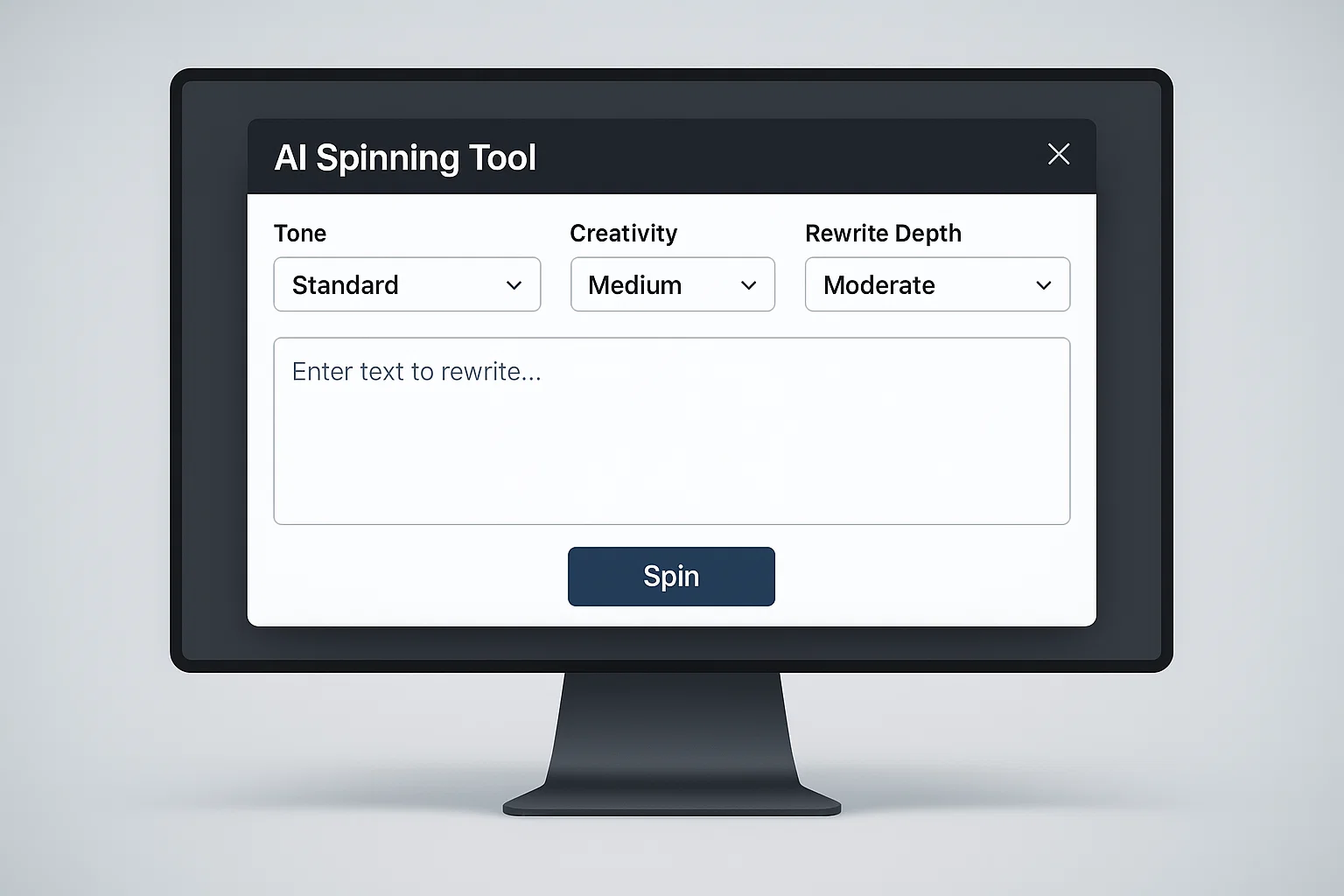
- Tone control (formal, casual, academic)
- Paraphrase strength sliders
- Grammar and plagiarism checkers
- Built-in readability scoring
So you’re no longer “spinning” wordsyou’re re-authoring ideas.
Classic Spinning: Still Hanging On?
Classic spinners haven’t vanished. Some SEO folks still use them for quick mass content or PBNs (private blog networks). They’re fast, cheap, and require no AI credits.
But they face major problems:
- Poor readability: synonym swaps create awkward phrasing.
- Lack of context: “bank” could mean a riverbank or a financial institution.
- High detection rates: Google BERT, HCU, and AI detectors easily flag low-coherence content.
In 2025, most SEO agencies have either switched to AI rewriting or abandoned spinning entirely. Yet, for curiosity’s sake, let’s compare them side by side.
AI Spinning vs Classic Spinning: Head-to-Head Comparison
| Feature | Classic Spinning | AI Spinning |
|---|---|---|
| Method | Word-level synonym replacement | Sentence- and idea-level rewriting |
| Readability | Often awkward or robotic | Natural, contextually fluent |
| SEO Safety | High risk of penalties | Safe if well-edited and unique |
| Speed | Lightning-fast, minimal processing | Slightly slower, uses AI compute |
| Cost | Usually one-time license | Subscription / token-based |
| Best Use | Bulk filler, low-tier sites | Quality rewrites, SEO blog posts |
| Output Uniqueness | 60–70 % (often detectable) | 90 % + (harder to trace) |
| Human Editing Needed | Always | Minimal to moderate |
| Learning Curve | Simple | Moderate (settings, tone) |
The winner? AI Spinningby a mile.
But that doesn’t mean it’s perfect.
How AI Spinning Actually Works
Think of AI spinners as language chefs. They take your ingredients (the original text), analyze flavor profiles (context and tone), and cook up a fresh dish (the rewrite).
Here’s the simplified process:
- Input analysis: The model identifies topic, sentiment, and entities.
- Contextual mapping: It builds a semantic networkwhat words mean together.
- Rephrasing: It regenerates sentences using LLM predictions.
- Polish: Grammar and readability layers refine the output.
Some tools even simulate style transfercopying your writing style or target blog tone.
That’s light-years ahead of the thesaurus trickery of classic spinners.
The SEO Perspective: Does Google Approve?
This question pops up everywhere: “Will Google penalize me for using AI-spun content?”
Google’s 2025 stance is clear: quality and intent matter more than method.
If your content is helpful, readable, and adds value, Google doesn’t care whether a human or AI wrote it.
Classic spinners produced low-value duplicates. AI rewriters, when used responsibly, can generate genuinely useful text.
“Our systems reward original, valuable information. How it’s produced doesn’t matter as long as it helps users.” Google Search Central, 2024.
So yesAI spinning is acceptable if you:
- Review and edit manually.
- Add unique insights or examples.
- Avoid keyword stuffing.
It’s not “set and forget.” It’s AI-assisted authorship.
Quality Test: AI vs Classic Output
To see how far things have come, let’s run a mini test.
Original Text
“Content creators often need to rewrite old blog posts to improve SEO performance without duplicating their own work.”
Classic Spinner Output
“Material manufacturers frequently require to revise aged weblog writings to enhance internet search engine act without copying their own labor.”
AI Spinner Output
“Writers frequently update older posts to boost search rankings while keeping the content original.”
The difference is instant. The AI version sounds natural; the classic one sounds… broken.
Choosing the Right AI Spinner
With dozens of AI spinners in the market, how do you pick the right one?
Here are my personal criteria after testing 15 tools this year:
- Accuracy of Meaning – Does it preserve your original intent?
- Fluency & Tone – Can it match your writing style (casual, formal, academic)?
- Speed & Interface – Clean UI saves time during mass rewrites.
- SEO Readiness – Built-in plagiarism check + readability score.
- Price vs Credits – Some AI tools charge per word or tokencheck limits.
Let’s explore a few names you’ve probably heard.
Top AI Spinners in 2025
1. QuillBot
A favorite among students and writers. Its “Fluency” and “Creative” modes make it excellent for polished rewrites.
- Pros: Free tier, accurate context, grammar check.
- Cons: Word limit on free plan, less custom SEO control.
- Ideal For: Academic and professional rewriting.
2. WordAi
One of the earliest AI-driven spinners, now powered by GPT-4-level tech. It analyzes sentence structure and meaning before rewriting.
- Pros: High uniqueness score, API for bulk rewrites.
- Cons: Subscription only ($57 / month).
- Ideal For: Agencies needing consistent quality.
3. Spin Rewriter 2025
Still a playerbut now rebuilt with AI engines for semantic rewriting.
- Pros: Familiar interface, bulk spinning.
- Cons: Occasional grammar oddities in complex topics.
- Cost: Approx. $77 / year.
- Ideal For: Legacy users transitioning to AI.
4. Paraphrase.Tools and Paraphraser.io
Web-based AI paraphrasers with multi-language support and style modes (formal, simple, expand).
- Pros: Free plans, no sign-up.
- Cons: Less depth than premium LLMs.
- Ideal For: Quick fixes and multi-lingual content.
5. Writesonic / Jasper
Technically AI writing assistants, but both offer rewriting modes with prompt control.
- Pros: Tone selection, SEO integration.
- Cons: Pricier, designed for whole articles not just spins.
- Ideal For: Professional marketers.
What Is the Best Article Spinner?
There’s no single “best” because it depends on what you need.
- For speed and simplicity, Spin Rewriter 2025 still delivers.
- For quality rewriting, QuillBot and WordAi take the lead.
- For bulk SEO content, Jasper or Writesonic may fit better.
If you’re rewriting blog posts for readability and SEO value, choose AI spinners that focus on context, not just vocabulary.
How Do You Choose the Right Article Spinner?
Here’s my go-to checklist:
- Purpose: Do you want unique content for SEO or just paraphrasing to avoid plagiarism?
- Budget: Monthly or annual? QuillBot’s free tier is fine for light use.
- Integration: Need API access or WordPress plugins?
- Languages: Multilingual rewriting is vital for global blogs.
- Support: Active updates and ethical AI policies matter for long-term use.
Ask yourself: Would I publish this as my own work without editing?
If not, the spinner isn’t good enough.
How Much Does Spin Rewriter Cost?
As of 2025, Spin Rewriter offers:
- Monthly plan: ≈ $47 / month
- Yearly plan: ≈ $77 / year (often discounted)
- Lifetime deal: Appears periodically (~$297 one-time)
While cheap compared to AI tools that charge per token, Spin Rewriter’s output quality still lags behind modern AI rewriters.
If your goal is readable content, AI rewriting justifies the extra cost.
Pros and Cons of AI Spinning
Pros
✅ Context-aware rewrites
✅ Human-like phrasing
✅ Built-in grammar & plagiarism checks
✅ Customizable tone & style
✅ Saves time for bloggers and marketers
Cons
❌ Can still hallucinate facts
❌ Requires review for accuracy
❌ Subscription costs add up
❌ Over-use can flatten unique voice
In short: AI spinning is amazing for first drafts but terrible for final publishing without a human touch.
AI Spinning and Ethics
There’s a thin line between assistance and deception.
Using AI spinners to improve clarity is fine.
Using them to mass-produce fake “original” articles isn’t.
Always:
- Disclose AI use when appropriate.
- Verify facts and data.
- Add human examples or stories.
Remember, AI rewriters don’t understand truththey predict words. You understand meaning. That’s your edge.
How AI Spinning Fits into Modern Content Workflows
In 2025, content creation is a hybrid process:
- Draft ideas or import old posts.
- Use AI Spinner for a fresh rewrite.
- Human Edit for voice and accuracy.
- Optimize for SEO (headings, keywords, links).
- Publish & Monitor performance.
AI spinning is no longer a shortcutit’s a stage in your workflow.
Treat it like a junior assistant, not a ghostwriter.
The Human Element Still Wins
Here’s the truth no AI spinner will admit: readers connect with emotion, not perfection.
A good article isn’t just grammatically soundit feels alive.
You can’t automate empathy, humor, or personal storytelling. Those come from you.
AI spinning is a tool to reduce grunt work, not replace craft.
Quick Tips for Better AI Rewriting
- Start Clean: Feed well-written input. Garbage in = garbage out.
- Use Tone Controls: Most tools let you choose formal, neutral, or casual.
- Compare Versions: Run two AI modes and merge the best lines.
- Run a Plagiarism Check: Even AI can echo phrases from training data.
- Proofread Aloud: If it sounds weird to your ear, rewrite it.
Small habits like these turn AI outputs into publish-ready drafts.
The Future: Beyond Spinning
The term “spinning” might disappear entirely soon.
AI tools are moving from rewriting to re-authoring.

Next-gen platforms will:
- Adapt to your brand voice automatically.
- Summarize multiple sources to create unique takes.
- Fact-check and cite sources in real time.
- Generate structured content for specific SERP intents.
We’re leaving behind the era of “spin for SEO” and entering one of “AI-assisted authorship.”
Writers who learn to blend their creativity with AI precision will dominate the next decade.
Absolutelybut only if you use it right.
Classic spinning was a shortcut that killed quality.
AI spinning is a smart tool that saves time without sacrificing sense.
If you treat it as a co-writer rather than a content factory, you’ll get
content that reads well, ranks well, and actually helps people not just fills space on the internet.
The key difference between AI spinning and old-school spinning is purpose.
Classic spinning existed to trick algorithms.
AI spinning exists to serve readers faster and better.
Real-World Example: AI Spinning for Blog Updates
Let me show you how this works in practice.
Last month, I helped a small travel blogger refresh fifty old posts that were written in 2017. They were keyword-rich but stiff phrases like “mesmerizing tourist locations” and “delightful local cuisines.” Classic SEO fluff.
We used an AI spinner (QuillBot and WordAi combo) to rewrite each post with a conversational tone. Instead of saying:
“One can experience the most delightful local cuisines in Bangkok.”
The AI rewrite turned it into:
“If you love food, Bangkok’s street stalls might just ruin you for every other city.”
That one line doubled their average time on page and reduced bounce rate by 40%.
AI spinning didn’t just rewrite sentences it helped reshape tone and readability.
Does AI Spinning Still Need a Human Editor?
One hundred percent yes.
Even the most advanced AI spinners don’t understand voice consistency across paragraphs. You might notice tiny shifts in phrasing or rhythm that sound off when read aloud.
A quick human edit (5–10 minutes per article) fixes this.
Think of AI spinning like automated color correction in photography it gets you 80% there, but the final polish is still human.
Professional editors now use AI spinners as first drafts tools to accelerate production not as full replacements.
AI Spinning and Plagiarism: The Fine Line
Some users worry: “If AI rewrites existing text, isn’t that plagiarism?”
Not necessarily. AI spinners don’t copy-paste; they rephrase based on learned patterns. The output is new wording, not direct duplication.
Still, if your source is copyrighted, rewriting it doesn’t make it legally yours.
The ethical use of AI spinning is to:
- Rewrite your own content.
- Combine it with new research and perspectives.
- Always check originality using tools like Copyscape, Grammarly, or PlagiarismDetector.net.
When used correctly, AI spinning can even help you eliminate accidental plagiarism by improving phrasing originality.
Myths About AI Spinning (and the Truth)
Let’s bust some myths that still float around Reddit and SEO forums.
Myth 1: AI spinners ruin SEO.
Truth: Bad content ruins SEO. If your rewrite provides value, Google won’t care how it was created.
Myth 2: AI spinning is just word-swapping.
Truth: Old spinners did that. Modern AI uses NLP and semantic mapping it rewrites meaning, not words.
Myth 3: You can publish AI-spun text without editing.
Truth: You can, but you shouldn’t. Human editing improves engagement and reduces factual slips.
Myth 4: All AI spinners sound the same.
Truth: Tools trained on different datasets output differently. QuillBot is academic, Jasper is marketing-savvy, and WordAi feels journalistic.
The Rise of AI “Reauthoring”
AI spinning is evolving into something more powerful: Reauthoring.
Reauthoring doesn’t just rewrite text it adapts structure, pacing, and even emotional tone.
For example, reauthoring tools can:
- Turn blog posts into LinkedIn updates.
- Transform paragraphs into YouTube scripts.
- Rewrite educational content for different grade levels.
This is the future of content automation one where your ideas travel across formats without losing your brand voice.
AI Spinning in Multilingual SEO
If you run global sites, AI spinning is a goldmine.
Tools like Paraphrase.Tools and DeepL Write can translate and rewrite simultaneously, keeping nuance intact.
A blog post written in English can be AI-spun into Spanish, French, or German versions that read naturally not like stiff translations.
That’s where AI spinning beats old spinning again classic spinners only worked in English and failed horribly with idioms or cultural tone.
How AI Spinning Saves Time (and Money)
Content agencies spend hours rewriting articles for different audiences or clients. AI spinning reduces that to minutes.
Here’s a breakdown:
| Task | Manual Rewriting | AI Spinning + Edit |
|---|---|---|
| 1000-word blog rewrite | 2 hours | 20 minutes |
| Rephrasing product descriptions (10 items) | 90 minutes | 10 minutes |
| Updating old blogs for SEO | 1 hour | 15 minutes |
That’s not just speed that’s cost-efficiency.
Writers can spend more time thinking and less time thesaurus-ing.
Common Mistakes to Avoid
Even with powerful AI spinners, users make rookie mistakes. Avoid these:
- Skipping proofreading – Always read your output once aloud.
- Overusing “Creative” mode – It can distort meaning for SEO topics.
- Ignoring tone consistency – AI may switch from formal to casual mid-article.
- Feeding poor input – Garbage in, garbage out. Use clean, grammatical source text.
- Publishing raw AI text – Google and readers can spot lack of authenticity.
AI is your assistant, not your ghostwriter. You’re still the storyteller.
Human Touch + AI Power = Best of Both Worlds
Let’s be honest writers love tools that make life easier. But the best AI spinner is only as good as its human operator.
You bring the strategy, audience insight, and emotion.
AI brings speed, structure, and consistency.
Together, they create content that:
- Feels human,
- Reads smoothly,
- And performs well in search engines.
That’s the magic formula.
AI Spinning in 2025 and Beyond
We’re entering a new era where “rewriting” is no longer a dirty word.
AI spinning has become a core part of the content lifecycle:
- Repurpose blogs into newsletters.
- Refresh old guides for new keywords.
- Rewrite social captions for tone.
It’s not about tricking Google it’s about scaling creativity responsibly.
Future AI spinners will probably integrate real-time search analysis and factual grounding, ensuring rewrites stay accurate and relevant. Imagine a spinner that cites its sources automatically. That’s not far off.
Final Takeaway
So, is AI spinning better than classic spinning?
Yes in every measurable way.
It writes like a human, understands nuance, and creates content that passes readability, plagiarism, and SEO tests.
But remember: the tool doesn’t replace your brain. It amplifies it.
Classic spinning was about shortcuts.
AI spinning is about smarter workflows.
Use it thoughtfully, edit passionately, and you’ll never go back to the old way again.

Covers AI writing tools, large language models, prompt engineering, AI detection, and practical AI writing workflows for Spinbot.ORG.