

A page should usually have one main search intent, supported by one primary keyword and several closely related terms. There is no official Google rule saying you should use 3, 5, 10, or any other fixed number of keywords on a page.
In practice, I would rather build a page around one clear primary keyword plus roughly three to eight useful supporting terms than try to squeeze 20 unrelated phrases into the same article. That range is a planning guideline, not a ranking formula.
Google’s own SEO guidance supports this broader approach. It recommends thinking about the different words people may use when searching for your content, but it also says its language systems can understand how a page relates to many queries even when every variation is not written word-for-word on the page.
How Many Keywords Should You Target Per Page?
For most pages, use:
- One primary keyword or topic
- Several closely related secondary keywords
- Natural variations and questions where they help the reader
You do not need to count every variation as a separate SEO keyword.
Suppose your primary keyword is:
how many keywords SEO per page
Closely related supporting ideas could include:
- how many keywords should a page target
- primary and secondary keywords
- how to use keywords
- keyword placement
- SEO keyword density
- keyword stuffing
- keyword cannibalization
These terms belong together because they help answer the same basic question.
Now compare that with something like amazon keywords search tool. It contains the word keywords, but the searcher is probably looking for Amazon marketplace keyword research rather than advice about optimizing a normal webpage for Google.
Putting both topics into one article would make the page broader without making it better.
That distinction matters more than hitting a certain keyword count.
Search Intent Matters More Than Keyword Count
Two keywords can look similar and still need different pages.
Search intent means the result a person expects when they type a query.
For example:
best keywords for real estate
and
how many keywords should I use on a real estate page
both involve real estate keywords, but the desired answers are different.
The first searcher probably wants a list of useful real estate search terms. The second wants an SEO strategy for deciding how many terms one property, service, or blog page should target.
Trying to rank one page equally for both can pull the content in different directions.
A better test is to ask:
Would a person searching both phrases be satisfied by essentially the same page?
If yes, the keywords can probably live together.
If one query requires a noticeably different answer, format, product, location, or decision, it may deserve its own page.
This is why keyword clustering should begin with intent instead of word similarity.
Primary, Secondary, and Supporting Keywords
Keyword planning becomes easier once you stop treating every phrase as equally important.
What Is a Primary Keyword?
The primary keyword is the phrase that best represents the page’s central topic and search intent.
It should normally influence the page title, main heading, opening discussion, and overall scope.
For this article, the central question is how many keywords a page should target for SEO. Everything else should help answer that question.
The primary keyword is not something you need to repeat every 100 words. It is a planning anchor.
What Counts as a Secondary Keyword?
Secondary keywords are closely related searches that add useful angles to the main topic.
If your article targets keyword usage per page, secondary topics might include:
- keyword research
- primary versus secondary keywords
- keyword placement
- search intent
- keyword stuffing
- cannibalization
Some secondary terms will appear exactly. Others will appear as natural variations.
That is fine.
Google specifically says publishers should not worry about anticipating every possible variation of a search query because its language matching systems can understand relationships between pages and many different searches.
How Many Supporting Terms Can You Use?
There is no meaningful maximum as long as the terms belong naturally in the discussion.
The better question is whether each term contributes something useful.
A 700-word answer might need only a few supporting phrases. A 2,500-word guide could naturally cover many more because it answers more related questions.
Do not expand an article merely because a keyword tool produced another 40 suggestions.
The page should stop expanding when additional keywords start introducing different search intents rather than deeper coverage of the same subject.
How to Search for Keywords for One Page
Good keyword research starts wider than one phrase, then becomes narrower.
Start With a Seed Keyword
Begin with the simplest phrase that describes what the page will answer.
For example:
real estate SEO
You might then find related searches such as:
- real estate SEO keywords
- local SEO for real estate
- real estate listing keywords
- SEO for real estate agents
- keywords for real estate listings
Do not immediately put all of them on one page.
First work out what each searcher actually wants.
Find Related Searches and Questions
Google’s search results can expose useful wording through autocomplete, related searches, and questions people commonly ask.
SEO tools can add search-volume estimates and competitor data, but the search result itself is useful for checking intent.
Look at the pages ranking for two keywords.
If nearly the same kinds of pages rank for both, that is a strong clue that Google interprets the searches similarly.
If the results are completely different, combining the terms may be a mistake.
Use Google Keyword Planner
Google Keyword Planner can generate ideas from keywords or from a website. Google says you can enter words related to your product or service or use a website as the starting point for discovering related keyword ideas.
Keyword Planner is primarily a Google Ads tool, so its competition and cost data should not be treated as direct organic-ranking difficulty scores.
Still, it can help you discover how people phrase a topic.
Check Existing Queries in Search Console
If your website already gets Google impressions, Search Console is often more useful than starting from scratch.
The Performance report shows the actual queries through which your pages appeared in search results. You can examine clicks, impressions, click-through rate, and page-level performance.
A useful workflow is:
- Open the page in Search Console’s Performance report.
- Review the queries associated with that URL.
- Find closely related searches with meaningful impressions.
- Check whether your page already answers those searches properly.
- Expand weak sections only when doing so genuinely improves the page.
One page may show impressions for dozens or hundreds of different searches. That does not mean somebody intentionally optimized the article for hundreds of keywords.
It often means Google understands the topic well enough to match the page with many variations.
How to Look for Keywords on a Website
There are several things people can mean when they ask how to look for keywords on a website.
If you simply want to see whether a phrase appears on a page, use your browser’s Find command.
That tells you whether the wording exists, but almost nothing about whether the page ranks for it.
For your own website, Search Console is much more useful. You can select a query and then view the Pages report to see which URLs Google has shown for that search. Google specifically documents this workflow in Search Console.
That becomes useful when checking for keyword cannibalization.
Imagine three blog posts all appear for the same important query. That is not automatically a problem, but it should make you inspect whether those pages serve different purposes or are competing versions of essentially the same answer.
For competitor websites, third-party SEO tools can estimate ranking keywords. Treat those figures as research data rather than exact Google data.
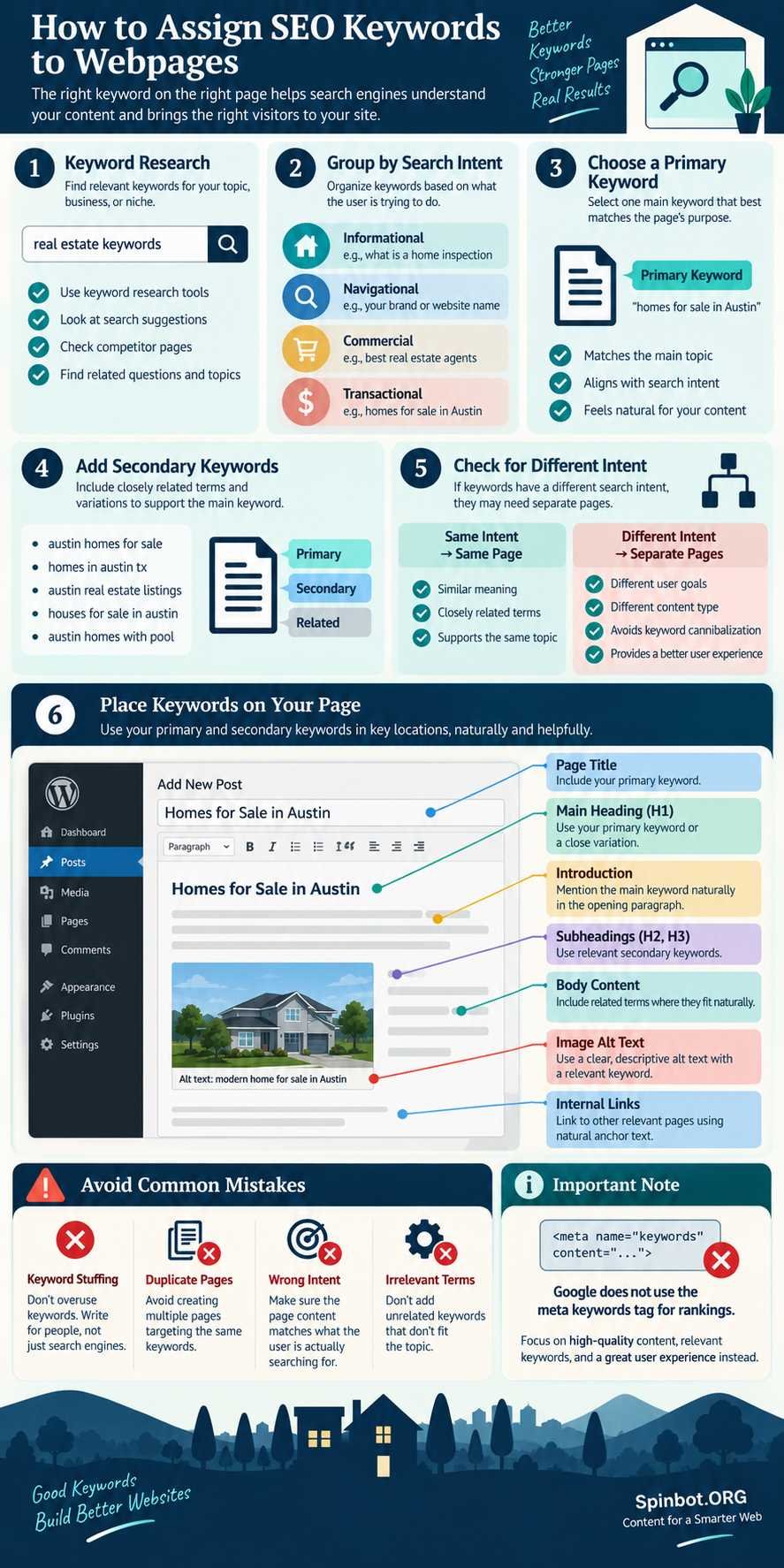
Where to Use SEO Keywords on a Page
Keyword placement still matters, but placement should help explain the page rather than satisfy a density formula.
Google’s Search Essentials recommends using words people would use to find your content in prominent places such as the title, main heading, alt text, and link text where appropriate.
For most pages, consider the keyword in these areas:
| Page element | Practical approach |
|---|---|
| SEO title | Use the main topic naturally |
| Page title or H1 | Clearly describe the page |
| Introduction | Establish the topic early |
| H2/H3 headings | Use related terms when they describe sections |
| Body text | Write naturally around the subject |
| URL slug | Keep it short and descriptive |
| Internal links | Use meaningful anchor text |
| Image alt text | Describe the image accurately |
Notice what is missing from that table: a required repetition count.
If inserting the exact keyword again makes a paragraph sound awkward, you probably do not need it.
How to Use Keywords in WordPress
WordPress does not require a special SEO writing method.
Your theme will commonly use the post or page title as the H1, while the Heading block lets you organize the rest of the content with H2, H3, and lower levels. WordPress notes that headings help humans and search engines understand content structure, although exact H1 behavior can depend on the theme or template.
A sensible SEO on page WordPress workflow looks like this:
Write a clear post title around the primary topic. Keep the slug short. Introduce the subject naturally in the opening. Use H2 and H3 headings to divide genuinely different parts of the answer.
If you use an SEO plugin, its fields can help you edit titles and descriptions, but a green optimization score should not become your writing strategy.
The plugin can tell you that a keyword is missing. It cannot always tell you whether adding it improves the sentence.
That decision still belongs to the writer.
When Two Keywords Need Separate Pages
Here is where keyword strategy becomes more useful than keyword counting.
Suppose you run a real estate website and find these searches:
- homes for sale in Austin
- houses for sale in Austin
- Austin homes for sale
Those phrases probably represent the same general intent. Creating three nearly identical pages would add little value.
Now compare:
- homes for sale in Austin
- best neighborhoods in Austin
- Austin real estate agent
- Austin mortgage calculator
These searches belong to the same broad industry, but the reader wants something different from each one.
You could reasonably create separate pages for property listings, neighborhood guidance, agent services, and a mortgage tool.
So when selecting the best keywords for real estate, do not ask how many phrases can physically fit onto one page.
Ask which phrases belong to the same useful answer.
That principle applies to almost every industry.
What Happens When You Target Too Many Keywords?
The biggest problem is not that Google sees keyword number 11 and penalizes you.
The problem is that the page starts losing focus.
A page targeting too many different intents may develop several weaknesses at once.
The title promises one thing, while half the article discusses something else. Headings become a collection of keyword variations instead of a logical explanation. Important sections stay shallow because the writer is trying to cover too much ground.
You may also create overlap with other pages on your site.
The fix is often not to delete keywords. It is to reorganize the content.
Keep closely related ideas together. Move substantially different intents to separate pages and connect them with useful internal links.
Keyword Stuffing and Keyword Density
Keyword density is usually calculated as the percentage of words on a page represented by a particular keyword.
The calculation itself is easy.
Its usefulness as an SEO target is much weaker.
Google does not publish an ideal keyword-density percentage. Its SEO Starter Guide instead advises writers to create natural, useful content and warns against excessive repetition. Google also explicitly states that keyword stuffing violates its spam policies when words or phrases are repeated unnaturally in an attempt to manipulate rankings.
Google also does not use the meta keywords tag for Google Search. Filling a hidden meta keywords field with dozens of phrases will not give you an SEO advantage.
A better editing test is surprisingly ordinary: read the paragraph.
If the keyword keeps drawing attention to itself rather than helping explain the subject, rewrite it.
A Simple Keyword Map You Can Use
Before publishing your next page, make a small keyword map.
For example:
Primary topic: how many keywords SEO per page
Primary intent: learn how many keywords one page should target
Supporting topics: primary keywords, secondary keywords, keyword research, keyword placement, search intent, keyword stuffing, keyword cannibalization
Separate intents: Amazon keyword tools, marketplace SEO, unrelated industry keyword lists
Then build the article around the reader’s problem rather than around the list itself.
That is the part many SEO checklists get backward.
You are not trying to make a page contain as many keywords as possible. You are trying to create the clearest page for one useful search intent, using the vocabulary people naturally use when they look for that information.
If that takes one primary keyword and four supporting phrases, fine. If a detailed guide naturally covers twelve related searches, that can work too.
The number is not the strategy.
One focused intent, strong coverage, and natural language are the better rules for deciding how many SEO keywords to use per page.

Raj blends SEO mastery with real-world freelance grit. Covers SEO, blogging, content strategy, copywriting, freelance writing, marketing, and business communication.