
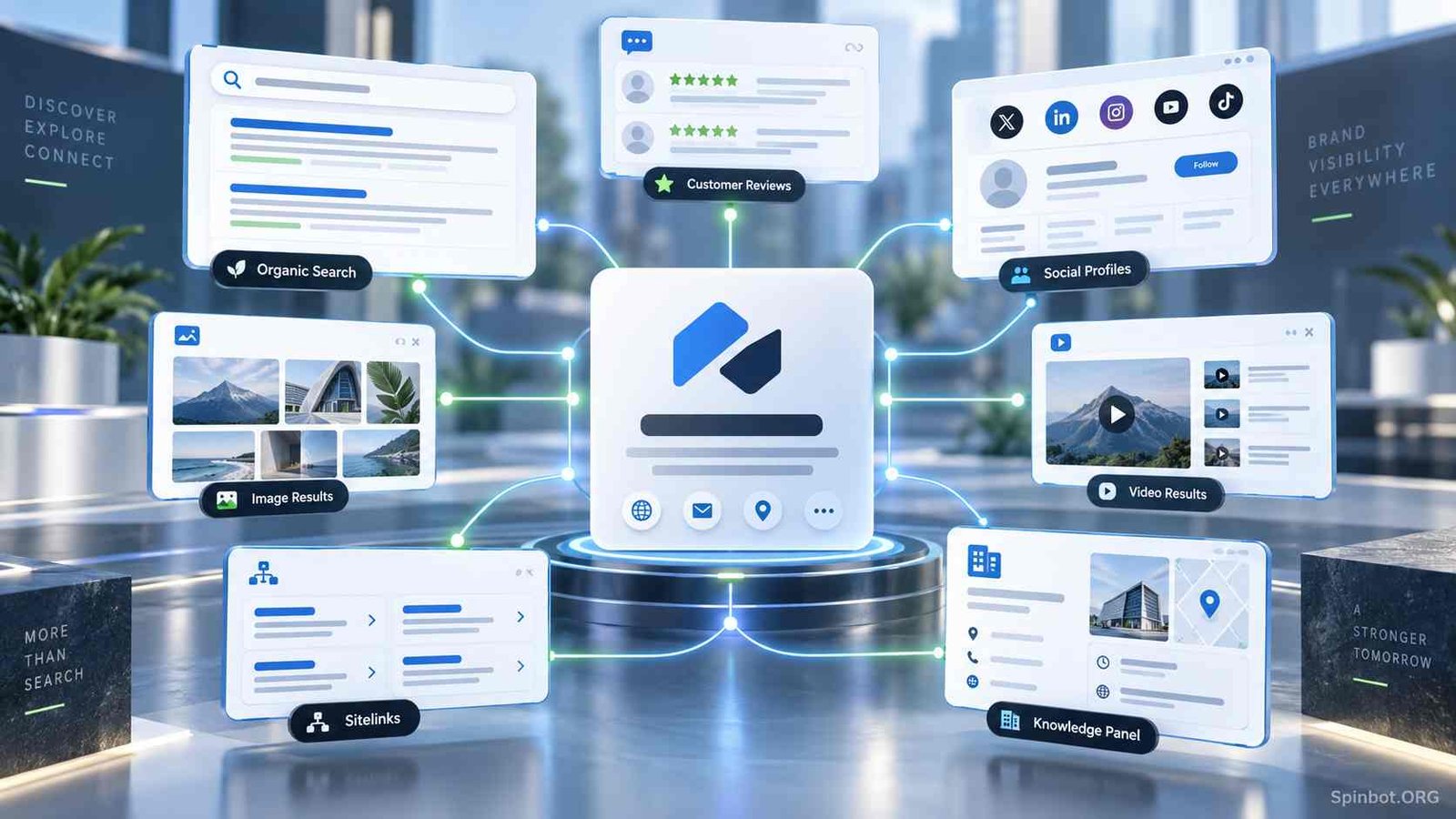
A branded search results page may show your homepage, sitelinks, reviews, social profiles, images, videos, news coverage, business information, third-party articles, and a Knowledge Panel. Together, these elements create an immediate impression of your brand.
You cannot fully control what Google displays. You can, however, give Google clearer information, improve the pages and profiles you own, earn credible third-party coverage, and respond to reputation problems. That is the practical purpose of Brand SERP optimization.
What Branding in Google SERPs Actually Means
A search engine results page, or SERP, is the page Google displays after a search. A Brand SERP is the results page shown for a query that contains a company, product, service, or personal brand name.
Examples include:
- Spinbot
- Spinbot reviews
- Spinbot pricing
- Is Spinbot safe?
- Spinbot versus QuillBot
- Spinbot customer support
- Spinbot alternatives
The first query is mainly navigational. The searcher probably wants the official website. The others show different needs, such as comparing products, checking trustworthiness, finding help, or deciding whether to buy.
SERP branding covers how your brand appears across all those searches. It includes four basic qualities:
- Visibility: How much of the results page features your brand
- Accuracy: Whether names, descriptions, images, and business details are correct
- Credibility: Whether the results suggest that the business is established and trustworthy
- Usefulness: Whether searchers can quickly reach the information they need
Brand SERP optimization does not mean filling Google with promotional pages. It means building a clear, accurate, and useful search presence that reflects the real organization.
Why Your Brand SERP Deserves Attention
People often search for a brand after encountering it somewhere else. They may have seen an advertisement, recommendation, social media post, guest article, product listing, or offline promotion.
At that moment, Google becomes a verification tool. The person may be asking:
- Is this the official website?
- Is the company legitimate?
- What do customers say about it?
- Does it provide the service I need?
- How can I contact it?
- Are there serious complaints?
- Is there a better alternative?
A clear Brand SERP reduces uncertainty. An unclear one creates friction.
Imagine that a customer searches for your company and finds an outdated homepage description, abandoned social profiles, inconsistent contact details, and several unanswered complaints. Even if your products are good, the results create doubt before the customer reaches your website.
The opposite is also true. Accurate information, helpful pages, active profiles, credible mentions, and balanced reviews make the organization easier to understand.
Branded searches can also reveal where people are in their journey. Someone searching for your brand plus “login” has a different goal from someone searching for your brand plus “reviews.” Treating every branded query as a request for the homepage wastes useful opportunities.
How to Audit Your Current Brand SERP
A Brand SERP audit gives you a baseline before you make changes. It also helps you distinguish problems you can address directly from results that require a longer reputation or content strategy.
Search the important brand variations
Start with the exact brand name. Then test common variations, including:
- Brand name plus reviews
- Brand name plus pricing
- Brand name plus location
- Brand name plus contact
- Brand name plus support
- Brand name plus alternatives
- Brand name plus complaints
- Brand name versus a competitor
- Important product or service names
- Common misspellings and previous brand names
Check results in the main countries or regions where the organization operates. Search results can vary by location, language, device, and search history, so one search does not represent every customer’s experience.
Do not focus only on the first blue link. Record the full page, including advertisements, images, videos, local results, People Also Ask questions, review platforms, social profiles, news stories, and Knowledge Panels.
Classify what appears
Place each result into one of four groups:
- Owned: Your website, blog, support pages, and official profiles
- Controlled: Listings or profiles you can claim and update
- Influenced: Reviews, interviews, media coverage, and partner pages
- Independent: Content you neither own nor directly influence
Next, label every result as positive, neutral, negative, inaccurate, or outdated. This prevents a common mistake: treating every third-party result as a problem. A neutral directory listing or objective review can add credibility even though you do not control it.
Look for gaps, not just negative results
A weak Brand SERP is not always hostile. Sometimes it is simply empty or confusing.
Common warning signs include:
- Another organization with a similar name dominates the results
- Google displays the wrong logo or site name
- Old pages rank instead of current information
- Important social profiles cannot be found
- The homepage lacks useful sitelinks
- Review results contain unanswered complaints
- Searchers ask questions the official site never answers
- Contact or location details differ between platforms
- Competitors rank for comparison searches involving your brand
Document the current results with screenshots and dates. Google changes its layouts and result selection, so a dated record makes later comparisons more meaningful.
Strengthen the Search Signals You Control
Your website should be the clearest and most reliable source of information about your organization. Before chasing mentions elsewhere, make sure it explains the brand consistently.
Clarify the homepage
The homepage should clearly identify:
- The official brand name
- What the organization offers
- Who it serves
- Its main location or service area, when relevant
- Links to About, Contact, Support, Products, and Services pages
Use the same primary brand name in the page title, main heading, logo description, organization information, and important profiles. If the business commonly uses an abbreviated or alternative name, explain the relationship rather than switching between names without context.
Google creates site names automatically using information from the homepage and references elsewhere on the web. According to Google’s site-name documentation, WebSite structured data is the most important way to indicate a preferred site name, although Google may also consider the homepage title, headings, og:site_name, and other text.
This markup communicates a preference. It does not force Google to display a particular name.
Improve page titles and descriptions
Every important branded page needs a distinct purpose.
For example:
- Brand Name | Official Website
- Pricing and Plans | Brand Name
- Customer Support | Brand Name
- About Brand Name
- Brand Name Reviews and Customer Feedback
- Product Name Features | Brand Name
Avoid using the same title on every page. Duplicate or vague titles make it harder for searchers and search engines to distinguish the homepage from support, pricing, product, and informational pages.
Descriptions should also be accurate. A promotional description may attract attention, but it can disappoint the searcher if it promises information that the page does not contain.
Support useful sitelinks
Sitelinks are the additional page links Google sometimes places under a main search result. They can help people reach high-value sections without entering the homepage first.
You cannot manually choose organic sitelinks. You can make the site easier to interpret by:
- Maintaining a clear navigation structure
- Using descriptive internal links
- Giving important pages unique titles
- Avoiding duplicate pages with the same purpose
- Linking prominently to useful sections
- Keeping account, contact, pricing, and support paths easy to find
A well-organized website gives Google better options, but it does not guarantee that sitelinks will appear.
Add accurate organization information
Organization structured data can provide explicit information about the organization, including its name, URL, logo, contact details, address, and related profiles.
Google recommends using the most specific applicable organization subtype and adding properties that are useful to visitors. Its Organization structured-data guide also supports sameAs links that identify profiles or pages containing more information about the organization.
Structured data must match the visible content. Do not add an address, review score, social profile, or other detail that visitors cannot verify.
Markup helps Google understand information, but eligibility is not a promise of a Knowledge Panel or enhanced result. Google’s structured-data introduction makes clear that markup provides clues about a page; Google still decides whether and how to use them.
Improve Third-Party Brand Signals
An official website explains how a company describes itself. Independent sources help searchers understand how others view it.
That distinction matters. Creating dozens of low-quality profiles will not build the same confidence as earning a smaller number of relevant, well-maintained mentions.
Keep external profiles consistent
Review the profiles most relevant to the organization, such as:
- YouTube
- Industry directories
- Professional associations
- App marketplaces
- Product-review platforms
- Local business directories
Use a consistent name, logo, description, URL, and contact information. Close or update abandoned profiles where possible. If different locations require different details, make the relationship between the main organization and each branch clear.
Consistency does not mean copying the same biography everywhere. Each profile can suit its platform while preserving the same basic facts.
Earn relevant mentions
Useful third-party coverage may include interviews, expert contributions, partnership pages, awards, directory listings, event participation, original research, or product reviews.
The goal is not to manufacture praise. It is to create real reasons for trustworthy publications and communities to discuss the brand.
Branded links can help readers and search engines connect those mentions to the official site. However, buying placements, publishing thin guest posts, or creating fake profiles can introduce more low-quality results without improving credibility.
Manage reviews responsibly
Review pages often appear for searches containing “reviews,” “complaints,” “safe,” or “legitimate.” You usually cannot remove criticism merely because it is unfavorable.
A more credible response is to:
- Monitor important review platforms
- Answer genuine complaints calmly
- Correct factual errors with evidence
- Explain what action was taken
- Avoid arguing with customers
- Report content only when it violates the platform’s rules
- Encourage authentic customers to leave honest feedback
Do not buy reviews or ask employees to pose as customers. A suspicious wall of perfect ratings can damage trust rather than strengthen it.
When negative coverage is accurate, fixing the underlying problem matters more than publishing additional promotional content.
Optimize Local Branded Search Results
Local companies should pay particular attention to Google Business Profile because it can affect information shown in Search and Maps.
Claim and verify the correct profile, then maintain:
- Business name
- Primary and secondary categories
- Address or service area
- Telephone number
- Website
- Opening hours
- Products or services
- Photos and videos
- Holiday or temporary hours
Google says local results are mainly influenced by relevance, distance, and prominence. Complete information helps Google understand relevance, while links, reviews, and general recognition can contribute to prominence. Businesses cannot pay Google to receive a better organic local ranking, according to its local ranking guidance.
Keep the official website and Business Profile aligned. Conflicting names, telephone numbers, addresses, or opening hours create problems for both customers and search systems.
Create Content for Important Branded Queries
A branded keyword report can expose questions that your existing pages do not answer.
Suppose people regularly search for:
- Brand Name cancellation policy
- Brand Name free trial
- Brand Name refund
- Brand Name student discount
- Brand Name data privacy
- Brand Name tutorial
- Brand Name for businesses
Those searches show specific information needs. If the answer is buried inside a generic FAQ or legal document, consider improving the relevant page or creating a focused resource.
Create a separate page only when the query deserves one. Ten thin pages targeting slight variations of the same question will usually provide less value than one well-organized, authoritative guide.
Comparison searches require particular care. A page titled “Brand A versus Brand B” should use clear criteria, current information, and honest limitations. Declaring your product the winner in every category makes the comparison less credible.
Measure Whether Your Brand SERP Is Improving
Visual appearance is important, but measurement should go beyond taking occasional screenshots.
Google Search Console’s Performance report shows queries that generated impressions and clicks for your website. Use it to monitor important branded terms and compare performance over time.
Useful measures include:
- Branded impressions
- Branded clicks
- Click-through rate
- Average position
- Which official page ranks for each query
- Number of accurate owned or controlled results
- Presence of sitelinks, videos, images, or local features
- Sentiment of visible review and media results
- Accuracy of business information
- Unanswered branded questions
- Competitor presence on high-intent brand searches
Do not treat rising branded search volume as proof that SEO caused greater awareness. Advertising, public relations, social media, events, news, word of mouth, and offline marketing can all increase brand searches.
Look for patterns rather than a single score. If more people are searching for the brand but the click-through rate falls, examine whether advertisements, competitors, outdated pages, or negative results are taking attention away from the official site.
A Practical Brand SERP Optimization Checklist
Use this checklist during monthly or quarterly reviews:
- Search the exact brand name and major variations.
- Record results by country, language, and device when relevant.
- Confirm that the official website ranks for navigational searches.
- Check the displayed site name, favicon, title, and description.
- Review homepage messaging and organization details.
- Validate relevant
WebSiteandOrganizationstructured data. - Make important pages easy to reach through navigation.
- Update inaccurate social and directory profiles.
- Verify Google Business Profile details for local organizations.
- Review visible ratings, complaints, and responses.
- Identify branded questions the website does not answer.
- Monitor branded queries in Search Console.
- Record changes instead of relying on memory.
- Recheck results after substantial site or profile updates.
Prioritize accuracy and user impact. Fixing an incorrect telephone number is usually more urgent than trying to obtain an additional social-media result.
Build a Search Presence People Can Trust
Effective branding in Google SERPs is not about controlling every result. That is rarely possible. It is about making your identity clear, publishing useful official information, maintaining accurate profiles, earning credible mentions, and dealing honestly with reputation issues.
Start with the searches closest to a customer decision: your exact brand name, reviews, pricing, contact details, support, and comparisons. Audit what appears, correct the information you control, and create content for genuine gaps.
Over time, these actions can produce branded search results that are more accurate, recognizable, and useful. That is the real objective of Brand SERP optimization: helping people understand your brand well enough to make an informed next move.

Raj blends SEO mastery with real-world freelance grit. Covers SEO, blogging, content strategy, copywriting, freelance writing, marketing, and business communication.