
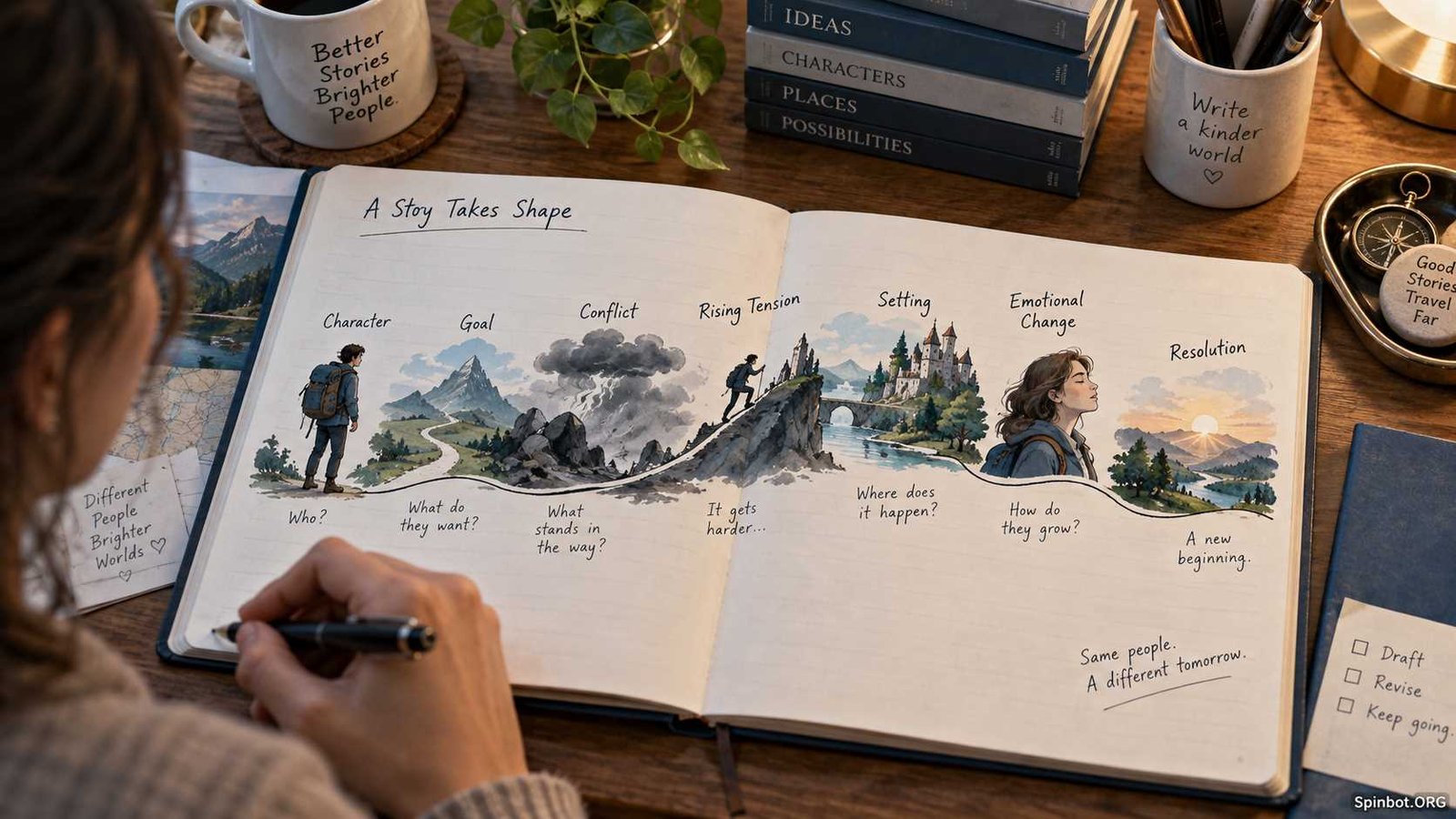
That reason might be a character they understand, a problem that feels impossible, a mystery they want solved, or a choice with real consequences. The story does not need dragons, murder, romance, or a world-ending crisis. Even a quiet story about a child trying to make a friend can work if the goal matters to the character and something meaningful stands in the way.
So, what makes a good story? Most strong stories combine a clear character goal, conflict, stakes, cause and effect, an effective setting, a fitting voice, some form of change, and an ending that feels earned.
None of these elements works alone. The real craft lies in making them support one another.
1. Give the Main Character Something to Want
A story becomes easier to follow when the main character wants something.
The National Centre for Writing offers a simple way to think about story:
Desire + Action + Conflict = Story.
A character wants something, takes action to get it, and meets resistance along the way.
That desire gives the story direction.
Imagine a student named Maya who wants to win her school’s short-story contest.
That’s a start, but it becomes more interesting when we ask why.
Maybe Maya’s older sister has always been seen as the talented writer in the family. Maya does not simply want a certificate. She wants to prove that her own voice matters.
Now the story has two levels:
- External goal: Win the competition.
- Personal desire: Feel recognized and capable.
The second part is often what makes readers care about the first.
Make the goal clear enough to follow
Readers do not need to know everything your character wants on page one. But they should soon understand what is pulling the character forward.
Weak goal:
Leo wants his life to improve.
Stronger goal:
Leo wants to earn enough money before Friday to stop his family from losing their apartment.
The second version creates direction. We know what success looks like, and we can imagine what failure means.
Connect the goal to a personal reason
Goals become stronger when they matter emotionally.
A detective trying to solve a crime may be interesting.
A detective trying to solve the crime that ruined her father’s reputation has a more personal reason to keep going.
You do not need to make every motivation tragic. The important question is simple:
Why does this particular goal matter to this particular character?
2. Put Meaningful Conflict in the Way
If a character wants something and gets it immediately, there is usually not much of a story.
Conflict creates resistance.
It is the distance between what the character wants and what the character can easily have.
Reedsy’s guidance on scene construction describes conflict as the force that keeps a story from becoming a random collection of events. It can come from other people, society, nature, circumstances, or the character’s own thoughts and fears.
Suppose Maya submits her story and wins the contest on the first try.
Nice for Maya. Not very exciting for the reader.
Now suppose:
- she cannot find an idea she believes in;
- her best friend enters the same contest;
- her teacher dislikes her first draft;
- she accidentally deletes part of her work;
- she begins copying her sister’s style instead of trusting her own;
- she has to decide whether winning matters more than writing honestly.
Now the goal creates pressure.
External conflict creates obstacles
External conflict comes from outside the character.
It might involve:
- another person;
- a deadline;
- lack of money;
- a dangerous environment;
- a social rule;
- a physical limitation;
- missing information;
- an unexpected event.
These obstacles force the character to act.
Internal conflict makes choices harder
Internal conflict happens inside the character.
A person may want two things that cannot comfortably exist together.
For example, Maya wants to beat her best friend, but she also wants to support her.
A man wants to tell the truth, but telling it may destroy his family.
A teenager wants independence, but she is afraid to leave home.
Strong internal conflict gives a story emotional depth because the solution is not simply “try harder.”
The character must choose.
3. Give the Conflict Real Stakes
Conflict tells us what is difficult.
Stakes tell us why the difficulty matters.
A useful way to separate the two is this:
- Goal: What does the character want?
- Conflict: What is stopping them?
- Stakes: What could they lose?
Story stakes do not have to involve death, war, or disaster. Personal consequences can be just as powerful when they matter deeply to the character. Writing teacher K.M. Weiland describes stakes as the cost of failure rather than simply the reward for success.
Imagine two versions of the same scene.
In the first, Ben is late for a bus.
In the second, Ben is late for the last bus that can get him to his daughter’s school play before she goes on stage.
The physical problem is almost identical.
The emotional meaning is completely different.
Good stakes answer the reader’s quiet question:
So what?
If you cannot explain why success or failure matters, the story may feel flat even when a lot is happening.
4. Build a Cause-and-Effect Plot
A plot is not simply a list of events.
This happened.
Then this happened.
Then something else happened.
A stronger story feels connected:
This happened, so the character did this, which caused that, which created a new problem.
Cause and effect makes the story feel as if it is moving rather than wandering.
Suppose Maya receives harsh feedback on her first story.
Because of that feedback, she throws away the draft.
Because she starts again too late, she falls behind.
Because she is desperate, she borrows an idea from her sister’s notebook.
Because of that choice, winning the contest now creates a moral problem instead of solving everything.
Each event changes what can happen next.
That is much stronger than giving Maya four unrelated problems simply because the middle of the story needs excitement.
Let choices create consequences
Characters become more interesting when their decisions affect the plot.
If problems appear and disappear regardless of what the main character does, the character can start to feel like a passenger.
Give choices weight.
A good decision may create an unexpected problem.
A bad decision may seem helpful at first.
A small lie may require a bigger lie later.
This creates momentum.
Increase pressure instead of repeating obstacles
Writers sometimes mistake “more conflict” for “the same conflict again.”
If a character asks for a job and gets rejected five times in almost identical scenes, the story may stop moving.
Instead, change the situation.
First, the character gets rejected.
Then she lies about her experience.
The lie gets her an interview.
Now she must decide whether to continue lying.
The pressure has changed. The story has progressed.
5. Make the Setting Affect the Story
Setting is more than a description of where events happen.
A useful setting changes possibilities.
A story set in a small village creates different social pressure from one set in a crowded city. A snowstorm can trap characters together. A school hallway can expose a private argument to classmates. A family dinner can force two people who are avoiding each other to sit at the same table.
Scribophile’s guide to story elements points out that setting can influence how characters behave and which choices are available to them.
That means setting should often do more than look attractive.
Ask:
- What can happen here that could not happen elsewhere?
- What becomes harder because of this place?
- What does the setting reveal about the character?
- How does it change the mood?
Instead of writing three paragraphs describing a rainy street, perhaps show how the rain ruins the letter your character has been carrying for ten years.
Now the setting is doing story work.
6. Choose a Voice and Point of View That Fit
Two writers can tell the same basic story and create completely different experiences.
That difference often comes from voice.
Voice includes the language, rhythm, attitude, observations, and personality through which the story reaches the reader.
Compare:
Daniel entered the room and noticed everyone staring at him.
With:
The room went quiet before Daniel even found a chair. Great. Apparently humiliation had a sound.
The event is similar, but the second version gives us more personality.
Point of view matters too.
A first-person narrator can bring readers very close to one character’s thoughts.
Third-person narration can be either intimate or more distant, depending on how it is written.
Neither is automatically better.
Choose the viewpoint that gives readers access to the most useful part of the story.
And remember: beautiful sentences cannot replace a story that has no direction. Strong prose helps, but readers still need characters, tension, choices, and consequences.
7. Let Something Change
A story usually leaves something different from how it began.
The character may change.
A relationship may change.
The reader’s understanding may change.
A secret may become known.
A kingdom may fall.
A family may heal.
Someone may realize they were wrong.
Change does not always mean improvement.
A tragedy may show a character becoming more bitter, selfish, isolated, or destructive. A mystery may end with the detective unchanged while the reader’s understanding of the crime changes completely.
The National Centre for Writing notes that characters often change through the process of pursuing what they want and facing conflict.
That change also helps create theme.
You do not need to begin by deciding, “My theme is courage.”
Instead, look at what your character is forced to choose.
If the character repeatedly has to choose between safety and honesty, ideas about courage may appear naturally.
Theme becomes stronger when it grows from the story rather than being attached to it like a lesson at the end.
8. Make the Ending Feel Earned
A satisfying ending does not have to be happy.
It has to feel connected to what came before.
If your hero suddenly discovers a magical power on the final page and uses it to solve a problem that seemed impossible, readers may feel cheated.
If that power was established earlier, had limits, required sacrifice, and became part of the character’s struggle, the same ending could feel satisfying.
This is why good endings often depend on preparation.
The ending should answer the story’s central question.
Will Maya win the competition?
Will the detective solve the case?
Will the couple stay together?
Will the explorer return home?
But the answer alone is not enough.
The ending should also show what the journey cost and what changed because of it.
Maybe Maya loses the contest but finally writes something that sounds like her rather than her sister.
She failed at the original external goal, yet the deeper story reached its natural destination.
That can be far more satisfying than an easy victory.
Good Ways to Open a Story
Writers often spend too long preparing to begin.
They explain the town.
They introduce the character’s parents.
They describe the weather.
They tell us what happened ten years ago.
Then, several pages later, something changes.
A stronger opening usually starts closer to the moment when normal life stops being normal.
Reedsy’s editors recommend approaches such as using an unusual situation, a compelling image, immediate action, tension, or curiosity to pull the reader into the story.
Here are a few good ways to open a story.
Start with a change
Something happens that forces the character to respond.
The letter arrives.
The phone rings.
The dog disappears.
A stranger sits in Dad’s chair.
The teacher announces the competition.
You do not need an explosion. You need movement.
Start with a decision
A choice can create instant tension.
Nora had promised herself she wouldn’t open the box. At 2:13 a.m., she broke the promise.
We immediately want to know what is inside and why she was afraid to look.
Start with an unanswered question
Curiosity keeps readers moving.
But do not confuse mystery with confusion.
Readers can wonder why something is happening while still understanding what is happening.
That difference matters.
Avoid unloading the backstory
Background information can be useful, but readers rarely need all of it before the story begins.
Give information when it becomes relevant.
Let readers learn about the past while something is happening in the present.
A Quick Test for Whether Your Story Is Working
When a draft feels weak, you do not always need a new plot.
Check the basic connections first.
Ask yourself:
- What does my main character want?
- Why does that goal matter personally?
- What is stopping the character from getting it?
- What could the character lose?
- Do the character’s choices change what happens next?
- Does the pressure grow or simply repeat?
- Does the setting affect events or choices?
- Does the voice fit the character and story?
- What changes between the beginning and ending?
- Does the ending grow from earlier choices and events?
Then ask one final question:
Would a reader want to know what happens next?
That is one of the simplest tests of storytelling.
You can have perfect grammar, clever descriptions, and carefully planned chapters, but if there is no reason to turn the page, the story will struggle.
When a Story Feels Flat, Fix the Weakest Link
Learning how to write a good story is less about memorizing rules and more about understanding connections.
A character wants something. That desire creates action. Resistance creates conflict. Possible loss creates stakes. Choices create consequences. Those consequences create change. The ending shows what all of it meant.
When a draft is not working, resist the urge to immediately add another villain, subplot, twist, or dramatic disaster.
Find the weakest connection first.
Perhaps the character’s goal is vague.
Perhaps the conflict does not threaten anything meaningful.
Perhaps scenes happen without changing the situation.
Perhaps the ending solves a problem the character never truly faced.
Strengthen that part and read the story again.
A good story does not need to be complicated. It needs to make readers care, wonder, feel, and keep going until they know how it ends.

Academic editor turned AI copy pro, Sarah-Jane fuses research precision with smart storytelling. She covers academic writing, research, citation, plagiarism, copyright, grammar, editing, and publishing.