

These situations need a procedural response, not a louder argument. A point of order under Robert’s Rules asks the chair to identify and correct a rule violation. Used properly, it protects fair participation without turning the meeting into a dispute about personalities.
What Is a Point of Order in Robert’s Rules?
A point of order is a member’s request for the chair to enforce the meeting’s rules when a violation occurs. The member identifies the procedural problem, and the chair normally rules on it before the interrupted business continues. It is not a speech against the proposal being discussed. Jurassic Parliament’s explanation.
Robert’s Rules classifies it as an incidental motion: it arises from the business being handled rather than introducing a new project or decision.
Here are its basic characteristics:
| Question | General rule |
|---|---|
| Does it require a second? | No |
| Must you first obtain the floor? | No |
| Can it interrupt a speaker? | Yes, when the violation warrants immediate interruption |
| Is it debatable? | No |
| Can it be amended? | No |
| Does it require a vote? | Normally no; the chair rules |
The distinction between “normally no vote” and “never a vote” matters. A chair who is uncertain may submit the question to the assembly. A member may also appeal an appealable ruling. Sheridan College’s procedural guide.
This guide explains RONR’s default procedures. Applicable law, your bylaws, and adopted special rules may take priority. For a consequential governance dispute, check those documents and obtain qualified advice. Robert’s Rules Association FAQs.
How to Raise a Point of Order
You do not need an elaborate speech. The useful part is identifying the rule and the conduct that conflicts with it.
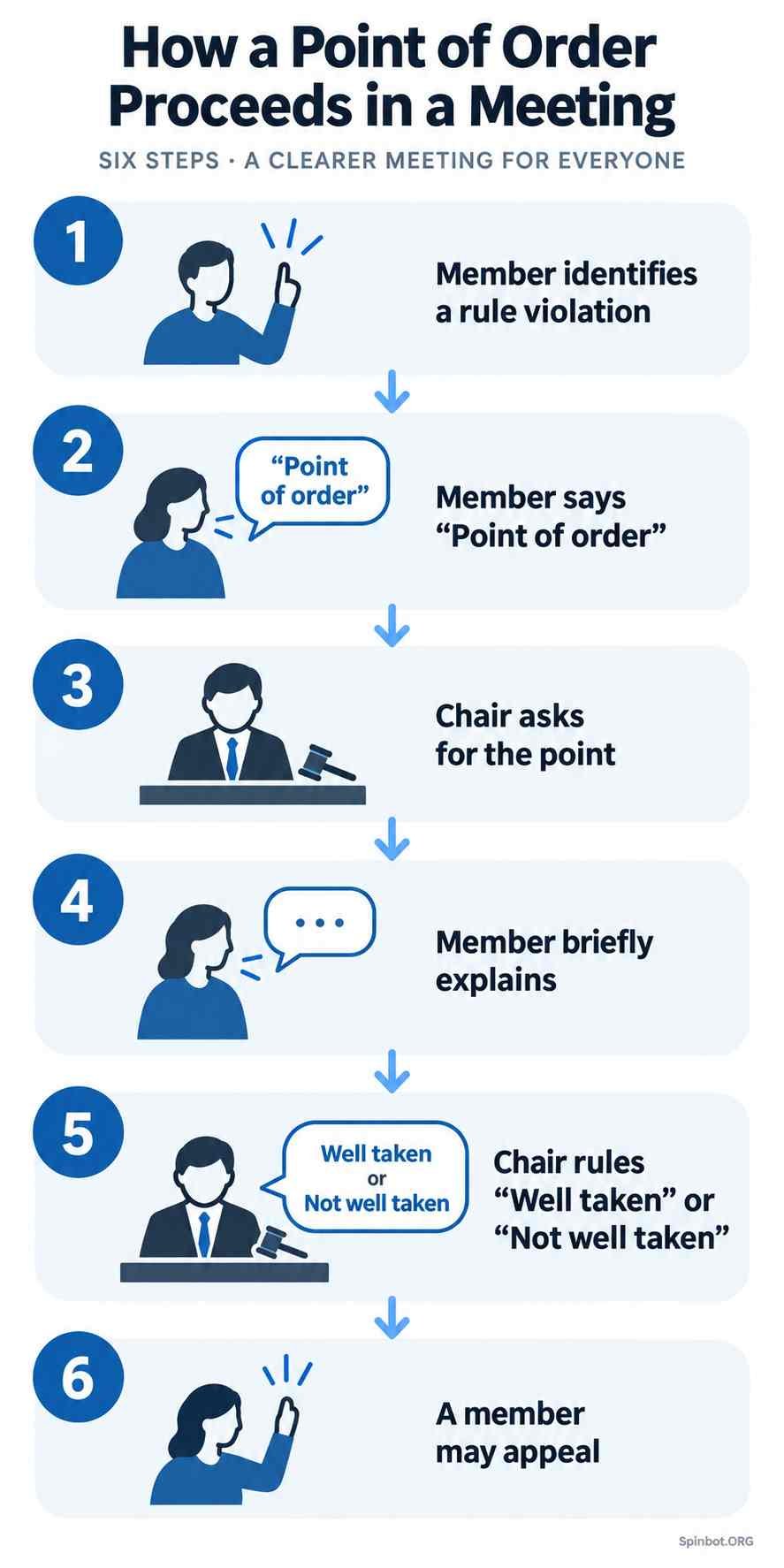
- Raise the issue promptly. Do not wait until the meeting has moved on.
- Address the chair. Say “Point of order.”
- Explain when invited. State the procedural problem briefly.
- Let the chair rule. Avoid arguing directly with the other member.
That sequence gives the chair something specific to resolve. Simply saying that the meeting feels unfair does not identify a procedural error. Civility’s point-of-order guide.
When can you interrupt?
A point of order can interrupt a speaker when the breach needs immediate attention. That does not mean every concern justifies cutting someone off.
For example, an ongoing personal attack may need an immediate response. A disagreement with someone’s cost estimate usually belongs in ordinary debate, not a procedural interruption.
Aim for clarity, not confrontation. Compare these two approaches:
- Unhelpful: “You keep ignoring everyone who disagrees with you.”
- Useful: “Our adopted speaking limit has expired, and no extension has been approved.”
The second version gives the chair a concrete rule to apply.
How the Chair Should Handle the Point
The chair should hear the concern and decide whether the claimed violation exists. A correct objection is ruled well taken; an incorrect objection is ruled not well taken.
Here is an illustrative exchange:
Member: Point of order.
Chair: Please explain the procedural concern.
Member: Our adopted rule allows three minutes per speech. The speaker has continued beyond that limit without an extension.
Chair: The point is well taken. The speaking limit has expired. We will recognize the next eligible speaker.
A ruling should resolve the problem, not merely acknowledge that somebody objected. If the objection is incorrect, a brief explanation helps everyone understand why proceedings will continue. The chair may also seek the assembly’s judgment when uncertain. Jurassic Parliament’s guidance on handling objections.
Keep the exchange short. The underlying proposal remains the meeting’s business; the procedural question is a necessary interruption.
Point of Order Examples and Sample Wording
The following scenarios are illustrative, not records of actual meetings. The wording should reflect your organization’s rules and the facts in front of you.
A speaker moves away from the pending question
Suppose members are debating whether to purchase accounting software, but a speaker begins discussing an unrelated dispute about parking.
You could say:
“Point of order. The pending question concerns accounting software. These remarks concern a separate parking issue.”
The chair must judge relevance. A connection you initially missed may make the remarks proper. Your objection asks for that judgment; it does not settle the question automatically.
Debate becomes personal
A member criticizes another person’s character rather than explaining why the proposal is flawed.
Possible wording:
“Point of order. The remarks are directed at a member personally rather than at the proposal.”
Strong criticism of an idea is different from an attack on its supporters. Keeping debate focused on the pending question helps preserve that distinction. Jurassic Parliament’s discussion of decorum.
A proposal conflicts with the bylaws
Imagine the bylaws expressly reserve membership-dues decisions to the full membership, but the board is considering setting new dues itself.
Possible wording:
“Point of order. Article VI reserves this decision to the membership. The board does not have authority to adopt this proposal.”
Have the actual provision available. Whether the objection succeeds depends on its wording and any other applicable provisions, not your recollection of what the bylaws probably say.
A member speaks without recognition
In a meeting using formal debate rules, one member repeatedly starts speaking while another has the floor.
Possible wording:
“Point of order. Another member has the floor.”
Check the meeting format before objecting. Informal small-board procedures differ from those of a large assembly, so do not assume every conversational exchange is improper.
The meeting appears to lack a quorum
A quorum is the minimum attendance required to transact substantive business. If departures appear to have removed it, raise the concern when another person is not speaking.
Possible wording:
“Point of order. It appears that a quorum is no longer present.”
The chair should establish whether enough members remain. Attendance at the beginning does not guarantee a quorum throughout the meeting. Official FAQ on loss of quorum.
When Is a Point of Order Too Late?
The general rule is to raise a procedural violation when it happens. Waiting may mean losing the opportunity to challenge it through a point of order.
That is why it helps to keep the bylaws and meeting rules accessible. A short, timely objection is more useful than a detailed complaint after the group has moved through several other decisions. Jurassic Parliament’s point-of-order guidance.
There are exceptions for certain continuing breaches. These are specific procedural categories, not simply decisions whose consequences continue to bother someone.
RONR’s 12th edition addresses continuing breaches and their remedies in Section 23. A later challenge needs careful analysis of the particular violation; it does not automatically erase everything the meeting did. Robert’s Rules Association’s edition guidance.
If a past decision has serious consequences, identify the exact rule allegedly violated before deciding whether a point of order, another parliamentary motion, or professional advice is appropriate.
What If the Chair’s Ruling Is Wrong?
A point of order asks the chair to rule. An appeal asks the assembly to review that ruling.
To make an appeal, a member can say, “I appeal from the decision of the chair.” Another member ordinarily must second it. Raise it immediately after the ruling, before intervening business.
The vote concerns whether the chair’s decision should stand. A majority voting against sustaining it overturns the ruling. A tie sustains it.
Appeals are not all debatable. For example, appeals concerning decorum or the priority of business are not debated. An appeal also cannot properly be used to dispute a clear rule when no reasonable difference of opinion exists. Jurassic Parliament’s appeal guide.
The practical distinction is simple: repeating the same objection louder does not create an appeal. Use the correct procedure so the assembly can decide.
How a Point of Order Relates to the Agenda
The phrase Robert’s Rules of Order agenda often brings together three different tasks: proposing the agenda, changing it, and enforcing its order.
They require different responses.
Before the agenda is adopted
A circulated agenda is ordinarily a proposal, not a binding instruction from the chair. Members may propose amendments when it is presented for adoption. Official FAQ on adopting agendas.
For example:
“I move to add the website renewal proposal under new business.”
That is a motion to amend the proposed agenda, not a point of order.
After the agenda is adopted
Changing an adopted agenda generally requires a two-thirds vote, a majority of the entire membership, or unanimous consent. The chair should not treat an adopted schedule as something they can freely rewrite. Civility’s agenda guide.
When the meeting leaves the agreed order
If your goal is to bring the assembly back to its adopted order of business, the specific procedure is to call for the orders of the day. This differs from identifying another procedural violation through a point of order. Civility’s explanation of agenda enforcement.
For example, challenging irrelevant remarks during debate concerns the pending question. Asking the meeting to take up the next scheduled item concerns its order of business.
Robert’s Rules of Order Meeting Agenda Template
Use this adaptable layout for an ordinary regular meeting. It is an illustrative template, not a mandatory official form.
Organization: [Name]
Meeting: [Board or membership meeting]
Date, time, and location: [Details]
Chair and secretary: [Names]
- Call to order
- Confirm that a quorum is present.
- Address adoption of a proposed agenda, if used.
- Reading and approval of minutes
- Previous meeting: [Date]
- Reports of officers, boards, and standing committees
- Treasurer: [Report]
- Standing committee: [Report]
- Reports of special committees
- Temporary project committee: [Report]
- Special orders
- [Business given special scheduling priority]
- Unfinished business and general orders
- [Qualifying unfinished or postponed matters]
- New business
- [Proposal one]
- [Proposal two]
- Announcements
- [Relevant notices and upcoming dates]
- Adjournment
This follows the familiar meeting framework described in iBabs’ agenda guide. Not every heading needs an item at every meeting.
Keep topic labels specific. “Approve website renewal expenditure” gives members more useful preparation than “Website.” Attach the proposal or supporting figures when available.
Common Point-of-Order Mistakes
The most frequent mistake is using procedure to continue an argument about substance.
“I dislike this proposal” is not a rule violation. Neither is “The speaker’s figures seem wrong.” Seek recognition to challenge the proposal or request the relevant information.
Another mistake is treating a point of order as a personal veto. Raising one requires a response, but it does not guarantee a favorable ruling or defeat the pending motion.
Finally, avoid importing a generic checklist into a meeting with different governing rules. A proper objection identifies what actually applies to that body.
Before speaking, ask yourself:
- What specific rule is being violated?
- What conduct conflicts with it?
- Does this require action now?
- Am I seeking enforcement, information, an agenda change, or an appeal?
A Simple Rule for Orderly Meetings
A point of order in Robert’s Rules works best when the wording is brief and the purpose is clear: identify the breach, address the chair, and allow a ruling.
For your next meeting, keep the adopted agenda, bylaws, and relevant procedural rules within reach. Knowing which document governs the issue makes it easier to raise a useful objection and return the group to its work.

Covers AI writing tools, large language models, prompt engineering, AI detection, and practical AI writing workflows for Spinbot.ORG.