

What matters is whether the keyword matches what your real estate business offers and what the searcher wants to do.
Someone searching for “real estate” could want market news, a definition, a job, an investment guide, or a property. Someone searching for “3 bedroom homes for sale in Austin TX,” however, has made their intent much clearer.
That difference should shape your entire real estate SEO strategy.
Google also advises site owners to think about the different words people may use when searching and to create useful content around those needs. You do not need to force every possible keyword variation into the page because Google’s language systems can understand related searches.
For most agents and brokerages, the strongest keyword strategy combines location, search intent, property type, service, and useful modifiers.
What Are the Best Keywords for Real Estate?
The best real estate keywords are phrases that describe what you offer, where you offer it, and what the searcher is trying to accomplish.
A useful starting list might include terms such as:
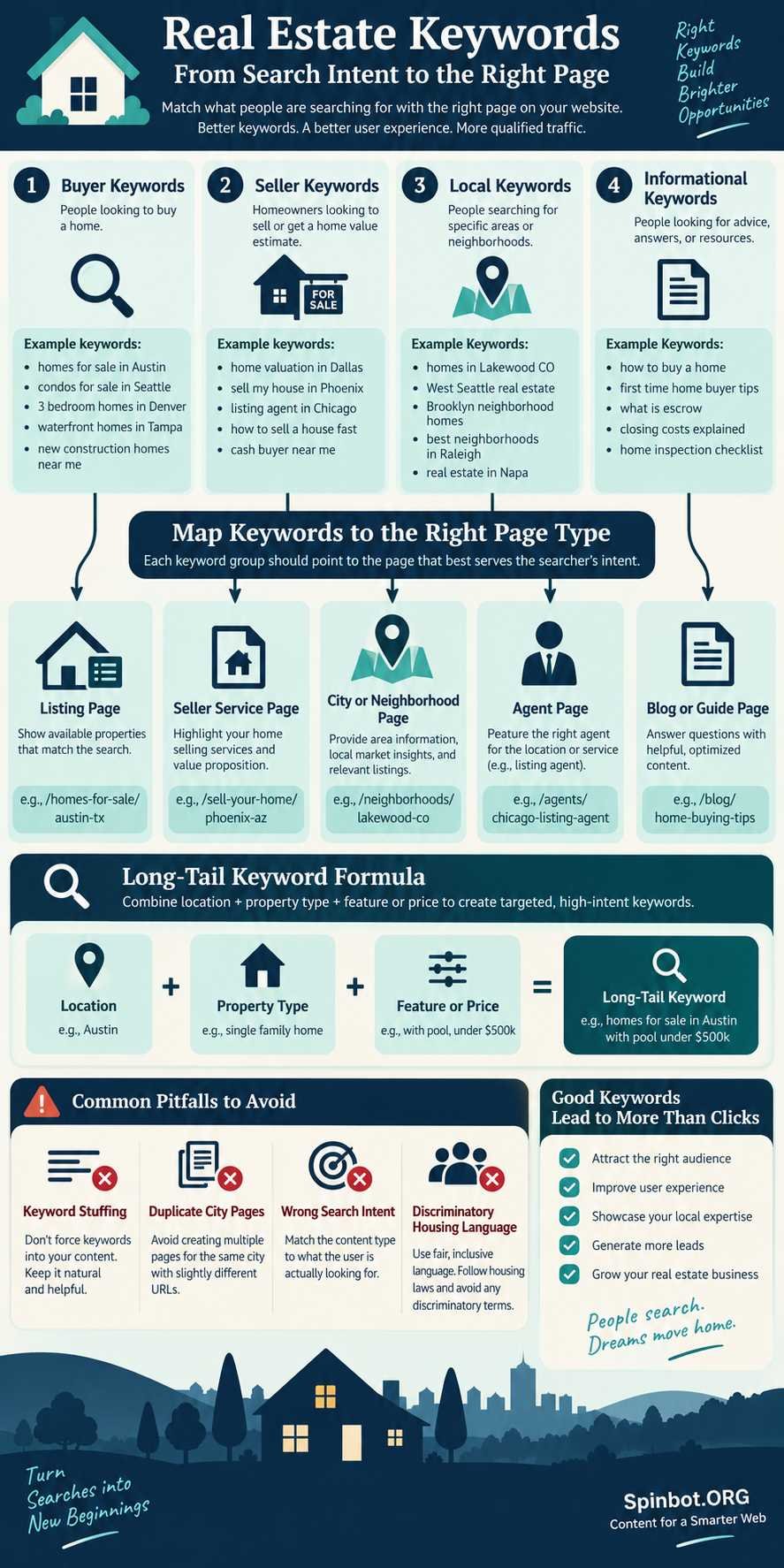
| Keyword type | Examples |
|---|---|
| Buyer keywords | homes for sale in Austin TX |
| Seller keywords | sell my house in Austin |
| Agent keywords | real estate agent in Austin |
| Listing keywords | condos for sale downtown Austin |
| Local keywords | Austin TX real estate |
| Property keywords | luxury homes in Austin |
| Long-tail keywords | 4 bedroom homes with pool in Austin |
| Informational keywords | how much are closing costs in Texas |
The strongest combination depends on your market.
A residential agent serving one city should usually care more about specific local searches than a broad national phrase such as “real estate.” An agent specializing in condos may need a different keyword set from someone selling rural land or luxury homes.
Search volume matters, but relevance and intent matter more.
Buyer Keywords for Real Estate
Buyer keywords often contain phrases such as:
- homes for sale
- houses for sale
- condos for sale
- townhomes for sale
- new construction homes
- property for sale
- waterfront homes
- luxury homes
- investment properties
- homes under $500,000
These become much more useful when combined with a location.
Instead of targeting:
homes for sale
you could target:
homes for sale in Raleigh NC
Then go more specific when your inventory and market justify it:
3 bedroom homes for sale in Raleigh NC
new construction homes in North Raleigh
condos for sale downtown Raleigh
homes with pools in Raleigh NC
These longer phrases may attract fewer searches individually, but the searcher is giving you much more information.
That makes it easier to create a page that actually answers the search.
Seller and Listing Agent Keywords
Buyers are only half of the real estate market. Agents looking for listing clients should build a separate seller keyword strategy.
Useful examples include:
- sell my house
- home selling agent
- listing agent near me
- best listing agent in [city]
- real estate agent to sell my house
- how much is my house worth
- home valuation [city]
- cost to sell a house in [state]
- how to sell a house in [city]
- Realtor for home sellers [city]
A search for “homes for sale in Denver” and a search for “listing agent in Denver” should not normally lead to the same page.
The first visitor wants inventory.
The second wants a professional service.
Trying to make one page rank for both can weaken the page because the content cannot fully satisfy either intent.
A dedicated seller page can explain your selling process, valuation approach, marketing services, local market knowledge, fees where appropriate, and the next step for requesting an evaluation.
Real Estate Agent and Service Keywords
Service keywords are especially important for agents, teams, and brokerages.
Common patterns include:
- real estate agent [city]
- Realtor [city]
- real estate broker [city]
- buyer’s agent [city]
- listing agent [city]
- luxury real estate agent [city]
- commercial real estate agent [city]
- relocation Realtor [city]
- new construction real estate agent [city]
- investment property agent [city]
The best phrase is not necessarily whichever version has the highest search volume.
Suppose you specialize in helping buyers purchase new construction homes. A broad page targeting “real estate agent Phoenix” may make sense for your main service page, while a dedicated page about “new construction real estate agent Phoenix” can address builder contracts, representation, inspections, incentives, and the buying process.
That second page serves a much clearer need.
Property and Niche Real Estate Keywords
Property type can narrow search intent quickly.
Depending on the properties you actually represent, useful keyword groups may include:
- single-family homes
- condos
- townhouses
- apartments
- luxury homes
- waterfront homes
- lake houses
- vacation homes
- land for sale
- farms
- commercial real estate
- office space
- retail property
- investment property
- multi-family homes
- new construction
- foreclosure properties
You can combine these with locations and useful characteristics.
For example:
waterfront homes for sale in Tampa
downtown Seattle condos for sale
commercial property for sale in Dallas
new construction homes in Charlotte NC
Do not create pages for property types you barely cover simply because a keyword tool shows search volume. A page should represent a genuine part of your business or provide meaningful information that your audience needs.
Keywords for Real Estate Listings
Keywords for real estate listings work differently from keywords for broader service or location pages.
An individual property listing is about one specific home. Its wording should accurately describe that property rather than trying to rank for every real estate search in the area.
Useful terms may include:
- property type
- city
- neighborhood
- number of bedrooms
- number of bathrooms
- approximate property size
- lot size
- relevant architectural style
- garage
- pool
- updated kitchen
- basement
- waterfront location
- nearby factual amenities
- other genuine property features
Imagine you are marketing a three-bedroom condo in downtown Miami with a balcony and assigned parking.
A useful title could naturally communicate those facts rather than becoming something like:
“Best Miami Real Estate Miami Condos Miami Homes for Sale Cheap Miami Realtor.”
The second version is written for keywords rather than people.
Google recommends clear, concise page titles that accurately describe the page. It also notes that location can be useful in a title when it genuinely helps describe the business or page.
Good real estate listing keywords should help a buyer understand what is being offered.
Long-Tail Real Estate Keywords Can Be More Valuable
Long-tail real estate keywords are longer, more specific searches.
A simple formula is:
Location + property or service + qualifier
For example:
Austin + homes for sale + under $500k
becomes:
homes for sale in Austin under $500k
You can create many useful combinations using modifiers such as:
- price range
- bedroom count
- property type
- neighborhood
- new construction
- waterfront
- pool
- garage
- acreage
- downtown
- investment
- luxury
- first-time buyer
- seller
- relocation
That gives you searches such as:
- 4 bedroom homes for sale in Orlando
- condos under $400k in San Diego
- new construction homes in Nashville
- homes with acreage near Atlanta
- waterfront condos for sale in Tampa
- listing agent for luxury homes in Scottsdale
The point is not to manufacture hundreds of combinations automatically.
Create a page only when you can satisfy the search with real listings, useful expertise, or substantial information.
Real Estate Local SEO Starts With Location
Real estate is unusually dependent on geography. That makes real estate local SEO a central part of keyword planning.
A searcher may include the location directly:
real estate agent in Boston
Or Google may infer location from a search such as:
real estate agent near me
You therefore do not need to write “near me” twenty times on your website.
Google says local results are mainly influenced by relevance, distance, and prominence. Complete business information helps Google understand relevance, while distance depends on the searcher’s location or the location used in the query. Prominence includes signals such as links, reviews, and how well known a business is.
For a local real estate business, that means your strategy should extend beyond inserting city names into articles.
Useful work includes keeping your Google Business Profile accurate, maintaining consistent business information, earning legitimate reviews, building useful local pages, attracting relevant links, and publishing content tied to markets you genuinely serve.
City and Neighborhood Keywords
Build your keyword research around real geographic levels:
City
homes for sale in Sacramento
Neighborhood
homes for sale in East Sacramento
Property type + city
condos for sale in Sacramento
Service + city
listing agent Sacramento
Specific need + location
first-time home buyer agent Sacramento
Neighborhood pages can be especially useful when they contain real information, listings, market context, transportation details, property types, maps, local features, and answers that buyers actually need.
Simply changing the city name across 50 otherwise identical pages is much weaker.
How to Find Real Estate Keywords for Your Market
You do not need to guess every keyword.
Start with what your business actually sells.
Write down:
- The cities and neighborhoods you serve.
- The property types you handle.
- Whether you target buyers, sellers, investors, renters, or several groups.
- Your major specialties.
- Questions clients ask before contacting you.
Now combine those ideas.
If you serve Denver condo buyers, your seed topics might include:
Denver condos
condos for sale Denver
downtown Denver condos
Denver condo Realtor
buying a condo in Denver
Those seeds can then be researched with keyword tools and actual search data.
Use Google Keyword Planner for Discovery
Google Keyword Planner can generate keyword ideas related to a product, service, or website and provide estimates such as monthly searches.
Do not automatically select the highest-volume phrase.
Look for the intersection of:
relevance + intent + realistic competition + business value
A keyword with modest search activity could be far more valuable if every searcher is looking for exactly the property or service you provide.
Use Google Search Console Once You Have Traffic
For an established real estate website, Search Console may reveal opportunities no generic keyword list can show you.
Its Performance report lets you examine the queries where your site appears, along with clicks, impressions, click-through rate, and average position.
Suppose a neighborhood page gets many impressions for:
townhomes in Westfield
but the page barely discusses townhomes.
That is useful evidence.
You may be able to improve the existing page with a better townhome section, relevant listings, clearer headings, internal links, or a dedicated page if the topic is substantial enough.
That is more grounded than creating pages from keyword-tool numbers alone.
Match Keywords to the Right Pages
A simple keyword map prevents one of the most common SEO problems: several pages competing for essentially the same search.
| Page type | Good keyword direction |
|---|---|
| Homepage | real estate agency + primary market |
| Agent page | real estate agent + location |
| Buyer page | buyer’s agent + location |
| Seller page | listing agent + location |
| City page | homes for sale + city |
| Neighborhood page | homes for sale + neighborhood |
| Property listing | address + property facts |
| Niche page | property type + location |
| Blog post | informational question |
You do not need a separate URL for every slightly different keyword.
“Real estate agent Chicago,” “Chicago real estate agent,” and “real estate agents in Chicago” usually represent the same basic intent. A strong page can naturally be relevant to several variations.
Google specifically says its language matching systems can understand relationships between a page and searches even when every exact keyword variation is not written on the page.
Where Should Real Estate Keywords Be Used?
Once you have selected a primary topic for a page, use the wording where it helps readers understand the page.
That commonly includes:
- page title
- main heading
- opening copy
- relevant subheadings
- main body content
- descriptive URL
- internal-link anchor text where appropriate
- image alt text when the description naturally matches the image
- meta description when useful
Google recommends descriptive URLs, clear titles, relevant text around images, and descriptive alt text.
There is no useful reason to chase a fixed keyword density such as 1%, 2%, or 3%.
If the same phrase sounds awkward after the sixth repetition, stop repeating it. Use normal language and cover the subject properly.
Real Estate Keyword Mistakes That Cost You Opportunities
Chasing Volume Instead of Leads
A broad keyword can have impressive search volume while being almost useless to a local agent.
Ten serious searches from people looking for your exact service may have more business value than thousands of unrelated visitors.
Mixing Buyer and Seller Intent
A buyer wants properties and purchasing help.
A seller wants valuation, marketing, representation, and information about selling.
Give each audience a clear path.
Building Thin Location Pages
Changing “Miami” to “Tampa,” “Orlando,” and “Jacksonville” does not create four useful pages if everything else stays the same.
Only build location pages where you can provide meaningful local value.
Letting Several Pages Target the Same Topic
If five articles all target “homes for sale in Portland,” Google and readers may struggle to understand which page is the main resource.
Choose one primary page and use supporting content to strengthen it.
Stuffing Keywords Into Listing Copy
Listing descriptions still need to sound like property descriptions. Include facts and features because they help buyers, not because you are trying to hit a keyword count.
Using Risky Housing Language
Real estate marketers also need to consider fair housing rules when selecting advertising language.
HUD states that housing advertisements must not communicate a preference, limitation, or discrimination based on characteristics protected by the Fair Housing Act. Its digital advertising guidance specifically addresses discriminatory words, phrases, images, symbols, and targeting practices.
For REALTORS®, the 2026 NAR Code of Ethics likewise prohibits property advertising that indicates discriminatory preferences or limitations based on listed protected characteristics.
From an SEO perspective, there is little reason to take that risk anyway.
Describe the property and objective location facts instead of trying to describe the “ideal” resident.
Build a Smaller Keyword List You Can Actually Use
The best keywords for real estate are not necessarily the phrases with the largest numbers beside them.
They are the keywords you can connect to a real searcher, a real service, a real location, and a useful page.
For most local real estate businesses, a practical starting strategy is:
Choose your main markets. Separate buyer, seller, and service intent. Add property types and meaningful long-tail modifiers. Map each important keyword cluster to one strong page. Then use Search Console and actual client questions to discover what deserves expansion.
That gives you a keyword system rather than a keyword pile.
And that is far easier to turn into useful pages, stronger SEO for real estate, and search traffic that has a realistic chance of becoming an inquiry.

Raj blends SEO mastery with real-world freelance grit. Covers SEO, blogging, content strategy, copywriting, freelance writing, marketing, and business communication.