
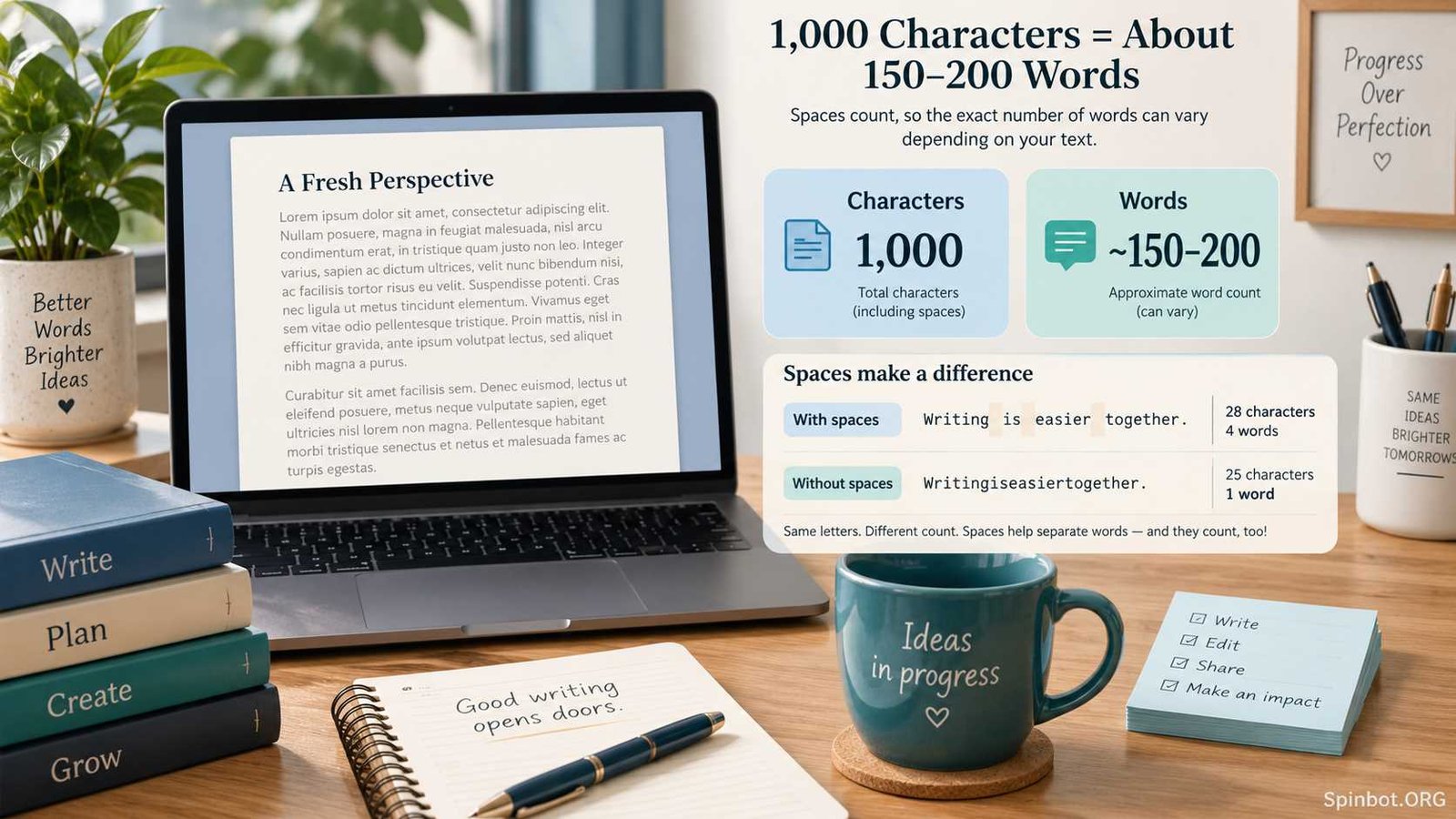
The short answer is simple: 1,000 characters is usually about 150 to 180 words when spaces are included. If spaces do not count toward the character limit, 1,000 characters may be closer to 180 to 210 words.
Those numbers are estimates, not fixed conversions. Short words let you fit more words into 1,000 characters. Long words, numbers, and punctuation can reduce the total. Current character-count guides generally place ordinary English text within these ranges.
How Many Words Is 1000 Characters?
For everyday English writing, these are useful planning numbers:
| Character count | Approximate word count |
|---|---|
| 1,000 characters with spaces | 150–180 words |
| 1,000 characters without spaces | 180–210 words |
| Easy planning estimate with spaces | About 170 words |
| Easy planning estimate without spaces | About 200 words |
If you just need one number, use about 170 words for 1,000 characters including spaces.
A current character-to-word guide gives the same general estimate of 150–180 words for 1,000 characters, while another real-text example reached 173 words at exactly 1,000 characters including spaces.
Still, don’t treat 170 as a rule. Two paragraphs with the same number of words can have very different character counts.
1000 Characters With Spaces to Words
When a system says that spaces count, every blank space between words uses part of your 1,000-character allowance.
Imagine a sentence like:
The dog ran across the road.
The letters count as characters, but so do the spaces and punctuation. This means your available character limit is used by more than the letters inside each word.
A practical estimate is to allow about six characters per word when spaces are included.
Using that shortcut:
1,000 ÷ 6 = about 167 words
That is why an estimate of roughly 150 to 180 words works well for normal English prose.
Your actual result may be higher if you use simple words such as “I,” “we,” “go,” “new,” and “help.” It may be lower if your writing contains longer terms such as “communication,” “international,” or “characterization.”
1000 Characters Without Spaces to Words
A character limit that excludes spaces works differently.
If spaces are ignored, only letters, numbers, punctuation, and other counted symbols use the character allowance. You can therefore usually fit more words into a limit of 1,000 characters without spaces.
A useful working range is around 180 to 210 words. One current guide recommends using about 200 words as a quick planning estimate when spaces are excluded.
A simple calculation explains why:
1,000 ÷ 5 = about 200 words
Here, five characters per word is being used as a rough planning average without charging an extra character for the space after each word.
Again, it is only an estimate. A paragraph packed with long technical terms can contain far fewer words.
Why 1000 Characters Does Not Equal One Exact Word Count
There is no exact mathematical conversion from characters to words because words are not all the same length.
Three things make the biggest difference.
Average word length
Compare these two groups:
I am at my new job.
and
Professional communication requires preparation.
The first uses short words. The second uses much longer ones.
Even if two pieces of writing communicate a similar idea, the one with shorter words can fit more words inside the same character limit.
Spaces and punctuation
Spaces matter whenever they are included in the character count.
Punctuation can matter too. Commas, periods, apostrophes, question marks, quotation marks, and other symbols may count as characters depending on the software or platform.
That is why you should always check what a form means by “characters” before writing to a strict limit.
Your writing style
Conversational writing often uses shorter words and sentences.
Academic, legal, scientific, and technical writing tends to contain longer terms. As a result, 1,000 characters of technical writing may contain fewer words than 1,000 characters of a casual email.
The character limit stays the same. The word count changes.
A Simple Way to Convert 1000 Characters to Words
You can estimate 1000 characters to words without using a calculator.
Use this quick method:
- Find out whether spaces count.
- If spaces count, divide the character limit by about 6.
- If spaces do not count, divide it by about 5.
- Treat the result as a planning estimate.
- Check your finished text with an actual word and character counter.
For example:
1,000 characters including spaces
1,000 ÷ 6 = 166.7
Round that to about 167 words.
1,000 characters excluding spaces
1,000 ÷ 5 = 200
That gives you an estimate of about 200 words.
These calculations are useful when you have not written the text yet. Once your draft exists, counting the real characters is more accurate than any formula.
What Does 1000 Characters Look Like in Real Writing?
A thousand characters is not very long.
In normal writing, it may give you enough room for two or three compact paragraphs. You could state one main point, explain it briefly, give a small example, and finish with a clear closing sentence.
One published example containing exactly 1,000 characters including spaces came to 173 words. That gives a useful visual sense of how much writing will fit.
But the same limit might produce only 145 or 150 words if you use longer vocabulary.
For example, a simple personal response might say:
I started helping with the school project because I wanted to learn more about our community.
The wording is short and direct.
A more formal version could say:
My participation in the community development project provided valuable opportunities for professional collaboration.
Both sentences express a related idea, but the second uses far more characters per word.
That difference becomes significant when you only have 1,000 characters available.
Quick Character-to-Word Conversion Table
The following table can help when you need a fast estimate. It assumes ordinary English text with spaces included.
| Characters | Approximate words |
|---|---|
| 500 | 75–90 |
| 750 | 110–135 |
| 1,000 | 150–180 |
| 1,500 | 225–270 |
| 2,000 | 300–360 |
These ranges are useful for planning, but they should not replace an exact count when you are submitting text to a system with a hard character limit.
A current word-count tool gives a similar estimate of 150–180 words for 1,000 characters.

How to Check the Exact Count
Estimating helps before you write. Counting helps after you write.
Google Docs
Google Docs can show:
- Pages
- Words
- Characters
- Characters without spaces
On a computer, open your document and choose Tools > Word count. Google also lets you display the word count while you type.
This is especially useful if a form tells you that spaces should not be included.
Microsoft Word
Microsoft Word also counts words and characters. You can view the word count while writing and open the Word Count information to see additional document statistics.
If you only need to check part of a document, select that section first. Word can show the count for the selected text as well as the full document.
Should You Count Words or Characters?
Use whatever measurement the requirement gives you.
If a form says maximum 1,000 characters, don’t assume that 170 words will automatically fit. Write your response and check the actual character count.
If an assignment asks for 200 words, focus on words instead.
This distinction matters because 200 short words might stay fairly close to a 1,000-character limit, while 200 long words could go far beyond it.
When the instructions are unclear, check whether the platform explains if spaces are included.
The Best Number to Use When Planning
So, 1000 characters is how many words?
For most ordinary English writing:
1,000 characters with spaces = about 150–180 words.
1,000 characters without spaces = about 180–210 words.
For quick planning, remember 170 words with spaces and 200 words without spaces.
That estimate is good enough when you are outlining a response or deciding how much you can write. But if a website, application, assignment, or publishing system enforces a strict character limit, always check the finished text itself. Your vocabulary, punctuation, and sentence style determine the real number.

Academic editor turned AI copy pro, Sarah-Jane fuses research precision with smart storytelling. She covers academic writing, research, citation, plagiarism, copyright, grammar, editing, and publishing.