
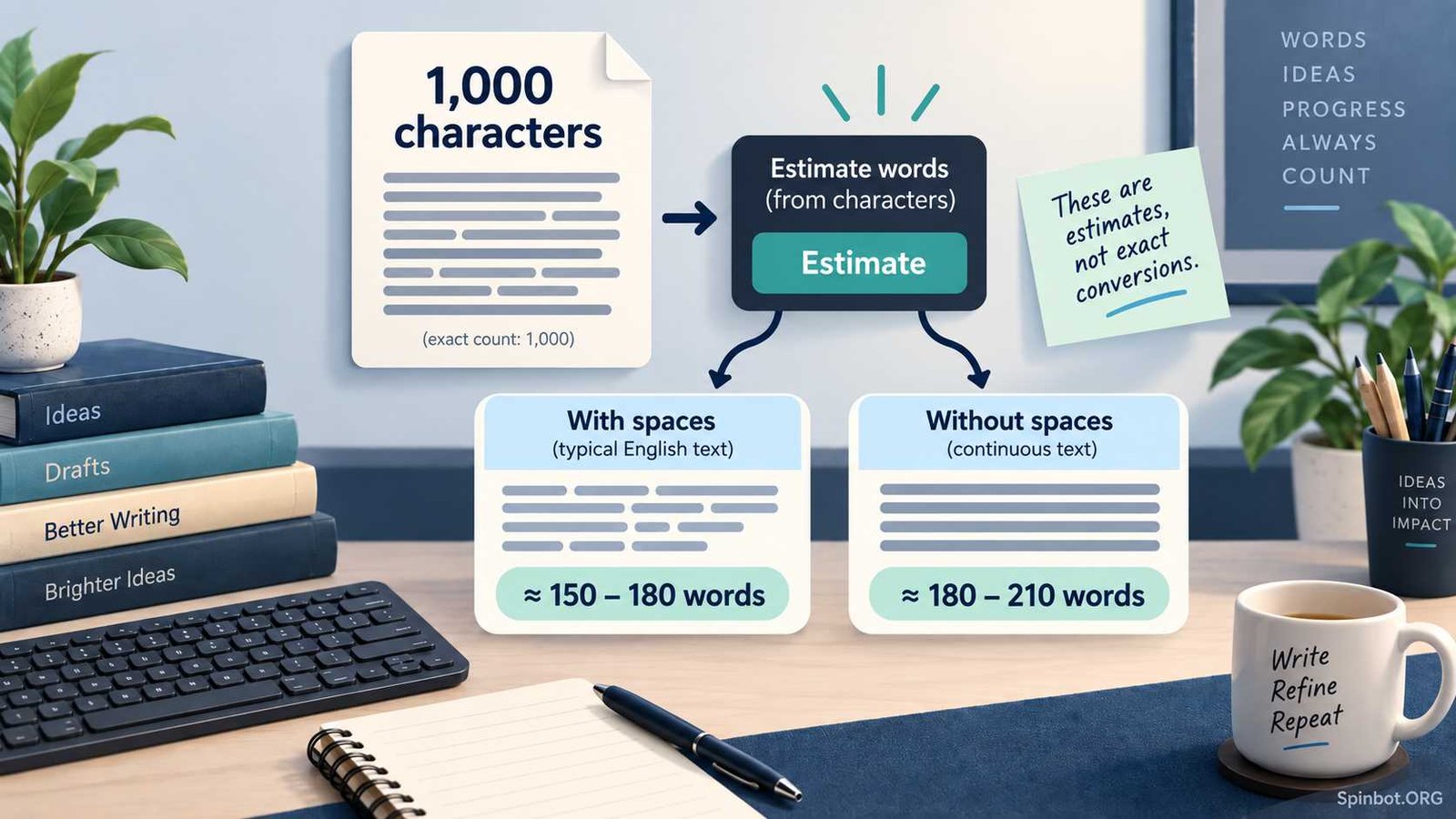
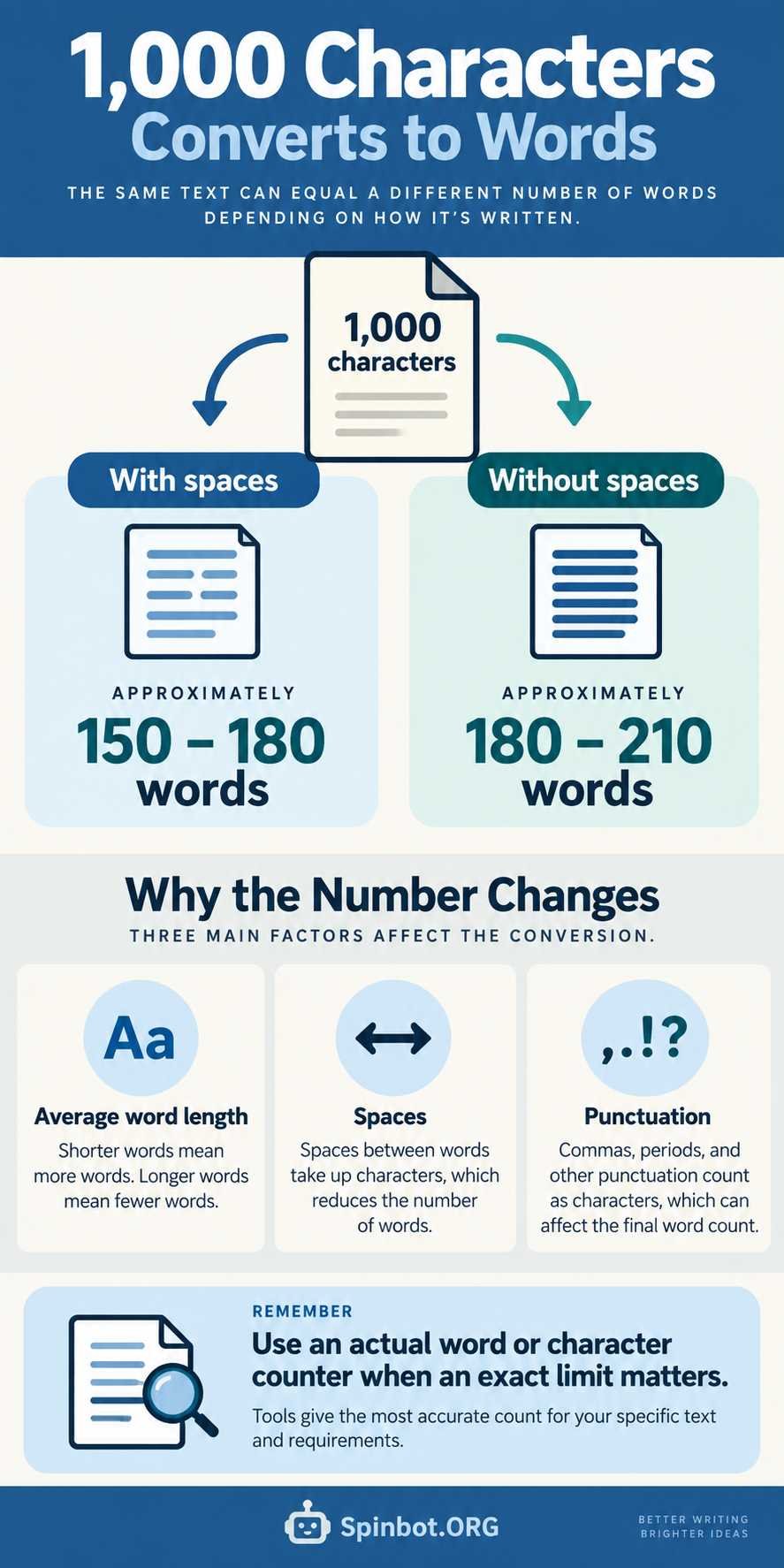
A thousand characters is usually about 150 to 180 words when spaces are included. If spaces are not included in the character count, 1,000 characters is often closer to 180 to 210 words.
A useful planning shortcut is:
- 1,000 characters with spaces: about 170 words
- 1,000 characters without spaces: about 200 words
These are estimates, not fixed conversions. The exact number changes because some words are short, some are long, and punctuation and spaces may also count as characters.
How Many Words Is a Thousand Characters?
For normal English writing, 1,000 characters usually works out to roughly 150–180 words when spaces count.
For example, a paragraph filled with short words such as “we,” “you,” “can,” and “write” can fit more words into 1,000 characters. A paragraph using longer words such as “communication,” “information,” and “professional” will fit fewer.
This is why there is no exact answer to how many words is a thousand characters.
One published example containing exactly 1,000 characters including spaces had 173 words. Other character-count guides place typical English text in a broader range of roughly 140 to 200 words.
For everyday planning, 170 words per 1,000 characters is a practical estimate when spaces are counted.
1000 Characters With Spaces to Words
When a system says that spaces count toward the character limit, every blank space between words takes up part of your 1,000-character allowance.
Suppose you write:
Writing clearly helps people understand your message.
The letters count as characters, but so do the spaces between the words. Punctuation such as the period also adds to the character total.
That means 1,000 characters with spaces generally gives you fewer words than 1,000 characters without spaces.
A reasonable estimate is:
| Character count | Approximate word count |
|---|---|
| 250 characters with spaces | 40–45 words |
| 500 characters with spaces | 75–90 words |
| 1,000 characters with spaces | 150–180 words |
| 1,500 characters with spaces | 225–270 words |
| 2,000 characters with spaces | 300–360 words |
These numbers are best used for planning. Your actual text may fall above or below them.
If you need one simple number rather than a range, use about 170 words for 1,000 characters with spaces.
1000 Characters Without Spaces to Words
The calculation changes when spaces do not count.
If a tool reports 1,000 characters without spaces, it is counting mainly letters, numbers, punctuation, and similar characters while leaving blank spaces out of that total.
As a result, the same 1,000-character allowance can hold more words.
A practical estimate is:
1,000 characters without spaces = roughly 180 to 210 words.
For quick planning, you can round that to about 200 words.
Google Docs makes this difference easy to see because its Word Count tool can display both Characters and Characters excluding spaces, along with the document’s word count.
So when someone asks “1000 characters is how many words?”, the first thing to check is whether the character limit includes spaces.
Why 1000 Characters Does Not Equal One Exact Word Count
Characters and words measure two different things.
A character counter looks at individual letters, numbers, spaces, punctuation marks, and other symbols according to its counting rules. A word counter looks at groups of characters treated as words.
Several factors therefore change the conversion.
Average Word Length
Compare these two sentences:
We can do it now.
Professionals communicate effectively.
The first uses very short words. The second contains much longer words.
If you keep writing with short words, you can fit more words inside 1,000 characters. If your writing contains long academic, legal, scientific, or technical terms, the word count will usually be lower.
Spaces and Punctuation
Spaces may take up a surprisingly large part of a normal paragraph.
Punctuation also matters. Commas, periods, apostrophes, quotation marks, brackets, and other symbols can all add characters depending on how a platform counts text.
That is why two passages containing exactly 1,000 characters can have different word counts.
Writing Style and Vocabulary
Conversational writing tends to use shorter words and contractions such as “it’s,” “don’t,” and “we’re.”
Technical or academic writing often contains longer terms.
A simple product description might therefore contain more words within the same character limit than a technical explanation.
The conversion is useful for estimating space, but it should never replace an actual count when you must meet a strict limit.
How to Convert 1000 Characters to Words
You can make a quick estimate without using a calculator designed specifically for character conversion.
For ordinary English text with spaces, assume that each word uses roughly six characters once the word itself and the space after it are considered.
Then divide:
1,000 ÷ 6 = about 167 words
Round that to approximately 170 words.
For a rough estimate without spaces, using about five characters per word gives:
1,000 ÷ 5 = about 200 words
This produces an easy rule to remember:
Use 170 words when spaces count and 200 words when they do not.
Current character-count guides use similar working ranges, although exact estimates differ because they use different assumptions about average word length.
A Realistic 1000-Character Example
One of the easiest ways to understand 1,000 characters is to think about its physical amount of text.
It is not a full essay.
It is closer to a few compact paragraphs, a detailed form response, a short email, a profile description, or a brief explanation.
In one measured example, exactly 1,000 characters including spaces produced 173 words.
That example sits close to the 170-word shortcut, but you should not expect every 1,000-character passage to have 173 words. Another writer using longer vocabulary could reach 1,000 characters with considerably fewer words.
This is also why writing 170 words first and assuming they will automatically fit a 1,000-character box can cause problems. Treat 170 as a planning estimate, then check the finished text.
How to Check the Exact Word and Character Count
Estimating is useful when you are planning. Once your text is written, an exact counter is better.
Google Docs
On a computer, open your document in Google Docs and choose Tools > Word count.
Google Docs can show:
- Pages
- Words
- Characters
- Characters excluding spaces
You can also select only part of a document if you want to check a specific paragraph or response. Google’s official documentation confirms these counting options.
This is especially useful when an application form says something like “maximum 1,000 characters including spaces.”
You can check the exact passage rather than relying on an estimate.
Microsoft Word
Microsoft Word also includes built-in word-count information. Its counting tools can report words as well as characters and other document statistics.
If you are writing your response in Word before pasting it into another website, check the character count before submission.
One caution matters here: the destination platform has the final say.
Different websites or software systems can handle line breaks, special characters, emojis, or formatting differently. When a strict maximum is involved, check the counter on the actual form as well.
Quick Character-to-Word Reference
Here is a simple reference you can use when spaces are included:
| Characters | Estimated words |
|---|---|
| 100 | 15–18 |
| 250 | 40–45 |
| 500 | 75–90 |
| 750 | 110–135 |
| 1,000 | 150–180 |
| 1,500 | 225–270 |
| 2,000 | 300–360 |
| 3,000 | 450–540 |
These figures are deliberately shown as ranges because an exact character-to-word ratio does not exist.
For example, a 1,000-character passage made mostly of short sentences may move toward the high end. Dense writing with longer words may move toward the low end.
What to Use When You Have a Strict Character Limit
If you only need to plan your response, remembering one simple rule is enough:
1,000 characters is about 170 words with spaces or about 200 words without spaces.
But if a school assignment, application, website, submission form, or client gives you a hard 1,000-character maximum, do not rely on the estimated word count alone.
Write your response, then check the actual characters.
Also leave yourself a little room below the maximum. Editing a 1,040-character response down at the last minute is harder than planning for roughly 900 to 950 characters from the start.
So, how many words is 1000 characters? For everyday English, expect roughly 150–180 words with spaces and around 180–210 words without spaces. Use those figures for planning, and use an exact character counter when the limit really matters.

Academic editor turned AI copy pro, Sarah-Jane fuses research precision with smart storytelling. She covers academic writing, research, citation, plagiarism, copyright, grammar, editing, and publishing.