
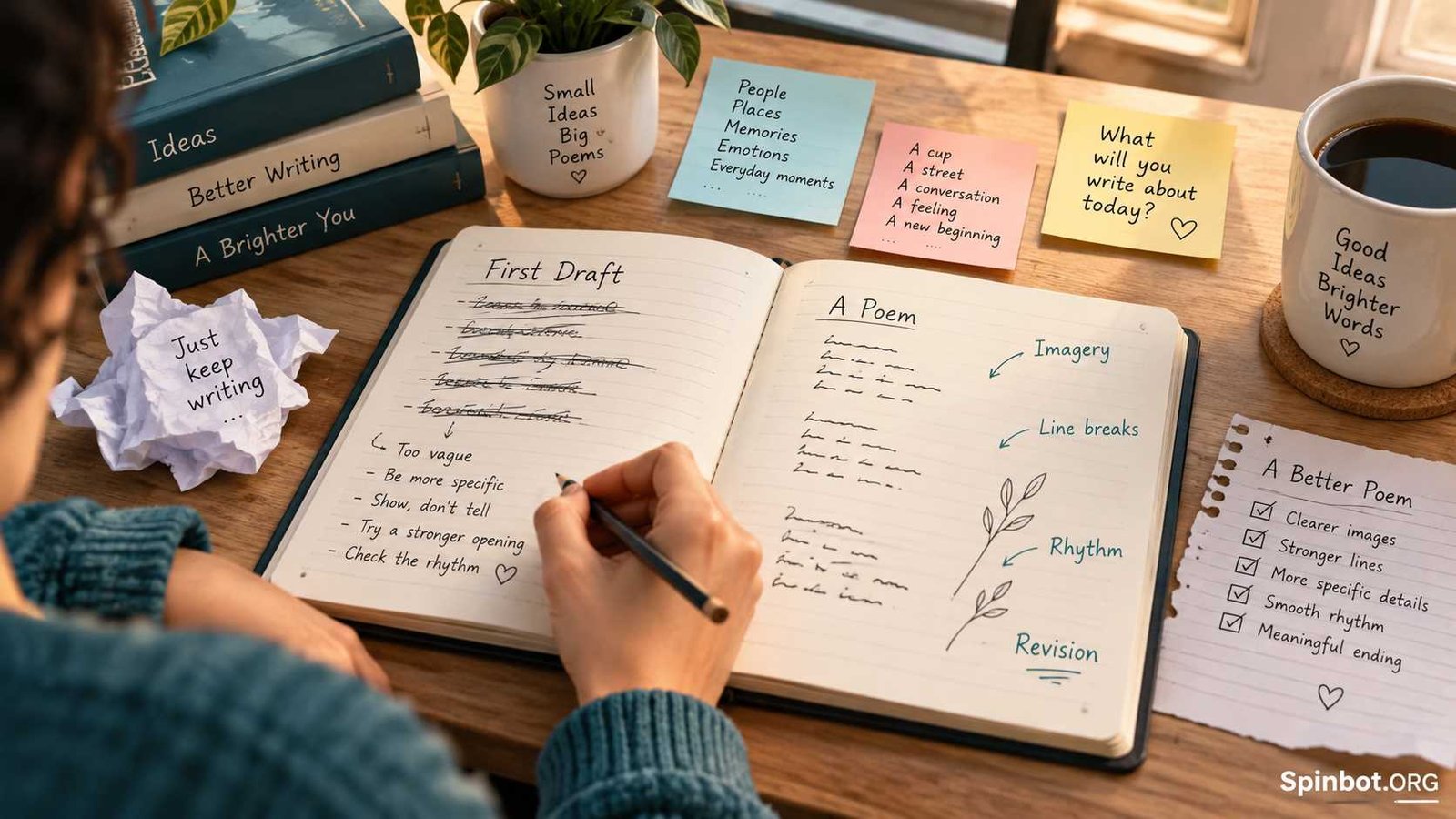
A poem does not have to rhyme. It does not need the same number of words in every line. It does not even need a fixed number of lines or stanzas.
What matters is that your choices have a purpose.
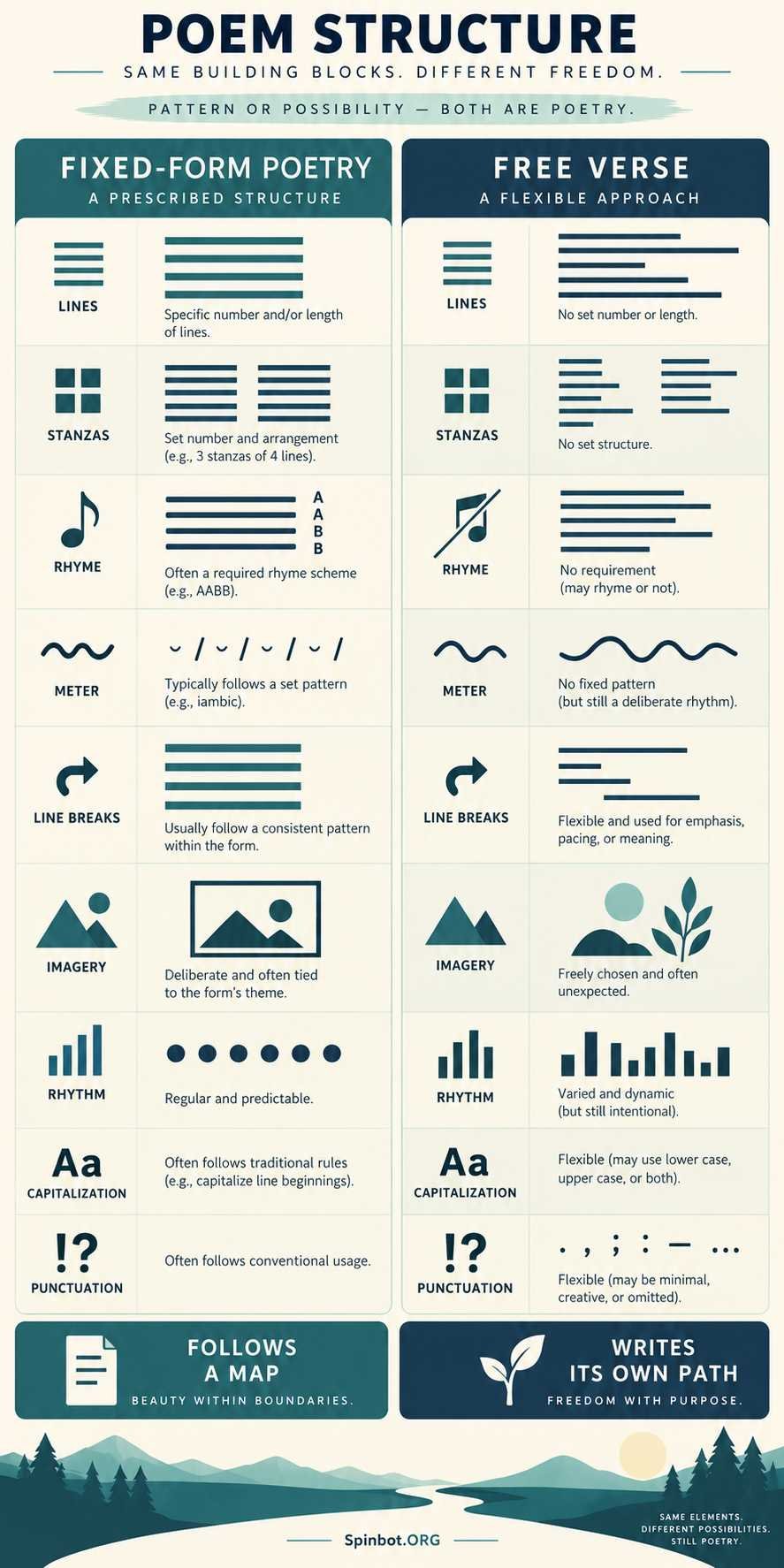
Some types of poetry come with clear rules. A sonnet, for example, traditionally has 14 lines and follows particular patterns of rhythm and rhyme. Free verse gives you much more freedom. It does not follow a fixed rhyme or metrical pattern.
So the real rules for a poem depend partly on the kind of poem you want to write.
Are There Really Rules for a Poem?
There is no single rulebook that applies to every poem.
The Academy of American Poets defines form as the structure of a poem, including its line lengths, line breaks, meter, stanza lengths, and rhyme scheme. Some poetic forms have established rules, while others allow the writer to create a unique structure.
Think of it this way.
If you decide to write a sonnet, haiku, villanelle, or another fixed form, you are choosing a set of limits. Those limits become part of the writing challenge.
If you write free verse, you have fewer fixed limits. But that does not mean anything goes without thought. You still decide:
- where each line ends
- where a new stanza begins
- how the poem sounds when read aloud
- whether words or sounds repeat
- how much detail to include
- whether punctuation helps or interrupts the poem
- what emotion, image, or idea holds the poem together
Freedom in poetry means making your own choices, not avoiding choices.
Seven Basic Rules for Writing a Poem
These rules work as useful starting points for most beginners. You can bend them later once you understand what they do.
1. Choose a Form That Fits Your Idea
Before worrying about rhyme, ask what kind of poem suits your subject.
A short memory might work well as a small free-verse poem. A funny idea could become a limerick. A subject that needs tight control might suit a fixed form.
You do not have to know dozens of poetic forms before you begin.
For your first poem, you can simply choose between:
Free verse: No fixed meter or rhyme scheme.
Fixed form: A poem that follows established rules for line count, rhyme, rhythm, repetition, or another feature.
Free verse is often easier for beginners because you can focus on the idea first. Just remember that your line breaks and word choices still matter.
2. Start With Something Specific
Broad topics are difficult to turn into strong poems.
Consider the topic “sadness.” It is an emotion, but it gives the reader little to see.
Now make it specific:
A child sitting beside an empty chair after a friend moves away.
That gives you a scene.
Instead of writing about “love,” you might write about someone saving the last piece of cake for another person.
Instead of writing about “nature,” you could describe rain hitting a hot road after weeks without a storm.
Specific details give readers something they can picture, hear, smell, touch, or remember.
3. Make Every Line Break Intentional
A poetic line is more than a sentence chopped into pieces.
The Poetry Foundation explains that a line can end for reasons such as rhythm, meaning, syllable count, pacing, or rhyme. Where a poet breaks the line can also give extra weight to particular words.
Consider this simple sentence:
The old bicycle waited beside the empty house.
You could arrange it as:
The old bicycle waited
beside the empty house.
Or:
The old bicycle
waited beside
the empty house.
The basic meaning stays similar, but the pace changes.
The second version slows the reader. The word “waited” receives more attention because of its position.
When deciding where to break a line, ask:
- Do I want the reader to pause here?
- Is the final word important?
- Does this line sound too long?
- Would breaking it create emphasis?
- Does the next line complete or surprise the thought?
A sentence that continues past the end of one poetic line into the next is called enjambment. You do not need to memorize the term to use the technique.
4. Use Stanzas to Organize the Poem
A stanza is a group of lines separated from other groups in a poem. In free verse, stanzas can help mark a change in time, mood, thought, or focus.
Think of stanzas as rooms inside the same house.
One stanza might show what is happening now.
The next could move into a memory.
Another could reveal what the speaker finally understands.
You do not need to make every stanza the same length unless your chosen form requires it.
White space can also give the reader a small pause before moving to the next part of the poem.
5. Treat Rhyme as a Choice, Not a Requirement
One of the most common beginner mistakes is trying to rhyme every line.
Rhyme can make a poem musical and memorable, but forced rhyme can weaken the writing.
Suppose you want to write:
I watched the evening disappear.
Then you decide the next line must rhyme with “disappear.” You may start searching for words such as “near,” “fear,” “clear,” or “year” even if none expresses what you actually want to say.
Now the rhyme is controlling the idea.
That is backwards.
Meaning should usually come first.
Use rhyme when it adds something to the poem. Leave it out when it makes your language sound unnatural.
6. Pay Attention to Rhythm and Sound
A poem can have music even when it does not rhyme.
Meter is a measured pattern of stressed and unstressed sounds in poetry. Some forms use strict metrical patterns, while many modern poems use looser rhythms closer to ordinary speech.
You do not need to study meter before writing your first poem.
Start by reading your draft aloud.
Listen for:
- words that are awkward to say together
- lines that feel too long
- repeated sounds
- natural pauses
- words that deserve emphasis
- sections where the rhythm becomes dull
Reading aloud often reveals problems your eyes miss.
7. Cut Words That Are Not Doing Useful Work
Poetry often gains strength from concentration.
That does not mean every poem must be short. It means each word should contribute something.
Look at a draft such as:
I looked outside through the window and saw
a very bright and beautiful red-colored bird.
You might tighten it to:
Through the window
a red bird flashed across the rain.
The second version gives the reader an image without explaining every part of it.
During revision, question words that merely repeat what the reader already knows.
How to Structure a Poem
If you are wondering how to structure a poem, start with four basic parts: lines, line breaks, stanzas, and sound.
Lines and Line Breaks
The line is one of the basic units of poetry. The Academy of American Poets describes it as a unit that carries meaning both across the page and from one line to the next.
Your lines can be short:
Rain
against glass
at midnight.
Or long:
Rain keeps tapping the bedroom window while the whole house sleeps.
Neither approach is automatically better.
Short lines may slow the reader or create emphasis. Longer lines can feel more conversational or flowing.
What matters is whether the line length fits the poem.
Stanzas and White Space
Use a new stanza when something changes.
That change could involve:
- time
- place
- speaker
- mood
- image
- idea
- point of view
Stanzas can also create visual pauses. You do not need to start a new stanza after a fixed number of lines unless your form requires it.
Rhyme, Meter, and Repetition
These are tools, not mandatory ingredients.
You might repeat a phrase at the beginning of several lines:
I remember the gate.
I remember the dust.
I remember your shoes beside the door.
That repetition creates structure without rhyme.
You can also repeat sounds, sentence patterns, images, or key words.
Free Verse Versus Fixed Forms
Free verse does not follow a regular metrical or rhyming plan.
A fixed form gives you more restrictions.
For example, the traditional sonnet is a 14-line form with an organized structure and established metrical and rhyme traditions.
Neither is more “poetic.”
Choose the form that helps you express the idea.
How to Format a Poem on the Page
There is no single correct answer to how to format a poem, but consistency makes your choices easier for readers to understand.
Start with these basics.
Give the Poem a Title When It Helps
A title can introduce a place, object, person, question, or idea.
It does not need to explain the entire poem.
Sometimes a simple title such as “After the Storm” gives enough context. Some poems are intentionally untitled, so a title is not compulsory unless an assignment or publisher requires one.
Separate Stanzas Clearly
Leave white space between stanzas so readers can see the structure.
Avoid random gaps unless they serve a purpose.
Use Capitalization Deliberately
You do not have to capitalize the first word of every line.
You can follow normal sentence capitalization, capitalize each line, or use another consistent approach.
The key word is deliberately.
Do not change capitalization randomly because you think poems are supposed to look unusual.
Use Punctuation When It Helps Meaning
Periods, commas, question marks, colons, and other punctuation can guide the reader.
You can also use less punctuation in a poem, but the reader still needs enough clues to understand the movement of the language.
A poem becomes harder to read when punctuation disappears without a reason.
What Should You Write a Poem About?
If you keep asking yourself what to write about for a poem, stop looking for a huge subject.
Look for a small moment.
Good starting points include:
- a childhood memory
- someone you miss
- a conversation you cannot forget
- your bedroom at night
- the view from a bus
- a family tradition
- an object you have kept for years
- your first day somewhere new
- a sound that reminds you of home
- an ordinary event that suddenly felt important
If you still do not know what to write a poem about, choose one object in front of you.
A cup, shoe, cracked phone screen, key, photograph, tree, or old jacket can become the center of a poem.
Describe it first.
Then ask what it reminds you of.
That connection is often where the real poem begins.
How Do I Write a Poem About Myself?
You do not need to tell your whole life story.
If you are asking, how do I write a poem about myself?, choose one moment that reveals something about you.
For example, instead of writing:
My life has had many difficult times.
Choose one scene:
At twelve, I learned to ride
on my brother’s rusted bicycle,
one hand bleeding,
both knees full of dust.
Now the reader can enter the memory.
Try this simple method:
- Choose one memory.
- Write down what you saw.
- Add what you heard, smelled, touched, or tasted.
- Include one detail that seems small but matters to you.
- Write the scene as lines.
- Remove explanations the details already communicate.
A personal poem does not have to explain who you are directly. Sometimes one carefully chosen moment says more.
How to Start a Poem When the Page Is Blank
Figuring out how to start a poem is often harder than writing the middle.
Do not put pressure on yourself to produce a brilliant first line immediately.
Try one of these approaches.
Begin With an Image
Three wet shoes wait beside the heater.
The reader immediately sees something.
Begin With an Action
My father folds the letter twice.
Something is happening, so the reader wants to know why.
Begin With an Observation
The quietest house on our street has three dogs.
A small contradiction can create interest.
Begin With Freewriting
Set a timer for five minutes and write continuously about your subject.
Do not worry about lines, rhyme, spelling, or structure yet.
When you finish, underline the strongest sentence, image, or phrase.
That might become the real opening.
Your first written line does not have to remain the first line of the finished poem.
A Simple Poem-Building Example
Imagine you want to write about waiting for a school bus on a cold morning.
Start with rough notes:
Cold hands. Streetlight still on. Breath visible. Backpack heavy. Bus late. Mother watching from the window.
Now choose the strongest details.
A first draft could become:
Under the yellow streetlight
I hide both hands in my sleeves.My breath appears,
disappears.Behind the kitchen window
my mother lifts her cup.The road stays empty.
Notice what happened.
There is no forced rhyme.
The lines are broken to control the pace. Stanzas separate different images. Concrete details create the mood without saying, “I was cold and lonely while waiting.”
That is one of poetry’s strengths: details can carry emotions without naming every emotion directly.
Check Your Poem Before You Call It Finished
A first draft is rarely the final poem.
Revision is where many of your best choices happen.
Read the poem aloud and ask:
- Does the opening make me want to continue?
- Is every line break helping the poem?
- Are any words unnecessary?
- Have I used vague words where a specific detail would be stronger?
- Does each stanza have a reason to exist?
- Does forced rhyme weaken any line?
- Is the rhythm awkward anywhere?
- Can I replace explanation with an image?
- Does the ending feel earned rather than simply stopping?
If you are using a fixed poetic form, check its rules again during revision.
If you are writing free verse, check the rules you created for yourself. Maybe you used short lines, repeated a phrase, kept each stanza focused on one image, or avoided rhyme.
Consistency can make even a very simple poem feel intentional.
The Best Poetry Rule Is to Make Choices on Purpose
The most useful rule for a poem is not “make it rhyme” or “use exactly four lines in every stanza.”
It is this:
Know why you are making each choice.
Choose line breaks because they affect pace or emphasis. Create stanzas because the poem is shifting. Use rhyme because the sound adds something. Break a traditional rule because doing so improves the poem, not because the rule seemed inconvenient.
And if you are a beginner, keep your first goal simple.
Choose one clear subject. Notice specific details. Put those details into lines. Read the poem aloud. Change what does not sound right.
You do not need permission to write poetry, and you do not need to master every poetic form before you begin. Learn the basic rules, understand what they do, and then decide which ones your poem actually needs.

Academic editor turned AI copy pro, Sarah-Jane fuses research precision with smart storytelling. She covers academic writing, research, citation, plagiarism, copyright, grammar, editing, and publishing.