
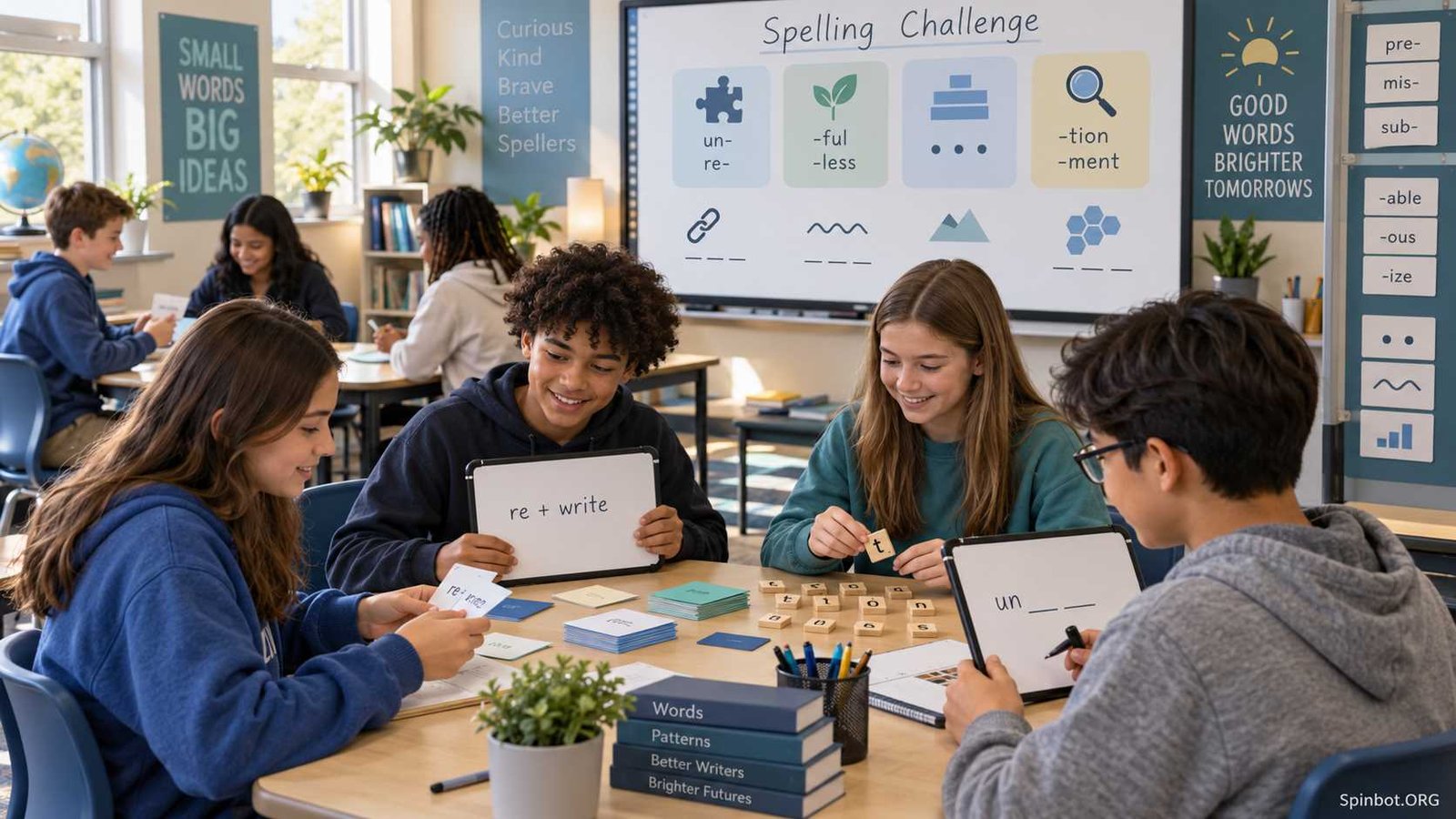
Good spelling games for 6th graders give students a reason to look closely at words. They can break longer words into syllables, notice prefixes and suffixes, compare spelling patterns, correct mistakes, and use new vocabulary in context.
That matters at this age. Grade 6 language standards still expect students to spell correctly, but they also ask students to work with context, roots, affixes, and academic vocabulary. Middle-school literacy guidance from the Institute of Education Sciences also recommends explicit practice with multisyllabic words and meaningful word parts.
The games below turn those skills into short activities you can use in a classroom, tutoring session, homeschool lesson, or at home.
What Makes a Good Spelling Game for Sixth Graders?
Sixth graders are old enough to notice when an activity feels designed for much younger children. That doesn’t mean spelling practice has to become serious and dull. It simply means the challenge needs to grow with the student.
A useful sixth-grade spelling activity should do more than test whether a student memorized Tuesday’s word list.
Look for games that help students:
- recognize spelling patterns
- break multisyllabic words into manageable parts
- understand prefixes, suffixes, and roots
- distinguish commonly confused words
- connect spelling with meaning
- find and correct errors
- use words in sentences
- apply spelling skills to real writing
Reading Rockets notes that spelling instruction can draw on sound-letter relationships, spelling patterns, word origins, and meaningful word parts such as prefixes.
That gives you far more possibilities than another traditional spelling test.
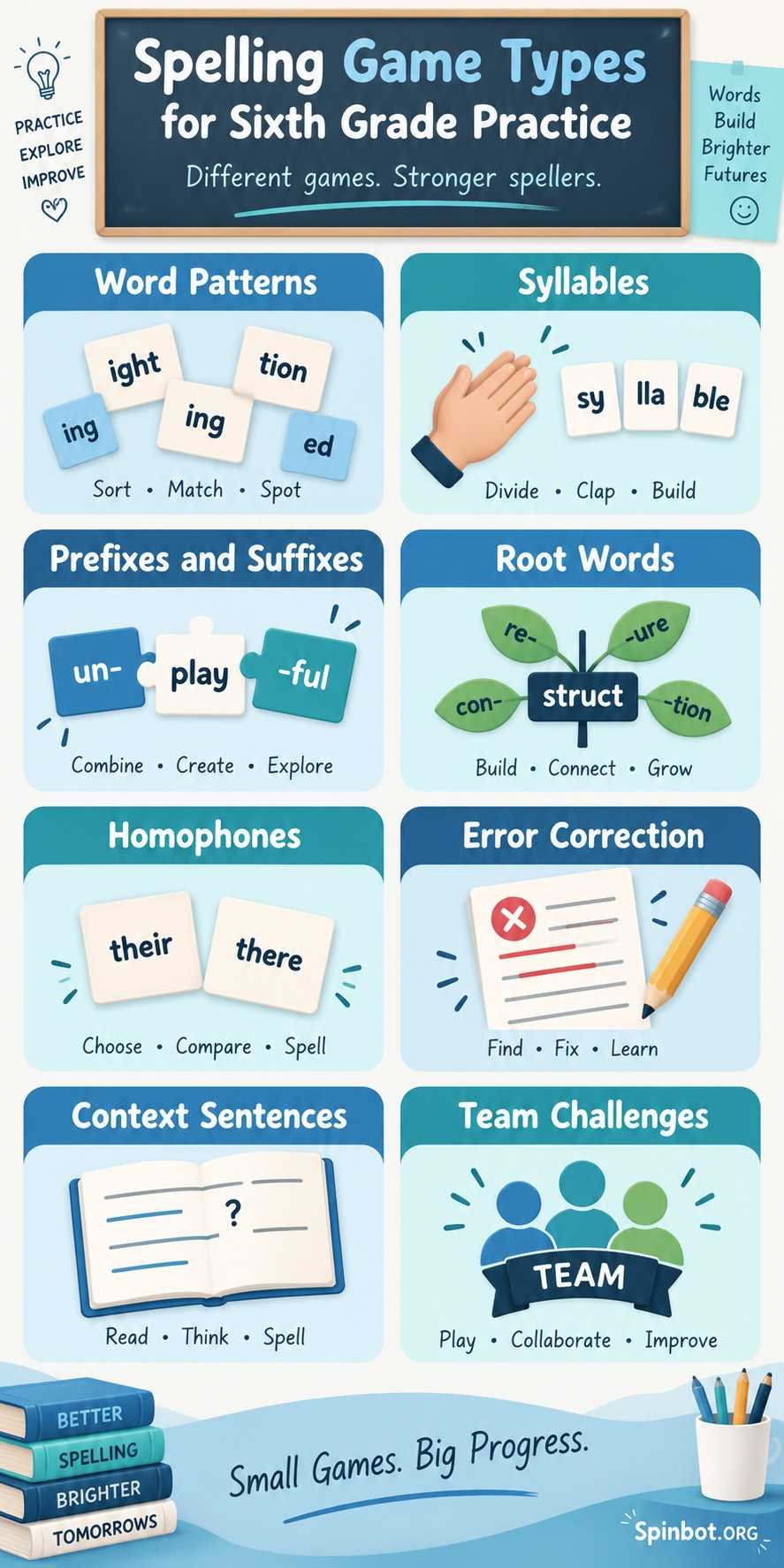
1. Word Sort Showdown
Give students 15 to 25 spelling words and ask them to sort the words into groups.
You can choose the categories beforehand or let students discover them.
For example, students might group words by:
- prefix
- suffix
- vowel pattern
- number of syllables
- silent letters
- word origin
- similar roots
Suppose the list includes preview, prediction, prevent, rewrite, return, and reconsider. Students could sort them according to prefixes such as pre- and re-.
To turn it into a game, award one point for each correct placement and a bonus point when a student can explain the pattern.
The explanation is the useful part. Students are not only seeing how a word is spelled. They are thinking about why words belong together.
2. Correct the Teacher
Sixth graders usually enjoy catching an adult making a mistake.
Use that to your advantage.
Write five to ten sentences containing deliberately misspelled words. Students become editors and identify every error.
For example:
The scientist made an important discoverey during the experament.
Students correct the spelling and explain what was wrong.
You can make the activity harder by including correctly spelled words that look suspicious. That prevents students from assuming every highlighted word must be wrong.
For an extra round, let students write their own mistake-filled sentences for classmates to edit.
3. Spelling Relay
Divide the class into small teams.
Say a word aloud. The first student writes the first part of the word, then passes the marker or paper to another teammate, who continues it.
For a word such as communication, students might work through it by syllables:
com – mu – ni – ca – tion
A team receives a point only when the final word is correct.
This game works especially well with longer words because students learn to treat them as combinations of manageable parts rather than intimidating strings of letters.
IES middle-school guidance specifically recommends helping students think about the different parts or syllables in multisyllabic words while spelling them.
4. Root Word Builder
Choose a useful base or root and challenge students to build as many related words as possible.
Start with act, for example.
Students might create:
- action
- active
- activity
- inactive
- reaction
- interaction
Then ask them to underline the base and circle any prefixes or suffixes.
The game can continue with roots such as struct, port, spect, or graph.
This combines spelling and vocabulary. Students begin to recognize that many difficult-looking words are made from familiar pieces.
5. Syllable Sprint
Say or display a multisyllabic spelling word.
Students first divide it into syllables before spelling the entire word.
For example:
information → in / for / ma / tion
You can have students clap the syllables, mark them with lines, or write each part in a separate box.
Give one point for correctly identifying the parts and another for spelling the complete word.
For students who struggle with longer words, this can be more useful than asking them to memorize the whole word at once.
6. Prefix and Suffix Match
Create two sets of cards.
One set contains base words:
- agree
- appear
- possible
- comfort
- use
The second contains prefixes or suffixes:
- dis-
- im-
- -able
- -ful
- -ment
Students combine cards to create real words and then spell the finished word.
You can make the game more challenging by asking for the meaning of each new word or having students use it in a sentence.
Grade 6 language standards specifically include using common Greek and Latin roots and affixes to help determine word meaning.
7. Homophone Challenge
Homophones sound alike but have different spellings or meanings, which makes them perfect for a spelling game.
Give students choices such as:
- their / there / they’re
- principal / principle
- weather / whether
- accept / except
- aloud / allowed
Read a sentence with the target word missing.
Students must choose and spell the correct word.
Instead of asking only, “How do you spell it?” the game forces students to think about meaning too.
That makes the spelling easier to connect with actual writing.
8. Dictionary Race
Give students a challenging word and a print or digital dictionary.
Their job is to find:
- the correct spelling
- pronunciation
- part of speech
- definition
The first person or team to complete all four accurately wins the round.
This is more than a speed exercise. It teaches students how to verify words instead of guessing.
Common Core Grade 6 language standards include consulting dictionaries, glossaries, and thesauruses to check pronunciation, meaning, and word use.
9. Word Scramble Battle
Scramble the letters of a spelling word and ask students to rebuild it.
For example:
r-e-p-o-r-t-e-c-u-m → computer
For harder rounds, use longer academic words.
You can also provide a definition as a clue. This makes the game less about random letter rearranging and more about vocabulary knowledge.
Ask students to spell the word once more without looking after they solve it.
10. Team Spelling Bee
The traditional spelling bee still works, but one change can make it less stressful.
Use teams instead of immediate individual elimination.
Say a word and allow teammates a few seconds to discuss its syllables, roots, or possible spelling patterns before one student gives the final spelling.
Rotate the spokesperson each round so everyone participates.
You can also award partial points for correctly identifying a prefix, suffix, or root even when the whole word is misspelled.
This keeps the focus on learning instead of simply staying in the competition.
11. Create-a-Crossword
Give students their spelling list and ask them to create crossword clues for several words.
If the word is photosynthesis, for example, they should write a clue based on its meaning rather than simply copying a dictionary definition.
Students can swap puzzles with a partner when they finish.
This requires them to spell the word correctly several times while also thinking about meaning and vocabulary.
For a quick version, the teacher can prepare the crossword and let students solve it in teams.
12. Context Clue Spelling
Choose one spelling word and give students a sentence that strongly suggests its meaning without showing the word.
For example:
The scientist carefully watched the chemical ______ during the experiment.
Target word: reaction
Students identify the missing word and spell it correctly.
This works well with academic vocabulary because students must connect meaning, context, and spelling.
It also reflects a broader Grade 6 language skill: using sentence and paragraph context to determine the meaning of unfamiliar words.
13. Spelling Memory Match
Create pairs of cards.
One card contains a word. Its matching card might contain:
- the definition
- a root
- a prefix meaning
- a synonym
- a missing-letter version of the word
Turn all cards face down.
Students flip two cards at a time and keep any correct matches.
For example, transportation could match a card showing port = carry.
The game works especially well when students are studying word families rather than unrelated weekly words.
14. Whiteboard Speed Round
Give every student or team a small whiteboard.
Say a spelling word aloud and use it in a sentence.
Students write the word but keep their boards hidden until you say, “Show.”
Everyone reveals the answer at once.
This has an advantage over calling on one student: the entire group has to attempt every word.
After each round, briefly discuss the tricky part.
For example:
necessary
Rather than simply announcing the correct answer, ask what part caused trouble and identify a memory aid or spelling pattern.
Keep the rounds short. Five focused minutes can be enough.
15. Spelling Detective
Give students a paragraph containing a mixture of correct and incorrect spellings.
Their job is to investigate it like an editor.
Ask them to:
- circle suspected errors
- write the correct spelling
- explain the reason when possible
- check uncertain words in a dictionary
- rewrite one corrected sentence
Include realistic errors such as doubled consonants, missing suffix letters, homophone confusion, and difficult vowel patterns.
This is one of the best games for spelling words when you want spelling practice to connect with editing and real writing.
Choosing the Right Words for Sixth-Grade Games
The game matters, but the words matter just as much.
A sixth-grade spelling list should not consist only of random difficult words.
Choose groups that teach something.
Multisyllabic words
Words such as independent, communication, responsible, and environmental encourage students to practice breaking longer words into parts.
Prefixes, suffixes, and roots
Try word families such as:
predict, prediction, predictable, unpredictable
Students can see how spelling, structure, and meaning are connected.
IES guidance recommends working with prefixes, suffixes, roots, and related words because these meaningful parts can help students deal with complex vocabulary.
Commonly confused words
Words such as affect/effect or principal/principle help connect spelling with accurate writing.
Subject vocabulary
Don’t keep spelling separate from the rest of school.
Use appropriate words from science, history, geography, mathematics, and literature. Grade 6 standards encourage students to build both general academic and subject-specific vocabulary.
Make the Games Easier or Harder
A spelling activity should be adjustable because students in the same class rarely have exactly the same spelling skills.
To make a game easier, you can:
- provide the first syllable
- show several possible spellings
- allow students to work with partners
- use shorter words
- provide the word in a sentence
- let students study the word briefly before spelling it
To increase the challenge:
- use longer words
- remove visual clues
- ask students to explain a root or affix
- require a definition
- ask for a sentence using the word correctly
- include commonly confused words
- ask students to identify the spelling rule or pattern
Avoid turning every game into elimination. A student who misses one word should still get opportunities to practice the rest.
The goal is better spelling, not finding out who can survive the longest.
Using Spelling Games at Home or in Class
You don’t need a full lesson period for these activities.
A simple weekly routine might look like this:
Monday: Word Sort Showdown
Tuesday: Prefix and Suffix Match
Wednesday: Correct the Teacher
Thursday: Whiteboard Speed Round
Friday: Team Spelling Bee
Most can be adapted into five-to-ten-minute activities.
At home, one parent and one child can play nearly all of them. Replace teams with turns, use index cards instead of classroom materials, and keep a running list of words that still cause trouble.
Teachers can also use the games for small-group stations. One group might work with roots while another plays a homophone challenge and another practices multisyllabic words.
The variety keeps practice fresh without requiring a completely new teaching method every day.
What About Spelling Games for Younger Grades?
Many game formats can move between grade levels, but the words and thinking skills should change.
Spelling games for 5th graders may use similar word sorts, relays, and spelling bees with slightly simpler vocabulary.
For younger elementary students, games generally need more emphasis on sound-letter relationships, basic patterns, and shorter words. A game suitable for first or second grade should not simply use the same material as a sixth-grade activity with fewer words.
Likewise, spelling practice for third and fourth graders can gradually introduce more complex patterns and word parts before students reach the longer academic vocabulary common in middle school.
The format can stay playful. The language challenge should grow with the learner.
Keep Spelling Practice Focused on Real Word Skills
The best spelling games for 6th graders don’t hide spelling practice behind entertainment. They make the spelling itself interesting.
A student sorting predict, prediction, and predictable is learning more than three separate spellings. A student breaking communication into syllables has a strategy for approaching other long words. A student correcting a misspelled sentence is practicing the same kind of attention needed during real writing.
Start with three or four games that fit your students. Rotate them instead of introducing a new activity every day. Change the word patterns, roots, and vocabulary while keeping the rules familiar.
When students know how to examine a word instead of simply memorizing it, spelling practice becomes much more useful.

Academic editor turned AI copy pro, Sarah-Jane fuses research precision with smart storytelling. She covers academic writing, research, citation, plagiarism, copyright, grammar, editing, and publishing.