

A creative brief fixes that problem before production begins. It gives everyone involved a shared understanding of what the project needs to achieve, who it is for, what must be communicated, and what limits the creative team needs to work within.
The best briefs provide clear direction without deciding the creative solution in advance.
What Is a Creative Brief?
A creative brief is a short document that explains the strategy and requirements behind a creative project. It normally covers the project objective, audience, message, deliverables, tone, timeline, budget, constraints, and people responsible for approval.
Adobe describes a creative brief as a document that defines a project’s scope and goals while giving creative teams the direction they need. Crucially, Adobe also makes a useful distinction: the brief should establish the framework for the work rather than dictate the actual creative concept.
That distinction matters.
Suppose a company wants to promote a new meal-delivery service.
A weak brief might say:
“Create a fun video showing a family enjoying dinner.”
The creative decision has already been made, yet the team still knows very little about the business problem.
A stronger brief might say:
“The campaign should persuade busy working parents that preparing a good weekday dinner does not need to take an hour. The primary audience is parents with limited evening time. The main message is that the service makes weekday meals easier without removing choice.”
Now the writer, designer, filmmaker, or agency has a problem to solve instead of an instruction to copy.
Canva notes that creative briefs are commonly only one or two pages long, although there is no rule requiring every project to fit that length. The real goal is to make the document detailed enough to remove harmful ambiguity without turning it into a 20-page strategy report nobody uses.
What a Creative Brief Actually Does
A creative brief creates a common reference point before different people begin making different assumptions.
That becomes especially useful when a project involves marketers, writers, designers, video teams, managers, clients, and external agencies. Asana describes the brief as a way to align stakeholders around creative requirements, messaging, expectations, deliverables, budget, timelines, and distribution.
In practice, a good brief does four important jobs.
It defines the problem
Creative teams cannot solve a problem that has never been clearly stated.
“We need a new landing page” describes an output.
“Our current landing page gets visitors, but many do not understand why the paid plan is different from the free plan” describes a problem.
The second version gives the team something meaningful to work on.
It keeps the audience visible
Creative discussions can easily become internal debates about what the CEO likes, what the designer prefers, or what a competitor recently published.
The brief brings the conversation back to the person who actually needs to respond to the work.
Who are we trying to reach?
What do they already believe?
What do they need?
What might stop them from taking action?
Those questions are usually more useful than deciding whether someone personally prefers blue or green.
It limits unnecessary revisions
A brief will not eliminate revisions, nor should it. Creative work develops as ideas become visible.
But it can prevent avoidable revisions caused by information appearing too late.
If the designer learns after completing a campaign that every image must work in three different aspect ratios, that is not really a creative failure. It is a briefing failure.
Smartsheet similarly emphasizes that creative briefs help keep internal teams and external stakeholders aligned around objectives, audiences, messages, and deliverables.
It gives creative people useful boundaries
Constraints are not automatically bad for creativity.
Knowing that a video must be 30 seconds long, that a campaign cannot use customer testimonials, or that a particular legal statement must appear can save hours of work on concepts that could never be approved.
What hurts creativity is discovering those limits after the work is finished.
The Core Creative Brief Components
There is no single creative brief format that fits every project. A logo redesign, email campaign, product launch, video advertisement, and annual report will need different details.
Still, most useful briefs contain the following components.
Project Background and Objective
Start with enough background to explain why the work exists.
Then state what the project needs to accomplish.
Avoid goals such as:
- Create awareness
- Increase engagement
- Make the brand look modern
They may point in the right direction, but they are too broad to guide many creative decisions.
A clearer objective connects the work to a desired change.
For example:
“Help first-time visitors understand the product’s main benefit and encourage qualified visitors to start a free trial.”
Whenever possible, define how the project will be evaluated. Asana recommends making goals measurable so the team can later judge whether the work achieved its intended objective.
Target Audience and Audience Insight
“Everyone” is not a useful target audience.
Neither is “men and women aged 18 to 65” unless that demographic distinction genuinely influences the creative work.
Describe the people whose needs should shape the project. Depending on the campaign, useful details might include:
- What they want
- What problem they face
- What they already know
- What they misunderstand
- What worries them
- What motivates them
- Where they will encounter the content
An audience insight goes one step further.
Suppose your audience consists of small-business owners shopping for accounting software. The demographic description matters less than an insight such as:
“They know spreadsheets are becoming difficult to manage, but they worry accounting software will be even more complicated.”
That gives a copywriter and designer something concrete to address.
Key Message and Desired Response
A brief should identify the main idea the audience needs to understand.
If the project has five equally important messages, it usually has no clear main message.
Try completing this sentence:
After seeing this work, the audience should understand that ________.
Then ask what you want them to do.
The desired response might be:
- Request a quote
- Register for an event
- Remember a new brand position
- Start a trial
- Donate
- Download a guide
- Visit a store
- Change an existing perception
The message and action should make sense together.
Tone and Creative Direction
Tone explains how the communication should feel.
Useful direction might be:
“Knowledgeable but conversational. Avoid technical jargon unless it is explained.”
That is more actionable than writing three fashionable adjectives such as:
“Bold. Authentic. Disruptive.”
If you include references, explain what you like about each one. A reference video might be useful because of its pacing, not because you want the team to reproduce its visual style.
The objective is shared understanding, not imitation.
Deliverables and Channels
Be precise about what needs to be produced.
Instead of:
“Social media assets”
write something closer to:
- Three vertical short-form videos
- Four square campaign graphics
- One landing-page hero image
- Two email banner variations
Also state where each asset will be used.
Distribution is part of the creative problem. An image designed for a website hero area may need different composition from one designed for a vertical social placement.
Mandatories and Constraints
A mandatory is something the creative team cannot choose to ignore.
Examples include:
- Required logo treatment
- Legal wording
- Approved product name
- Brand colors
- Accessibility requirements
- Prohibited claims
- Existing brand guidelines
- Required call to action
Separate genuine requirements from preferences.
If everything is mandatory, creative freedom disappears.
Timeline, Budget, Measurement, and Approval
The team also needs to know the practical limits of the project.
State important dates, including when the first concept, review rounds, final files, and launch are expected.
Include the available budget when it affects the possible solution. Asana includes budget, timeline, stakeholders, and distribution among the core elements of a creative brief because each can change what the team is realistically able to produce.
Finally, name the decision maker.
A project with seven reviewers and no final approver can stall even when the creative work is good.
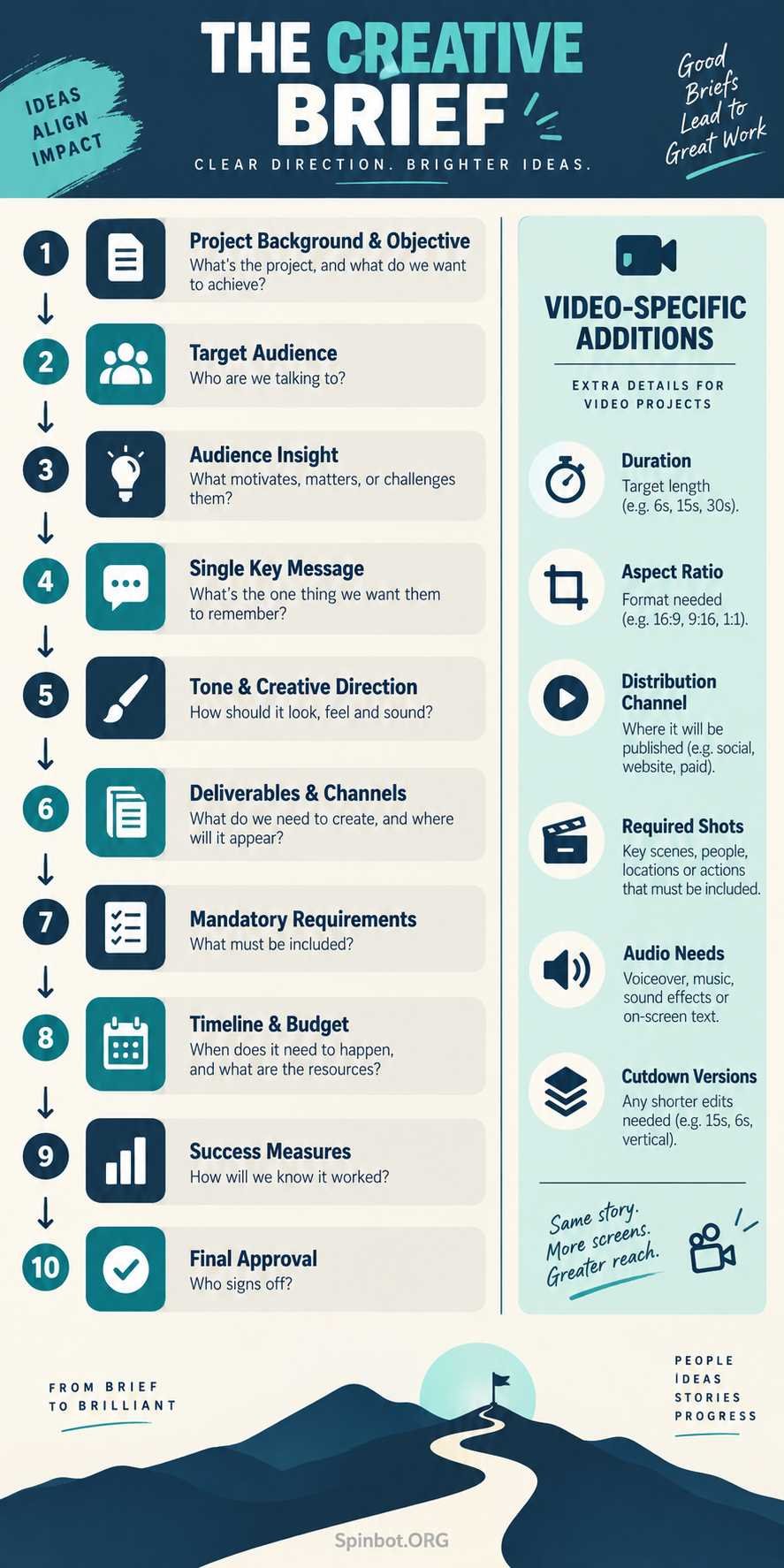
A Simple Creative Brief Format
You do not need special software to create a useful brief. A document, shared workspace, or project-management page is enough.
A practical creative brief template can look like this:
Project name
What is the project called?
Background
Why is this work needed now?
Objective
What should the project accomplish?
Target audience
Who needs to respond to the work?
Audience insight or problem
What does the audience currently think, need, fear, or misunderstand?
Key message
What single idea should they remember?
Desired action
What should they do after seeing the work?
Tone and direction
How should the communication feel?
Deliverables
What exactly needs to be created?
Channels
Where will each deliverable appear?
Mandatories
What absolutely must be included or avoided?
Timeline
What are the important review and delivery dates?
Budget
What resources are available?
Success measures
How will the project be evaluated?
Approver
Who has final sign-off?
Notice what is missing: a long explanation of exactly what the design, headline, script, or campaign concept should be.
That space belongs to the creative team.
Creative Brief Example
Imagine a fictional neighborhood fitness studio called Northline Fitness that wants to promote a six-week beginner program.
A useful brief might contain the following:
Project: Northline Beginner Program Campaign
Background: Many inquiries come from people who want to exercise but feel uncomfortable joining classes designed for experienced members.
Objective: Increase qualified registrations for the next six-week beginner program.
Audience: Adults who have been inactive for some time and want structured exercise but feel intimidated by traditional gyms.
Audience insight: They are not necessarily afraid of exercise. They are worried about looking inexperienced in front of fitter people.
Key message: You do not need to be fit before you start.
Desired action: Book an introductory session.
Tone: Welcoming, straightforward, encouraging, and never aggressive.
Deliverables: Landing-page copy, one email, three social graphics, and two short videos.
Mandatory: Show that the program is designed specifically for beginners. Avoid before-and-after body imagery.
Success measure: Completed introductory-session bookings from the campaign.
Approver: Studio owner.
This example works because the creative team can make decisions from it.
A copywriter might focus on removing fear.
A photographer might avoid intimidating bodybuilding imagery.
A video team might feature the first-day experience instead of advanced exercises.
The brief guides all three without telling them exactly what to create.
How a Video Creative Brief Changes the Template
A video creative brief template needs the same strategic foundation as any other brief: objective, audience, message, tone, deliverables, budget, timeline, and approval.
Video production adds another layer because technical and production decisions can affect filming before anyone reaches the editing stage.
HolaBrief’s video production guidance, for example, includes the project’s objective, audience, intended communication, and technical requirements as key information.
For video, add fields such as:
- Video type
- Target runtime
- Required aspect ratios
- Number of versions or cutdowns
- Primary distribution channels
- Caption requirements
- Voiceover or interview requirements
- Required people, products, or locations
- Existing footage or brand assets
- Production dates
- Delivery specifications
Suppose the brief simply says:
“Create a product video for social media.”
The production team still has to guess whether that means one horizontal two-minute video, three 15-second vertical clips, a square ad, or all of them.
Those differences can affect framing, scripting, shooting, editing, captions, and cost.
That is why video deliverables should be defined early rather than treated as an export decision at the end.
Creative Brief vs. Content Brief
These two documents overlap, but they are not identical.
| Creative brief | Content brief |
|---|---|
| Guides a creative project or campaign | Usually guides a specific content asset |
| Can cover design, copy, advertising, video, or mixed deliverables | Often focuses on articles, landing pages, or other written content |
| Emphasizes audience, message, creative direction, deliverables, and constraints | Often includes search intent, topic coverage, headings, sources, keywords, and editorial requirements |
| Leaves room for creative concept development | May provide a much more detailed content structure |
Search Engine Land defines a content brief as instructions and guidelines for producing an article or other written work. In SEO workflows, that often includes objectives, on-page requirements, and an article outline with headings.
A campaign can need both.
For example, a company launching a new software product might create one creative brief covering the overall campaign. The team could then create a separate content brief template for each SEO article that supports the launch.
The creative brief keeps the campaign coherent. The content briefs help individual writers execute specific pages correctly.
Common Creative Brief Mistakes
The biggest briefing problems usually come from either saying too little or trying to control too much.
The objective is really a deliverable
“Make three videos” explains what needs to be produced, not why.
Ask what those videos are supposed to change.
The audience is too broad
“Small businesses” could include a freelance photographer and a 200-person manufacturing company.
If those audiences face different problems, narrow the brief.
There are too many main messages
A creative project can contain supporting information, but the audience usually needs one clear central idea.
Decide what matters most.
Constraints arrive late
Do not wait until the design review to mention that an image needs to fit several placements or that legal approval is required.
Put foreseeable constraints into the brief.
Subjective language replaces direction
Words such as “modern,” “premium,” “fresh,” and “engaging” can mean almost anything.
Explain what those words mean in this project.
The brief becomes the creative concept
This is the opposite problem.
When the brief specifies the headline, image, layout, script concept, visual metaphor, and execution before the creative team has explored the problem, it stops being a brief and starts becoming an unfinished creative treatment.
Adobe’s guidance is useful here: define the framework and requirements while leaving the team room to develop the actual concepts.
How to Know the Brief Is Ready
A creative brief does not need to answer every possible question.
It needs to answer the questions that would otherwise force the team to make risky assumptions.
Before production begins, check whether everyone can clearly explain:
- Why the project exists
- Who the audience is
- What problem the work needs to address
- What the main message is
- What response you want
- What needs to be delivered
- Where the work will appear
- What cannot be changed
- When it is due
- Who makes the final decision
If those answers are clear, the creative team has a useful starting point.
If the document is 12 pages long but nobody can identify the main objective, you do not have a strong brief. You have a lot of information.
That is the practical value of understanding what a creative brief is. It is not paperwork added before the interesting work begins. It is the point where strategy becomes clear enough for the interesting work to begin.
Give the team a specific problem, a real audience, a focused message, useful constraints, and a clear definition of success. Then leave enough space for them to create the solution.

Raj blends SEO mastery with real-world freelance grit. Covers SEO, blogging, content strategy, copywriting, freelance writing, marketing, and business communication.