

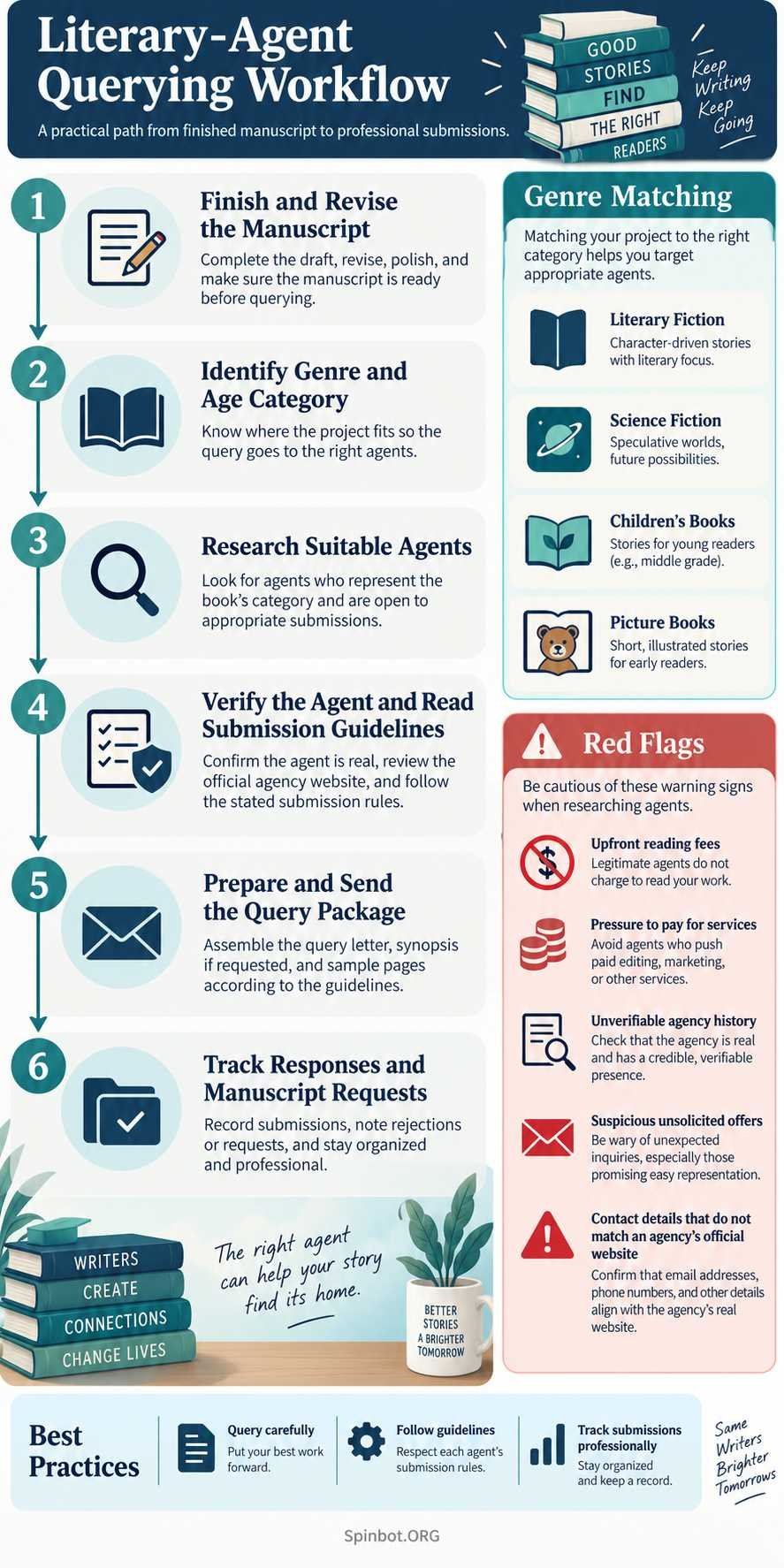
The query letter matters, but it is only one part of the job. A beautifully written pitch sent to an agent who does not represent your genre is still a poor query. The better approach is to start with a polished book, build a carefully researched agent list, follow each agent’s instructions, and send a clear pitch that makes the book easy to understand.
That takes more work than firing the same email at 100 names. It also gives each submission a much better reason to exist.
What It Means to Query a Literary Agent
A literary agent represents authors in their dealings with publishers. Depending on the relationship and the book, an agent may help shape a manuscript or proposal, submit it to suitable editors, negotiate publishing contracts, advise on rights, and help manage parts of an author’s publishing career.
Many traditional publishers do not accept unsolicited manuscripts directly from writers, which is one reason agents play such an important role. The Authors Guild recommends finding agents through resources such as the Association of American Literary Agents, professional directories, and established agent databases.
When you query, you are not asking the agent to publish your book. You are asking whether they are interested enough in the project to read more and potentially discuss representation.
That distinction helps put the query letter in perspective. Its job is not to tell every detail of your book. Its job is to make the right agent want the next piece.
Make Sure Your Book Is Ready Before You Query
For a novelist, one of the easiest querying mistakes to avoid is starting too early.
Most novelists and memoirists should have a complete, revised manuscript ready before querying. If an agent likes your pitch and immediately asks for the full manuscript, you should be able to send it rather than explain that you still need another month to finish the ending. Current query guidance from publishing expert Jane Friedman makes the same recommendation for novels and most memoirs.
Finished does not mean you will never change another word. It means you have taken the manuscript as far as you reasonably can before asking an industry professional to consider it.
Nonfiction can work differently. Many nonfiction projects are pitched through a book proposal and sample chapters rather than a completed manuscript. A nonfiction query therefore has to establish more than the book idea. It may also need to explain the intended readership, why the book belongs in the market, and why you are positioned to write it.
Before building an agent list, know which publishing path fits the type of book you have written.
Find Literary Agents Who Actually Represent Your Book
The phrase “how do you get a literary agent” makes the process sound as though you first find a good agent and then persuade them to take your book.
In practice, fit comes first.
An excellent agent for celebrity memoirs may be completely wrong for your middle-grade fantasy. An agent who represents commercial science fiction may not be interested in quiet literary fiction. Even two agents at the same agency can have very different tastes.
Start With Your Genre and Age Category
Describe your book accurately before researching agents.
For adult fiction, that might mean literary fiction, science fiction, fantasy, romance, thriller, horror, historical fiction, or another established category. Children’s publishing requires another layer because the reader age matters. A picture book, middle-grade novel, and young-adult novel should not be treated as interchangeable children’s books.
This matters because agent databases can get quite specific. Current QueryTracker profiles, for example, distinguish between categories such as picture books, middle grade, young adult, science fiction, fantasy, and literary fiction, and individual agents may accept some while rejecting others.
Do not widen your category simply to produce a longer agent list. Twenty genuinely suitable agents are more useful than 100 people who do not represent what you wrote.
Use More Than One Research Source
Agent directories are useful starting points, not final proof that somebody should receive your query.
The Authors Guild recommends established resources including AALA and professional agent directories. QueryTracker can help you search by genre and see querying information, while Manuscript Wish List can reveal much more specific interests.
Once you find a promising name, go to the agent or agency’s own website.
Confirm three things:
- The agent still works there.
- They currently represent your category.
- They are open to submissions and tell you how to submit.
This last check is easy to skip. It is also easy for an old listicle or database profile to become outdated. Current agent records show exactly why verification matters: some agents who represent relevant genres may still be closed to unsolicited queries at a particular time.
Treat the agency website as the final word on current submission instructions whenever possible.
Finding Agents for Different Types of Books
The basic research process stays the same across genres, but what counts as a good match changes.
Literary Agents for Children’s Books
Searching for a “literary agent children’s books” list is only the beginning. Children’s publishing covers several markets.
An agent may represent:
- picture books
- chapter books
- middle grade
- young adult
- children’s nonfiction
- graphic novels
Do not assume that an agent who represents young adult also takes picture books. Check the categories explicitly.
Picture Book Literary Agents
Picture books deserve special attention because some agents only want certain kinds of creators or projects. One may consider text-only submissions from writers, while another may strongly favor author-illustrators.
Current Manuscript Wish List and QueryTracker profiles show agents making distinctions between picture books, author-illustrators, middle grade, and other children’s categories.
You should also follow picture-book submission instructions exactly. A full picture-book manuscript is short enough that an agent may request material differently than they would for a 90,000-word novel.
Literary Agents for Literary Fiction
Literary fiction is not a catch-all label for any serious novel.
Look at the agent’s client list and wishlist. Do they appear interested in voice-driven work, experimental fiction, family stories, historical literary fiction, or fiction that crosses into the upmarket category?
An agent who says “literary fiction” may still have strong preferences within it. The more accurately you understand those preferences, the easier it becomes to decide whether personalization in your query is meaningful or merely decorative.
Sci-Fi Literary Agents
The same principle applies when looking for sci-fi literary agents.
Science fiction can include space opera, speculative fiction, climate fiction, near-future stories, science-fantasy hybrids, dystopian fiction, and many other approaches. An agent’s wishlist can tell you far more than a simple Science Fiction checkbox.
A current Manuscript Wish List profile, for example, may name very specific science-fiction interests while excluding literary fiction or other categories entirely.
That level of detail is useful. It lets you distinguish “technically represents sci-fi” from “actively wants books like mine.”
Research Each Agent Before Sending Anything
Once an agent passes the basic genre test, dig a little deeper.
Check the agency website, client list, recent deals or books where publicly available, interviews, Manuscript Wish List profile, professional memberships, and submission page.
You are trying to answer two different questions.
First: Could this agent want my book?
Second: Would I want this agent representing me?
Writers sometimes focus so heavily on getting an offer that they forget the second question exists.
A practical research sheet might contain:
| Agent | Genre Fit | Open Now | Submission Method | Why They Fit |
|---|---|---|---|---|
| Agent A | Strong | Yes | Query form | Wants character-led adult SF |
| Agent B | Strong | Yes | Represents recent literary fiction comps | |
| Agent C | Partial | No | Closed | Recheck later |
This simple step catches a surprising number of poor submissions before they leave your computer.
It also makes personalization easier. Instead of writing a vague line such as “I am querying you because of your impressive list,” you can mention a genuine connection when one exists.
Personalization is useful when it proves fit. Forced flattery is not.
Write a Query Letter That Makes the Book Clear
A query letter is a professional pitch. For narrative books, it normally needs to tell the agent what the book is, what drives the story, and why the project belongs on that agent’s list.
Jane Friedman’s current guidance identifies four common query elements: basic book information, the story description, comparison titles, and a brief author biography. She recommends keeping the complete query concise, generally around 200 to 450 words. Reedsy’s current guide similarly emphasizes the hook, story pitch, book details, comparisons, and relevant author information.
Give the Agent the Basic Book Details
Make it easy to identify the project.
For a novel, that usually means:
- title
- genre or category
- approximate word count
- intended readership where relevant
For children’s books, include the correct age category. “Children’s fiction” may be far too broad.
Build the Pitch Around Character and Consequences
A weak query often explains the setting instead of selling the story.
Suppose you have written an 85,000-word science-fiction novel about a mining colony on Mars. You could spend half the query explaining the political history of the colony, its economic system, and the technology behind its oxygen network.
But the agent first needs the dramatic core.
Who is the protagonist? What do they want? What changes? What stands in their way? What happens if they fail?
Those answers give the agent something to follow.
For narrative work, Friedman suggests that roughly 150 to 300 words can be enough for the story description in many queries.
That is not much room. Spend it on the conflict, not a miniature encyclopedia of your fictional world.
Choose Useful Comparable Titles
Comparable titles, often called comps, help place your book in the market.
A good comparison should clarify something meaningful about the audience, tone, subject, structure, or commercial position of your project. Do not simply choose two famous books because you hope your book will sell like they did.
The comparison should help the agent understand the book faster.
Keep the Author Bio Relevant
A novelist does not need an extraordinary biography to query.
Mention publishing credits, professional expertise, awards, or experience that is genuinely relevant. For nonfiction, credentials and platform can matter more because the author’s authority and ability to reach the intended audience may be part of the commercial case.
If you have little relevant publishing history, keep the bio short rather than padding it with unrelated achievements.
Follow Each Agent’s Submission Instructions
Here is where careful writers sometimes sabotage themselves.
They spend weeks polishing the query, then assume every agent wants the same package.
They do not.
One agent may request only a query. Another may want ten pages. Another may request several chapters, a synopsis, or a QueryManager form. Some want material pasted into the message rather than attached.
Current agent examples show this variation clearly. One Manuscript Wish List profile instructs writers to include up to three chapters in the email body, while another agent accepts submissions exclusively through QueryManager and states that emailed queries will not be considered.
That means your master query package should have separate pieces ready to go:
- query letter
- short synopsis
- longer synopsis if needed
- first five or ten pages
- first chapter
- first three chapters
- full manuscript
- nonfiction proposal where applicable
Then send only what the agent requests.
Do not attach your full manuscript because you think it gives the agent a useful bonus. Instructions are part of the submission.
Query in Manageable Batches and Track What Happens
You can usually query more than one agent rather than waiting for each rejection before sending the next submission. But there is a good reason not to send your entire list in one afternoon.
Your early queries give you information.
Suppose you have researched 36 strong science-fiction agents. You send six carefully prepared queries. Over time, you receive six form rejections and no manuscript requests.
That does not prove the book is bad. It does give you a reason to inspect the query and opening pages before sending the same material to the remaining 30 agents.
If two of those first six request the full manuscript, the query is at least doing its basic job: making some qualified readers want more.
There is no magic batch size. Former AALA president Gail Hochman has suggested beginning with a core group of roughly five or six carefully chosen agents, which is a useful model rather than a universal rule.
Keep a tracking sheet with the agent name, agency, date, project, submission method, materials sent, expected response policy, response, and any manuscript request.
Without tracking, querying gets messy quickly.
Literary Agents and Offers You Should Avoid
Searching for “literary agents to avoid” can lead you toward static blacklists that may become outdated.
A better skill is learning to recognize the warning signs yourself.
The Association of American Literary Agents’ revised 2026 Canon of Ethics, effective September 1, 2026, states that member agents may not charge reading fees for evaluating query letters, proposals, partial manuscripts, or complete manuscripts for possible representation. Its current rules also restrict arrangements in which representation is tied to paid editorial or other services.
Be cautious when someone:
- asks you to pay simply to have your manuscript considered for representation
- makes representation conditional on buying editing, marketing, or another paid service
- promises a major publishing contract before properly evaluating your work
- contacts you unexpectedly with an unusually lucrative offer
- pressures you to pay or act immediately
- uses contact details that do not match the real agency
- cannot provide a credible professional history
- claims famous connections that you cannot independently verify
One complication is that scammers sometimes impersonate legitimate agents and agencies. The Authors Guild reported in 2026 that author-targeted scams are becoming more sophisticated and specifically warns writers to investigate unexpected publishing, agent, marketing, and adaptation offers. It recommends independently contacting the genuine person or organization when necessary rather than trusting the information contained in the suspicious message.
So a familiar agent’s name is not enough.
Check the sender’s email domain. Visit the agency website yourself. Find the official contact details independently. If a supposed agent offers you a huge deal out of nowhere and then asks for money, verification should happen before anything else.
What Happens When an Agent Requests Your Manuscript
A manuscript request is a good result, but it is not yet an offer of representation.
The agent may ask for a partial manuscript or the complete book. Send exactly what was requested, in the requested format, and check the email before attaching anything.
This is another reason your manuscript should be finished before querying fiction.
Then continue following the agent’s stated process. Do not assume a full request means the agent has already decided to represent you. They still need to read the work and decide whether they believe in both the book and the working relationship strongly enough to take it on.
Keep your tracking sheet updated so you know who has what.
What to Do If an Agent Offers Representation
An offer changes the conversation.
You are no longer simply trying to impress the agent. You are evaluating a potential business relationship.
Ask about the agent’s vision for the manuscript, possible revisions, submission strategy, communication style, experience in your category, and what happens if the book does not sell.
If there is an agency agreement, read it carefully before signing. The Authors Guild recommends paying attention to issues such as what works the agreement covers, termination rights, commission arrangements, communication, rights, and what happens to pending submissions when the relationship ends.
You should also notify other agents who are actively considering the manuscript when appropriate, giving them a fair opportunity to respond before you make your decision.
An offer is exciting. It is still a contract decision.
You want an agent who understands the work, communicates in a way that suits you, operates professionally, and has a convincing plan for representing the book.
Build Your Query List Around Fit, Not Volume
The best answer to “how to query a literary agent” is not a perfect email template.
Start with a book that is ready. Identify its real genre and audience. Find agents who actively represent that kind of work. Verify their current interests and submission status. Write a concise query that makes the book understandable. Follow the individual instructions. Track what happens and adjust when the evidence gives you a reason to do so.
Whether you are looking for literary agents for literary fiction, sci-fi literary agents, children’s book representation, or picture book literary agents, the principle is the same: specific fit beats mass outreach.
Querying contains a lot that you cannot control. An agent may already have a similar project. Their list may be full. Your book may be strong but outside their taste. Timing can be awkward.
You can control whether the manuscript is ready, whether your research is accurate, whether the query explains the book clearly, and whether you behave professionally throughout the process.
Those are the parts worth getting right.

Academic editor turned AI copy pro, Sarah-Jane fuses research precision with smart storytelling. She covers academic writing, research, citation, plagiarism, copyright, grammar, editing, and publishing.