
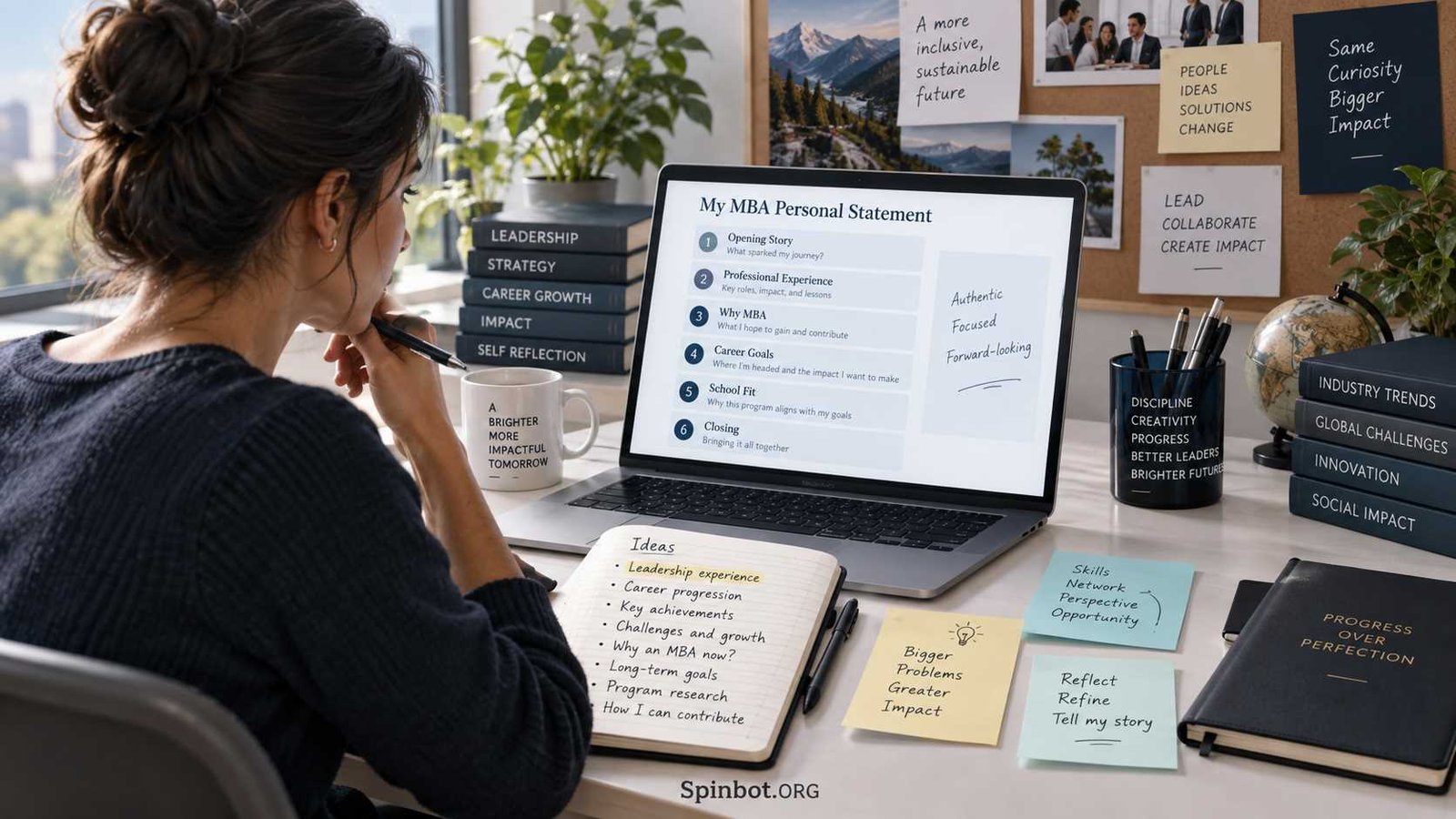
An MBA personal statement template can help because it gives your ideas an order. It should not, however, become a script that every applicant fills in with different company names.
Many leading MBA programs do not even ask for one document formally called a personal statement. Stanford GSB, for example, currently asks applicants to respond to two separate personal essays, with limits of 650 and 350 words. Wharton’s 2026–2027 application uses two short career-goal responses plus a 350-word essay about contributing to its community.
That means the most useful template is a thinking framework, not a universal document format. Use it to decide which experiences, goals, and motivations belong in your application, then reshape those ideas around the exact questions your target school asks.
What an MBA Personal Statement Actually Needs to Do
A strong MBA statement helps an admissions reader understand the connection between three things:
- What has shaped you so far
- Why you need an MBA at this point
- What you intend to do with it
The résumé already shows where you worked, what roles you held, and often what you accomplished. Your essays have a different job.
Stanford explicitly describes its MBA essays as a way to understand applicants’ values, aspirations, perspective, and the forces that have shaped them. Its guidance also emphasizes writing in your own voice rather than searching for a supposedly correct answer.
That distinction matters.
Compare these two statements:
I was promoted to regional operations manager after improving performance across three locations.
That may be an impressive résumé point, but it tells us little about the person behind it.
Now consider:
When I became responsible for three locations, I initially tried to solve every performance problem myself. Watching one branch improve while another stalled taught me that scaling a business depends less on having the best individual answer and more on building managers who can make good decisions without me.
The second version still discusses professional experience, but now the experience reveals judgment, growth, and a reason for pursuing management education.
That is the territory your personal statement should occupy.
MBA Personal Statement Template
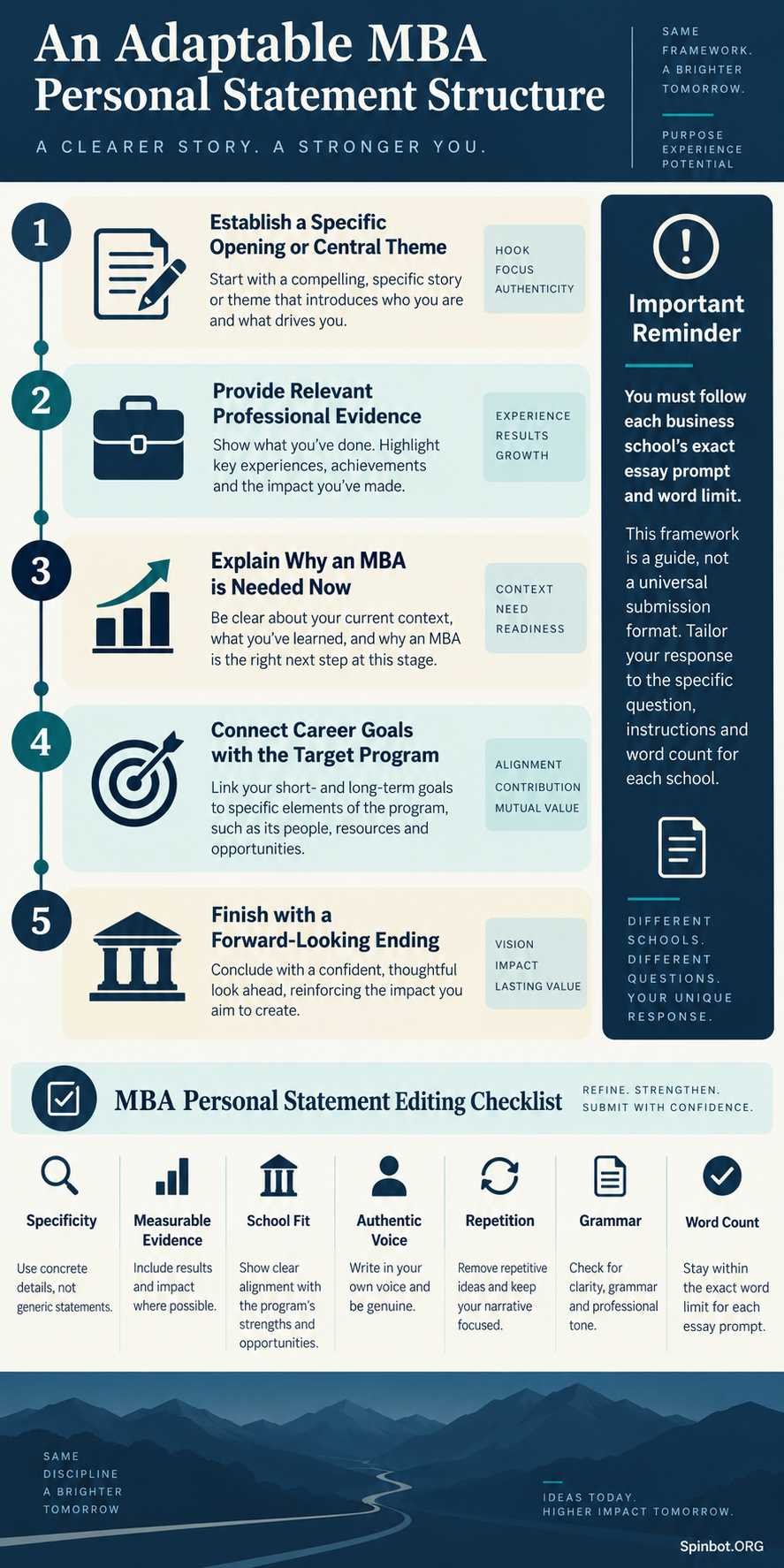
The following framework works well for applications that allow a broad personal statement or career-focused essay. If the school gives you several narrow questions, divide these elements across those responses instead of squeezing the entire template into every essay.
1. Opening and central idea
Begin with a specific experience, decision, tension, or realization that helps explain your direction.
You do not need a dramatic childhood story. In many MBA applications, a recent professional moment is more useful because it connects naturally to the decisions you are making now.
A simple opening framework is:
Situation → realization → direction
For example:
During [specific situation], I encountered [problem, decision, or responsibility]. I initially believed [earlier assumption], but the experience showed me [important realization]. That shift has influenced how I approach [leadership, business problem, career direction, or goal].
The important word here is specific.
An opening such as “Business has always been my passion” could belong to thousands of applicants. A statement about negotiating your company’s first supplier agreement in another country, managing a struggling team, launching a service with limited resources, or seeing customers abandon a poorly designed product gives the reader something concrete to understand.
2. Professional experience and evidence
Once you establish the central idea, show how your work has developed it.
Choose one or two experiences that reveal qualities relevant to your future rather than trying to retell your whole career.
A useful paragraph structure is:
Challenge → action → result → reflection
Suppose you want to show leadership. Instead of writing:
I developed strong leadership skills while managing a team.
You could write:
When customer complaints rose during a rapid expansion, I was asked to coordinate a team across sales and operations. I introduced a weekly review of recurring complaints and gave frontline employees responsibility for proposing fixes. Within the project, I learned that useful leadership was not simply giving faster instructions. It meant creating a process in which people closest to the problem could influence the solution.
If you have reliable numbers, they can strengthen the evidence. Revenue growth, cost reductions, team size, processing time, customer retention, geographic expansion, or project scale can make an accomplishment easier to understand.
Numbers should support the story, though. Your MBA essay should not become a second résumé written in paragraphs.
3. Explain why you need an MBA and why now
This is where many statements become vague.
Applicants often say they want an MBA to improve their leadership, broaden their network, or learn more about business. All three may be true, but they are too broad to explain why graduate business education is necessary for your next step.
A better structure is:
Current capability → missing capability → future responsibility
For example:
My experience has taught me how to improve operations within established systems, but my long-term goal requires me to evaluate market entry, financing, and product strategy across entire businesses. An MBA would help me build those broader skills before moving from operational management into general management.
The gap should be believable.
If you already work in marketing and want to become a chief marketing officer, claiming that you need an MBA simply to “learn marketing” sounds weak. Perhaps what you actually need is deeper financial judgment, organizational leadership, international exposure, pricing strategy, or experience making decisions across functions.
The more precisely you identify the gap, the more convincing your reason for pursuing the degree becomes.
4. Connect your career goals with the program
Your goals need enough detail to show direction without pretending you can predict the next 20 years perfectly.
Think in two stages.
Short-term goal: What role, function, industry, or problem do you want to pursue immediately after the MBA?
Long-term goal: What larger responsibility or impact do you eventually want to take on?
Instead of:
After my MBA, I hope to become a successful business leader.
Try:
After the MBA, I plan to move into product strategy within the financial technology sector, working on services for small businesses. Longer term, I want to lead a company that makes financial tools easier for smaller firms to adopt and use.
Then explain why the particular MBA program fits that path.
School fit becomes stronger when you connect a program resource to an actual development need.
Weak:
Wharton is world renowned and has excellent professors, clubs, and alumni.
Stronger:
Because I want to move from operations into product strategy, I would prioritize opportunities that strengthen my ability to evaluate customer needs alongside financial decisions. I would also seek project-based work where I could test those skills with people from product, finance, and entrepreneurial backgrounds.
For your real application, replace general descriptions with accurately researched courses, centers, experiential programs, clubs, faculty interests, or other relevant resources.
Do not copy a school’s marketing language. Explain the relationship between the opportunity and your goal.
5. End with forward movement
Your ending should make the next step feel logical.
You do not need to summarize every paragraph.
A useful final structure is:
What you now understand → what comes next → what you hope to contribute
For example:
My experience has shown me how much stronger organizations become when operational decisions are connected to a clear understanding of customers and strategy. I am now ready to move beyond improving individual processes and learn to make decisions at the business level. An MBA would give me the broader perspective I need while allowing me to contribute the practical operating experience I have built so far.
The ending works because it completes the argument rather than simply announcing enthusiasm.
MBA Personal Statement Format
There is no universal MBA personal statement format that every business school accepts.
Treat the application instructions as the final authority.
Stanford currently sets separate maximum lengths of 650 words and 350 words for its two principal MBA essays and notes that effective responses can be shorter than the maximum. Wharton’s current application divides its required writing into 50-word and 150-word career questions plus a 350-word community essay.
Those differences show why blindly following a standard 1,000-word personal statement format can cause trouble.
If a school simply asks you to upload a personal statement without giving detailed formatting rules, these defaults are sensible:
- Use clear paragraphs rather than one large block of text.
- Keep one main purpose in each paragraph.
- Use a readable standard font if you are submitting a document.
- Follow any page, file-type, font-size, spacing, or word-count instructions given by the school.
- Do not add decorative graphics unless the application specifically invites them.
- Keep your name or application details only where requested.
- Proofread the uploaded version, not merely your working document.
If the essay is entered into an online application box, elaborate formatting may disappear anyway.
Content matters far more than trying to make an admissions essay look like a designed brochure.
Sample MBA Personal Statement Example
The following is a fictional example designed to demonstrate structure. It is not based on a real applicant and should not be copied into an application.
Three years ago, I assumed that improving a distribution business meant improving its numbers. When I was assigned to a regional warehouse struggling with late deliveries, I focused first on routes, inventory levels, and scheduling. Those changes helped, but our most persistent problems remained. The breakthrough came when I began meeting regularly with drivers and warehouse staff. They identified small handoff failures that management reports had hidden. Fixing those issues taught me that operational performance depends as much on listening and organizational design as it does on efficiency.
That lesson shaped my next role. When my company opened two additional distribution locations, I helped develop a shared performance process rather than imposing one operating model on every site. Managers reviewed the same core measures but could adapt staffing and delivery practices to local conditions. Working across locations made me increasingly interested in a larger question: how should a growing company decide where to standardize and where to remain flexible?
My experience has given me a practical foundation in operations, but I now want to understand these decisions from a broader business perspective. I need stronger skills in corporate finance, market analysis, organizational strategy, and investment decisions. An MBA is the right next step because my goal is no longer simply to run operations well. I want to help decide how businesses expand.
Immediately after the MBA, I plan to move into a strategy role with a logistics or commerce company expanding across emerging markets. In that role, I hope to work on market entry, operating models, and growth planning. Longer term, I want to lead a regional logistics business serving small and midsize companies that often lack access to reliable distribution networks.
I would bring to an MBA classroom the perspective of someone who has seen strategy succeed or fail at the point where employees must actually execute it. I now want to pair that operating experience with the financial and strategic judgment required to make decisions at the enterprise level. The next stage of my career is not about leaving operations behind. It is about learning to see the entire business around them.
Notice what this example does not do.
It does not begin with a dictionary definition of leadership. It does not list every promotion. It does not claim that an MBA has been a lifelong dream. And it does not end by telling the admissions committee that the applicant is certain to succeed.
Instead, each paragraph advances the same story: operational experience created a larger strategic question, which created a skills gap, which created a reason for the MBA.
How to Personalize the Template Without Sounding Generic
The fastest way to weaken an MBA statement is to keep the structure but remove the evidence.
Consider this sentence:
My experience taught me the importance of teamwork.
Ask the obvious follow-up: What happened?
Perhaps two departments disagreed about a launch date. Maybe an engineer challenged your original plan. Perhaps a junior colleague noticed something you had missed. Maybe you had to persuade a team when you had no formal authority.
That event is usually more interesting than the abstract lesson.
A good revision method is to highlight every broad claim in your draft:
- I am a strong leader.
- I value collaboration.
- I am passionate about entrepreneurship.
- I want to make an impact.
- I have strong communication skills.
- I want to grow professionally.
Then ask whether the essay contains evidence that allows the reader to reach the same conclusion without being told.
You do not have to remove every direct statement, but evidence should carry much of the weight.
How to End the Personal Statement
Applicants sometimes struggle with how to end the personal statement because they think the final paragraph must sound inspirational.
It doesn’t.
A useful ending answers one question:
Why does the next step make sense now?
You can usually build it from three elements:
- A lesson or perspective developed through your experience.
- The responsibility you are preparing to take on.
- The contribution or perspective you would bring to the MBA community.
Avoid endings such as:
I know your prestigious MBA program will make all my dreams come true.
Also avoid:
In conclusion, my leadership, communication, analytical, and teamwork skills make me the ideal candidate.
The first gives the school almost magical power. The second simply repeats claims that the essay should already have demonstrated.
Your last paragraph should feel more like the next page of the story.
What Common MBA Personal Statement Examples Get Wrong
Reading examples of MBA personal statements can be useful when you are studying structure. It becomes risky when you begin borrowing someone else’s identity.
Several problems appear repeatedly.
The dramatic opening that goes nowhere
A childhood memory can work when it clearly explains a value or ambition that still affects the applicant’s decisions. If the rest of the essay concerns an unrelated consulting career, however, an elaborate story about a childhood lemonade stand may feel attached rather than essential.
The résumé in paragraph form
If an admissions reader can get the same information from your résumé, the essay is wasting scarce space.
Use the statement to explain decisions, turning points, motivations, conflicts, and lessons that bullet points cannot show.
Vague career goals
“Become a leader in business” gives the reader almost nothing to evaluate.
A goal does not need to name one future employer, but it should usually contain some combination of function, industry, customer, problem, geography, or desired responsibility.
School praise instead of school fit
Calling a university prestigious, diverse, global, innovative, and world class does not demonstrate research.
Fit means explaining why particular opportunities matter for the capabilities you need to develop.
Copying the style of polished samples
This is the hidden danger of sample MBA personal statement examples.
A professionally edited example may sound impressive because it reflects another person’s experiences, choices, and voice. Copying its rhythm can make your own essay strangely distant.
Use samples to study questions such as:
- How quickly does the writer introduce the main idea?
- Where does the writer provide evidence?
- How is the career transition explained?
- What makes the goals specific?
- How does the ending connect to the opening?
Study architecture, not sentences.
Final MBA Personal Statement Checklist
Before submitting, read the application prompt again and check your statement against it rather than against a generic template.
Ask yourself:
- Have I answered the actual question the school asked?
- Does my opening reveal something specific about me?
- Have I included evidence rather than relying on adjectives?
- Does each major accomplishment add insight instead of repeating my résumé?
- Is my reason for pursuing an MBA clear?
- Have I explained why this is the right point in my career?
- Are my short-term and long-term goals understandable?
- Is the connection between my goals and the program specific?
- Could I remove the school name and paste in another one without changing the paragraph? If so, the fit section probably needs more work.
- Does my ending move the story forward rather than repeat the introduction?
- Have I stayed within every required word or character limit?
- Does the essay still sound like me after editing?
That last check deserves special attention. Stanford’s current guidance encourages applicants to ask people who know them well whether their essays actually capture who they are, because polished writing is not useful if the applicant disappears from it.
An MBA personal statement template is most valuable when it helps you organize your own evidence. Use the framework to connect experience, reflection, goals, program fit, and the next stage of your career. Then adapt it aggressively to the actual application.
The strongest statement is rarely the one that sounds most impressive in isolation. It is the one that makes the reader understand why your past choices have led naturally to this particular next step.

Academic editor turned AI copy pro, Sarah-Jane fuses research precision with smart storytelling. She covers academic writing, research, citation, plagiarism, copyright, grammar, editing, and publishing.