
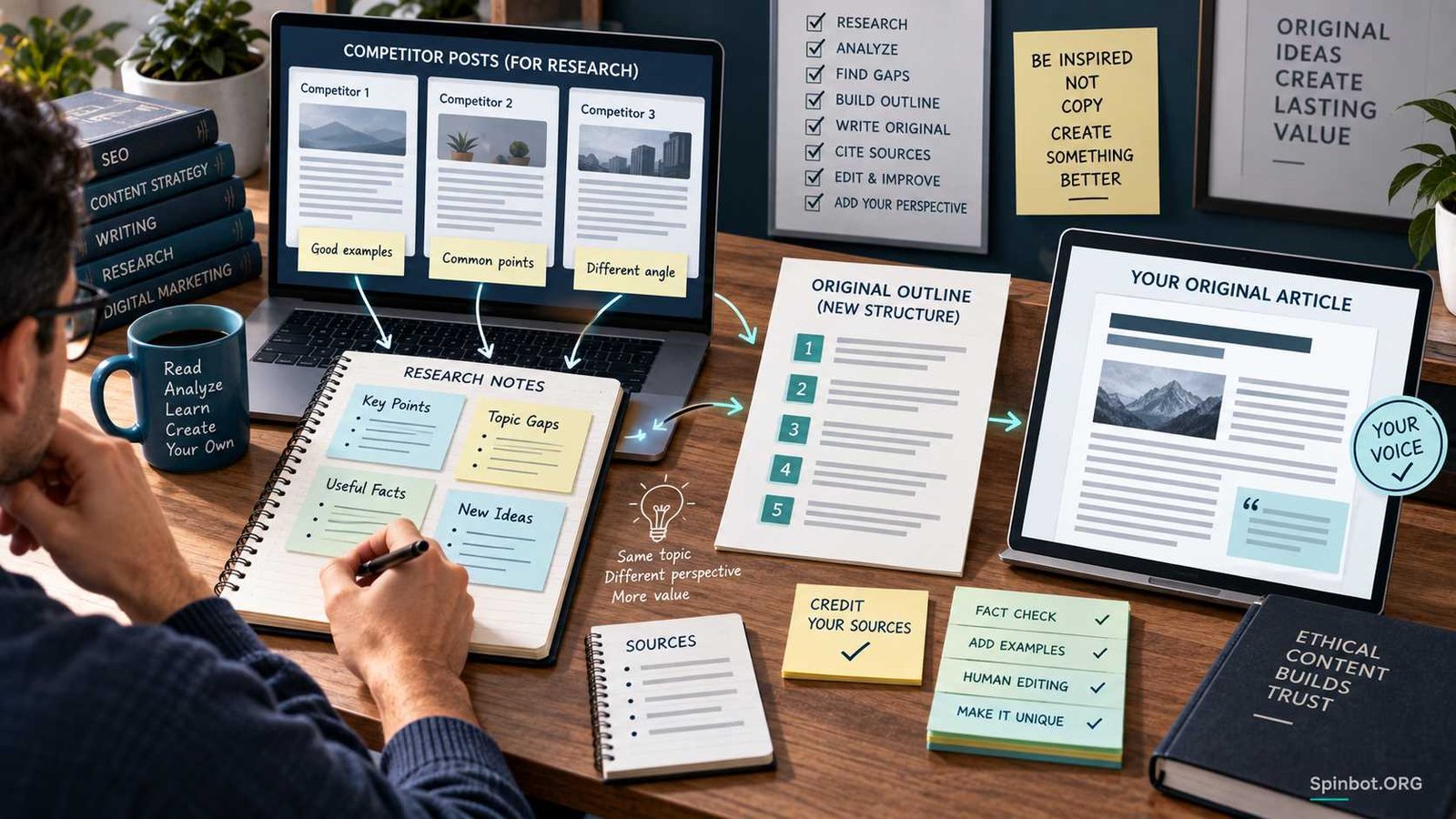
The problem starts when research turns into imitation.
If you open a competitor’s article, keep the same headings, follow the same order, and rewrite each sentence with different words, you have not really created a new article. You have created a modified version of someone else’s work.
A safer approach is simple: research the topic, understand the information, build your own structure, and write from your own plan.
That approach is better for readers, safer from a copyright standpoint, and closer to what Google recommends for original, people-first content. Google specifically asks whether content that draws from other sources avoids simply copying or rewriting them and instead provides substantial additional value.
What Does It Mean to Rewrite a Competitor Post Safely?
Rewriting a competitor post safely does not mean finding cleverer ways to disguise the original wording.
It means using competitor content as research rather than as your draft.
You might study competing pages to discover:
- Important questions readers ask
- Common subtopics
- Useful statistics worth verifying
- Products, tools, studies, or organizations mentioned
- Weak explanations you can improve
- Missing examples
- Outdated information
- Areas where several sources disagree
You can then research those points independently and decide how your own article should answer the reader’s question.
Researching the same topic is not copying
Two writers can cover the same topic without one copying the other.
Imagine five websites publish guides about improving blog introductions. They may all discuss hooks, clarity, reader intent, and unnecessary filler. Those concepts are not automatically owned by the first website that mentioned them.
Copyright generally protects the specific expression of an idea, not the underlying facts, ideas, systems, or methods themselves. The U.S. Copyright Office explains that articles and blog posts can receive copyright protection, while facts and ideas generally do not.
This distinction matters.
You can research a factual idea such as:
Short introductions often help readers reach the main answer faster.
But copying another writer’s distinctive explanation, examples, metaphors, or paragraph structure may be a different matter.
When in doubt, research the underlying point from independent sources and explain it in the way that best serves your audience.
The Biggest Mistake: Rewriting One Article Line by Line
One of the weakest rewriting methods looks like this:
- Open a competitor article.
- Read the first sentence.
- Replace several words.
- Rewrite the second sentence.
- Continue until the article is finished.
This feels like rewriting because the words change.
But the source article is still controlling almost everything: the argument, sequence, paragraphs, examples, emphasis, and often the sentence structure.
Synonym swapping is not meaningful originality
Suppose the original says:
Regular content updates can help keep old information accurate and useful.
A weak rewrite might become:
Frequent content revisions can help maintain older information correctly and make it valuable.
The vocabulary changed, but almost nothing else did.
A stronger writer asks a different question:
What does my reader actually need to understand here?
That might lead to something like:
An old post does not need updating just because six months have passed. Refresh it when facts, screenshots, links, recommendations, or search intent have changed.
Now you are developing the idea rather than translating the original sentence into synonyms.
Google’s spam policies specifically mention copied material that has been only slightly modified, including through synonym substitution or automated techniques, as a form of abusive scraping when used to manipulate rankings.
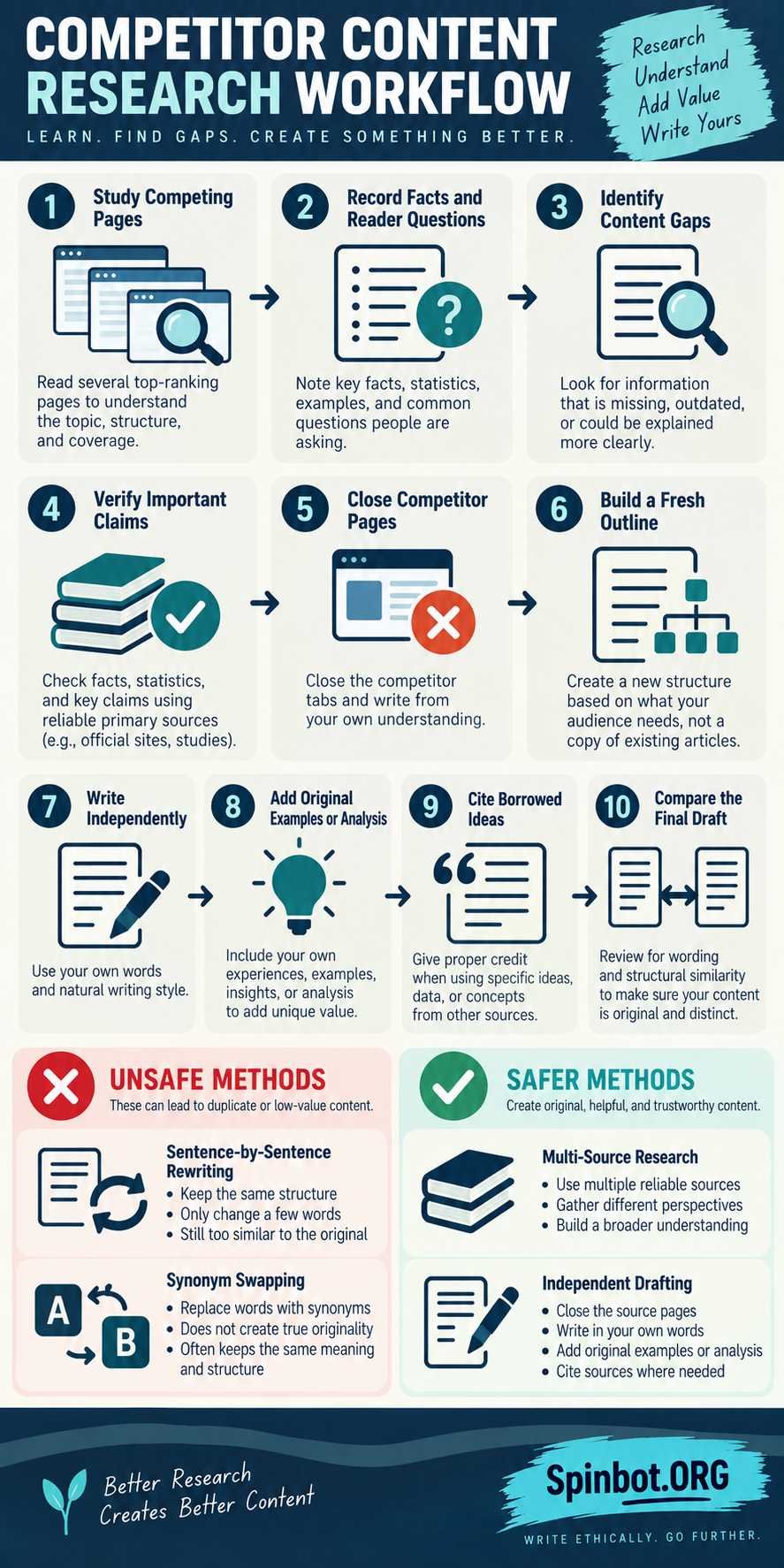
A Safer Competitor Research and Writing Process
The safest practical workflow puts distance between the source material and your final draft.
1. Read several competing posts, not just one
Do not make one article your blueprint.
Review several useful sources covering the same search intent. Look for patterns rather than sentences.
For example, if six strong guides all explain:
- The definition
- Common mistakes
- A step-by-step process
- Tools
- Examples
those sections probably reflect reader needs.
You still do not need to copy their heading order.
2. Extract questions, facts, and content gaps
Your notes should contain information, not rewritten paragraphs.
Good notes might look like:
- Explain difference between paraphrasing and copying
- Readers may want AI recommendations
- Check copyright guidance
- Show unsafe vs. safer rewrite example
- Competitors barely explain independent research
- Add final publishing checklist
Notice what is missing: full competitor sentences.
That is intentional.
3. Verify important information independently
If a competitor cites a study, law, product feature, statistic, or official policy, go to the original source whenever possible.
Do not turn the competitor into your evidence merely because they ranked highly.
For this topic, for example, the U.S. Copyright Office is a stronger source for basic U.S. copyright principles than a random marketing blog. Google Search Central is a better source for Google’s content guidance than someone’s interpretation of it.
Primary sources also give you more context and reduce the risk of repeating another writer’s mistake.
4. Close the competitor pages
This step is surprisingly useful.
Once you understand the topic and have factual notes, close the competing articles before drafting.
You are less likely to unconsciously follow their sentence rhythm, section order, or wording when the original is not sitting beside your document.
5. Build your own outline from reader intent
Ask:
What is the fastest, clearest path from the reader’s question to a useful answer?
Then build the article around that path.
Your structure might be completely different from the pages you researched.
One competitor may begin with ten definitions. You might begin with the practical workflow because that is what your audience needs first.
Original structure is not about being different for the sake of being different. It is about organizing information according to your own editorial judgment.
6. Draft from your research notes
Write as if you were explaining the subject to someone who had not read any of the competitor posts.
Use your notes, verified sources, examples, and outline.
Do not repeatedly reopen the competitor page to ask, “How did they say this?”
Instead ask:
How can I make this clearer?
That one change in mindset produces much stronger writing.
7. Add something competitors do not provide
This is where an article stops being a rewrite and starts becoming useful original content.
You might add:
- A clearer process
- A decision table
- Updated information
- Better examples
- A checklist
- A different audience perspective
- Original analysis
- A comparison
- Important limitations
- Primary-source research
Google recommends original information, research, analysis, and substantial additional value rather than pages that mainly summarize or rewrite what already exists.
8. Cite sources where appropriate
Changing the words does not remove the need for attribution.
If a statistic, research finding, quotation, or distinctive claim came from another source, cite the appropriate source.
Whenever possible, link to the original research rather than the competitor that happened to mention it.
Facts may not receive copyright protection in the same way creative expression does, but readers still benefit from knowing where important claims came from.
9. Compare your final draft against the sources
After writing, reopen the strongest competitor articles and check:
- Are several headings unusually similar?
- Did you use the same examples?
- Did you follow the same sequence?
- Are any sentences too close in wording?
- Did a distinctive explanation slip into your draft?
- Does your article add meaningful value?
This is much more useful than relying only on a percentage from a plagiarism checker.
How Can I Professionally Rewrite Sentences?
Professional rewriting begins with meaning, not synonyms.
A good rewrite usually does at least one of these things:
- Makes the idea clearer
- Changes the sentence structure
- Removes unnecessary words
- Adds missing context
- Adjusts the tone for the reader
- Combines repetitive sentences
- Splits an overloaded sentence
- Corrects vague or outdated information
Consider this example.
Original idea:
Writers should research several competing websites before preparing an article.
A mechanical rewrite might say:
Authors should examine multiple rival websites before creating an article.
That is mostly word replacement.
A more useful rewrite could be:
Do not build your article from one competitor. Compare several sources first so you can see which points are widely supported and which belong mainly to one writer’s approach.
The second version develops the reasoning and helps the reader understand why the advice matters.
Can ChatGPT Rewrite Text?
Yes. ChatGPT can help draft, rewrite, tighten, restructure, and adjust the tone of writing. OpenAI lists rewriting as one of ChatGPT’s core writing capabilities.
But how you use it matters.
A weak prompt would be:
Rewrite this competitor article so it looks original.
A better workflow is:
Analyze these notes and identify the reader’s main questions. Create a new outline based on those questions. Do not copy the source structure or wording.
You could then provide your own research notes and ask:
Draft this section for beginner bloggers. Explain the idea clearly, use an original example, and flag any factual claims that need verification.
AI works better as an editor, organizer, and drafting assistant than as a machine for disguising copied material.
You should still review the result. Check facts, examples, citations, tone, and similarity to your source material.
Which AI Tool Is Best for Rewriting?
There is no single rewriting tool that is best for every situation.
Different tools solve different problems.
ChatGPT is useful when you want flexible restructuring, tone changes, explanations, outlines, or rewriting based on detailed instructions.
QuillBot is commonly used for focused paraphrasing and sentence alternatives.
Grammarly is better suited to polishing clarity, grammar, tone, and readability during editing.
Wordtune can be useful when you want alternative ways to phrase a sentence or change its tone.
The important point is that no tool makes copied material automatically original.
If you feed an entire competitor article into a rewriter and publish the transformed output with essentially the same structure and value, the underlying editorial problem remains.
The best tool is the one that helps you produce better independent writing, not the one that changes the highest number of words.
Can I Rewrite My Text Without Using AI?
Yes, and the manual method is often excellent for important content.
Try this simple process:
- Read the source until you understand the point.
- Write short factual notes.
- Put the original source away.
- Explain the idea from memory in plain language.
- Check the source again for accuracy.
- Add your own example, context, or explanation.
- Cite the source when the information requires attribution.
- Edit the final paragraph for clarity.
This works because you are writing from understanding instead of translating one sentence into another.
It is also a useful technique when you notice that AI-generated rewrites sound too close to the source.
What Makes a Competitor-Inspired Article Truly Original?
Originality is bigger than vocabulary.
A strong article develops its own editorial identity through several choices.
A different purpose
A competitor may write for experienced marketers. You may explain the same subject for beginners.
That changes what needs explanation and what can be skipped.
An independent structure
Your headings should follow your reader’s needs rather than another site’s table of contents.
Better examples
Examples make abstract advice practical. Create your own rather than slightly modifying someone else’s scenarios.
Updated sources
Competitor posts often contain outdated data, old screenshots, dead links, or old product information.
Verify the current facts instead of carrying old information forward.
Original analysis
You can explain tradeoffs competitors ignore.
For example, AI may make sentence rewriting faster, but it can also encourage writers to remain too close to the source if they use it sentence by sentence.
That observation gives readers something more useful than another list of rewriting tools.
Genuine experience when available
If you or your organization has real experience with the topic, relevant firsthand details can add value.
But never invent personal tests, clients, experiments, or results simply to make an article appear more authoritative.
A Final Safety Check Before Publishing
Before publishing competitor-inspired content, review six things.
Wording: Are any sentences noticeably close to the source?
Structure: Did you reproduce another article’s headings and sequence without a good reason?
Sources: Have important factual claims been verified and appropriately attributed?
Facts: Did you accidentally repeat outdated or unsupported information?
Added value: Does the reader get something useful that the competing article did not already provide?
Media: Did you reuse screenshots, illustrations, photos, charts, or tables that may be protected separately from the surrounding text?
Also ask one simple question:
Would this article still make sense if the competitor post disappeared tomorrow?
If the answer is yes because you have independent research, your own structure, verified sources, and original explanation, you are probably working from a much healthier editorial process.
Use Competitors as Research, Not as Drafts
The safest way to rewrite competitor posts is not to “rewrite” them in the traditional sentence-by-sentence sense.
Study the market. Learn what readers need. Collect facts. Verify important claims. Identify missing value. Then close the competing pages and create your own article from a fresh outline.
AI tools such as ChatGPT can help you reorganize ideas, improve sentences, and polish drafts, but they do not replace editorial judgment or make copied material safe just because the wording changed.
Treat competitors as research sources and quality benchmarks, not templates.
That leads to better writing, clearer differentiation, and content that has a genuine reason to exist.

Academic editor turned AI copy pro, Sarah-Jane fuses research precision with smart storytelling. She covers academic writing, research, citation, plagiarism, copyright, grammar, editing, and publishing.