
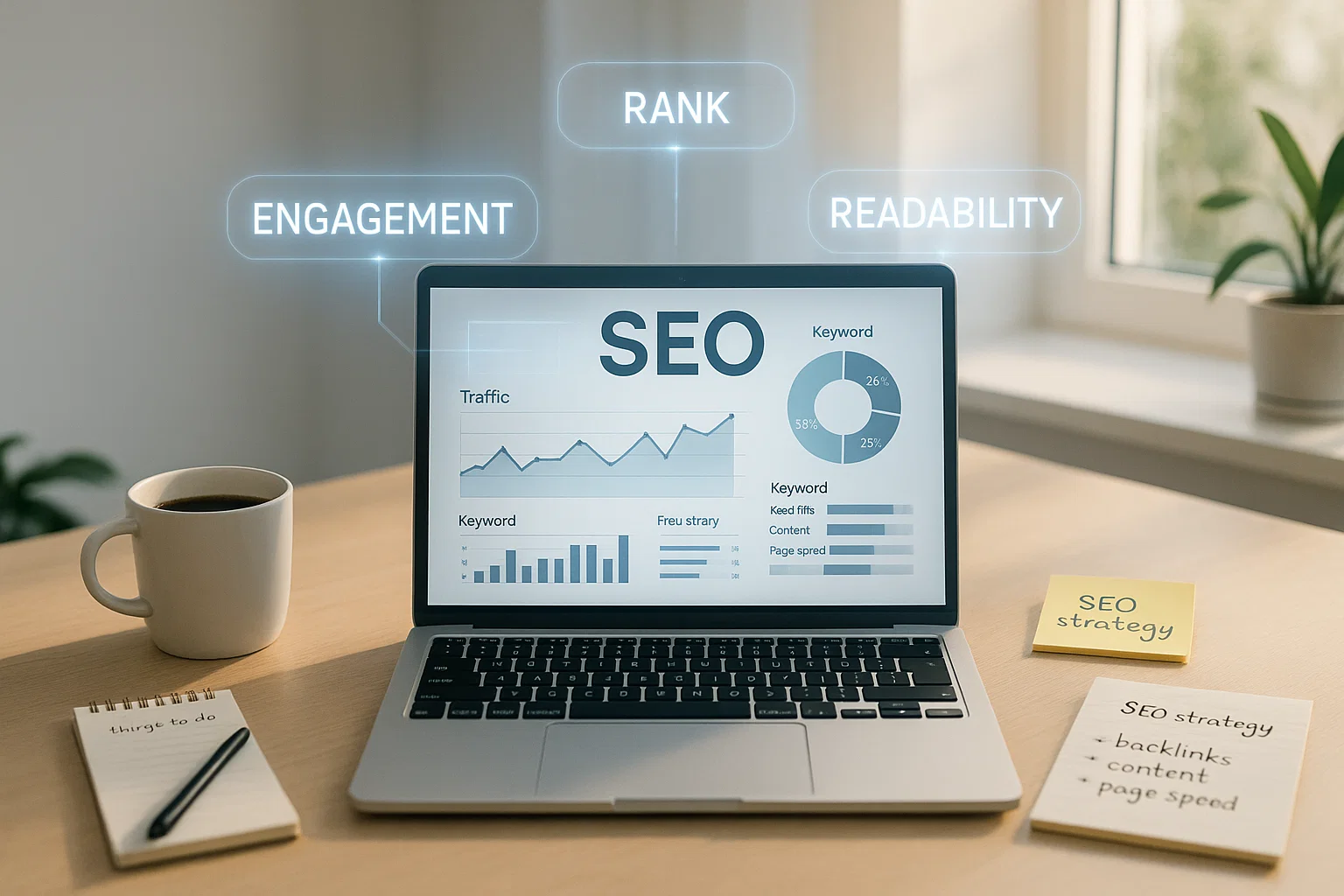
There’s a reason why some blog posts rank for years while others vanish within months. It’s not luck it’s optimization. Real optimization isn’t about stuffing in keywords or gaming Google’s algorithm. It’s about creating content that readers love, search engines understand, and businesses benefit from.
If you’ve ever published a great article that just didn’t perform, you already know why this matters. You can write beautifully, research deeply, and still miss your audience if your content isn’t optimized. Let’s fix that.
What “Content Optimization” Actually Means
Content optimization is the process of improving text, visuals, and structure so that both humans and algorithms find it valuable. The goal? Make your content rank higher, perform better, and drive real engagement.
According to Google’s SEO Starter Guide, great content should be helpful, original, and organized for clarity. Optimization adds the science behind that art it’s how you make sure your helpful content is discoverable.
In simple terms:
Content optimization = visibility + readability + credibility.
Each piece of content must balance these three. Miss one, and your results drop fast.
The Core Elements of Optimized Content
Here’s what truly optimized content looks like:
- Keyword Strategy That Matches Intent
You’re not just chasing phrases. You’re identifying what people actually mean when they type them. For instance, “content optimization techniques” signals learning intent, while “best SEO optimizer tools” signals purchase intent. Understanding this helps tailor structure, tone, and CTA placement. - Structured Flow That Feels Effortless
Optimized writing doesn’t feel mechanical. It feels natural, like reading a story that quietly answers your questions before you even ask them. - Readable Layout
Most readers skim. If your piece isn’t scannable short paragraphs, clear subheadings, bullet points where needed it’s lost before it begins. - Driven Depth
Tools like Clearscope, MarketMuse, or Frase use NLP (Natural Language Processing) to show what topics or entities should appear in your article. Use them as a compass, not a script.
The 80/20 Rule of SEO: Focus Where It Counts
Here’s where many writers go wrong: trying to do everything. The 80/20 rule in SEO means that roughly 20% of your efforts generate 80% of your results.
Your priority list should look like this:
- Write content that answers specific user intent (your 20% core effort).
- Optimize key metadata titles, meta descriptions, and headings.
- Build internal links to signal topical authority.
- Update and refresh old articles quarterly.
That’s it. Spending hours tweaking every paragraph for a 0.1% keyword boost isn’t worth it. Strategic focus scales results.
The 3 C’s of SEO: Content, Code, and Credibility
Think of optimization as a tripod. Each leg supports stability.
- Content: Relevance, readability, freshness.
- Code: How search engines access and interpret your page structured data, speed, mobile usability.
- Credibility: Backlinks, user engagement, author reputation.
A brilliant article buried under slow load times or weak authority won’t survive the algorithm shakeups. Conversely, a technically perfect site without genuine writing feels hollow. The best SEO practitioners balance both worlds.
Keyword Optimization Without Overdoing It
Keyword optimization used to be about density. Now it’s about context.
Google’s NLP systems (like BERT and MUM) read relationships between phrases, not just the phrases themselves. That’s where LSI (Latent Semantic Indexing) keywords come in. They give your content meaning and breadth.
Example:
If your main keyword is content optimization techniques, LSI phrases like “SEO strategy,” “on-page optimization,” “search intent,” and “keyword mapping” reinforce context naturally.
Here’s a quick checklist:
- Include your main keyword in the title, intro, one H2, and conclusion.
- Sprinkle LSI keywords every few paragraphs never forced.
- Use variations like “content optimization strategies” or “how to optimize content for SEO.”
Optimization should sound like real conversation, not a keyword checklist.
Write for Humans, Format for Machines
Google now uses “experience signals” to evaluate content. That means the better your article satisfies a real human’s need, the better it performs. Still, formatting tells the algorithm what’s important.
- Use H2/h2 headings to organize your content logically.
- Include lists and tables for quick understanding.
- Add alt text to images describing what’s shown (not what’s obvious).
- Use schema markup (like FAQ or HowTo) for rich snippets.
When you help search engines read your content, you help users find it.
The Role of NLP in Modern Optimization
AI tools like Clearscope, SurferSEO, or MarketMuse use natural language processing to evaluate your draft’s coverage against top-ranking pages. They don’t replace creativity they reveal blind spots.
For instance, if your article misses semantically related entities (like “SEO tools,” “organic reach,” or “SERP ranking factors”), these tools flag the gaps. Adding that context can lift you into higher ranking brackets without rewriting your tone.
Still, the golden rule: You write for people, you optimize for machines. Both must coexist.
Updating and Repurposing Old Content
Optimization isn’t a one-time act it’s maintenance. Even evergreen posts lose power over time if left untouched.
How to keep them fresh:
- Add new data: Reference 2025 trends or updated statistics.
- Improve readability: Split long paragraphs and refresh visuals.
- Enhance internal linking: Connect with newer, related articles.
- Refine meta tags: Make sure descriptions reflect current search intent.
Small changes like updating a statistic or rephrasing a CTA can reignite an old post’s performance.
User Intent: The Hidden Engine Behind Optimization
Every query hides intent. And matching that intent defines success.
- Informational intent: Users want to learn (e.g., “What is content optimization?”).
- Navigational intent: They’re looking for a specific page (e.g., “Clearscope blog”).
- Transactional intent: They want to act (e.g., “best SEO tool subscription”).
When your content format (tutorial, review, guide) fits intent, it outperforms competitors no matter their backlinks.
The Psychology of Optimized Reading
Here’s a secret most SEO blogs skip: optimization isn’t just technical it’s psychological.
A well-optimized article respects cognitive flow:
- Curiosity at the start (hook).
- Logical sequence of insights (clarity).
- Small dopamine hits through relatable phrasing or micro-takeaways.
Readers remember emotional beats more than statistics. So if your content feels satisfying, they stay longer improving dwell time, bounce rate, and ranking signals.
Visual Optimization: Beyond Pretty Images
Visuals aren’t filler they’re ranking factors. Optimized images improve time-on-page and accessibility.
Here’s the checklist:
- Compress images with tools like TinyPNG or WebP conversion.
- Name files with descriptive text (e.g., “content-optimization-dashboard.webp”).
- Add captions that subtly reinforce key points.
- Embed infographics or charts summarizing data (great for backlinks).
When readers share visuals, they extend your reach far beyond on-page SEO.
Content-Length vs. Quality: The 2025 Reality
Google’s algorithm doesn’t reward word count it rewards topic completeness.
Long-form content works when it provides layered value. But 500-word tutorials can also rank high if they answer a specific question perfectly. The key is completeness, not length.
So instead of asking, “How long should my article be?”
Ask, “Does my article fully answer the query in one place?”
From Optimization to Personalization
AI-driven search is evolving fast. In 2025, search results are increasingly personalized based on behavior, location, and device. That means content optimization is becoming audience optimization.
What you can do:
- Adapt tone and examples to your audience’s skill level.
- Use schema for local SEO if applicable.
- Include real-life examples or quotes to build trust signals.
Personalization isn’t just about cookies or data it’s about writing like you know who’s reading.
Measuring Success: Metrics That Matter
You can’t optimize what you don’t measure. Focus on key metrics that reflect real progress:
- CTR (Click-Through Rate): Signals how enticing your titles are.
- Time on Page: Reflects reader engagement.
- Scroll Depth: Shows if your structure holds attention.
- Conversions or CTA Clicks: Measure your strategic payoff.
- Organic Keyword Growth: Reveals long-term authority.
Platforms like Google Search Console, Ahrefs, and Siteimprove make this process transparent. Review them monthly, not daily you need trend data, not dopamine hits.
Emerging Optimization Techniques for 2025
SEO never stands still. As search grows more AI-driven, these techniques are becoming essential:
- Entity-Based SEO: Focus on topics, not just keywords. Mention related concepts to strengthen semantic webs.
- Voice Search Optimization: Write in conversational phrasing since AI assistants now handle 40% of searches.
- Content Clustering: Build interconnected articles that reinforce a central theme.
- AI-Assisted Outlines: Use GPT-based tools for structure suggestions, then humanize the draft.
- Experience Optimization: UX elements load speed, layout, contrast directly affect rankings.
Optimization in 2025 means being reader-aware and tech-savvy simultaneously.
A Simple Optimization Workflow (The Practical Way)
Here’s how to optimize smarter without drowning in checklists:
- Start with search intent: Identify what users actually want.
- Use keyword tools: Grab main and supporting phrases.
- Outline naturally: Place key terms in headers and early paragraphs.
- Write conversationally: Keep tone human.
- Add visuals: Infographics, screenshots, or explainer images.
- Run an NLP analysis: Check topic coverage.
- Edit for clarity: Remove redundancy, tighten flow.
- Add internal/external links: Contextual and helpful, not spammy.
- Publish and monitor: Track metrics weekly, tweak monthly.
Consistency beats intensity. A sustainable optimization routine compounds results over time.
What Google Wants, and What Readers Need
If you strip away all the jargon, content optimization is simply alignment between what Google values and what readers love.
Google values:
- E-E-A-T (Experience, Expertise, Authoritativeness, Trustworthiness).
Readers value: - Clarity, authenticity, and usefulness.
When both align, your content becomes unstoppable.
That’s why optimization isn’t just about ranking it’s about resonance.
Wrapping It Up
The best content optimization techniques in 2025 aren’t tricks. They’re habits. You write with empathy, edit with precision, and format with strategy. You respect both your reader’s time and Google’s logic.
The bottom line:
Great content doesn’t just attract clicks it earns trust.
Keep refining. Keep updating. Keep making your writing easier to find, understand, and love.

AI writing strategist with hands-on NLP experience, Liam simplifies complex topics into bite-sized brilliance. Trusted by thousands for actionable, future-forward content you can rely on.