

You don’t need to plan every conversation or chapter before writing. You need enough structure to answer five questions:
- Who is the story about?
- What does that person want?
- What prevents them from getting it?
- What will happen if they fail?
- How will the struggle change them?
Once those answers are clear, you can turn your idea into a flexible outline of the plot.
What plotting a book really means
Plotting means deciding what happens in your book, why it happens, and how each major event affects what follows.
Plot is sometimes confused with premise. A premise is the core idea behind a story. For example:
A cautious teacher must rescue her missing brother from a city where memories can be bought and sold.
That sentence introduces a protagonist, a goal, and an unusual situation. It doesn’t yet explain the full sequence of events. The plot develops when you decide why the brother disappeared, what the teacher does about it, which obstacles she encounters, and what her choices cost her.
Plot is also different from story. Story includes the complete experience: characters, setting, atmosphere, theme, narration, and events. Plot is the connected chain of events that moves the narrative forward. As Reedsy’s guide to plot explains, those events usually need a cause-and-effect relationship rather than appearing as a series of unrelated incidents.
An outline is the document in which you record that plot. It might be a one-page roadmap, a list of scenes, a spreadsheet, or a detailed chapter plan.
Start with one clear story sentence
Before building chapters, compress your idea into one sentence. This forces you to identify the heart of the book.
A useful plot sentence contains four elements:
- A protagonist
- A concrete goal
- A central obstacle
- Meaningful stakes
You can use this template:
When [disruptive event] happens, a [description of protagonist] must [goal], but [central obstacle] stands in the way, and failure will result in [stakes].
Here is an example:
When a flood isolates her mountain town, a disgraced engineer must repair an abandoned dam, but the mayor who ruined her career is hiding evidence that the structure was deliberately weakened.
This sentence provides much more direction than “an engineer saves a town.” It suggests conflict, urgency, secrets, difficult choices, and several possible scenes.
Your sentence doesn’t have to sound like finished marketing copy. Its purpose is to help you make decisions. If a proposed subplot has no connection to the protagonist’s goal, obstacle, stakes, or development, it may not belong in the book.
Define what your protagonist wants
A plot moves when a character pursues something. The goal can be physical, emotional, social, or intellectual, but readers should understand what success looks like.
A protagonist might want to:
- Find a missing person
- Win a competition
- Escape an unsafe place
- Prove their innocence
- Repair a damaged relationship
- Discover the truth about their past
- Protect a community
- Earn respect or independence
Give the character an external goal that creates visible action. Then consider the internal need beneath it.
For example, a detective’s external goal may be to solve a murder. Internally, she may need to accept that asking for help isn’t a sign of weakness. The investigation drives the action, while her emotional struggle gives the outcome greater meaning.
The goal should matter personally. A character doesn’t need to save the world, but they must care about what they could lose. Reedsy’s novel-outlining guide recommends giving the main character one large problem and ensuring its stakes are important to that particular person.
Create conflict that tests the character
Conflict is not simply arguing, fighting, or placing a villain in the story. It is any force that makes the protagonist’s goal difficult to achieve.
Common sources of conflict include:
- Another person with an opposing goal
- Social rules or institutional pressure
- Nature, illness, distance, or limited resources
- Missing information
- Time pressure
- The protagonist’s fear, pride, guilt, or false belief
- Two desirable outcomes that cannot both be achieved
Strong plots often combine external and internal conflict. A character may be trying to expose corruption while also fearing public attention because of a past mistake. The external problem generates events; the internal problem complicates the character’s decisions.
Each obstacle should do more than delay the protagonist. It should force a response. That response creates a new situation, which leads to the next obstacle.
Consider this progression:
- A journalist receives evidence of election fraud.
- She contacts the source, causing someone to start following her.
- She hides the evidence with a colleague.
- The colleague disappears, making her question whom she can trust.
- She publishes part of the evidence to protect herself.
- The publication alerts the conspirators to what she still knows.
Every event changes the conditions of the story. That cause-and-effect movement prevents the middle of the book from feeling like a collection of loosely connected episodes.
Decide where the story ends
Many writers hesitate to choose an ending because they want to discover the story while drafting. You don’t need to know every detail, but a provisional destination makes plotting much easier.
Ask:
- Does the protagonist achieve the external goal?
- What do they gain, lose, or sacrifice?
- How have they changed?
- What central question does the ending answer?
- Which important relationships are different?
- What feeling should the final pages leave with the reader?
An ending can be happy, tragic, bittersweet, ambiguous, or unsettling. What matters is that it resolves the story’s main dramatic question.
If the book asks, “Will the engineer save the town and expose the sabotage?” the climax should confront that question directly. A last-minute conflict about an unrelated inheritance would feel like another story had suddenly taken over.
Choosing the ending also helps you plant earlier details. If the protagonist ultimately succeeds by trusting a former rival, earlier scenes can establish their distrust, show the rival earning credibility, and prepare the reader for that choice.
The ending may change during drafting. That is normal. For now, it acts as a compass.
Map the major beats of your plot
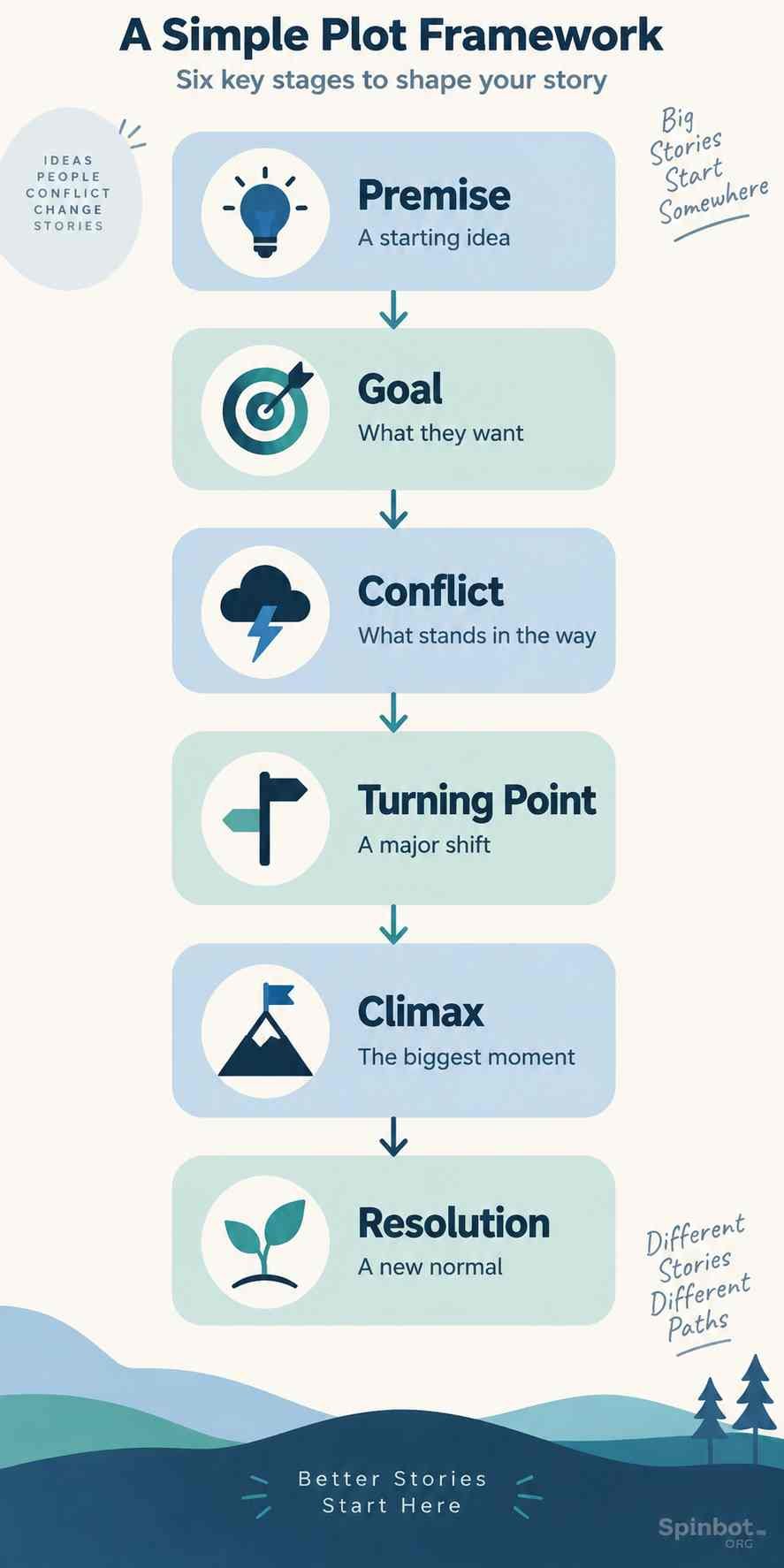
A story beat is a meaningful event that changes the character’s situation, understanding, or direction. Begin with the major beats rather than trying to invent fifty chapters at once.
Opening situation
Show the protagonist’s life before the main conflict takes control. Establish what feels normal, what is already wrong, and what the character lacks.
The opening does not require a long background section. Start close to the moment of change. If nothing threatens, surprises, pressures, or challenges the protagonist for several chapters, the story may be starting too early.
Inciting incident
The inciting incident disrupts the existing situation and introduces the central problem or opportunity.
It might be an arrest, discovery, invitation, accident, arrival, betrayal, or unexpected decision. The event should demand some kind of response, even if the protagonist initially refuses to become involved.
First major decision
After the disruption, the protagonist makes a choice that commits them to the central conflict. This is where the book’s main direction becomes clear.
A reluctant character may finally accept the mission. A trapped character may attempt an escape. A suspicious character may begin an investigation.
The decision matters because the protagonist is no longer merely reacting. They are pursuing something.
Rising complications
The protagonist tries to reach the goal, but the task becomes harder. Early plans fail, new information appears, relationships change, and the cost of failure grows.
Complications should vary. Repeating the same kind of obstacle can make the middle predictable. Mix external setbacks with discoveries, moral choices, interpersonal conflict, and consequences created by the protagonist’s own actions.
Midpoint shift
Near the middle, include an event that changes how the protagonist understands the conflict. They may discover the real enemy, gain temporary success, suffer an unexpected loss, or learn that their original goal was incomplete.
The midpoint should not feel like another routine obstacle. It changes the game.
Crisis
The crisis brings the protagonist to their most difficult decision. Resources are limited, an important relationship may be broken, and the original plan no longer works.
This moment often tests the character’s internal weakness. They must decide whether to repeat an old pattern or act differently.
Climax
The climax is the decisive confrontation. The protagonist takes action using what they have learned, and the main dramatic question is answered.
A climax becomes satisfying when the protagonist’s choices help determine the result. Coincidence can create trouble, but it rarely provides a strong resolution.
Resolution
Show the consequences of the climax. Resolve the most important character and relationship arcs, establish the new situation, and fulfill the promises made by the story.
The resolution doesn’t need to explain what happens to everyone. It should give readers enough space to understand what the journey meant.
These labels are tools, not laws. Jerry Jenkins’ outline method uses similar structural elements: an opening, an inciting incident, escalating crises, a climax, and an ending. You can adapt their placement to your genre and narrative style.
Turn the beats into a scene outline
Once the major events are visible, connect them with scenes. Each scene should normally contain a goal, pressure, and change.
For every proposed scene, record:
- Viewpoint character
- Location and time
- Immediate goal
- Obstacle or source of tension
- Important revelation or decision
- Result
- Connection to the next scene
A basic scene entry might look like this:
Scene 12: Mara enters the closed pumping station to find the missing inspection records. Security arrives before she can leave. She escapes with one damaged report but loses her phone, allowing the mayor’s aide to identify her investigation.
That entry explains why the scene exists and how it changes the plot. It leaves dialogue, description, pacing, and smaller discoveries open for the drafting stage.
Review adjacent scenes by asking “because of that” rather than “and then.”
Weak progression:
Mara finds a report, and then she visits her mother, and then the dam begins leaking.
Stronger progression:
Mara finds a report proving that repairs were cancelled. Because the cancellation bears her late father’s signature, she confronts her mother. During that conversation, she learns someone forged his records, but the confrontation delays her response to a new leak at the dam.
The second version creates continuity. One event produces the next.
Choose a plotting method that suits you
There is no single correct answer to how you plot a story. Writers differ in how much preparation helps them.
A discovery writer may need only:
- A one-sentence premise
- The protagonist’s goal
- Five to eight major beats
- A possible ending
A moderate planner might create a paragraph for each act, a character arc, and a list of twenty to thirty scenes.
A detailed outliner may plan every chapter, subplot, clue, reveal, and viewpoint change before drafting.
The three-act structure is a useful starting framework because it divides the story into setup, confrontation, and resolution. Other options include the Snowflake Method, the Hero’s Journey, the Seven-Point Story Structure, and scene-card planning. These methods organize similar storytelling principles in different ways.
Don’t select a method because it looks impressive. Select the lightest system that answers your current questions and helps you keep writing.
A flexible story map can be especially useful if detailed outlines make you feel trapped. Author Mary Adkins describes a story map as a set of important destinations rather than instructions for every turn. You know where the narrative is heading while leaving room for discovery.
Check the plot before drafting
Read your outline from beginning to end and look for weak connections.
Ask:
- Does the protagonist have a specific goal?
- Are the stakes clear and personal?
- Does the inciting incident disturb the existing situation?
- Do events follow one another through cause and effect?
- Do obstacles become more difficult or costly?
- Does the protagonist make consequential choices?
- Does the midpoint change the direction or understanding of the story?
- Does the climax resolve the central conflict?
- Does the character’s internal change affect the outcome?
- Are subplots connected to the main story?
Pay close attention to the middle. If several scenes could be removed or rearranged without changing anything, they may lack consequences.
Also check whether the antagonist or opposing force has a coherent goal. Strong opposition does not exist only to interfere with the hero. It acts according to its own needs, beliefs, and plans.
Start writing before the outline feels perfect
If you are wondering, “How do I start a book after plotting it?” choose the first moment when the protagonist’s normal life becomes unstable. Give them an immediate concern, place them in a specific setting, and let something change.
Avoid explaining the entire history of the world or character before the story begins. Readers can learn background information when it becomes relevant.
Your outline is a working document. Update it when drafting reveals a better decision, a deeper motivation, or a more convincing ending. If a character acts differently from what you planned, investigate why. The new direction may be more truthful to the character.
Knowing how to plot a book does not mean removing surprise from writing. It means creating enough direction to recognize which surprises strengthen the story. Begin with a protagonist, goal, conflict, stakes, and possible ending. Map the major turns, connect them through consequences, and then start drafting while the story still has room to grow.

Academic editor turned AI copy pro, Sarah-Jane fuses research precision with smart storytelling. She covers academic writing, research, citation, plagiarism, copyright, grammar, editing, and publishing.