
If you’re asking, “How do I find a primary source?” start by identifying the evidence your research question needs. Then search library catalogs, relevant databases, and archives, or follow citations in reliable books and articles. Before using a result, confirm who created it, what it records, and how it relates to your question.
The goal isn’t simply to find something old or official. It’s to find material you can examine directly and use responsibly.
What Counts as a Primary Source?
A primary source provides original evidence about the subject you’re studying. It might be a letter, photograph, interview, government record, novel, dataset, or research article reporting a new study.
Primary sources aren’t limited to historical documents. In science, an article reporting the authors’ own experiment can provide primary evidence. In literature, the novel itself is a primary source, while an essay interpreting that novel is usually secondary. UNSW Library’s source guide explains these differences across source types.
Your research question determines the source’s role
Consider a newspaper editorial about a strike.
If you’re studying how newspapers portrayed workers, the editorial is primary evidence of that portrayal. If you’re using it to learn what happened during the strike, its commentary may function as a secondary account.
Ask: Am I examining this material itself, or relying on its explanation of something else?
This distinction matters more than the document’s age, format, or website address.
How to Find Primary Sources Step by Step
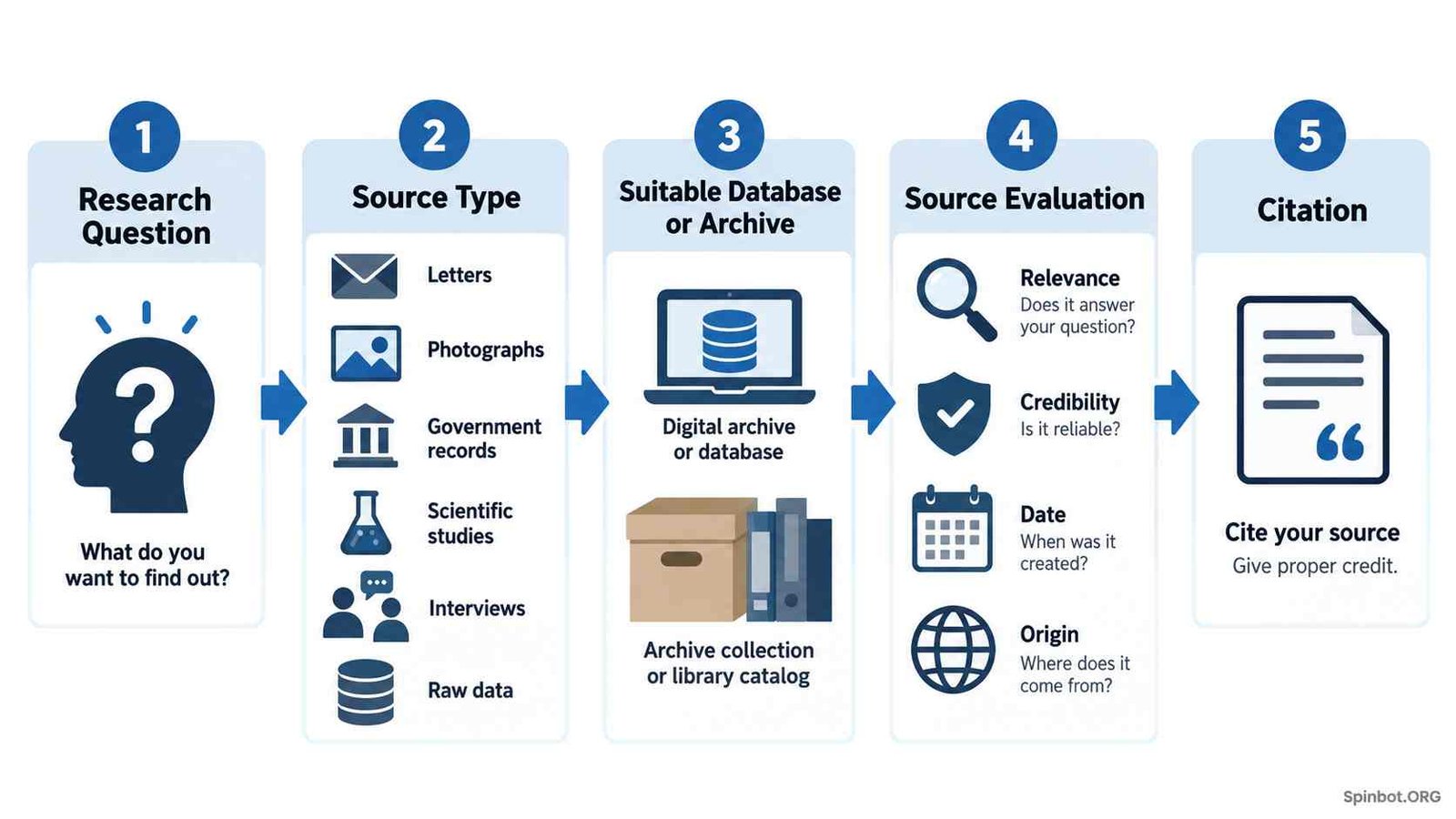
1. Define the evidence your question requires
Start with a focused question, not just a broad topic.
“Women’s suffrage” could produce thousands of unrelated results. “How did American suffrage organizations persuade voters between 1910 and 1920?” gives you clearer targets: campaign leaflets, posters, speeches, advertisements, and organizational records.
Write down four things before searching:
- The person, group, or event.
- The place.
- The relevant dates.
- The type of evidence that could answer your question.
For a scientific assignment, that fourth item might be experimental results rather than historical records.
2. Learn the language used in the sources
People may have used different names and terms during the period you’re researching. Organizations change names, places acquire new boundaries, and modern labels may not appear in older records.
Begin with a reliable overview to collect alternative spellings, earlier names, and key participants. Search those variations separately.
Historical collections may also contain outdated or offensive terminology. You may need those terms to locate records, but you don’t need to adopt them in your own writing.
3. Follow citations in secondary sources
A well-researched book or article can point you toward evidence that a general search misses.
Check its footnotes, endnotes, bibliography, and image credits. Look for references to letters, interviews, archival collections, official reports, or original studies.
Copy the identifying details, then search for the original item. A citation naming a collection, box, and folder may lead to an archive rather than a downloadable document.
Use the secondary source as a route to the evidence. Don’t assume its quotation gives you the full context.
4. Search library catalogs by topic and format
Try combining your topic with likely source types:
factory workers diariesimmigration oral historiessuffrage correspondencetown council minutesschool attendance annual reports
Open a promising catalog record and examine its subject headings. These standardized labels can reveal related material described differently from your original search.
Also check your library’s subject guides. A history librarian and a biology librarian will usually recommend different starting points.
5. Choose a database that matches your evidence
A historical newspaper collection is useful for contemporary reporting, but not necessarily for laboratory data. An academic article database may contain original research alongside reviews and commentary.
Read the collection description before spending time searching. Check its subject coverage, dates, geography, and document types.
The fact that a database is scholarly does not make every item in it a primary source.
6. Read collection descriptions and finding aids
Some searches lead to descriptions of records rather than the records themselves.
A finding aid explains an archival collection’s contents and organization. It can help you identify relevant folders and understand whether materials are available online or require further assistance.
Don’t treat the absence of a download button as proof that the source is unavailable. Some primary materials remain accessible only at specific locations, as the American Library Association’s historical research guidelines explain.
7. Ask a librarian or archivist a specific question
Share your research question, date range, places, and searches already attempted. If you found a collection record, include its identifier.
A focused request makes it easier for staff to suggest a collection, explain access conditions, or identify a more useful search term.
Ask whether a relevant item has been digitized and whether copies or research appointments are available. Check any charges before ordering reproductions.
Useful Primary Source Databases and Collections
Choose a starting point based on the material you need.
| Starting point | Useful material | What to check |
|---|---|---|
| National Archives | Federal records, photographs, and historical documents | Whether the record itself is digitized |
| Library of Congress | Historical documents, images, and curated primary-source sets | Original item details versus explanatory text |
| JSTOR primary-source collections | Documents, images, artifacts, and data | Open access or institutional access |
| University special collections | Personal papers, manuscripts, and local records | Collection coverage and access arrangements |
The National Archives research page points readers toward its catalog and research tools. The Library of Congress finding guide offers curated starting points. JSTOR brings primary materials together with secondary scholarship, so you still need to classify individual results.
For science, use your library’s subject databases to locate studies that report original methods and results. For statistics, look for the organization that collected or published the data, then read its methodology.
For topics outside the United States, prioritize the relevant national archive, national library, university collections, or local historical institutions.
Before paying for access, check whether your school or public library already provides it.
Search Terms That Produce Better Results
Searching only “primary sources about my topic” often returns teaching pages rather than evidence.
Instead, combine a subject with a format, place, or creator. These are illustrative searches, not guaranteed results:
"women's suffrage" pamphlets"factory workers" oral history"school attendance" annual report"town name" council minutes"organization name" correspondence
Use quotation marks when an exact phrase matters. In advanced search, try separate fields for creator, title, subject, and date when available.
Change one element at a time. If a narrow date range produces nothing, broaden it. If a modern phrase fails, try contemporary terminology.
Once you find a useful item, inspect its collection name and subject labels. Related records may be more valuable than the next page of general search results.
Primary vs Secondary Sources
Primary sources supply evidence for direct examination. Secondary sources interpret, explain, or assess evidence.
| Research subject | Primary evidence | Secondary analysis |
|---|---|---|
| A novelist’s use of dialogue | The novel | A critical essay about its dialogue |
| A scientific experiment | The researchers’ original study report | A review discussing several studies |
| A political campaign’s messaging | Campaign advertisements | A historian’s analysis of the campaign |
Neither category guarantees accuracy. A firsthand account may be mistaken or self-serving. A careful secondary analysis may identify problems that aren’t obvious in the original material.
Use primary evidence to investigate your question and secondary scholarship to understand context and competing interpretations. The ALA’s guidance on using primary sources emphasizes this complementary approach.
How to Evaluate a Primary Source
Finding an original record is only the beginning. Before using it, examine five things.
Creator: Who made it? Were they a participant, observer, researcher, institution, or later recorder?
Date: When was it created relative to the events? A later recollection may differ from a diary written that day.
Provenance: Where did the item come from, and how did it reach the collection holding it?
Purpose and audience: Was it private correspondence, publicity, an official record, or research intended for publication?
Completeness: Are you seeing the full document, a cropped image, an excerpt, or a transcription?
Compare significant claims with other evidence. If a transcription looks unclear, consult the scan when available. A collection’s explanatory note can help, but distinguish that note from the original source.
The National Archives’ document-analysis guidance encourages readers to observe a document, make sense of its context, and then use it as historical evidence. That order prevents premature conclusions.
How Do You Cite Primary Sources?
There is no single citation format called “primary source citation.” The format depends on the item and the required style.
A published research article follows journal-article rules. An unpublished letter follows archival-material rules. A photograph or recorded interview needs details appropriate to that format.
Record citation information while searching
Save these details when available:
- Creator’s name.
- Title or an accurate description.
- Creation or publication date.
- Collection and repository.
- Box, folder, item number, or other identifier.
- Page, image, or timestamp used.
- DOI or stable URL.
- Access date when required.
Cite the item you examined, not merely the archive’s homepage. The Library of Congress citation guide explains why documenting a source’s origin supports both attribution and analysis.
APA, MLA, and Chicago examples
The following are simplified patterns with placeholders, not citations to real documents.
APA archival letter:
Surname, A. A. (Year, Month Day). [Letter to Recipient Name]. Collection Name (Box number, Folder number). Repository Name, Location.
APA’s archival reference guidance provides examples for adapting author, date, title, and source information to archival materials.
MLA digitized book:
Surname, First Name. Book Title. Publisher, Year. Digital Collection Name, Stable URL.
Record the original publication details and the digital version consulted. The MLA Style Center’s digitized-source examples demonstrate this approach.
Chicago archival note:
- First Name Surname to Recipient Name, Month Day, Year, Collection Name, box number, folder number, Repository Name.
This is a note pattern, not a bibliography entry. Consult your assignment’s requirements and the appropriate Chicago citation examples before finalizing punctuation and details.
Never invent missing information. If you only encountered a quotation through another author and cannot obtain the original, follow your required style’s indirect-citation rules.
A Quick Primary Source Research Checklist
Before using a source, confirm:
- It directly relates to your research question.
- You can explain why it functions as primary evidence.
- You have examined the relevant material yourself.
- You understand its creator, context, purpose, and limitations.
- You have saved enough information to locate and cite it again.
- Your claim does not go beyond what the evidence supports.
Turn the Source Into Useful Evidence
Suppose you find one worker’s letter describing long shifts. It can support a claim about that writer’s reported experience. By itself, it cannot establish that every worker faced identical conditions.
Introduce the source, explain the relevant detail, and connect it to your argument. Then acknowledge what remains uncertain.
The practical answer to “How do I find a primary source?” is to follow the evidence back to its origin. Start with a focused question, choose a suitable collection, examine the original material, and preserve its citation details. One well-understood source is more useful than a folder full of unexplained downloads.

Covers AI writing tools, large language models, prompt engineering, AI detection, and practical AI writing workflows for Spinbot.ORG.