

There is no permanent worldwide list of expired trademarks that anyone may safely reuse. Trademark rights are tied to particular countries, goods or services, and commercial activity. A federal registration may expire while the owner continues using the name and retains common-law rights. A logo may also remain protected by copyright after its trademark registration ends.
The safest approach is to treat a list of expired trademarks as a research starting point, not a collection of free brand names.
Legal note: This guide provides general information, mainly about United States law. It is not legal advice. Trademark rules and rights vary by country.
Is There a Reliable List of Expired Trademarks?
Trademark offices maintain searchable records, but they do not provide one universal list showing every name that is free for public use.
The USPTO Trademark Search system contains millions of U.S. federal applications and registrations. Some records are live, while others are marked dead because an application was abandoned or a registration was cancelled or expired.
However, a dead federal record does not prove that:
- The former owner stopped using the mark
- No one else owns a similar live mark
- The name is available in every industry
- The mark is unprotected outside the United States
- Copyright in an associated logo has expired
- Using the name would not confuse consumers
The USPTO itself warns that marks in dead applications or registrations may still be used in commerce and may still carry common-law rights. Some records can also be revived or reinstated, according to the USPTO glossary.
Official lists from other countries are equally limited to their jurisdictions. For example, the Uganda Registration Services Bureau publishes expired trademark records, but an expired Ugandan registration says nothing by itself about the same mark’s status in the United States, United Kingdom, European Union, or another market.
Famous Trademarks That Lost Protection
The following examples are commonly included in lists of expired, cancelled, abandoned, or genericized trademarks. Those categories are not identical, so each example needs context.
| Former trademark | Original association | What happened |
|---|---|---|
| Aspirin | Bayer pain medicine | Became generic in the United States |
| Escalator | Otis moving staircases | Lost protection after becoming a generic product term |
| Cellophane | Transparent wrapping material | Became generic in the United States |
| Thermos | Vacuum-insulated containers | Treated as generic in some jurisdictions or contexts |
| Trampoline | Griswold-Nissen equipment | Became the common name for the product |
| Zipper | B.F. Goodrich fasteners | Became a generic product name |
| Laundromat | Automatic laundry equipment | Registration expired and the term became widely generic |
| Taco Tuesday | Restaurant promotions | Major U.S. registrations were voluntarily abandoned |
| Super Hero | Marvel and DC publications | Joint U.S. registrations were cancelled in 2024 |
This table should not be read as a worldwide availability report. A word may be generic in one country yet remain protected for certain products or services elsewhere.
Aspirin
Aspirin is one of the best-known examples of a former trademark becoming a generic word. Bayer once used it as a brand name for acetylsalicylic acid.
The term lost trademark protection in the United States and became the ordinary name for the medicine. However, Bayer has retained rights in the Aspirin name in several other countries. This illustrates why a list of expired trademarks must identify the relevant jurisdiction.
Escalator
Otis Elevator Company used Escalator as a brand name for moving staircases. Over time, consumers and the company itself increasingly used the word as the name of the product rather than as an indicator of one commercial source.
The mark eventually lost protection, and “escalator” became the standard English word for that type of moving staircase.
This process is known as genericide. It occurs when the public primarily understands a trademark as the general name of a product or service instead of a brand.
Cellophane
Cellophane began as a proprietary name for transparent wrapping film. In the United States, the word eventually became a generic description for that type of material.
As with other historical examples, its legal position has not always been identical in every country. Anyone researching an old name must check the current records in each intended market.
Thermos
Thermos originated as a brand for vacuum-insulated containers. Widespread public use turned the word into a common description for insulated bottles in several places.
The history of Thermos is more complicated than a simple expiration. Courts and trademark offices have treated the term differently across countries and product categories. That makes it a useful warning against declaring a familiar word “free” without defining the territory and goods involved.
Trampoline
Trampoline was once used as a brand name by the Griswold-Nissen company. The public adopted it as the common name for the entire type of recreational and athletic equipment.
Today, businesses routinely use “trampoline” descriptively. The word no longer identifies one producer in ordinary U.S. usage.
Zipper
B.F. Goodrich used Zipper for a fastener featured on rubber boots. The name spread beyond that product until consumers used it for the fastener itself.
Zipper is now a generic word rather than an exclusive brand name. This is another case of lost distinctiveness, not merely an owner forgetting to submit a renewal form.
Laundromat
Laundromat was registered in connection with automatic washing machines and coin-operated laundry services. The registration later expired, while the word became a common term for a self-service laundry.
This example comes closer to what people usually mean by an expired trademark. Even so, an expired historical registration does not eliminate the need to search for newer registrations containing the word.
Taco Tuesday
Taco Tuesday offers a more recent example of registrations being given up rather than quietly expiring.
In 2023, Taco Bell petitioned to cancel federal registrations that restricted use of the phrase for restaurant services. Taco John’s abandoned its registration covering most of the United States, and Gregory’s Restaurant and Bar later gave up its New Jersey registration.
The dispute involved whether consumers understood the phrase as a brand or merely as a common description of Tuesday taco promotions. A separate application for TACO TUESDAY had already been refused because it failed to function as a trademark, as shown in the USPTO’s TTAB record.
That history does not mean every use incorporating “Taco Tuesday” is automatically risk-free. Other live marks, designs, slogans, and local rights may still need investigation.
Super Hero
Marvel Characters and DC Comics jointly controlled federal registrations for SUPER HERO and SUPER HEROES for certain publications and merchandise.
After a cancellation challenge, the registrations were cancelled in September 2024. The USPTO proceeding for SUPER HERO records the case as terminated on September 26, 2024.
The cancellation of these registrations did not place every superhero character, comic, logo, costume, or story into the public domain. Individual works and characters may still be protected through copyright, other trademarks, and unfair-competition law.
Expired, Cancelled, Abandoned, and Genericized Are Different
These terms are often mixed together online, but they describe different events.
Expired or cancelled registration
A federal registration can be cancelled or allowed to expire when its owner fails to submit required maintenance documents and fees. The registration is no longer active, but the underlying mark may still be used in commerce.
That continuing use could support common-law rights even without an active federal registration.
Abandoned application
An abandoned application never necessarily became a registered trademark. The applicant may have missed a response deadline, failed to prove use, withdrawn the application, or decided not to continue.
The USPTO explains that an application can be declared abandoned when an applicant fails to respond to an office action on time. Certain applications may be revived if the legal requirements and deadlines are met. See the agency’s trademark application process.
An abandoned application therefore does not automatically mean the applicant abandoned the brand itself.
Abandonment through nonuse
Legal abandonment concerns what happens in the marketplace, not only what appears in a registration database.
Under 15 U.S.C. §1127, a mark may be considered abandoned when its use has been discontinued with no intention to resume. Three consecutive years of nonuse provide initial legal evidence of abandonment, but circumstances and evidence still matter.
A temporary business closure does not necessarily establish abandonment if the owner genuinely intends to resume use.
Genericized trademark
A genericized trademark has stopped functioning as a source identifier because consumers understand it as the name of the product or service itself.
Aspirin and Escalator are classic U.S. examples. By contrast, words such as Kleenex, Velcro, Google, and Band-Aid are often used informally as generic terms, but they remain protected trademarks. Popular misuse alone does not give competitors permission to adopt them.
When Do Trademarks Expire?
Trademarks do not have a fixed maximum lifetime comparable to most copyrights and patents. Trademark rights can potentially continue indefinitely if the mark remains distinctive, stays in genuine commercial use, and meets applicable legal requirements.
For a standard U.S. federal registration, the owner generally must:
- File a declaration of continued use or excusable nonuse between the fifth and sixth anniversaries of registration.
- File renewal and continued-use documents between the ninth and tenth anniversaries.
- Repeat the required renewal process during each successive ten-year period.
- Continue using the mark for the goods or services covered by the registration.
- Keep the registration accurate by removing goods or services for which the mark is no longer used.
The USPTO provides a six-month grace period after certain maintenance deadlines, with additional fees. Missing the final deadline can cause cancellation or expiration. The owner must generally submit a new application to regain federal registration, and approval is not guaranteed. Current deadlines and requirements appear in the USPTO maintenance guide.
This is why the question “How long are trademarks good for?” has two answers:
- A federal registration operates through renewable periods with required filings.
- Trademark rights may last indefinitely while the mark continues to identify a commercial source.
How to Find Expired Trademarks
A careful search begins with official records, but it cannot end there.
1. Search the USPTO database
Use the official USPTO Trademark Search tool. Search the exact wording and reasonable variations, including:
- Alternative spellings
- Singular and plural forms
- Similar-sounding words
- Translations
- Abbreviations
- Words with similar meanings
Do not look only for exact matches. The USPTO may refuse an application when a similar mark for related goods or services could create consumer confusion.
2. Inspect each relevant record
Open the full record and note its:
- Owner
- Serial and registration numbers
- Filing basis
- Goods and services
- International classes
- First-use claims
- Live or dead status
- Cancellation or abandonment date
- Documents and correspondence
Use Trademark Status and Document Retrieval to review the status and official documents connected with a particular serial or registration number.
The documents may reveal why a record died. An abandoned application caused by a missed response is different from a registration cancelled after decades of nonuse.
3. Search for related live marks
A dead exact match can coexist with a similar active mark. Search for related wording, designs, and commercial impressions within connected product or service categories.
Trademark protection is not limited to identical names. The central issue is often whether consumers could mistakenly believe the goods or services come from the same source.
4. Investigate present marketplace use
Search beyond federal records. Review:
- Search engines
- Company and state business records
- Online shops and marketplaces
- Social platforms
- Industry directories
- Domain registrations and active websites
- News archives
- App stores
- Trade publications
The USPTO confirms that its database does not include every party with unregistered trademark rights. Its explanation of common-law trademark rights makes this limitation clear.
5. Check the intended country
A U.S. search covers only part of the problem. If a product will be sold internationally, search the relevant national and regional databases, such as those maintained by the UK Intellectual Property Office, European Union Intellectual Property Office, and World Intellectual Property Organization.
The same word can have different owners and legal treatment in different countries.
Can You Legally Use an Expired Trademark?
Possibly, but a dead database status is not enough to make that decision.
Before adopting the name, consider five major risks.
Continued common-law rights
The former registrant may still sell products or services under the name. In the United States, commercial use can create enforceable rights without federal registration, although their scope may be more limited.
Similar active trademarks
Another owner may hold a live registration for a similar name, logo, or slogan. Your application could be refused, or your use could attract an infringement claim.
Residual reputation
Consumers may continue associating an old brand with its former owner long after registration ends. Reviving that identity for related products could cause confusion about sponsorship, approval, or business continuity.
Copyright in the logo
A dead trademark registration does not automatically remove copyright protection from its artwork. A logo may qualify as a copyrighted creative work and remain protected under a different legal system.
The safest approach is usually to create original branding instead of copying an old logo.
Rights in other countries
A mark that is dead in one database may remain active elsewhere. Online selling makes territorial conflicts easier to create because a website can reach several markets at once.
Trademarks and Copyright Are Not the Same
Copyrights and trademarks are both examples of intellectual property, but they protect different subjects.
A trademark identifies the commercial source of goods or services. It can protect a brand name, logo, slogan, symbol, or another distinctive source indicator.
Copyright protects original creative expression, including books, articles, illustrations, music, films, photographs, and software code. The USPTO’s overview explains that trademarks generally protect brands, while copyright protects original artistic and literary works.
This distinction matters when researching old music. A list of music in the public domain is not a list of expired trademarks. A song may contain at least two separately protected works:
- The musical composition, including music and lyrics
- A particular sound recording of that composition
The U.S. Copyright Office’s guide for musicians confirms that compositions and sound recordings are separate works that may have different owners and licensing rules.
A composition entering the public domain does not necessarily make every later recording of it free to copy. Likewise, copyright expiration does not automatically cancel a trademark used for an artist, band, record label, or entertainment service.
Checklist Before Adopting a Dead Mark
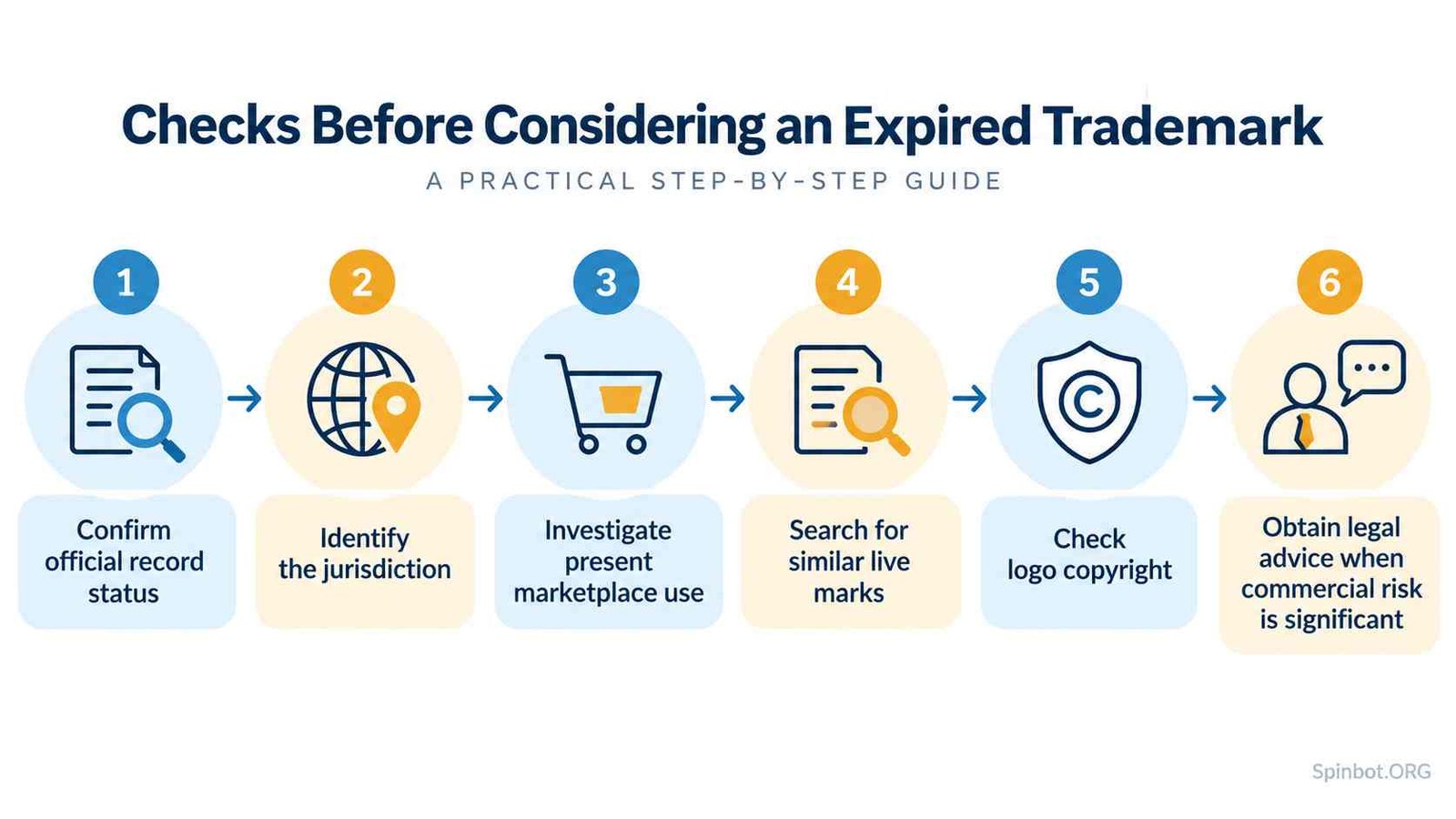
Before investing in a former trademark, complete these checks:
- Confirm the exact status in an official trademark database.
- Read the record documents instead of relying on the “dead” label.
- Identify why and when the application or registration ended.
- Search for similar live marks covering related goods or services.
- Investigate whether the former owner still uses the name.
- Search state, common-law, company, domain, and marketplace records.
- Check each country where you plan to trade.
- Avoid copying old logos, packaging, characters, or artwork.
- Consider whether consumers still associate the name with another business.
- Obtain professional clearance advice before a significant launch.
A name is much cheaper to change before packaging, web development, advertising, and inventory are created.
What This List Can and Cannot Tell You
A list of expired trademarks can help you discover naming history, understand why brands lose protection, and identify records worth investigating. It cannot conclusively tell you which names are available.
Here’s what matters: registration status and trademark rights are related, but they are not the same thing. An expired registration may leave common-law rights behind. An abandoned application may concern a brand that remains active. A generic word may be usable descriptively but still appear inside protected composite marks.
Use official records to begin the search, investigate real marketplace activity, and assess similar marks in the correct product categories and countries. If the name will support a serious commercial investment, professional clearance is far safer than building a brand around a tempting “dead” result.

Covers AI writing tools, large language models, prompt engineering, AI detection, and practical AI writing workflows for Spinbot.ORG.