
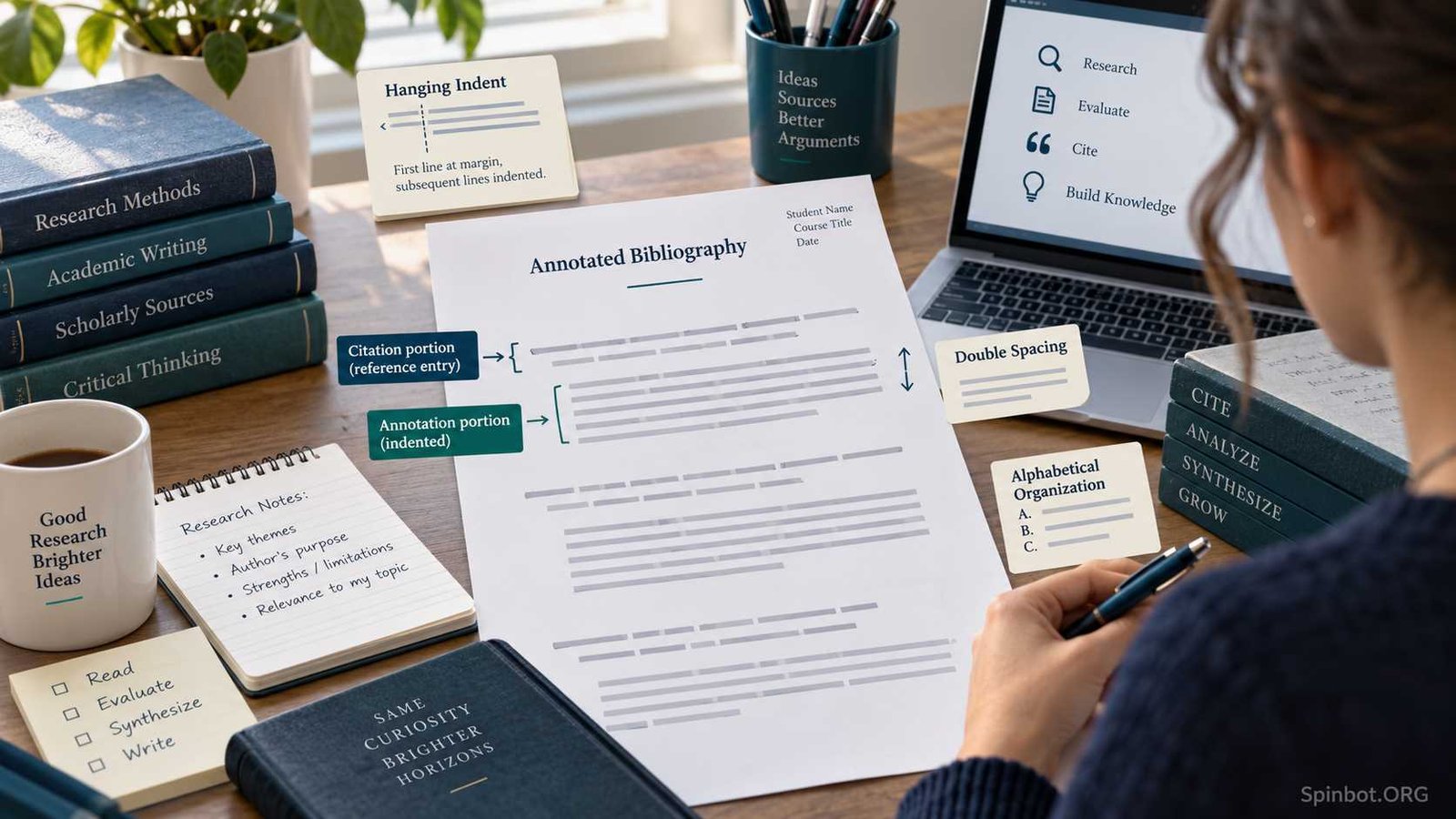
The good news is that the structure is simple once you see it clearly. Each entry begins with a normal APA reference. Directly below it comes the annotation, usually a short paragraph that summarizes, evaluates, or explains the usefulness of the source.
APA’s current guidance specifically recognizes annotated bibliographies and directs writers to Section 9.51 of the Publication Manual of the American Psychological Association. APA also provides an annotated bibliography student-paper template among its official sample materials.
The template below shows how to build one correctly without mixing APA rules with MLA formatting.
What an APA Annotated Bibliography Looks Like
An annotated bibliography is more than a reference list. A normal APA reference list identifies the works cited in a paper. An annotated bibliography adds commentary beneath each source.
A basic entry looks like this:
APA reference entry
Author, A. A. (Year). Title of work. Publisher.
Your annotation begins here. Explain the source's main idea, assess its value or credibility when the assignment requires it, and describe how it relates to your research.
That simple pattern is the foundation of the entire document.
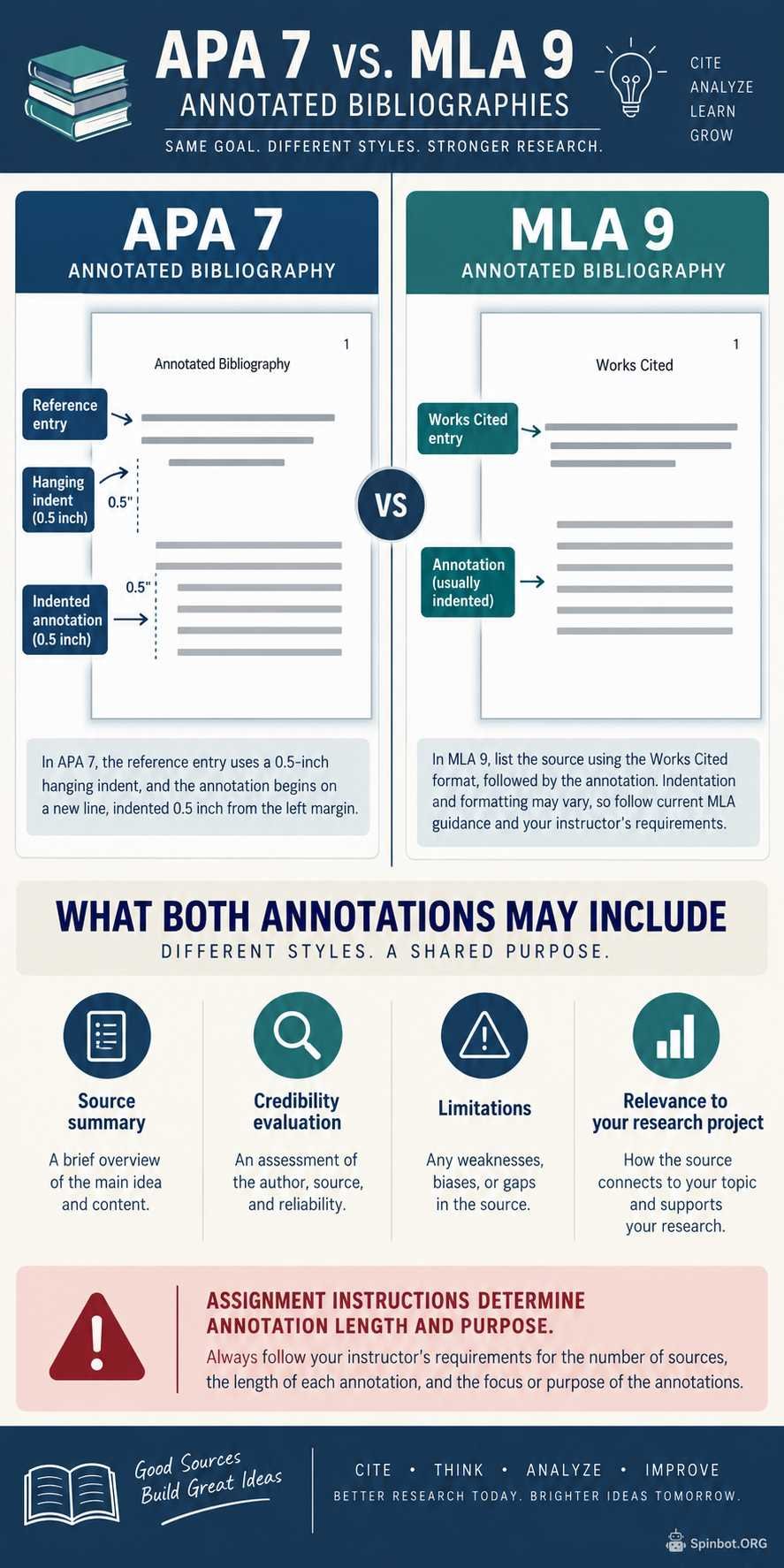
APA states that reference entries use a 0.5-inch hanging indent. This means the first line begins at the left margin while additional lines in the same reference move half an inch to the right.
The annotation itself begins below the reference. APA 7 guidance used by academic writing centers places the annotation 0.5 inch from the left margin, aligned with the hanging portion of the reference entry. The first line of the annotation does not receive another paragraph indent.
Think of the page as two connected pieces: first the formal citation, then your explanation of why the source matters.
Copy-Ready APA Annotated Bibliography Format Template
The citation changes according to the type of source, but the annotation structure stays largely the same.
Journal Article Template
Author, A. A., & Author, B. B. (Year). Title of the article. Journal Title, Volume(Issue), page–page. DOI or URL
This article examines [main subject or research question]. The authors argue or find that [main finding or argument]. The source is useful because [reason it is credible, relevant, current, or important]. One limitation is [relevant limitation, if needed]. This source will help with [specific part of your research].
Do not copy the article’s abstract and use it as your annotation. An abstract is the author’s summary of the work. An annotation should show that you have read and assessed the source.
Book Template
Author, A. A. (Year). Title of book. Publisher.
The book focuses on [main subject]. It explains [key idea, argument, method, or evidence]. The author's treatment of the topic is useful for this research because [reason]. Compared with other sources, this book provides [special perspective, historical background, detailed evidence, or other contribution].
For a book with several authors, editors, editions, or a DOI, format the reference according to the normal APA rules for that type of book. The annotation does not replace any part of the citation.
Website Template
Author or Organization. (Year, Month Day). Title of webpage. Website Name. URL
This webpage provides information about [topic]. It is published by [organization or author], which is relevant because [reason connected to authority or expertise]. The page supports the research by providing [data, definitions, guidance, policy information, or background]. Because online information can change, the date and authority of the page should also be considered.
If the author, date, website name, or other element is missing, use the appropriate APA rule rather than inventing information.
APA 7 Formatting Rules You Need to Follow
The easiest way to create a clean annotated bibliography is to format the document before you begin entering sources.
APA papers are generally double-spaced. APA’s current line-spacing guidance says to double-space all parts of the paper, including the reference list, and not to insert extra blank space between entries.
Use one-inch margins unless your instructor gives different directions. Choose one of APA’s accepted readable fonts and use it consistently. Your student paper will normally include page numbers, and assignment-specific title-page requirements may also apply.
The most important formatting distinction is the indent.
Suppose this reference runs onto three lines. The first line starts at the left margin. Lines two and three move 0.5 inch inward. That is the hanging indent.
The annotation then begins on the next line and is itself positioned 0.5 inch from the left margin. If the annotation contains another paragraph, follow APA guidance for subsequent paragraph indentation rather than manually adding spaces.
Do not create indents by repeatedly pressing the space bar. Use the paragraph-formatting controls in Microsoft Word, Google Docs, or your writing program. APA’s student guidance similarly recommends using word-processing paragraph settings to create hanging indents.
References should also be arranged alphabetically by the surname of the first author, just as they are in a standard APA reference list. APA’s official guidance confirms both alphabetical arrangement and the 0.5-inch hanging indent.
What Should the Annotation Include?
A weak annotation simply tells the reader what the source is about. A stronger one tells the reader why the source deserves a place in the research.
What you include depends on the assignment.
Some instructors want only a descriptive annotation. In that case, your main job is to summarize the source accurately.
Others expect an evaluative annotation. You may need to consider the author’s expertise, research method, evidence, publication quality, strengths, weaknesses, or potential bias.
A research-focused assignment may also ask you to explain how you expect to use the source in your paper.
For example, imagine that you are researching how social media affects college students’ study habits. One source might provide survey data about daily social media use. Another might explain attention and distraction from a psychological perspective. Your annotations should not merely say that both sources discuss social media. They should make the different roles of those sources clear.
A useful annotation might explain that the first source provides recent quantitative evidence while the second gives a theoretical framework for interpreting that evidence.
That is much more valuable than repeating each article’s opening paragraph.
How Long Should an APA Annotation Be?
There is no single universal annotation length that fits every APA assignment.
This is where students often receive misleading advice. You may see claims that every APA annotation must contain a specific number of words, such as 100, 150, or 200. Those figures can be useful assignment targets, but they should not be treated as a rule for every annotated bibliography.
Your instructor’s directions come first.
A short assignment may require only a few sentences per source. A research methods course might require a much fuller paragraph covering purpose, methodology, credibility, limitations, and relevance.
Before writing, check the assignment sheet for three things: the required number of sources, the expected annotation length, and whether the annotation should summarize, evaluate, reflect, or combine those functions.
APA controls the citation and document-formatting conventions. Your instructor usually controls how much analysis the annotation must contain.
Complete APA Annotated Bibliography Example
Here is a model using a real research-writing book rather than a made-up academic source.
Booth, W. C., Colomb, G. G., Williams, J. M., Bizup, J., & FitzGerald, W. T. (2016). The craft of research (4th ed.). University of Chicago Press.
This book explains how researchers develop questions, evaluate sources, build arguments, and communicate evidence effectively. It is written as a practical research guide and addresses both the process of finding information and the larger problem of turning evidence into a convincing argument. The source is particularly useful for students who need help moving beyond collecting information toward evaluating and organizing it. For a project about academic research methods, it could support discussion of source evaluation, argument development, and the relationship between evidence and claims.
The bibliographic details for this fourth edition identify Booth, Colomb, Williams, Bizup, and FitzGerald as the authors and the University of Chicago Press as the publisher in 2016.
Notice what the annotation does.
It does not reproduce the publisher’s description. It identifies the book’s purpose, explains its practical value, and states how it could contribute to a particular research project.
Your own annotation should be based on the source you actually read. If your assignment asks for critical evaluation, you would go further by discussing limitations, evidence quality, perspective, or how the source compares with other research.
APA and MLA Annotated Bibliographies Are Not the Same
This distinction matters because searches for an annotated bibliography APA format template often bring up MLA examples as well.
The purpose is similar in both systems: identify a source and add an annotation that helps explain or assess it. The citation itself, however, must follow the chosen style.
In APA, a book reference begins with the author’s surname and initials, followed by the year in parentheses.
In MLA, a book entry typically begins with the author’s surname and full or fuller name, followed by the title, publisher, and publication year. The current MLA Handbook is the ninth edition, published in 2021, and MLA says that edition includes dedicated guidance on annotated bibliographies.
Here is the basic difference:
| Element | APA 7 | MLA 9 |
|---|---|---|
| List entry | APA reference | MLA Works Cited-style entry |
| Publication year | Near beginning | Usually later in entry |
| Author name | Surname and initials | Surname and given name format |
| Annotation | Added below reference | Added to Works Cited-style entry |
| Main use | Common in social sciences and related fields | Common in humanities and language studies |
MLA’s Style Center explains the general principle clearly: format the source as you would for a Works Cited list and then add the annotation. Its older online explanation refers to the eighth edition, so students using MLA today should rely on the current ninth-edition handbook or current instructor guidance for detailed formatting.
This means an MLA format annotated bibliography sample should not be copied into an APA assignment merely because the annotation paragraph looks similar.
The citation systems are different.
If your professor says APA 7, use APA references. If the assignment says MLA 9, use MLA Works Cited formatting. Mixing the two is one of the easiest ways to lose formatting marks.
Common Annotated Bibliography Mistakes
The hardest part of an annotated bibliography is usually not the citation generator or the hanging indent. It is understanding what the assignment is asking you to say about each source.
One common problem is copying or lightly rewriting the abstract. That gives the reader a summary but shows little evidence of evaluation.
Another is writing only about whether you personally liked the source. Academic evaluation should be more specific. Consider whether the information is relevant, well supported, current enough for the topic, produced by an appropriate author or organization, and useful for your particular research question.
Students also sometimes use the same annotation for sources that serve different purposes. A government dataset, a literature review, a textbook, and an opinion essay should not all be evaluated in exactly the same way.
Formatting errors matter too. Watch for missing hanging indents, extra spacing between entries, references arranged in the wrong order, inconsistent italics, and annotations accidentally aligned with the left margin rather than the intended indentation.
A particularly confusing mistake is switching between APA citation format and MLA annotation examples found online. Decide which style the assignment requires before you start formatting.
A Final Format Check Before You Submit
Before uploading your assignment, run through one last check:
- Confirm that every source uses APA 7 reference formatting and appears in alphabetical order. Check the hanging indent, double spacing, annotation indentation, italics, capitalization, dates, authors, DOI or URL information where required, and consistency across entries. Then reread each annotation to make sure it explains the source rather than merely restating its title or abstract. Finally, compare the finished bibliography with your instructor’s instructions, because assignment requirements for annotation purpose and length can be more specific than the general APA format.
A good annotated bibliography should help someone understand both what you found and why it matters.
The template is only the framework. The quality comes from choosing useful sources, citing them accurately, and writing annotations that show careful reading and judgment. When those three parts are in place, the APA formatting becomes much easier to manage.

Academic editor turned AI copy pro, Sarah-Jane fuses research precision with smart storytelling. She covers academic writing, research, citation, plagiarism, copyright, grammar, editing, and publishing.