
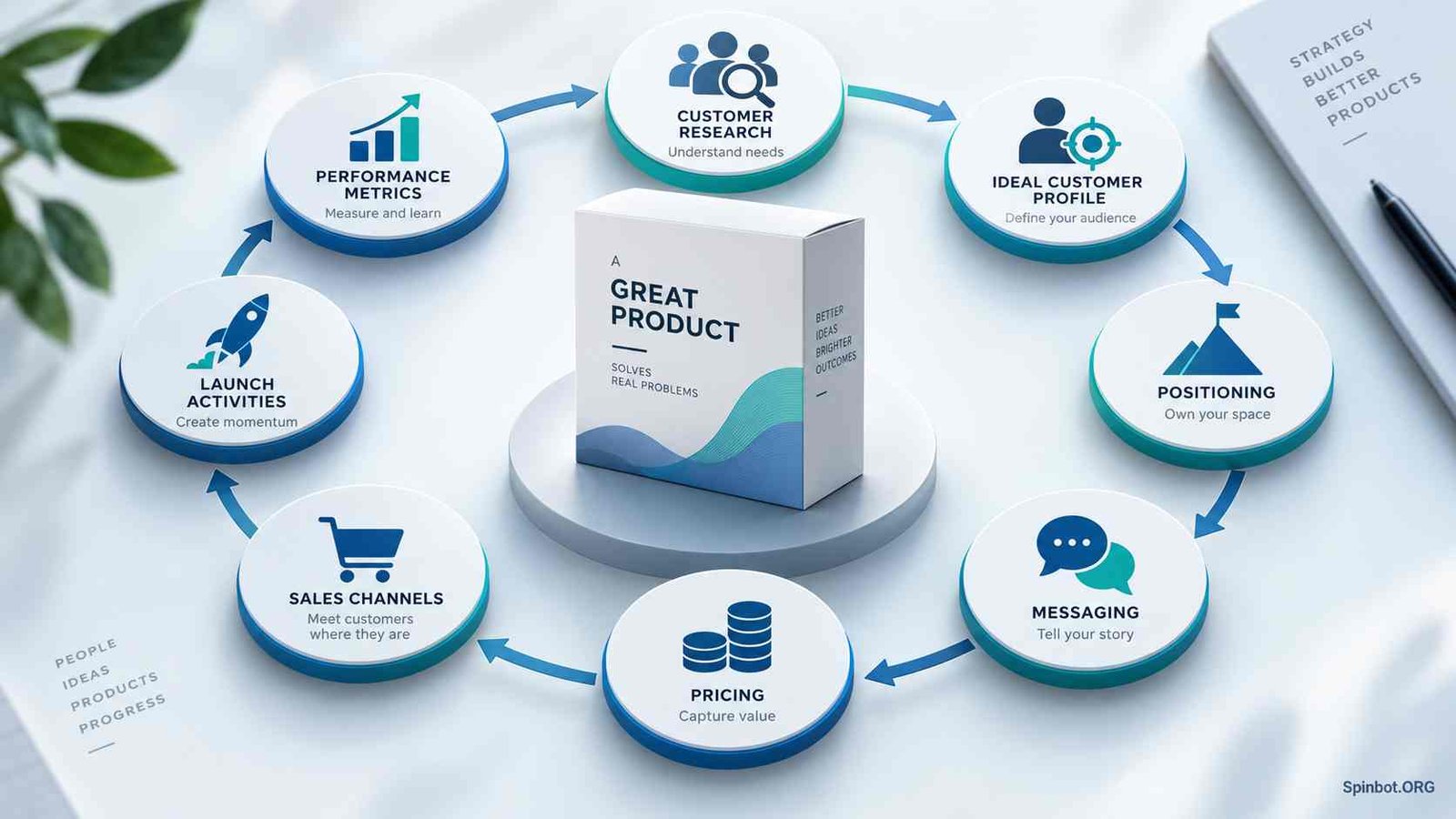
A product marketing strategy framework provides that connection. It organizes decisions about your customers, positioning, messaging, offer, channels, and measurement so each marketing activity serves a defined purpose.
You don’t need a complicated presentation to get started. You need clear choices, evidence behind those choices, and a practical way to test whether they work.
What Is a Product Marketing Strategy Framework?
A product marketing strategy framework is a structured process for deciding who a product serves, what makes it valuable, how to communicate that value, and how to encourage purchase and continued use.
It connects customer understanding with business decisions. Instead of beginning with “Which advertising platform should we use?” you begin with “Whose problem can we solve well enough to earn their business?”
Product marketing also extends beyond launch. Customer feedback, adoption, sales objections, and changing alternatives can all influence how you position and promote an existing product.
Product strategy, product marketing, and go-to-market strategy
These terms overlap, but they answer different questions:
- Product strategy: What should we build, for whom, and why?
- Product marketing strategy: How should customers understand, choose, and gain value from the product?
- Go-to-market strategy: How will the business bring an offer to a chosen market and coordinate the work required to sell and support it?
A go-to-market strategy commonly covers target customers, positioning, pricing, distribution, and sales enablement. It requires coordination across functions rather than marketing working alone. Product Marketing Alliance
For a small business, one person might handle several of these responsibilities. The distinction still matters because building the right product and explaining its value are related tasks, not interchangeable ones.
Marketing Plan vs. Marketing Strategy
The simplest distinction is this: strategy defines your choices; the plan organizes the work.
Your strategy explains which customers you will prioritize, why they should choose your offer, and how you intend to compete. Your marketing plan assigns campaigns, budgets, responsibilities, and deadlines.
The American Marketing Association distinguishes the overarching approach of strategy from the specific actions, timelines, and resources of a marketing plan. American Marketing Association
| Decision | Marketing strategy | Marketing plan |
|---|---|---|
| Audience | Target small content agencies | Build a prospect list matching that segment |
| Positioning | Simplify client approval workflows | Rewrite the product page around approvals |
| Channel | Reach buyers through problem-led search | Publish two relevant tutorials this month |
| Offer | Let prospects test the core workflow | Build a guided trial onboarding sequence |
| Measurement | Prioritize qualified customer acquisition | Review conversions and acquisition costs monthly |
Posting three times a week isn’t a strategy. It is an activity schedule.
A useful strategy explains why those posts should influence a particular audience and what action they should support.
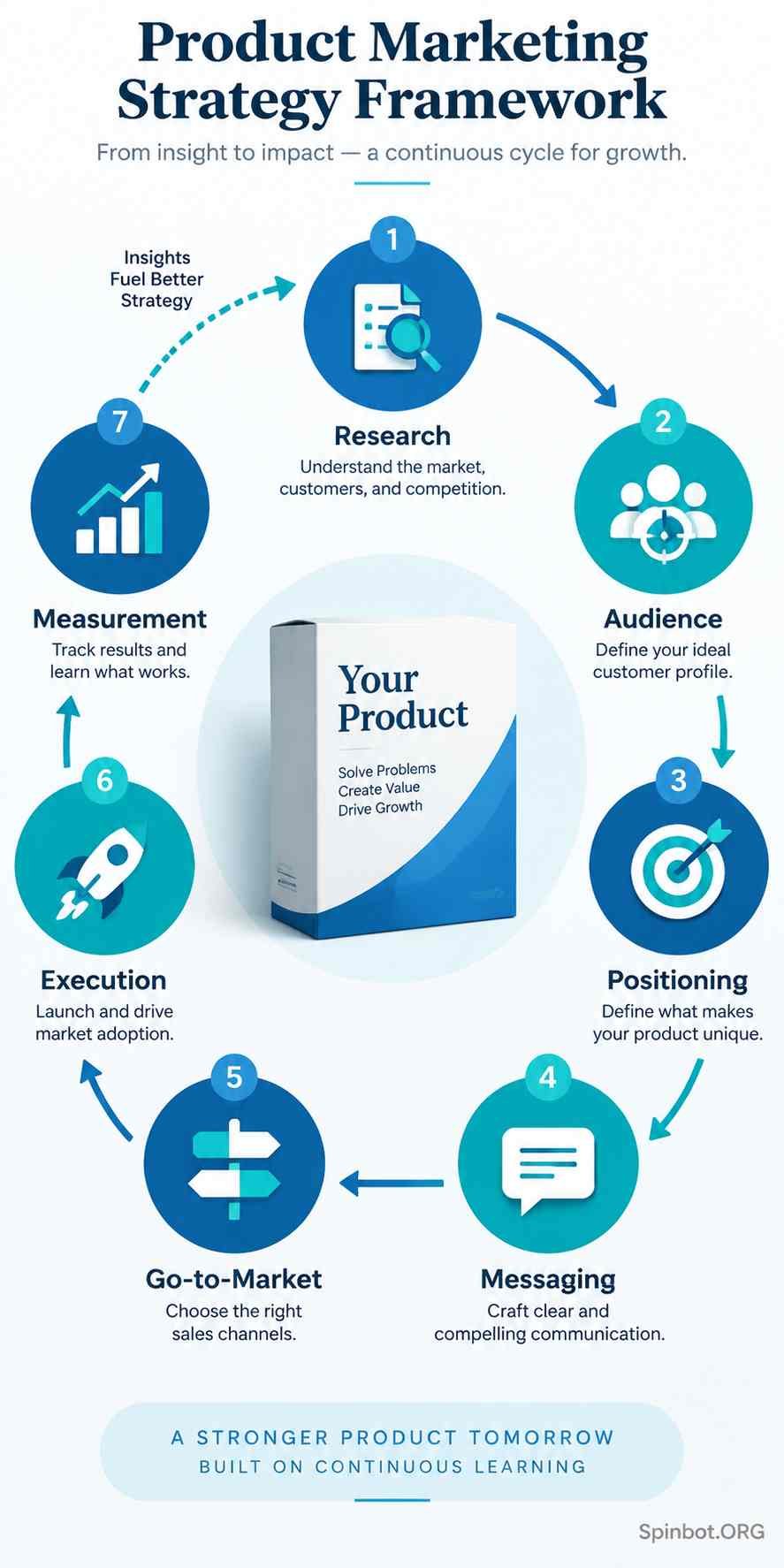
The Seven-Stage Product Marketing Strategy Framework
The following seven stages form a practical working framework, not a universal industry standard. Use them to turn research into decisions, then turn those decisions into measurable work.
1. Establish the business and product objective
Start with the result you need, not the campaign you want to run.
Your objective might be to acquire customers in a new segment, increase adoption of an existing feature, improve trial conversion, or help suitable customers understand a new offer.
Choose one primary outcome for the current planning period. Supporting goals are useful, but five competing priorities can make every decision harder.
Record:
- The outcome you want to change.
- The current baseline, if available.
- The target and time period.
- The team responsible.
- The limits you must respect.
For example, an illustrative objective could be: “Increase monthly new paying agency accounts from 10 to 15 over the next quarter, while staying within the agreed acquisition budget.”
Those numbers are planning assumptions, not recommended benchmarks. Your target should reflect your own baseline, resources, and sales cycle.
If you lack reliable data, make establishing the baseline part of the first phase.
2. Research the market and customer
Research should help you make decisions, not produce a folder nobody opens.
Start with customer interviews, sales conversations, support requests, product usage, and lost-deal feedback where available. Then examine competitors and other ways customers solve the problem.
Ask questions about actual behavior:
- What happened the last time this problem occurred?
- How did you solve it?
- What did that process cost in time, money, or frustration?
- What made you look for another option?
- Who was involved in choosing or approving the purchase?
“Would you use this product?” invites speculation. “What do you use now?” gives you something concrete to investigate.
Include alternatives beyond direct competitors. A buyer may compare your software with a spreadsheet, an agency, an internal process, or doing nothing.
Business Queensland identifies desktop research, quantitative research, and qualitative research as complementary ways to understand customers and market demand. Business Queensland
Keep findings separate from assumptions. A repeated complaint from current customers is evidence about those customers, not automatic proof that the entire market shares it.
3. Choose the target segment and ideal customer
Research gives you options. Strategy requires choosing among them.
“Small businesses” is usually too broad to guide messaging. A more useful segment might be content agencies with recurring client approvals, several writers, and no dedicated operations manager.
For a B2B marketing strategy framework, define your ideal customer profile, or ICP: the type of organization most likely to fit the product and receive meaningful value.
Useful criteria include:
- Industry and company size.
- Relevant workflow or use case.
- Existing tools and processes.
- Buying trigger.
- Budget and purchasing constraints.
- Requirements your product can or cannot meet.
Then distinguish the people involved. The daily user, internal champion, budget owner, and final approver may have different concerns.
A writer may want clearer feedback. An agency owner may care about delivery capacity. An operations lead may need a reliable approval record.
Also define poor-fit customers. Excluding organizations that require capabilities you cannot provide helps prevent misleading promises and wasted sales effort.
4. Develop positioning and messaging
Positioning defines the context in which your product should be understood. Messaging expresses that position in language customers recognize.
Begin with four questions:
- Who is the product for?
- What important problem does it address?
- What would the customer use instead?
- What relevant difference can you demonstrate?
A working positioning statement might follow this pattern:
“For [customer segment] dealing with [problem], our product is a [category] that provides [valuable difference], supported by [evidence].”
Treat this as an internal decision aid, not necessarily your homepage headline.
Next, turn features into useful explanations. “Version history” names a capability. “See which draft received client approval” connects that capability to a job the customer needs done.
Build messaging around a small number of claims. Each should have supporting evidence, such as an observable workflow, a product demonstration, or an appropriately documented customer example.
Product School’s GTM guidance connects customer definition, competitive alternatives, positioning, pricing, and channel choices. These decisions should reinforce each other. Product School
Avoid claims such as “the fastest” or “cuts costs by 50%” unless you have suitable evidence. Clear, specific wording is more useful than an impressive promise you cannot support.
5. Define pricing, packaging, and the customer journey
Messaging cannot compensate for an offer that buyers find confusing.
Clarify what customers receive, how they pay, what limits apply, and whether they can evaluate the product before purchasing.
For a software as a service marketing strategy, decisions may include subscriptions, usage-based charges, plan tiers, trials, demonstrations, or assisted onboarding. None is automatically the best choice.
A simple product may support self-service evaluation. A complex implementation may require sales conversations and technical review.
Map the customer journey around practical questions:
- How does the buyer recognize the problem?
- Where do they investigate solutions?
- What evidence helps them compare options?
- What must happen before they can purchase?
- What helps them reach their first useful outcome?
- Why would they continue using the product?
The journey should influence your content. A problem-aware visitor may need an explanatory guide. An evaluating buyer may need integration details, pricing clarity, or a demonstration.
Include product, sales, and customer support in these decisions. Marketing should not promise an onboarding experience the business cannot deliver.
6. Select channels and create the marketing plan
Choose channels based on customer behavior, buying intent, and your ability to execute consistently.
Search content may fit problems buyers already research. Partnerships may help where trusted advisers influence purchases. Direct sales may suit a narrow account list with complex buying requirements.
Social media can help communicate useful ideas and product demonstrations, but audience size alone does not establish commercial value.
Start with a manageable channel mix. For each channel, specify:
- The audience and buying stage.
- The message or offer.
- The next action.
- The required assets.
- The owner, budget, and deadline.
- The measure of success.
Include sales enablement where relevant: demo guidance, comparison materials, objection handling, and approved claims.
Your plan should also show dependencies. Advertising cannot send visitors to an unfinished landing page, and a launch email should not promote a feature that support teams cannot explain.
A channel earns continued investment through evidence. Being popular with other businesses is not enough.
7. Measure results and improve the strategy
Measurement should tell you what to change.
Separate business outcomes from diagnostic measures. New paying customers may be the outcome, while landing-page conversion, trial activation, and sales objections help explain it.
Define each metric before reporting it. Otherwise, teams can use the same label for different calculations.
For example:
- Trial-to-paid conversion: Eligible trial accounts that become paying accounts, divided by the relevant trial cohort.
- Activation: Completion of a defined action that indicates initial product value.
- Customer acquisition cost: The acquisition costs included in your chosen definition, divided by new customers acquired over the corresponding period.
- Customer churn: Customers lost during a period, divided by customers at its start, using a consistent policy.
Allow trial cohorts enough time to convert. Document what acquisition costs include. Don’t confuse customer churn with revenue churn.
Review the weakest point in the journey. Strong traffic with poor activation may suggest an audience, expectation, onboarding, or product problem. Buying more traffic would not explain which one.
Treat results as evidence to investigate, not automatic proof that one campaign caused every change.
B2B SaaS Product Marketing Strategy Example
Consider a fictional content-approval product for small agencies. The following sample marketing strategy illustrates the framework; it is not a real company case study.
Product, customer, and objective
The product brings draft review, comments, and client approval into one workspace.
Its initial target is content agencies with five to twenty staff members handling recurring client work. The buyer is the agency owner or operations lead, while writers and account managers use it daily.
The planning objective is to acquire ten paying agency accounts from a defined pilot cohort within ninety days. This is a hypothetical target, not an expected result.
Positioning and message
The positioning focuses on client approvals rather than general project management:
“A content approval workspace for small agencies that need to keep drafts, feedback, and sign-off together.”
Supporting messages explain concrete tasks:
- Identify the current draft.
- Collect comments in the relevant place.
- Check whether client approval is complete.
The team would need to verify that the product actually supports each claim before publishing it.
Channel and launch decisions
The pilot could combine a focused landing page, an approval-workflow tutorial, a short demonstration, and outreach to suitable agencies.
A guided evaluation would help prospects complete one real approval cycle. Follow-up messages would address obstacles encountered during that process.
The team would not need every channel at once. Its early question is whether the chosen audience understands the offer and reaches useful value.
Relevant performance indicators
Track qualified evaluations, first completed approval cycles, paid conversions, and continued usage.
If prospects start trials but never invite a reviewer, investigate that step. They may not understand the workflow, may lack a suitable live project, or may be reluctant to involve clients during evaluation.
Each explanation suggests a different action. That is why interviews and usage data should inform the same review.
Turning Strategy Into Advertising and Social Media
Advertising and social media should express the strategy rather than create a separate story.
A sample product advertisement
For the fictional product, an illustrative ad could read:
Headline: Keep Client Feedback With the Right Draft
Body: Give your agency one place to review content, collect comments, and record approval.
Call to action: See the Approval Workflow
The ad connects the audience’s problem to a specific capability. It avoids unsupported savings or performance claims.
The landing page should continue that message and show the promised workflow. A mismatch between the ad and destination creates unnecessary confusion.
What a social media strategy proposal should contain
A useful social media strategy proposal explains the business purpose before listing post formats.
For this example, it could define agency owners as the audience, workflow demonstrations as the content focus, and qualified product evaluations as the desired next step.
The proposal should also include the chosen platform, publishing responsibilities, resource limits, tracking approach, and review date.
Test the platform choice against where suitable buyers actually engage. Do not assume a particular network will work simply because the product is B2B.
Common Framework Mistakes
Confusing tactics with strategy
A list of emails, posts, and advertisements describes activity. Add the audience, problem, competitive choice, and intended outcome to explain why the activity belongs.
Targeting too many customers
Trying to speak to freelancers, agencies, universities, and large enterprises at once can blur your message. Start with a segment you can serve credibly, then expand when evidence supports it.
Listing features without customer value
Technical details matter, especially during evaluation. But buyers also need to understand what those details let them accomplish.
Selecting channels before positioning
A campaign cannot consistently communicate a difference the business has not defined. Clarify the offer before scaling distribution.
Measuring activity instead of behavior
Posts published and emails sent describe output. Evaluations, meaningful product use, purchases, and retention tell you more about customer response.
Treating launch as the finish line
A launch creates an opportunity to learn. Review objections, usage, support requests, and lost customers after the announcement. The strategy should evolve as evidence improves.
A One-Page Product Marketing Strategy Checklist
Keep a short working document with these fields:
- Objective: What outcome are we pursuing, by when?
- Audience: Which customer segment takes priority?
- Problem: What important job or difficulty are we addressing?
- Evidence: What research supports our decisions?
- Alternatives: What do customers use instead?
- Positioning: Why should a suitable customer choose us?
- Message: What can we promise and demonstrate?
- Offer: What is included, priced, and available to evaluate?
- Execution: Which channels, assets, owners, and budgets apply?
- Learning: What will we measure, review, and potentially change?
Mark unanswered questions openly. An assumption labeled for testing is more useful than a confident statement nobody has verified.
Put the Framework Into Practice
Start with one customer segment and one important problem. Gather evidence, define a meaningful difference, and build a small set of activities that communicate it consistently.
Your product marketing strategy framework should help you choose what to do next and what to leave out. Keep it specific enough to guide daily work, but flexible enough to change when customers show you something new.

Raj blends SEO mastery with real-world freelance grit. Covers SEO, blogging, content strategy, copywriting, freelance writing, marketing, and business communication.