
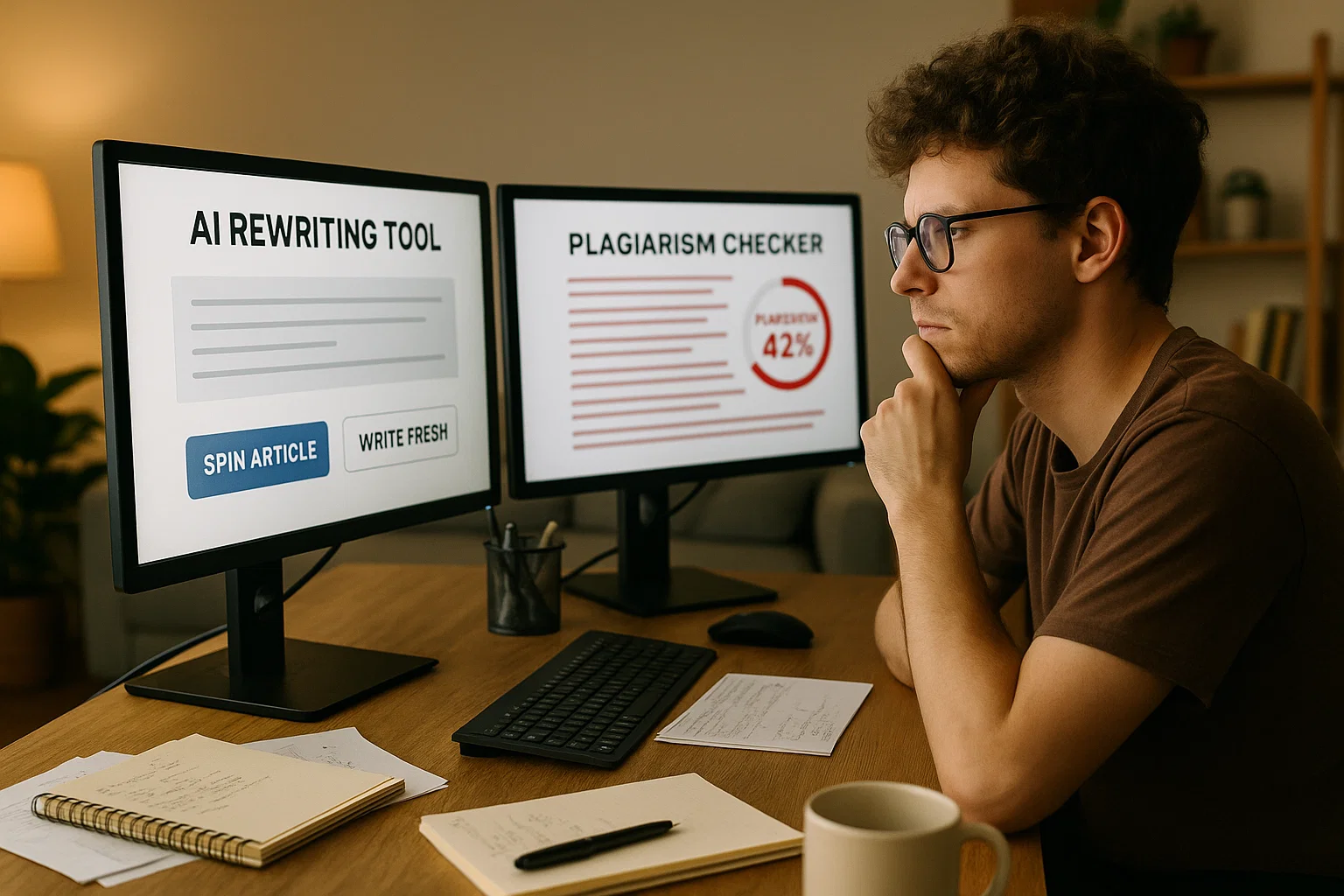
Ever wondered if content spinning is just a clever shortcut or straight-up plagiarism in disguise? You’re not alone. Every freelance writer, blogger, and SEO hustler hits this question at some point. You’re trying to rank, trying to write faster, trying to beat deadlines and somewhere between inspiration and imitation, things get messy.
Let’s unpack what “spinning” really means, how plagiarism fits into it, and whether using AI rewriting tools changes anything. Spoiler: intent still matters more than the algorithm.
What Exactly Is Content Spinning?
Content spinning is the act of taking an existing article and rewriting it sometimes manually, sometimes with software so it looks different while saying the same thing.
In theory, it’s about creating multiple “unique” versions of a post for SEO or republishing. In practice, it’s often about fooling search engines.
Early spinners worked like old thesaurus bots. They’d swap “good” for “excellent,” “fast” for “rapid,” “writer” for “author.” The output looked unique to a machine but clunky to humans. Search engines got smarter, and so did spinners. AI tools today can rewrite entire paragraphs with natural flow, making spun content harder to spot.
But here’s the catch: spinning doesn’t change the ideas, only the words. And plagiarism isn’t just about copy-pasting text it’s about stealing someone else’s intellectual effort.
What Is Spinning Plagiarism?
Plagiarism is presenting someone else’s work or ideas as your own, with or without copying exact words.
Spinning is plagiarism when it copies structure, logic, or expression from an original work while disguising it with synonyms and syntax changes.
Think of it like tracing another artist’s painting and recoloring it. The shapes, shadows, and perspective all come from the same source. Just because the lines aren’t pixel-perfect copies doesn’t make it original.
According to Wikipedia, article spinning is commonly used to “avoid duplicate content detection” but often results in “low-quality or semantically distorted text.” Ethical or not, it’s still built on an existing creation.
And plagiarism detectors today don’t just look for word-for-word matches. Tools like Grammarly, Copyscape, and Turnitin use AI to detect paraphrase patterns and conceptual duplication. If your rewritten piece follows the same narrative flow, facts, and tone it’s still likely to be flagged.
The Gray Zone: When Rewriting Becomes Theft
So where’s the line between rephrasing and plagiarism? Let’s look at a simple example.
Original:
“Content spinning tools help marketers repurpose existing material for better reach.”
Spun version:
“Writers use spinning software to reuse old content and target new audiences.”
Different words, same structure, same meaning. The reader gets the same takeaway. That’s plagiarism in intent, even if not in text.
Now compare that to genuine rewriting:
Authentic rewrite:
“Instead of copying old posts, smart creators extract key insights and rebuild the message from scratch, often adding new examples or personal takes.”
That’s not spinning it’s synthesis. You took inspiration, then rebuilt it in your own mind and voice. That’s how real content creation works.
Why People Still Spin Content (And Why It’s a Problem)
There’s no denying why spinning exists it’s faster. When clients pay by word or when blogs need daily uploads, rewriting feels like a shortcut to survive. Some marketers justify it by saying, “I’m just repurposing,” but let’s call it what it is: quantity over quality.
Here’s what happens when you rely on spinning:
- You kill creativity. Every sentence you don’t write from scratch dulls your voice. Over time, all your content starts sounding like someone else’s.
- You risk SEO penalties. Google’s algorithms now understand paraphrased patterns. If your content structure mirrors an indexed page, you can still be penalized for duplication.
- You lose credibility. Readers aren’t blind. They sense when something’s “off” the rhythm, the emotion, the missing spark that only comes from lived experience.
Even Elegant Themes warns that spinning “does more harm than good,” as it confuses search engines, dilutes brand trust, and undermines user engagement.
Bottom line: spinning might trick a plagiarism checker for a day, but it won’t build a real audience.
AI Tools Have Changed the Game But Not the Ethics
AI rewriting tools like QuillBot, WordAI, or GPT-based paraphrasers make spinning feel cleaner. They understand context, not just synonyms. You can feed in an article, and it spits out something fluent and “fresh.”
But let’s be honest does that make it yours?
AI can rewrite words. It can’t recreate your judgment, story, or personal insight. If your rewritten draft only exists because you reprocessed someone else’s article through AI, you didn’t create, you recycled.
The difference lies in how you use AI:
- Ethical AI use: You use it to brainstorm, edit tone, or simplify sentences you’ve written.
- Unethical AI use: You paste someone’s blog, click “rephrase,” and call it a day.
The intent behind the text determines its originality, not the tool you used.
How Plagiarism Checkers Still Catch Spun Content
Even when you think you’ve beaten the system, AI plagiarism detectors work differently now. They track:
- Semantic similarity: Tools like Turnitin use neural networks to identify meaning patterns that match other documents.
- Structural duplication: Copyscape flags parallel sentence or paragraph structures, even with altered vocabulary.
- Stylometric fingerprinting: Some advanced detectors analyze your writing style (average sentence length, word choice, rhythm) and spot when your voice suddenly shifts.
You might fool a basic checker, but not a semantic one.
As one Quora user put it in this discussion: “Spinning may avoid direct plagiarism detection, but your content is still ethically wrong and algorithmically traceable.”
The Ethical Perspective: Beyond Algorithms
Forget search engines for a second think about honesty.
When you spin, you’re taking someone’s time, research, and perspective and rebranding it as your own. You’re also denying yourself the skill growth that comes from thinking through ideas instead of just rewording them.
Ask yourself these two questions before rewriting anything:
- Do I truly understand this idea enough to explain it in my own words?
- Am I adding new value, or just rewriting for the sake of SEO?
If the answer to #2 is “just SEO,” you’re probably spinning, not creating.
How to Avoid Plagiarism When Rewriting
Here’s the good news: you can rewrite ethically and still stay original. Real writers don’t need to spin they interpret. Here’s how to do it right.
1. Read, close, rewrite.
Read the source material once, understand it fully, then close it.
Now write your version from memory. This forces your brain to process meaning, not structure.
2. Mix sources.
Don’t rely on a single article. Combine insights from 3–5 sources, add your interpretation, examples, or case studies. This naturally changes the phrasing and logic.
3. Add your story.
People trust lived experience more than perfect grammar. Add your own results, failures, or lessons learned. That instantly makes your post unique.
4. Use AI as an assistant, not a ghostwriter.
Let AI rephrase your sentences for clarity or flow, not someone else’s.
5. Cite and credit.
When using another person’s statistics, definitions, or ideas, mention the source. It’s not only ethical it’s professional.
What Is Content Spinning vs. Content Creation?
Let’s draw a clear line between the two:
| Feature | Content Spinning | Content Creation |
|---|---|---|
| Source | Based on one existing article | Built from multiple ideas or personal experience |
| Goal | Trick plagiarism/SEO filters | Deliver real value and insight |
| Process | Rewording without rethinking | Research, reflection, and originality |
| Quality | Often robotic or repetitive | Natural, engaging, human |
| Result | Short-term ranking, long-term penalty | Long-term trust and brand authority |
See the pattern? Spinning produces volume, not value. Creation builds authority.
Why Google Doesn’t Reward Spun Content Anymore
Old-school SEOs used to flood the web with spun articles hundreds of keyword variants pointing to backlinks. It worked until Google started reading like a human.
Updates like Panda (2011), Hummingbird (2013), and Helpful Content (2022) now evaluate context and originality. If your post reads like a rewrite of existing indexed content, it loses visibility fast.
Even if your plagiarism score is “0%,” Google still knows when content offers nothing new. Spinning may dodge copyright claims, but it fails at helpfulness, which is the heart of modern SEO.
When Rewriting Is Actually Okay
Rewriting isn’t evil it’s how we learn. The problem is intent.
Here are times when rewriting is perfectly fine:
- Summarizing research in your own words for clarity.
- Updating old posts you originally wrote.
- Translating your own content for different audiences.
- Repackaging ideas from multiple sources into something new (like a case study, listicle, or tutorial).
In those cases, you’re still creating you’re adding perspective, structure, or utility. The difference lies in whether you transform or just transpose.
The Future of Originality in AI Writing
AI won’t replace writers who think it’ll replace those who only rewrite.
As rewriting tools evolve, originality becomes the only real differentiator. The more machines learn to paraphrase, the more humans need to interpret and connect.
Writers who blend AI with creativity will dominate. Those who spin just to fill pages will fade.
If you want to future-proof your writing career:
- Build your voice.
- Add insight.
- Embrace AI as a partner, not a shortcut.
So, Is Content Spinning Plagiarism?
Yes most of the time, it is.
Because spinning isn’t just about changing words. It’s about replicating thought without respect for the creator behind it. And that’s the very essence of plagiarism.
You can’t automate originality.
You can’t outsource experience.
And you can’t fake authenticity.
If your goal is to stand out online, write like someone who means every word, not like someone trying to hide behind synonyms.
Final Takeaway
If you’re serious about being a writer, stop asking, “Can I spin this?”
Start asking, “What can I add that’s mine?”
Because in the long run, that’s what wins not the fastest rewriter, but the most genuine voice.

Raj blends SEO mastery with real-world freelance grit. From keyword to conversion, his expert writing helps readers and businesses win in today’s digital battlefield. Authentic. Sharp. Proven.